
QuickBooks closes your Stamford management company fine, but it can't touch fund-level accounting
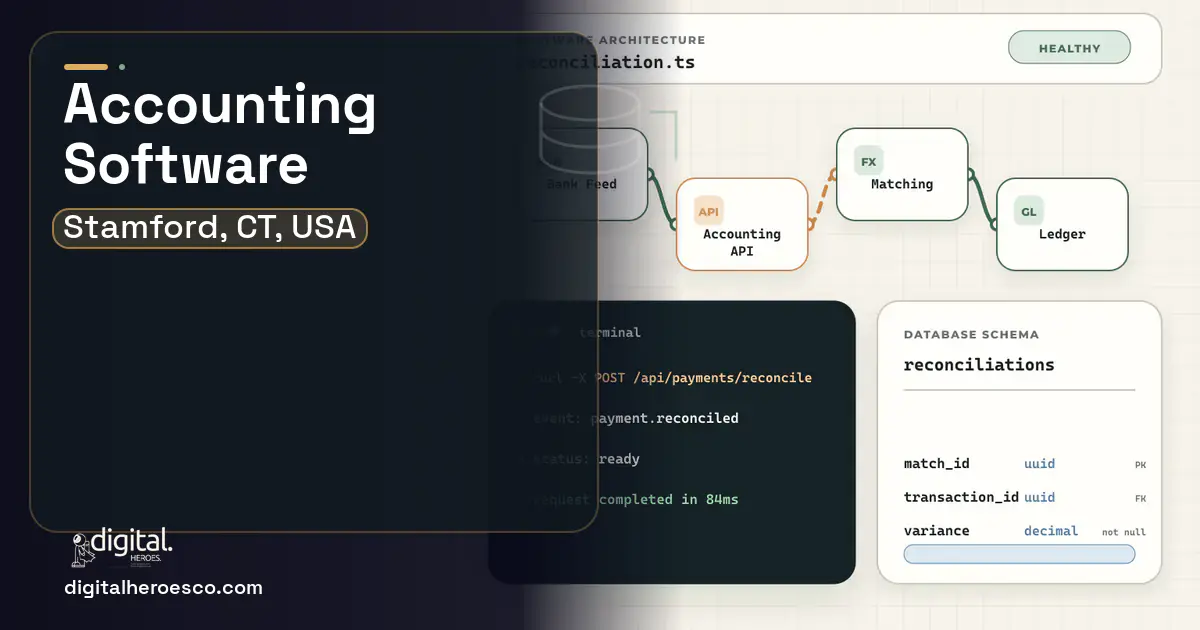
Build custom accounting software in Stamford when fund-level NAV, partner allocations, treaty accounting or multi-entity close exceed what QuickBooks, Xero and FreshBooks can do, and the spreadsheet bridge has become the real ledger. Expect $80,000 to $260,000 over 4 to 8 months. Off-the-shelf accounting is right for management-company books; it is wrong for fund and treaty accounting it was never built to hold.
QuickBooks closes your Stamford management company cleanly, and that is exactly where its usefulness stops. Fund-level accounting, NAV calculation, capital accounts and partner allocations live in a spreadsheet that has quietly become the real ledger, while QuickBooks holds only the operating entity. Each quarter the investor statement is assembled from the spreadsheet, and the gap between what QuickBooks knows and what investors receive is bridged by an analyst nobody can replace.
Xero and FreshBooks are built for small-business accrual accounting and sit even further from fund and treaty reality. None of them model a waterfall, a side-letter fee arrangement or a reinsurance ceding entry. So the most consequential accounting your firm does happens outside your accounting system, which is the inversion that eventually causes an audit finding or a costly error.
Budgeting a accounting build in Stamford
| Project scope | Typical cost | Timeline |
|---|---|---|
| Fund ledger layered on QuickBooks | $80k to $130k | 4 to 5 months |
| Fund accounting platform with waterfalls | $130k to $200k | 5 to 7 months |
| Full fund and treaty accounting system | $200k to $260k | 7 to 8 months |
The case for owning your accounting
Custom accounting software models the ledgers your firm actually keeps: fund-level books with NAV, capital accounts, allocations and waterfalls, plus treaty accounting where relevant, all reconciled to your management-company GL. The spreadsheet that has become your shadow ledger gets retired into a real system with an audit trail, while you keep QuickBooks for the operating entity. The investor statement generates from the books rather than being assembled by hand.
- Fund NAV and capital accounts live in a spreadsheet outside QuickBooks
- Waterfalls, allocations or treaty entries have no native ledger home
- The investor statement is assembled by hand each quarter
- Auditors flag the gap between your system and your real numbers
- You only keep management-company or small-business books
- QuickBooks or Xero models your accounting without spreadsheets
- You have no fund, partnership or treaty complexity
- You lack capacity to own and document a custom ledger
What your build should include
Accounting services we deliver in Stamford
The engagements Stamford teams bring us most often: custom accounting software, QuickBooks integration, Xero integration, invoicing software and bookkeeping software.
Delivery, week by week
Exactly what you get
You get accounting software that holds the books your Stamford firm actually keeps: a fund-level ledger with NAV, capital accounts, allocations and waterfalls, treaty accounting where relevant, all reconciled to QuickBooks for the operating entity. The shadow spreadsheet that became your real ledger is retired into a system with a full audit trail, and the quarterly investor statement generates from the books instead of being assembled by an analyst over several days.
How to choose a developer in Stamford
Pick a partner who has built fund accounting under audit, not just bookkeeping integrations. They should ask about your waterfall, your capital accounts and your treaty entries, and explain how they reconcile to QuickBooks before proposing anything. Insist on a clear audit trail, because auditors scrutinize custom ledgers hard. A developer experienced in fund or insurance accounting will discuss NAV and reconciliation before features.
- Fund-level NAV, capital accounts and allocations live in a real ledger with an audit trail
- Distribution waterfalls and side-letter fee terms are modeled, not improvised in Excel
- Treaty and ceding entries have a home that reconciles to the management-company GL
- Investor statements generate from the books instead of being assembled by an analyst
- Integrates with your ERP (Enterprise Resource Planning), business intelligence (BI) dashboards and CRM (Customer Relationship Management) for one financial truth
- Fund and treaty accounting logic is intricate, so a wrong model is expensive to fix
- You take on responsibility for accounting accuracy a packaged vendor would share
- Auditors will scrutinize a custom ledger, raising your documentation burden
- For a firm with only management-company books, this is more than needed
- !They treat fund accounting as QuickBooks classes. Ask how they model a distribution waterfall
- !No audit trail. Ask how a statement number traces to a transaction
- !They ignore treaty accounting. Ask where ceding entries live
- !No reconciliation to QuickBooks. Ask how the operating entity stays in sync
- !No fund-accounting references. Ask for a fund ledger they have shipped
If accounting is on the roadmap, warehouse management, field service management, erp usually follow within the year. Budget them as one conversation. Weighing options across the region? We publish the same accounting guide for Bridgeport, New Haven, Hartford. Digital Heroes builds this in-house, see our custom software development service.
The evidence behind this guide
Independent findings on why this investment pays off. Every link goes to the primary source.
- Organizations that scaled intelligent automation report an average cost reduction of 32% (up from 24% in 2020), and respondents expect an average 31% cost reduction over the next three years. Source: Deloitte (2022) →
- McKinsey found that currently demonstrated technologies can fully automate about 42% of finance activities and mostly automate a further 19%, indicating roughly 60% of finance work is technically automatable. Source: McKinsey & Company (2018) →
- An earlier SHRM benchmarking report (reflecting fiscal year 2015, published 2016) established a widely cited baseline average cost-per-hire of $4,129, illustrating how recruiting costs have climbed over time (SHRM's separate 2025 Benchmarking Report shows $5,475 for nonexecutive roles). Note: the $5,475 figure is not on this linked page; it comes from SHRM's 2025 report. Source: SHRM (Society for Human Resource Management) (2016) →
- McKinsey argues software developer productivity can be measured by combining system-level metrics (DORA and SPACE) with its own outcome-oriented approach, which it reports deploying across nearly 20 tech, finance, and pharmaceutical companies - a claim that sparked significant debate in the engineering community. Source: McKinsey & Company (2023) →
Diya works on mobile applications at Digital Heroes, implementing screens and features, wiring them to backend services and fixing the issues that only appear on real devices. Her posts give a builder's view of what goes into an app between the design handoff and the store listing.
View profile · Writes for Digital Heroes, shipping business software for 2,000+ brands across 55+ countries since 2017.
Frequently asked questions
Why can't QuickBooks do fund accounting?
QuickBooks is built for operating-company books. It has no native concept of NAV, capital accounts, partner allocations or distribution waterfalls, so Stamford funds keep those in a spreadsheet that becomes the real ledger while QuickBooks holds only the management company.
Do we replace QuickBooks entirely?
Usually not. The common approach keeps QuickBooks for the operating entity and builds a fund-level ledger on top that reconciles to it. That keeps cost focused on the fund and treaty accounting QuickBooks cannot do.
Can it model distribution waterfalls?
Yes. A custom build represents waterfalls, partner allocations and side-letter fee terms as ledger logic with an audit trail, replacing the Excel calculations that currently sit outside your accounting system.
What does fund accounting software cost in Stamford?
A fund ledger on QuickBooks runs $80k to $130k. A fund accounting platform with waterfalls lands at $130k to $200k. A full fund and treaty accounting system reaches $200k to $260k.
How do auditors view a custom ledger?
They scrutinize it, which is why the audit trail is central. A well-built custom ledger traces every statement number to its source transaction and reconciles to QuickBooks, which is what gives auditors confidence in numbers a spreadsheet could never substantiate.
I'm outgrowing FreshBooks. Is custom software the logical next step?
How long until custom accounting software pays for itself?
How many developers does it take to build accounting software?
What are the biggest mistakes first-time software buyers make?
How long does it take to build custom accounting software?
How many people should be working on my software project?
Should I hire a freelancer or an agency to build my accounting software?
What does it cost to maintain custom accounting software each year?
How do I calculate whether custom software will pay for itself?
What should I prepare before contacting an agency about accounting software?
Does my development team need to be located in Stamford?
How do I migrate years of QuickBooks data into a custom system?
Are local developer rates in Stamford worth it compared to hiring an offshore team?
Who can build custom accounting software for a business in Stamford?
Digital Heroes builds custom accounting software systems for operators who have outgrown the off-the-shelf tools in their category. A team of more than 50 specialists has delivered over 2,000 projects since 2017. Teams work from New York, London, Sydney, Delhi and Lucknow and deliver remotely, so an operator in Stamford gets an assigned senior team rather than a local account manager.
Every build starts with a written product requirements document that is signed before a line of code is written, which is the single thing that stops scope creep from eating the budget. Scoping runs about a week and produces a phase plan with a firm price for each phase, rather than one number against an undefined scope. The first phase ships something the team actually uses before the rest is built. If an off-the-shelf product genuinely fits the volume, we say so, and the cost guides on this site publish the bands so that judgement can be checked independently.
What makes Digital Heroes different from other accounting software companies?
Four things that competitors in this bracket cannot simply copy. Digital Heroes runs a YouTube channel with more than 2.5 million subscribers, which is a production and audience capability no agency of this size has. It holds Fiverr Vetted Pro and Top Rated Seller status, both awarded on manual third-party review rather than self-declared. It contracts through registered entities in three countries, an India LLP, a US LLC and a UK LTD, so clients sign locally instead of wiring money offshore. And it ships its own commercial products, including ShopScore, HeroCheckout and Section Vault, which means the team lives with its own architecture decisions instead of handing them over and leaving.
Two more that show up in the work. Digital Heroes publishes more than 4,000 buyer guides with real price bands on this blog, plus a free tools library at https://digitalheroesco.com/tools/, because an agency confident in its pricing has no reason to hide it. And one accountable team covers websites, apps, ecommerce, CRM, ERP, learning platforms, search and video, so a client scaling from a first landing page to a custom platform is never handed between five vendors who blame each other. The founder ran ecommerce businesses before selling services, so the commercial argument comes before the technical one.
How can I check Digital Heroes is legitimate before getting in touch?
Verify it independently rather than taking the site's word for it. The YouTube channel is at https://youtube.com/@DigitalMarketingHeroes, the Fiverr profile at https://www.fiverr.com/shreyanshsin261, and the Upwork profile at https://www.upwork.com/freelancers/shreyanshsingh. Client reviews sit on Clutch at https://clutch.co/profile/digital-heroes-0 and Trustpilot at https://www.trustpilot.com/review/digitalheroes.co.in, and the company page is at https://www.linkedin.com/company/digital-heroes-1/.
Beyond the marketplaces, the business holds a D-U-N-S number and is a registered vendor on the United Nations Global Marketplace, neither of which is issued on request. Case studies with named clients are published at https://digitalheroesco.com/case-studies/. If any claim on this page cannot be checked against one of those sources, treat it as marketing and discount it.


