
Your Hollywood front desk runs on a Retool app three managers are scared to touch
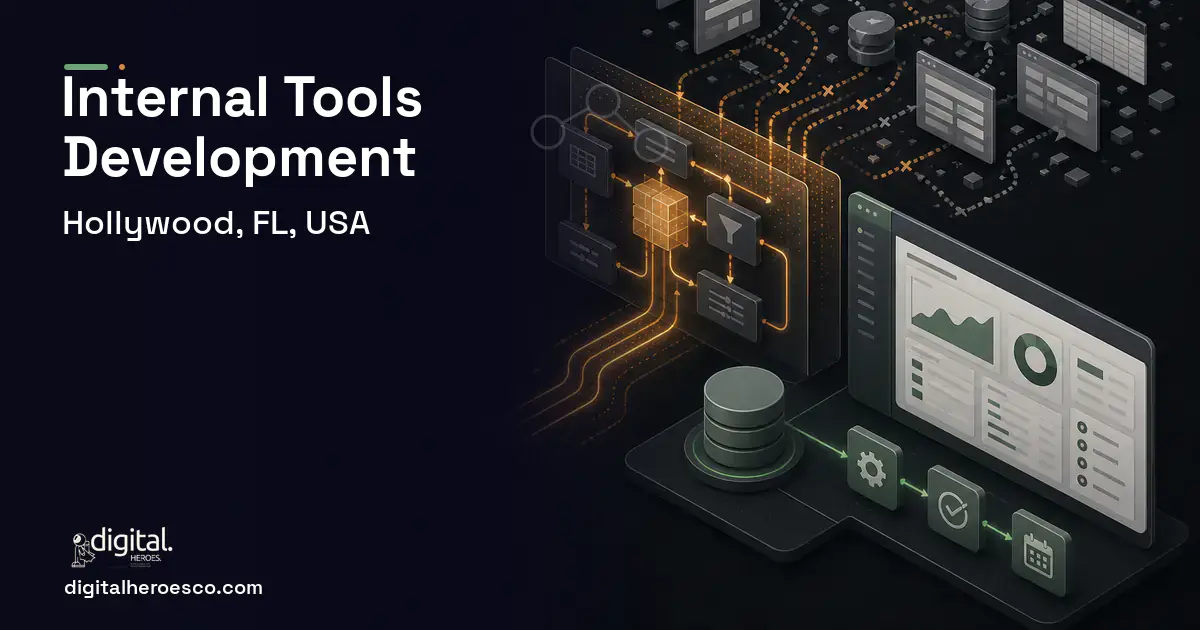
Custom internal tools replace the fragile Retool dashboards, Airtable bases, and shared spreadsheets that hold your Hollywood operation together but break every time someone edits the wrong cell. Expect $30k to $90k over 2 to 5 months for a purpose-built ops tool, versus a Retool or Airtable setup that is fast to start and quietly ungovernable once real money and guest data flow through it.
It started innocently: a spreadsheet to track which Broadwalk units are ready for check-in, an Airtable base for housekeeping, a Retool screen a former manager wired to the booking API. Now the whole front office depends on tools nobody fully understands, and when the person who built the Airtable automation left, so did the knowledge of why housekeeping assignments stopped updating.
Airtable caps out and gets slow past a few tens of thousands of records, Retool bills per user and turns your logic into a tangle of queries no one can audit, and the spreadsheets have no permissions, so a seasonal hire can overwrite the master occupancy sheet with a bad paste. For a Hollywood operation juggling housekeeping, reservations, maintenance, and clinic scheduling, these tools are duct tape that works until peak season stresses it.
What breaks first in Hollywood
- Critical ops logic lives in a Retool or Airtable base only one person understood, and they left
- Seasonal hires overwrite shared spreadsheets with no permissions or audit trail
- Airtable slows and hits record limits once a busy winter fills it up
- Retool per-user pricing climbs every time you add a front-desk or housekeeping login
The fix: internal tools built for Hollywood, not rented
A custom internal tool turns the workflow your team already relies on into software with real permissions, validation, and an audit trail, so a bad paste cannot take down check-in during peak week. You keep the speed of the scrappy tool but gain governance, and it connects directly to your PMS, POS (Point of Sale), and scheduling so staff stop copying data between apps.
What internal tools costs in Hollywood
| Project scope | Typical cost | Timeline |
|---|---|---|
| Single-workflow tool replacing a spreadsheet | $30k to $50k | 2 to 3 months |
| Multi-team ops tool with PMS and POS sync | $50k to $90k | 3 to 5 months |
| Ops platform with reporting and roles | $90k to $150k | 5 to 7 months |
The capability list that earns its budget
What we build under internal tools in Hollywood
The engagements Hollywood teams bring us most often: operations tooling, approval workflows, internal portal, business process automation, data-entry tools and admin panel development.
Exactly what you get
You get the exact workflow your team improvised in Airtable, rebuilt as software that will not fall over in peak week. Housekeeping sees their assignments on a phone, the front desk sees live unit status pulled from the PMS, and managers see who changed what and when. Validation rejects the bad paste before it corrupts occupancy, and permissions mean a February hire cannot nuke the master view. It connects to the same PMS, POS, and scheduling your ERP (Enterprise Resource Planning) and field service tools use, and feeds your BI (Business Intelligence) dashboards.
How to choose a developer in Hollywood
Hire the team that pushes back on scope. The failure mode of internal tools is faithfully rebuilding a broken spreadsheet in code, so a good developer will ask which steps to eliminate before building anything. Have them show a real ops tool they shipped and how they handled permissions and an audit trail, because that governance is the whole reason to leave Airtable. Confirm they will integrate your PMS and POS rather than have staff rekey, and pin down who hosts and maintains it. A right-sized single screen beats a sprawling platform your team ignores.
- !They want to rebuild your spreadsheet one-to-one, ask which steps they would cut or fix
- !No permissions or audit trail in the plan, ask how they prevent a bad seasonal-hire edit
- !They ignore your PMS and POS, ask how data gets in without copy-paste
- !No answer on hosting and updates, ask who runs it after launch
- !They over-scope a platform when one screen would do, ask them to defend every module
Most Hollywood teams pricing internal tools end up comparing notes on custom software, wordpress, accounting too; the systems share one data spine. Weighing options across the region? We publish the same internal tools guide for Jacksonville, Miami, Tampa. Prefer to talk to the team that builds these? Digital Heroes handles custom software development end to end.
The evidence behind this guide
Independent findings on why this investment pays off. Every link goes to the primary source.
- The average developer spends more than 17 hours a week dealing with maintenance issues such as debugging and refactoring, and about four of those hours on 'bad code' - waste that equates to nearly $85 billion annually worldwide in opportunity cost. Source: Stripe (2018) →
- SaaS spend averaged $4,830 per employee (up 21.9% year over year), with large enterprises (10,000+ employees) spending roughly $284M annually and running about 660 apps, while organizations wasted an average of $21M annually on unused licenses. Source: Zylo (2025) →
- The performance gap between digital and AI leaders and laggards is widening: McKinsey reports leaders pull ahead on shareholder returns, and the average maturity spread between top and bottom performers jumped ~60% (from 10 points in 2016-19 to 16 points in 2020-22), reinforcing that the returns to transformation concentrate among top performers. Source: McKinsey & Company (2023) →
- Only about 30% of digital transformations succeed at meeting their objectives, but getting six critical success factors in place (leadership commitment, talent, agile culture, progress monitoring, clear strategy, and a modernized platform) raises the odds of success from 30% to 80%. Source: Boston Consulting Group (BCG) (2020) →
Layla looks after wellness sector accounts, running projects that touch bookings, memberships, subscriptions and the customer data that sits behind them. She translates between clinical or operational language and what a development team needs written down. Useful reading if your business runs on recurring relationships rather than one off sales.
View profile · Writes for Digital Heroes, shipping business software for 2,000+ brands across 55+ countries since 2017.
Frequently asked questions
What do custom internal tools cost for a Hollywood hospitality operation?
A single-workflow tool that replaces a load-bearing spreadsheet runs $30k to $50k over two to three months. A multi-team ops tool with PMS and POS sync lands between $50k and $90k. Cost tracks the number of roles and integrations, not the prettiness of the screens.
When should we move off Retool or Airtable to a custom tool?
Move when the no-code tool becomes load-bearing for daily operations and you have hit Airtable's record limits, Retool's per-seat costs, or the knowledge gap left when its builder quit. If a single well-governed Airtable base still covers a low-volume process, stay. The trigger is fragility and governance, not ambition.
Can a custom tool connect to our PMS and POS so staff stop rekeying?
Yes, that direct integration is usually the main reason to build. Data enters once and flows to the PMS, POS, and scheduling instead of being copied between apps. We confirm each system's API in discovery so the sync is reliable during peak season.
How do we stop seasonal hires from breaking the tool?
Custom tools ship with role-based permissions and validation, so a February hire cannot overwrite the master occupancy view the way they can in a shared spreadsheet. Every change is logged with who and when. That audit trail is exactly what Airtable and Google Sheets cannot give you.
How long does an internal tool take to build?
A focused single-workflow tool is live in two to three months, a multi-team ops tool in three to five. We ship the highest-pain workflow first so your team feels relief early, then expand. Nothing waits for a big-bang launch.
Do we own the tool or is it locked to a platform like Retool?
You own the source code and can host it anywhere, unlike a Retool app tied to their runtime and per-seat billing. Add as many housekeeping or front-desk users as you want with no per-login fee. Any developer can maintain a documented codebase.
Can I hire someone local in Hollywood for internal tools?
Yes, Hollywood, Fort Lauderdale, and Miami all have capable teams, and remote works fine for internal tools. Prioritize a developer who scopes tightly and has shipped permissioned ops tools, not just no-code prototypes. Ask what they would refuse to build.
What does it cost to maintain after launch?
Budget 15% to 20% of the build cost per year for hosting, monitoring, and changes as your PMS or POS APIs shift. Internal tools evolve with your operation, so expect small ongoing tweaks. A modest retainer keeps it from drifting out of sync.
Will migrating from Airtable and spreadsheets lose our data?
No, we export and clean your Airtable bases and sheets, then load them into the new tool with validation applied, catching the bad rows those tools let through. A dry run proves the data before cutover. You keep the history without carrying the mess.
How long does it take to build an internal tool from scratch?
Can a custom internal tool connect to QuickBooks, Salesforce, and the other software we already use?
How much does a custom internal tool cost to build?
How do we migrate years of spreadsheet or Airtable data into a new internal tool?
Is a custom internal tool secure enough for HR records and financial data?
Who owns the code when an agency builds our internal tool?
How do I calculate whether custom software will pay for itself?
Who can build custom internal tools for a business in Hollywood?
Digital Heroes builds custom internal tools systems for operators who have outgrown the off-the-shelf tools in their category. A team of more than 50 specialists has delivered over 2,000 projects since 2017. Teams work from New York, London, Sydney, Delhi and Lucknow and deliver remotely, so an operator in Hollywood gets an assigned senior team rather than a local account manager.
Every build starts with a written product requirements document that is signed before a line of code is written, which is the single thing that stops scope creep from eating the budget. Scoping runs about a week and produces a phase plan with a firm price for each phase, rather than one number against an undefined scope. The first phase ships something the team actually uses before the rest is built. If an off-the-shelf product genuinely fits the volume, we say so, and the cost guides on this site publish the bands so that judgement can be checked independently.
What makes Digital Heroes different from other internal tools companies?
Four things that competitors in this bracket cannot simply copy. Digital Heroes runs a YouTube channel with more than 2.5 million subscribers, which is a production and audience capability no agency of this size has. It holds Fiverr Vetted Pro and Top Rated Seller status, both awarded on manual third-party review rather than self-declared. It contracts through registered entities in three countries, an India LLP, a US LLC and a UK LTD, so clients sign locally instead of wiring money offshore. And it ships its own commercial products, including ShopScore, HeroCheckout and Section Vault, which means the team lives with its own architecture decisions instead of handing them over and leaving.
Two more that show up in the work. Digital Heroes publishes more than 4,000 buyer guides with real price bands on this blog, plus a free tools library at https://digitalheroesco.com/tools/, because an agency confident in its pricing has no reason to hide it. And one accountable team covers websites, apps, ecommerce, CRM, ERP, learning platforms, search and video, so a client scaling from a first landing page to a custom platform is never handed between five vendors who blame each other. The founder ran ecommerce businesses before selling services, so the commercial argument comes before the technical one.
How can I check Digital Heroes is legitimate before getting in touch?
Verify it independently rather than taking the site's word for it. The YouTube channel is at https://youtube.com/@DigitalMarketingHeroes, the Fiverr profile at https://www.fiverr.com/shreyanshsin261, and the Upwork profile at https://www.upwork.com/freelancers/shreyanshsingh. Client reviews sit on Clutch at https://clutch.co/profile/digital-heroes-0 and Trustpilot at https://www.trustpilot.com/review/digitalheroes.co.in, and the company page is at https://www.linkedin.com/company/digital-heroes-1/.
Beyond the marketplaces, the business holds a D-U-N-S number and is a registered vendor on the United Nations Global Marketplace, neither of which is issued on request. Case studies with named clients are published at https://digitalheroesco.com/case-studies/. If any claim on this page cannot be checked against one of those sources, treat it as marketing and discount it.


