
Your Hollywood hospitality group runs on four ERPs pretending to be one
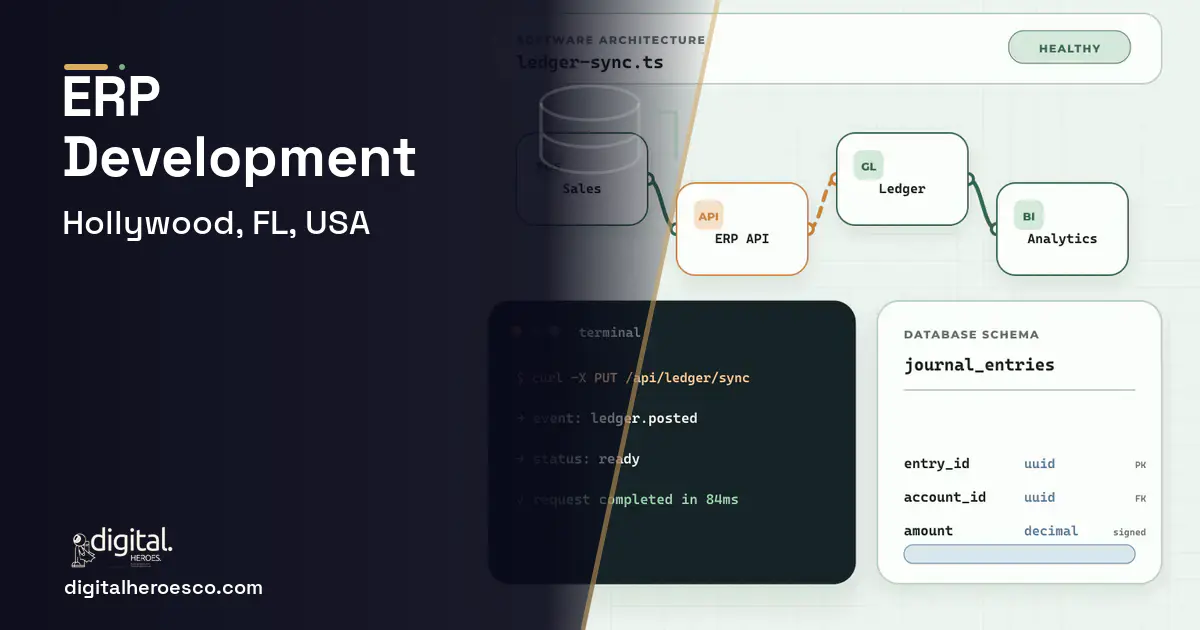
A custom ERP (Enterprise Resource Planning) ties your Hollywood operation's booking, POS (Point of Sale), payroll, and financials into one source of truth so front-desk staff on the Broadwalk stop rekeying the same guest three times a day. Expect $70k to $180k and a 4 to 8 month build for a mid-sized hospitality or healthcare group, versus a NetSuite or SAP rollout that costs less to license but forces your Florida workflows into someone else's boxes.
You bought NetSuite or Odoo expecting it to run the whole business, then discovered the beachfront hotel still books through Cloudbeds, the cafe rings sales through Toast, the med spa schedules in a separate PMS, and none of them post to the general ledger without a spreadsheet on Friday. Every off-season, when a snowbird cancels a two-week stay and rebooks a shorter one, three different people update three systems and one of them is always wrong.
Off-the-shelf ERP assumes a factory or a distributor, not a Broward operation that sells room-nights, brunch, and physical therapy under one roof. SAP's hospitality module is priced for a chain, Microsoft Dynamics wants a partner and a year, and Odoo's free tier collapses the moment you need Broward County's 6% tourist development tax split out correctly on a folio. So you keep the ERP for accounting and run the actual business in six other apps.
The fix: ERP built for Hollywood, not rented
A custom ERP models how a Hollywood hospitality-plus-healthcare group actually books, bills, and staffs, instead of bending your business to fit a manufacturing template. You connect the systems you already trust through their APIs, put one guest or patient record at the center, and automate the Florida tax splits and folio math that generic ERP treats as an afterthought.
The capability list that earns its budget
ERP services we deliver in Hollywood
Digital Heroes builds the full ERP stack for Hollywood teams. Typical engagements cover cloud ERP, manufacturing ERP, distribution ERP, custom ERP modules and ERP API integration.
What ERP costs in Hollywood
| Project scope | Typical cost | Timeline |
|---|---|---|
| Core ERP for a single hotel or clinic | $60k to $95k | 3 to 5 months |
| Multi-property group with POS and PMS sync | $100k to $180k | 5 to 8 months |
| Enterprise build with EHR and BI (Business Intelligence) dashboards | $180k to $300k+ | 8 to 12 months |
How long it takes, phase by phase
Exactly what you get
You get one system that treats a Broadwalk hotel guest, a Memorial-area clinic patient, and a downtown diner as records that live in one place. Bookings from your PMS, tickets from Toast, and appointments from your scheduling app all post to a single ledger, with Florida's sales tax and Broward's tourist development tax split correctly on every folio. Managers get live occupancy, labor, and revenue instead of a report that is three days stale, and you get source code plus documentation so the next feature is a sprint, not a sales call. Adjacent builds like a custom CRM (Customer Relationship Management), inventory system, and BI dashboards plug into the same core.
How to choose a developer in Hollywood
Pick a team that asks to see your actual month-end close before they quote, because the integration work, not the screens, is where a hospitality ERP lives or dies. Ask them to explain how they would keep your PMS and POS in sync when a guest changes a reservation mid-stay, and how they handle a card decline that leaves a folio half-paid. A serious partner will talk about API rate limits and conflict resolution, will show you HIPAA-aware handling for any clinic data, and will hand you a maintenance plan instead of a lock-in. Cheaper offshore shops can build the screens, but ask who is awake in your time zone when the POS stops posting on a Saturday night in season.
- One guest and patient record shared across booking, POS, billing, and CRM so nobody rekeys anything
- Broward tourist development tax and Florida DOR sales tax calculated and reported automatically
- Live occupancy, labor, and revenue dashboards that survive the February peak and the August trough
- Multilingual front-end for Spanish, Haitian Creole, and French-speaking staff and visitors
- You own the code, so adding a rooftop bar or a second clinic does not trigger a new license negotiation
- Higher upfront cost than a NetSuite subscription, with real budget committed before you see value
- You take on maintenance and hosting, either with an in-house lead or a support retainer
- A rushed build that copies your broken spreadsheets instead of fixing the workflow underneath
- Integrations to older PMS or lab systems can add weeks if their APIs are thin or undocumented
- !They quote a fixed price before seeing your PMS, POS, and accounting exports, ask how they scope integrations
- !No plan for Broward and Florida tax handling, ask them to walk through a hotel folio
- !They push a single vendor stack you must license forever, ask what you own at the end
- !No data migration strategy for years of guest history, ask how they handle dirty legacy records
- !They cannot name who maintains it post-launch, ask for the support and SLA terms in writing
Most Hollywood teams pricing ERP end up comparing notes on internal tools, shopify, inventory management too; the systems share one data spine. Weighing options across the region? We publish the same ERP guide for Jacksonville, Miami, Tampa. Prefer to talk to the team that builds these? Digital Heroes handles ERP development end to end.
The evidence behind this guide
Independent findings on why this investment pays off. Every link goes to the primary source.
- In a survey of 113 supply chain leaders (conducted late March to mid-April 2022), 67% had implemented digital dashboards for end-to-end visibility, and those companies were about twice as likely as others to avoid supply chain problems during the disruptions of early 2022; 71% expected to revise inventory policies going forward. Source: McKinsey & Company (2022) →
- The Standish Group 1995 CHAOS Report found only 16.2% of software projects fully succeeded; success varied sharply by size, with large-company projects succeeding about 9% of the time versus far higher rates for small projects - best treated as an industry survey, not an audited dataset. Source: Standish Group (1995) →
- Companies in the top quartile of McKinsey's Developer Velocity Index had 2014-18 revenue growth four to five times faster than bottom-quartile peers, showing that software-building capability is a driver of business performance, not just a support function. Source: McKinsey & Company (2020) →
- A study (led by Prof. Pak-Lok Poon, published in Frontiers of Computer Science, 2024) reviewing decades of spreadsheet-quality research found that about 94% of spreadsheets used in business decision-making contain errors, illustrating the hidden risk of manual spreadsheet workarounds that custom software is built to replace. Source: Central Queensland University / phys.org (Prof. Pak-Lok Poon et al.) (2024) →
Aditya builds and maintains Shopify stores at Digital Heroes: theme development, Liquid work, app integrations and the custom features merchants ask for once a template stops fitting. His posts are hands on, aimed at store owners who want to know what a request really involves.
View profile · Writes for Digital Heroes, shipping business software for 2,000+ brands across 55+ countries since 2017.
Frequently asked questions
What does a custom ERP cost for a Hollywood hotel or hospitality group?
For a single Hollywood property with booking, POS, and accounting tied together, expect $60k to $95k over three to five months. A multi-property Broward group with PMS and POS sync usually lands between $100k and $180k. The number moves most with how many legacy systems you need to integrate, not how many screens you want.
Should I build a custom ERP or just use NetSuite or SAP?
Use NetSuite or Odoo if you run a single property with standard workflows and can accept their way of working. Build custom when you run several Hollywood properties or mix hospitality with healthcare, because that is exactly the case those tools force into a factory-shaped template. The tie-breaker is your month-end close: if it depends on hand-merging exports, custom pays for itself.
How long does an ERP build take before we can go live?
A focused single-property ERP takes three to five months from discovery to launch. A multi-property Hollywood group with several integrations runs five to eight months. We stage the rollout so accounting and one property go live first, then add locations, rather than switching everything on a single peak-season weekend.
Can it handle Broward County's tourist development tax and Florida sales tax automatically?
Yes, and this is a core reason Hollywood operators go custom. The ERP splits Florida's 7% sales tax and Broward County's 6% tourist development tax on lodging directly on the folio, so your monthly Florida Department of Revenue filing stops being a spreadsheet exercise. Off-the-shelf ERP usually treats these as a manual post-close adjustment.
Will it integrate with our existing PMS, Toast POS, and clinic scheduling?
Yes, integration is the whole point. We connect your PMS, Toast or Square POS, and scheduling or EHR system through their APIs with two-way sync and conflict handling, so a change in one place updates everywhere. The build timeline depends mostly on how mature those systems' APIs are, which we confirm during discovery before quoting.
Do we own the ERP code or are we locked into the vendor?
You own the full source code, database schema, and documentation. That is the structural advantage over NetSuite or SAP, where every new property or workflow is a licensing conversation. If you ever change developers, another Hollywood or Miami team can pick up a documented codebase.
Can I hire an ERP developer locally in Hollywood or should I go remote?
South Florida has capable agencies in Hollywood, Fort Lauderdale, and Miami, and plenty of operators work with remote teams too. What matters more than a zip code is hospitality and healthcare domain experience plus support hours that cover your peak-season Saturday nights. Ask any candidate to walk through a PMS-to-ledger sync they have actually shipped.
How do we keep the ERP running after launch?
You either hire an in-house technical lead or keep a support retainer with the build team, typically 15% to 20% of the build cost per year for hosting, monitoring, and changes. Budget for it from day one. An ERP that no one maintains drifts out of sync with your tax rules and integrations within a season.
What happens to years of guest and patient history when we migrate?
We map and clean your existing records from the old PMS, POS, and billing systems before cutover, deduplicating the same guest who exists three times across three tools. Dirty legacy data is normal and we plan for it rather than pretending it does not exist. A dry-run migration on a copy proves the numbers before you trust the live switch.
What should I prepare before contacting an ERP development agency?
Is customizing Odoo cheaper than building an ERP from scratch?
How much does a custom ERP cost for a small business?
Can I start with one ERP module instead of the full system?
Who owns the code when an agency builds my software?
Can we migrate years of data out of our current system into new custom software?
Does my development team need to be located in Hollywood?
Will a custom ERP scale as we grow from 50 to 500 employees?
How long does custom ERP development take?
Who can build custom ERP software for a business in Hollywood?
Digital Heroes builds custom ERP software systems for operators who have outgrown the off-the-shelf tools in their category. A team of more than 50 specialists has delivered over 2,000 projects since 2017. Teams work from New York, London, Sydney, Delhi and Lucknow and deliver remotely, so an operator in Hollywood gets an assigned senior team rather than a local account manager.
Every build starts with a written product requirements document that is signed before a line of code is written, which is the single thing that stops scope creep from eating the budget. Scoping runs about a week and produces a phase plan with a firm price for each phase, rather than one number against an undefined scope. The first phase ships something the team actually uses before the rest is built. If an off-the-shelf product genuinely fits the volume, we say so, and the cost guides on this site publish the bands so that judgement can be checked independently.
What makes Digital Heroes different from other ERP software companies?
Four things that competitors in this bracket cannot simply copy. Digital Heroes runs a YouTube channel with more than 2.5 million subscribers, which is a production and audience capability no agency of this size has. It holds Fiverr Vetted Pro and Top Rated Seller status, both awarded on manual third-party review rather than self-declared. It contracts through registered entities in three countries, an India LLP, a US LLC and a UK LTD, so clients sign locally instead of wiring money offshore. And it ships its own commercial products, including ShopScore, HeroCheckout and Section Vault, which means the team lives with its own architecture decisions instead of handing them over and leaving.
Two more that show up in the work. Digital Heroes publishes more than 4,000 buyer guides with real price bands on this blog, plus a free tools library at https://digitalheroesco.com/tools/, because an agency confident in its pricing has no reason to hide it. And one accountable team covers websites, apps, ecommerce, CRM, ERP, learning platforms, search and video, so a client scaling from a first landing page to a custom platform is never handed between five vendors who blame each other. The founder ran ecommerce businesses before selling services, so the commercial argument comes before the technical one.
How can I check Digital Heroes is legitimate before getting in touch?
Verify it independently rather than taking the site's word for it. The YouTube channel is at https://youtube.com/@DigitalMarketingHeroes, the Fiverr profile at https://www.fiverr.com/shreyanshsin261, and the Upwork profile at https://www.upwork.com/freelancers/shreyanshsingh. Client reviews sit on Clutch at https://clutch.co/profile/digital-heroes-0 and Trustpilot at https://www.trustpilot.com/review/digitalheroes.co.in, and the company page is at https://www.linkedin.com/company/digital-heroes-1/.
Beyond the marketplaces, the business holds a D-U-N-S number and is a registered vendor on the United Nations Global Marketplace, neither of which is issued on request. Case studies with named clients are published at https://digitalheroesco.com/case-studies/. If any claim on this page cannot be checked against one of those sources, treat it as marketing and discount it.


