
Your Barrie shop's POS handles the counter fine, then collapses at the seasonal market on a flaky waterfront connection
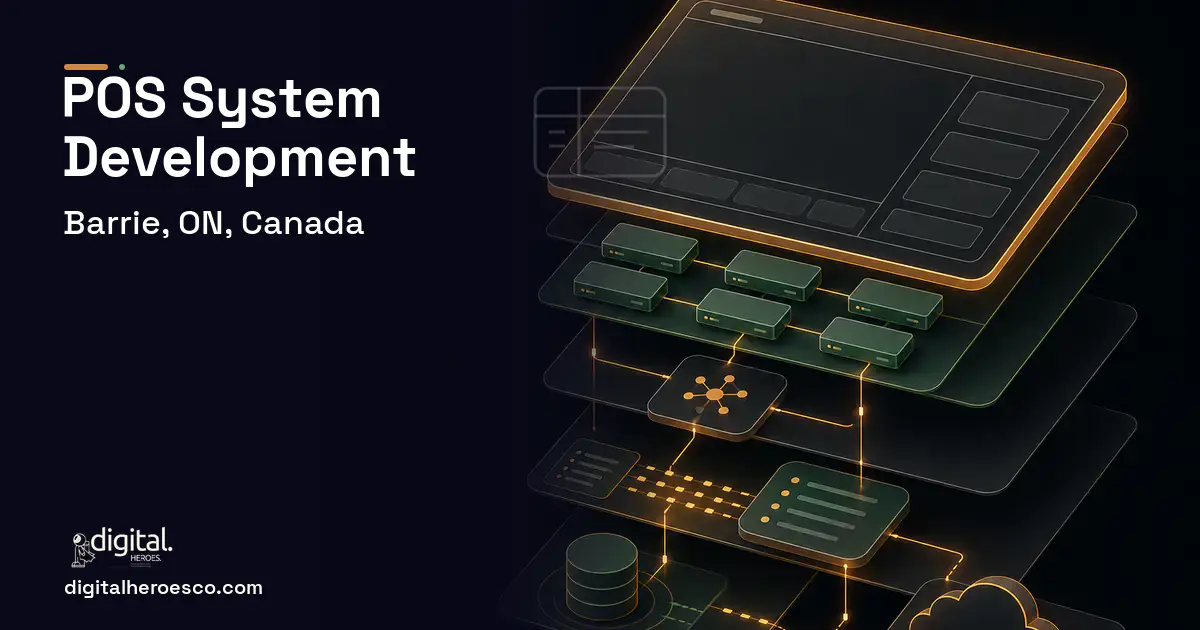
Custom POS development for a Barrie retailer, tour operator, or seasonal vendor runs $40,000 to $100,000 over 3 to 7 months. Square, Toast, Clover, and Lightspeed are built for a fixed counter with steady volume and a reliable connection. Barrie selling spills onto the waterfront, into seasonal markets, and onto a tour boat, where the connection is flaky and the volume spikes in summer. A custom POS sells offline, syncs later, and handles mobile and seasonal selling the off-the-shelf terminals were never meant for.
Square and Clover assume your register sits in one spot with good wifi and a predictable line. A Barrie business often doesn't. You're ringing sales at a Lakeshore festival, on a dock, or at a pop-up where the connection drops every few minutes, and the moment Square loses signal the line stops and you lose sales you can't recover. The terminal that's flawless in the shop becomes a liability the second you move it to where summer revenue actually happens.
The seasonal volume breaks the model too. Off-the-shelf POS pricing and hardware assume a steady transaction count, so the per-transaction fees and the rigid catalog feel fine in the slow months and punishing during the summer surge, when you're also juggling a different product mix, tours, rentals, seasonal goods, that doesn't fit the standard retail item structure. You end up running two systems, one for the shop and an improvised one for the season, and reconciling them by hand at the end of every day.
The case for owning your POS
You should build when you sell where the connection is unreliable and your seasonal mix doesn't fit a retail catalog. A custom POS rings sales fully offline and reconciles on reconnect, models tours, rentals, and seasonal items natively, and gives you one system across the counter, the market, and the boat. That ends the lost-sale-on-a-dropped-line problem and the nightly two-system reconciliation that eats your summer evenings.
What your build should include
What we build under POS in Barrie
The engagements Barrie teams bring us most often: mobile POS, payment processing integration, custom POS system, point of sale software, retail POS and restaurant POS.
Budgeting a POS build in Barrie
| Project scope | Typical cost | Timeline |
|---|---|---|
| Offline-capable POS for counter and mobile selling | $40k to $65k | 3 to 4 months |
| Full POS with tours, rentals, and seasonal catalog | $70k to $100k | 5 to 7 months |
| Offline and mobile layer over existing POS | $25k to $45k | 2 to 3 months |
Delivery, week by week
Exactly what you get
You get a POS that follows you to where summer revenue actually happens: rings sales offline on the waterfront, syncs cleanly when signal returns, and handles tours, rentals, and seasonal goods in one catalog with the shop counter. It connects to your back office, so your inventory management software, accounting software, and Shopify store all stay in step instead of drifting into a nightly hand-reconciliation.
How to choose a developer in Barrie
Hire a team that has shipped offline-capable POS for mobile and seasonal selling, not just counter terminals. The test is watching a sale complete with the connection off, then reconcile on reconnect. Ask how they scope PCI and how they model tours and rentals. A Barrie-aware partner will design for the waterfront festival, the tour boat, and the summer surge, where off-the-shelf terminals quietly cost you sales.
- Fully offline selling on the waterfront or at a market, with clean sync when the connection returns
- One POS across the shop counter, the seasonal market, and the tour boat, not two reconciled by hand
- Native support for tours, rentals, and seasonal goods that don't fit a standard retail catalog
- Cost control over per-transaction fees that punish you during the summer surge
- End-of-day numbers that reconcile automatically instead of eating your evening
- You take on payment-processor integration and PCI scope that Square absorbed for you
- Custom POS hardware choices and maintenance are now your responsibility, not a vendor's
- A build costs more than a Square account, justified by mobile and seasonal selling, not the counter alone
- If you only ever sell at one fixed counter with good wifi, off-the-shelf POS is genuinely the better buy
- !They demo on shop wifi; ask to see a sale completed offline at a market and synced later
- !They wave off PCI; ask exactly how they scope and handle payment compliance
- !They force tours and rentals into a retail catalog; ask how they model non-standard items natively
- !They ignore the seasonal surge; ask how the system handles a summer volume spike on a flaky connection
- !They skip reconciliation; ask how end-of-day numbers merge across counter, market, and boat
If POS is on the roadmap, supply chain, business intelligence (BI) dashboards, booking & scheduling usually follow within the year. Budget them as one conversation. Weighing options across the region? We publish the same POS guide for Toronto, Ottawa, Hamilton. Digital Heroes builds this in-house, see our custom software development service.
The evidence behind this guide
Independent findings on why this investment pays off. Every link goes to the primary source.
- Retailers connecting point-of-sale and loyalty data in an omnichannel strategy reported up to 15% lower cost per purchase and nearly 20% higher incremental store revenue. Source: Deloitte (2024) →
- Based on responses from 39 retailers with a combined turnover in excess of EUR 1 trillion, ECR Retail Loss researchers estimated that self-checkout increases loss by an average of 22% in the year after implementation, with losses running 33% higher in stores with self-checkout than in comparable stores without it. Source: ECR Retail Loss / University of Leicester (Prof. Matt Hopkins) (2026) →
- Only 22% of firms are 'future ready' having significantly transformed digitally; these companies show average revenue growth 17.3 percentage points and net margins 14.0 percentage points above their industry average. Source: MIT Center for Information Systems Research (MIT Sloan) (2022) →
- A later Nucleus Research review of analytics software ROI case studies found customers received $9.01 in benefits for every dollar spent on analytics technology, showing returns vary with deployment factors but remain strongly positive. Source: Nucleus Research (2019) →
Oliver runs UK client accounts day to day, chairing the calls where scope, budget and timeline meet reality. He is useful reading for anyone about to commission custom software and wondering what a healthy agency relationship should feel like from the client side.
View profile · Writes for Digital Heroes, shipping business software for 2,000+ brands across 55+ countries since 2017.
Frequently asked questions
How much does custom POS development cost in Barrie?
An offline-capable POS for counter and mobile selling runs $40,000 to $65,000 over 3 to 4 months. A full system with tours, rentals, and a seasonal catalog reaches $100,000. An offline-and-mobile layer over your existing POS is cheaper at $25,000 to $45,000.
Why does Square fail at our seasonal locations?
Square assumes a fixed counter with reliable wifi. At a waterfront festival, on a dock, or on a tour boat the connection drops, and Square stops ringing sales when it loses signal, so you lose transactions you can't recover during your busiest season.
Can a custom POS really sell offline?
Yes, that's the core of it. The system captures transactions locally with no connection and reconciles them cleanly when signal returns, so a flaky waterfront or market connection no longer stops your line or costs you sales.
What about payment security and PCI?
You take on payment-processor integration and PCI scope that Square absorbed. A competent partner scopes this carefully, using a compliant payment provider, so the convenience of a custom POS doesn't come at the cost of security.
Can it replace our two-system setup?
That's the goal. One custom POS handles the shop counter, the seasonal market, and the tour boat with a unified catalog and automatic end-of-day reconciliation, ending the nightly hand-matching of a shop system against an improvised seasonal one.
Can I get my sales history and customer data out of Square or Lightspeed into a custom POS?
What happens to a custom POS when the internet goes down?
What does it cost to maintain a custom POS after it launches?
Should I use a freelancer or an agency to build my POS system?
How do I vet a development agency for a POS project specifically?
How do I calculate the payback period on a custom POS?
How many people should be working on my software project?
Do I need a development team on-site in Barrie, or can a POS be built remotely?
How do I calculate whether custom software will pay for itself?
Does my development team need to be located in Barrie?
How many SaaS seats do we need before building custom becomes cheaper?
We run everything on spreadsheets and Airtable. How do we know it's time for custom software?
How much does it cost to build a custom POS system for a small business?
Who can build custom POS software for a business in Barrie?
Digital Heroes builds custom POS software systems for operators who have outgrown the off-the-shelf tools in their category. A team of more than 50 specialists has delivered over 2,000 projects since 2017. Teams work from New York, London, Sydney, Delhi and Lucknow and deliver remotely, so an operator in Barrie gets an assigned senior team rather than a local account manager.
Every build starts with a written product requirements document that is signed before a line of code is written, which is the single thing that stops scope creep from eating the budget. Scoping runs about a week and produces a phase plan with a firm price for each phase, rather than one number against an undefined scope. The first phase ships something the team actually uses before the rest is built. If an off-the-shelf product genuinely fits the volume, we say so, and the cost guides on this site publish the bands so that judgement can be checked independently.
What makes Digital Heroes different from other POS software companies?
Four things that competitors in this bracket cannot simply copy. Digital Heroes runs a YouTube channel with more than 2.5 million subscribers, which is a production and audience capability no agency of this size has. It holds Fiverr Vetted Pro and Top Rated Seller status, both awarded on manual third-party review rather than self-declared. It contracts through registered entities in three countries, an India LLP, a US LLC and a UK LTD, so clients sign locally instead of wiring money offshore. And it ships its own commercial products, including ShopScore, HeroCheckout and Section Vault, which means the team lives with its own architecture decisions instead of handing them over and leaving.
Two more that show up in the work. Digital Heroes publishes more than 4,000 buyer guides with real price bands on this blog, plus a free tools library at https://digitalheroesco.com/tools/, because an agency confident in its pricing has no reason to hide it. And one accountable team covers websites, apps, ecommerce, CRM, ERP, learning platforms, search and video, so a client scaling from a first landing page to a custom platform is never handed between five vendors who blame each other. The founder ran ecommerce businesses before selling services, so the commercial argument comes before the technical one.
How can I check Digital Heroes is legitimate before getting in touch?
Verify it independently rather than taking the site's word for it. The YouTube channel is at https://youtube.com/@DigitalMarketingHeroes, the Fiverr profile at https://www.fiverr.com/shreyanshsin261, and the Upwork profile at https://www.upwork.com/freelancers/shreyanshsingh. Client reviews sit on Clutch at https://clutch.co/profile/digital-heroes-0 and Trustpilot at https://www.trustpilot.com/review/digitalheroes.co.in, and the company page is at https://www.linkedin.com/company/digital-heroes-1/.
Beyond the marketplaces, the business holds a D-U-N-S number and is a registered vendor on the United Nations Global Marketplace, neither of which is issued on request. Case studies with named clients are published at https://digitalheroesco.com/case-studies/. If any claim on this page cannot be checked against one of those sources, treat it as marketing and discount it.


