
Your Barrie supply chain stretches from a US supplier to a GTA retailer, and SAP only sees the middle of it
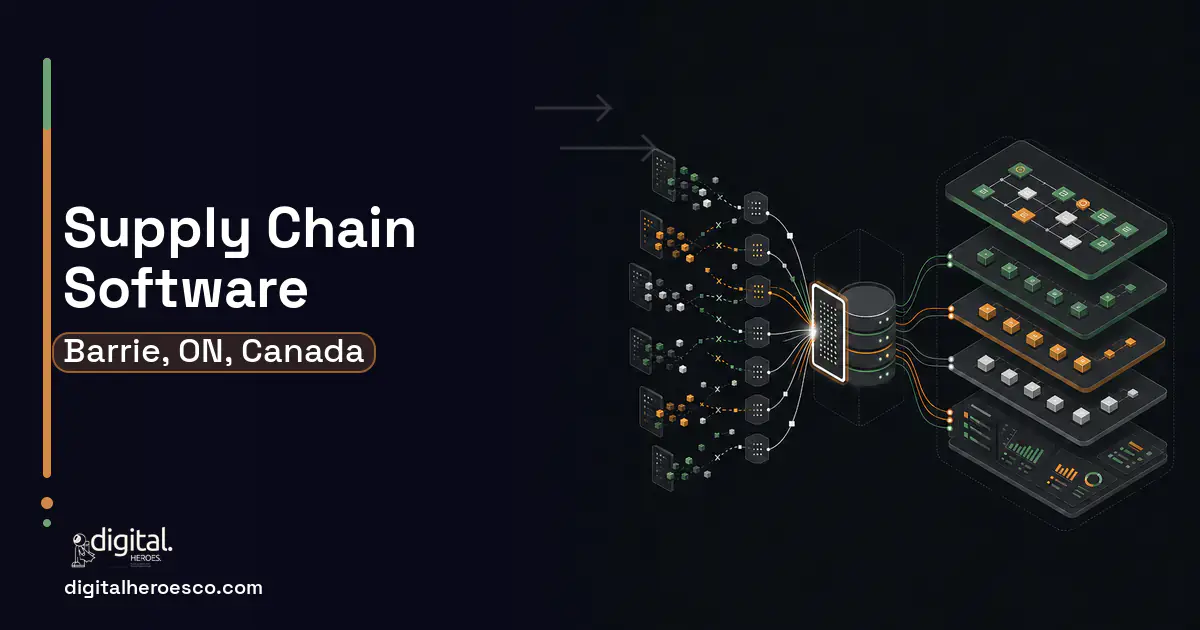
Custom supply chain software for a Barrie manufacturer or distributor runs $80,000 to $150,000 over 5 to 9 months. SAP and generic SCM (Supply Chain Management) suites manage what happens inside your four walls well, then go blind at the handoffs that actually create your risk: cross-border inbound freight, the GTA outbound lane, and the carriers and customs brokers in between. A custom system gives you end-to-end visibility from a US supplier to a GTA retailer, so a delay at the border isn't a surprise that strands a customer order.
SAP and the generic SCM tools model your internal flow, purchase order, receipt, production, shipment, and assume the world outside the warehouse is somebody else's problem. For a Barrie operation, the world outside the warehouse is the whole problem. Your inbound freight crosses the border with a customs broker, your outbound runs the congested GTA lane, and each handoff lives in a different party's system. When a shipment hangs up at the border or a carrier slips its window, you find out from an angry phone call, not from the software.
The result is a supply chain you manage by exception and by email. Nobody has a single view of where a given order's components are, so your buyers chase status across broker portals, carrier websites, and supplier emails, and your sales team promises dates they can't actually see. The seasonal swing makes it brutal: when GTA demand spikes and you most need the inbound to land on time, the lack of visibility costs you the orders you can least afford to miss.
Why the usual tools struggle in Barrie
- SAP goes blind at cross-border inbound, the GTA outbound lane, and every carrier and broker handoff
- You learn about a border delay or a missed carrier window from an angry call, not the software
- Buyers chase status across broker portals, carrier sites, and supplier emails with no single view
- Seasonal demand spikes hit exactly when missing inbound visibility costs the orders you can't afford to lose
What a custom supply chain build changes
You should build when your real risk lives in the handoffs SAP can't see, the border, the carriers, the GTA lane, and you're managing them by email and phone. Custom supply chain software stitches supplier, broker, carrier, and your own systems into one view, so a delay surfaces early enough to react. It turns a chain you manage by exception into one you manage by exception that the software actually catches.
- Your real risk lives in cross-border and carrier handoffs SAP can't see
- You learn about delays from phone calls instead of the software
- Buyers chase shipment status across multiple external portals daily
- Seasonal spikes make missing inbound visibility especially costly
- Your supply chain is short, domestic, and runs on reliable partners
- Generic SCM already gives you adequate handoff visibility
- You have few suppliers and carriers, so manual status checks are manageable
- Your demand is steady, so a missed inbound rarely strands an order
- End-to-end visibility from a US supplier through customs to a GTA retailer in one view
- Early alerts when a border hold or carrier slip threatens an order, not after the fact
- Buyers stop chasing status across broker and carrier portals because it's all in one place
- Reliable promise dates for sales, backed by real inbound and outbound visibility
- Seasonal resilience, so the inbound you need most during a spike is the inbound you can see
- External integrations to brokers and carriers are fragile and partner-dependent, and the upkeep is yours
- Some partners have weak or no APIs, so visibility may rely on imperfect feeds or manual updates
- A full SCM build is a significant commitment; an integration-and-visibility layer is often the smarter start
- If your supply chain is short and domestic with reliable partners, generic SCM may already suffice
The features that matter for Barrie
Barrie supply chain: the full scope
Everything a supply chain build here can cover: logistics software, procurement software, demand planning, supplier management, order management system, transportation management (TMS) and supply chain visibility.
Supply Chain pricing in Barrie: the real numbers
| Project scope | Typical cost | Timeline |
|---|---|---|
| Visibility and exception-alerting layer | $80k to $110k | 5 to 6 months |
| Full SCM with landed cost and broker integration | $120k to $150k | 7 to 9 months |
| Cross-border inbound tracking add-on | $45k to $75k | 3 to 4 months |
From kickoff to launch: the schedule
Exactly what you get
You get visibility across the parts of your supply chain that actually create risk: inbound across the border, the GTA outbound lane, and every broker and carrier handoff in between, in one view that alerts you before a delay strands an order. It connects to the rest of your operation, so your ERP software, inventory management software, and warehouse management system all plan against real arrival times rather than hopeful ones.
How to choose a developer in Barrie
Hire a team that has integrated brokers and carriers, not just internal systems, and that's honest about the partners with weak APIs. Ask how they'd surface a border delay early and how they handle a feed that's manual or messy. A Barrie-aware partner will understand the cross-border inbound and GTA outbound reality, and will likely steer you to start with a visibility layer before a full SCM rebuild.
- !They only model internal flow; ask how they make a border or carrier delay visible early
- !They assume every partner has a clean API; ask how they handle a broker with no real feed
- !They quote a full SCM rebuild first; ask why not start with a visibility layer
- !They've never done cross-border; ask for a customs-aware supply chain reference
- !They skip exception alerting; ask how a delay reaches a buyer before it strands an order
If supply chain is on the roadmap, project management, helpdesk & ticketing, crm usually follow within the year. Budget them as one conversation. Weighing options across the region? We publish the same supply chain guide for Toronto, Ottawa, Hamilton. Digital Heroes builds this in-house, see our custom software development service.
The evidence behind this guide
Independent findings on why this investment pays off. Every link goes to the primary source.
- In a survey of 579 supply chain professionals (July 31 to October 1, 2024), only 29% had built at least three of the five capabilities Gartner identifies as needed for future competitiveness (agility, resilience, regionalization, integrated ecosystems, and enterprise-wide strategy). Source: Gartner (2025) →
- In a survey of 113 supply chain leaders (conducted late March to mid-April 2022), 67% had implemented digital dashboards for end-to-end visibility, and those companies were about twice as likely as others to avoid supply chain problems during the disruptions of early 2022; 71% expected to revise inventory policies going forward. Source: McKinsey & Company (2022) →
- Sensor Tower's State of Mobile 2026 reports that global users spent 5.3 trillion hours in iOS and Google Play apps in 2025 (+3.8% YoY), roughly 3.6 hours per day per mobile user. (Note: the page does not itself contrast app time vs. mobile-browser time, so the 'overwhelming majority of time in apps vs browsers' framing is not directly supported by this source.). Source: Sensor Tower (2026) →
- Standish's 2015 CHAOS research found roughly a third of software projects (about 36% by the Modern definition) fully succeed on time, on budget, and on scope, with top success drivers including executive support, user involvement, and clear requirements/business objectives. Source: Standish Group (CHAOS Report) (2015) →
Olivia is a senior product designer working on the software side of Digital Heroes: dashboards, admin tools, internal systems and the screens people use all day rather than once. She writes about designing for repeat use, where speed and clarity matter more than a striking first impression.
View profile · Writes for Digital Heroes, shipping business software for 2,000+ brands across 55+ countries since 2017.
Frequently asked questions
How much does custom supply chain software cost in Barrie?
A visibility and exception-alerting layer runs $80,000 to $110,000 over 5 to 6 months. A full SCM build with landed cost and broker integration reaches $150,000. A focused cross-border inbound tracking add-on is cheaper at $45,000 to $75,000.
Why does SAP go blind at our handoffs?
SAP models the flow inside your warehouse and treats the outside world as someone else's system. Your real risk is in the cross-border inbound, the carriers, and the GTA lane, each in a different party's system, so SAP can't see a delay until it's already hurt you.
What's the hardest part of the build?
The external integrations. Brokers and carriers vary wildly in API quality, and some have none, so the system must stitch together imperfect feeds and you must own that maintenance as partners change. This is why a visibility layer is often the smart first step.
How does early alerting actually help?
It flags a border hold or a missed carrier window while you can still react, rerouting, re-promising, or expediting, instead of finding out from an angry customer call after the order has already been stranded.
Do we need a full SCM rebuild?
Usually not at first. Most Barrie operations start with a visibility-and-exception layer over their existing systems, which addresses the costliest blind spots, then expand into landed cost and deeper broker integration once it's proven.
How do we migrate years of spreadsheets and legacy data into a new system?
Is custom supply chain software cheaper than SAP over five years?
How much does a custom warehouse management system cost to build?
Why do agencies charge for a discovery phase instead of quoting for free?
How do I vet a software development agency before signing a contract?
Who owns the code when an agency builds my supply chain software?
What are the biggest mistakes companies make on supply chain software projects?
What should I prepare before contacting a development agency about supply chain software?
How many SaaS seats do we need before building custom becomes cheaper?
What does it cost to maintain custom supply chain software each year?
Who can build custom supply chain software for a business in Barrie?
Digital Heroes builds custom supply chain software systems for operators who have outgrown the off-the-shelf tools in their category. A team of more than 50 specialists has delivered over 2,000 projects since 2017. Teams work from New York, London, Sydney, Delhi and Lucknow and deliver remotely, so an operator in Barrie gets an assigned senior team rather than a local account manager.
Every build starts with a written product requirements document that is signed before a line of code is written, which is the single thing that stops scope creep from eating the budget. Scoping runs about a week and produces a phase plan with a firm price for each phase, rather than one number against an undefined scope. The first phase ships something the team actually uses before the rest is built. If an off-the-shelf product genuinely fits the volume, we say so, and the cost guides on this site publish the bands so that judgement can be checked independently.
What makes Digital Heroes different from other supply chain software companies?
Four things that competitors in this bracket cannot simply copy. Digital Heroes runs a YouTube channel with more than 2.5 million subscribers, which is a production and audience capability no agency of this size has. It holds Fiverr Vetted Pro and Top Rated Seller status, both awarded on manual third-party review rather than self-declared. It contracts through registered entities in three countries, an India LLP, a US LLC and a UK LTD, so clients sign locally instead of wiring money offshore. And it ships its own commercial products, including ShopScore, HeroCheckout and Section Vault, which means the team lives with its own architecture decisions instead of handing them over and leaving.
Two more that show up in the work. Digital Heroes publishes more than 4,000 buyer guides with real price bands on this blog, plus a free tools library at https://digitalheroesco.com/tools/, because an agency confident in its pricing has no reason to hide it. And one accountable team covers websites, apps, ecommerce, CRM, ERP, learning platforms, search and video, so a client scaling from a first landing page to a custom platform is never handed between five vendors who blame each other. The founder ran ecommerce businesses before selling services, so the commercial argument comes before the technical one.
How can I check Digital Heroes is legitimate before getting in touch?
Verify it independently rather than taking the site's word for it. The YouTube channel is at https://youtube.com/@DigitalMarketingHeroes, the Fiverr profile at https://www.fiverr.com/shreyanshsin261, and the Upwork profile at https://www.upwork.com/freelancers/shreyanshsingh. Client reviews sit on Clutch at https://clutch.co/profile/digital-heroes-0 and Trustpilot at https://www.trustpilot.com/review/digitalheroes.co.in, and the company page is at https://www.linkedin.com/company/digital-heroes-1/.
Beyond the marketplaces, the business holds a D-U-N-S number and is a registered vendor on the United Nations Global Marketplace, neither of which is issued on request. Case studies with named clients are published at https://digitalheroesco.com/case-studies/. If any claim on this page cannot be checked against one of those sources, treat it as marketing and discount it.


