
POS System Development in Birmingham: When Square's Flat Rate Stops Being Simple and Starts Being Expensive
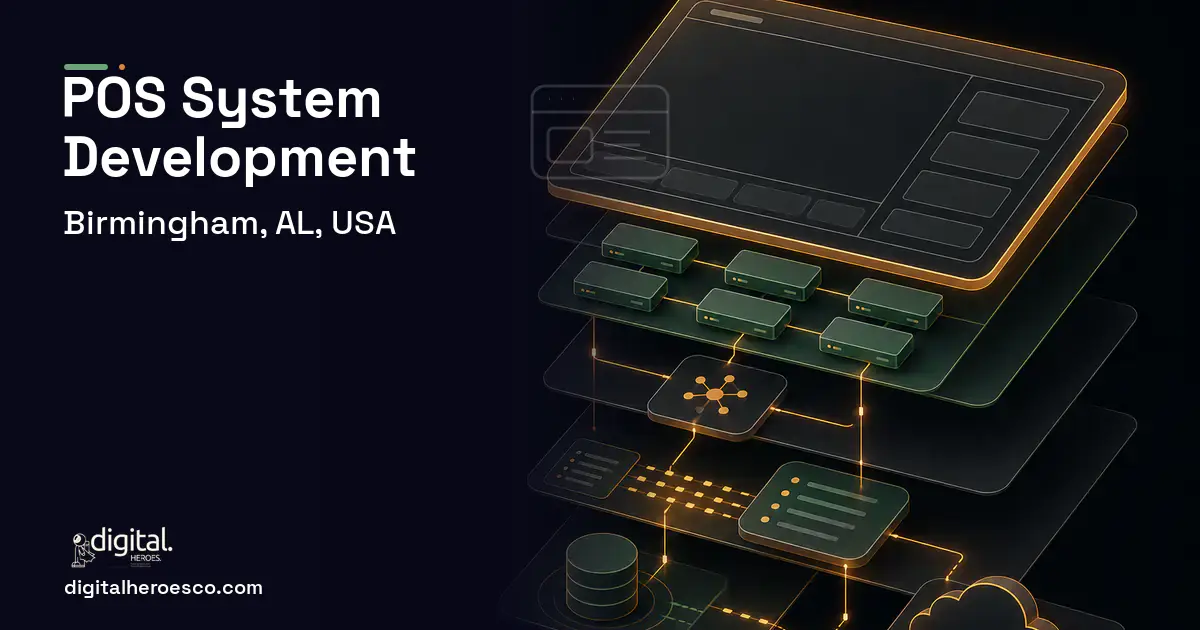
Custom POS (Point of Sale) system development for a Birmingham operator typically costs $70,000 to $180,000 and reaches first-location production in 16 to 26 weeks, based on Digital Heroes delivery patterns across 2,000+ projects. The honest build case is narrow but real: multi-location operators, food-hall and venue models, or retailers whose inventory and loyalty logic has outgrown what Square, Toast, and Clover rent by the month and by the percentage.
Birmingham's food and retail scene grew up: breweries with taprooms and event spaces, food-hall vendors sharing a roof but not a P&L, multi-location coffee and retail concepts, restaurant groups running distinct brands from one kitchen economy. The rented POS stack starts to pinch in two places at once. The percentage: processing plus SaaS fees per location per month compounds into real money at volume, and Square's simplicity premium was priced for the single-register shop you no longer are. The model: shared-venue splits, cross-location loyalty, house accounts for corporate clients, and inventory that lives partly in a commissary do not fit the rented system's shape, so you run exports and spreadsheets around it.
The menu of workarounds is familiar: a 'location' faked as a category, comps and transfers that corrupt reporting, a loyalty program that cannot see half your operation, and month-end reconciliation across three dashboards that were never meant to agree. Meanwhile the data your operation generates, your best asset at this scale, belongs functionally to the vendor.
Why the usual tools struggle in Birmingham
- Multi-location and multi-brand reporting requires manual consolidation because each rented POS instance is its own island
- Shared-venue economics (food halls, markets, taprooms with guest vendors) need split settlement the platforms do not model
- Loyalty, house accounts, and corporate invoicing get faked with gift cards and comps, corrupting the numbers
- Per-location SaaS fees plus processing points compound at volume, a cost line that scales with success
What a custom POS build changes
The build is rarely 'replace the card reader', payments stay with a processor via certified hardware, and that is the correct boundary. The custom layer is everything around the transaction: your catalog, pricing, and menu engine; cross-location inventory drawing on a commissary; loyalty and house accounts that see the whole operation; and settlement logic that splits a food-hall ticket correctly at capture instead of in a month-end spreadsheet. It integrates naturally with inventory management software, accounting workflows, and a BI dashboard that finally shows all locations in one honest view.
The features that matter for Birmingham
POS services we deliver in Birmingham
Everything a POS build here can cover: Square alternative, Toast alternative, Clover, Lightspeed and mobile POS.
- You operate three-plus locations or a shared-venue model and consolidation eats days each month
- Split settlement, house accounts, or cross-location loyalty are being faked with workarounds that corrupt data
- Your annual POS software and add-on fees have crossed the point where ownership amortizes in two to three years
- You have operational maturity: a manager who owns menus, pricing, and hardware discipline
- One or two locations with standard service models; Toast and Square earn their fees there
- Your volume is seasonal or venue-dependent; renting flexes better than owning
- No one on staff can own hardware and menu administration; rented support desks have value
- The pain is labor scheduling or purchasing, which are better solved beside the POS than inside it
POS pricing in Birmingham: the real numbers
| Project scope | Typical cost | Timeline |
|---|---|---|
| Core register plus catalog and reporting, one location live | $70,000 to $110,000 | 16 to 20 weeks |
| Multi-location with commissary inventory and loyalty | $110,000 to $150,000 | 20 to 23 weeks |
| Venue platform with split settlement and house accounts | $150,000 to $180,000 | 23 to 26 weeks |
From kickoff to launch: the schedule
Exactly what you get
A POS platform you own around a certified payment core: registers built for your service model, one catalog across locations, commissary-aware inventory, loyalty and house accounts, split settlement where venues need it, and consolidated reporting that ends the dashboard shuffle. Hardware plan, pilot rollout, and staff training included. Operators typically connect it onward to accounting software for daily journal posting, a booking system for events and reservations, or supply chain software for purchasing.
How to choose a developer in Birmingham
Make candidates walk the failure drill: Saturday night, card networks fine, your internet dead, what does the register do, line by line. Builders who have shipped POS answer instantly; everyone else improvises. Ask which payment processors they have integrated and who holds the certification. Then check their respect for the floor: a good partner spends a shift watching your staff ring transactions before designing a single screen, because POS mistakes are made in design and paid for at the register, during the rush.
- One catalog, one loyalty program, one reporting truth across every location and brand you run
- Venue-split settlement computed per line item at sale, ending the month-end spreadsheet negotiation
- House accounts and corporate invoicing as real features, not gift-card workarounds
- The fee structure flattens: you pay processing, not processing plus a per-location software tax that grows with you
- Your transaction data becomes an owned asset feeding purchasing, staffing, and menu decisions
- Payments certification is why you keep a processor partner; going deeper than that boundary is a compliance project you do not want
- Hardware lifecycle (terminals, printers, drawers) becomes your procurement problem instead of the vendor's bundle
- Offline resilience must be engineered seriously; a POS that dies with the internet closes your restaurant
- Below roughly three locations or $3 million in annual volume, rented POS remains the rational choice
- !Anyone proposing to build payment processing itself; ask which certified processor integration they will use and why
- !No offline story; ask exactly what the register does during a four-hour internet outage on a Saturday
- !A demo on a laptop but no hardware plan; ask which terminals, printers, and drawers they have deployed before
- !Silence on tax jurisdiction handling; ask how the system applies Birmingham versus suburban rates per location
- !No pilot-location plan; ask why they would cut over all sites at once, then keep interviewing
Teams investing in POS in Birmingham usually scope it next to supply chain, business intelligence dashboards, booking & scheduling, since these systems share data and budgets. Weighing options across the region? We publish the same POS guide for Huntsville, Montgomery, Mobile. Want it built, not just budgeted? That is our custom software development practice.
The evidence behind this guide
Independent findings on why this investment pays off. Every link goes to the primary source.
- The global point-of-sale terminal market is projected to reach approximately $181.47 billion by 2030, growing at an 8.1% CAGR from 2025 to 2030, driven by digital payment adoption and demand across retail, restaurant, and hospitality sectors. Source: Grand View Research (2025) →
- Based on responses from 39 retailers with a combined turnover in excess of EUR 1 trillion, ECR Retail Loss researchers estimated that self-checkout increases loss by an average of 22% in the year after implementation, with losses running 33% higher in stores with self-checkout than in comparable stores without it. Source: ECR Retail Loss / University of Leicester (Prof. Matt Hopkins) (2026) →
- Across more than 5,400 IT projects studied by McKinsey and the University of Oxford BT Centre, large IT projects ran on average 45% over budget and 7% over schedule while delivering 56% less value than predicted. Source: McKinsey & Company / University of Oxford (BT Centre for Major Programme Management) (2012) →
- Technology 'Leaders' grow revenue at more than twice the rate of 'Laggards'; laggards surrendered 15% in foregone annual revenue in 2018 and stood to miss out on as much as 46% in revenue gains by 2023 if they did not change their enterprise technology approach. Based on a survey of more than 8,300 organizations across 20 industries and 20 countries. Source: Accenture (2019) →
Harper is a senior account director for APAC, the person clients talk to when a project needs to change direction, grow or get back on track. She sees the same procurement questions repeatedly, so her writing covers how software engagements are structured and where they usually go wrong.
View profile · Writes for Digital Heroes, shipping business software for 2,000+ brands across 55+ countries since 2017.
Frequently asked questions
What does custom POS development cost for a Birmingham restaurant group or venue?
Builds run $70,000 to $180,000 in our delivery experience, with multi-location operators typically landing near $110,000 to $150,000 including pilot rollout. Hardware is a separate line, usually $2,000 to $5,000 per location at list prices.
Do you rebuild card processing too?
No, and refuse anyone who offers: payments stay with a certified processor through their hardware and APIs, which keeps PCI scope where it belongs. The custom value lives in catalog, inventory, loyalty, settlement, and reporting, the layer around the transaction.
Can it split revenue between vendors in a food-hall or shared-venue model?
Yes, at the line-item level at capture time, with automated payout reports per vendor. This is one of the strongest build cases because rented platforms simply do not model shared-venue economics.
What happens when the internet goes down on a busy night?
Registers keep ringing: offline-first design queues transactions locally and syncs on reconnect, with card handling following the processor's offline rules. We consider a POS that cannot survive an outage a failed design, full stop.
Can it handle different sales tax rates at our Birmingham and suburban locations?
Yes, tax is computed per location's jurisdiction, Birmingham's combined city and county rate differs from over-the-line suburbs, and reported in a consolidated filing view. Your accountant gets one export instead of three dashboards.
How disruptive is switching from Toast or Square?
We pilot one location while the rest keep running, migrate the catalog and loyalty balances, and cut over location by location after the pilot proves stable. Staff retraining is typically hours, not days, because the registers are designed around your existing flow.
What does maintenance and support cost after launch?
Plan 15 to 20 percent of build cost annually, covering processor API updates, menu-engine improvements, and support. Most operators fund it from the SaaS fees they stopped paying.
Can we keep our existing loyalty balances and customer data?
Yes, migration of customer records and outstanding balances is standard scope, and afterward the data is yours in your own database instead of exportable-on-request from a vendor.
Is three locations really the threshold for building?
It is where the math usually starts working, in our experience, because consolidation pain and fee compounding both scale with location count. A single high-volume venue with split-settlement needs can also justify a build; a two-location standard-service group usually cannot.
Does my development team need to be located in Birmingham?
How much does it cost to build a custom POS system for a small business?
How many people should be working on my software project?
Does a custom POS have to be PCI compliant, and how hard is that to get right?
Can a custom POS beat Square's 2.6% plus 10 cents processing rate?
How do I vet a software development agency before signing a contract?
Who owns the code when an agency builds my software?
If an agency builds my POS, who actually owns the source code?
Does it matter which tech stack the agency wants to use?
Are local developer rates in Birmingham worth it compared to hiring an offshore team?
Who can build custom POS software for a business in Birmingham?
Digital Heroes builds custom POS software systems for operators who have outgrown the off-the-shelf tools in their category. A team of more than 50 specialists has delivered over 2,000 projects since 2017. Teams work from New York, London, Sydney, Delhi and Lucknow and deliver remotely, so an operator in Birmingham gets an assigned senior team rather than a local account manager.
Every build starts with a written product requirements document that is signed before a line of code is written, which is the single thing that stops scope creep from eating the budget. Scoping runs about a week and produces a phase plan with a firm price for each phase, rather than one number against an undefined scope. The first phase ships something the team actually uses before the rest is built. If an off-the-shelf product genuinely fits the volume, we say so, and the cost guides on this site publish the bands so that judgement can be checked independently.
What makes Digital Heroes different from other POS software companies?
Four things that competitors in this bracket cannot simply copy. Digital Heroes runs a YouTube channel with more than 2.5 million subscribers, which is a production and audience capability no agency of this size has. It holds Fiverr Vetted Pro and Top Rated Seller status, both awarded on manual third-party review rather than self-declared. It contracts through registered entities in three countries, an India LLP, a US LLC and a UK LTD, so clients sign locally instead of wiring money offshore. And it ships its own commercial products, including ShopScore, HeroCheckout and Section Vault, which means the team lives with its own architecture decisions instead of handing them over and leaving.
Two more that show up in the work. Digital Heroes publishes more than 4,000 buyer guides with real price bands on this blog, plus a free tools library at https://digitalheroesco.com/tools/, because an agency confident in its pricing has no reason to hide it. And one accountable team covers websites, apps, ecommerce, CRM, ERP, learning platforms, search and video, so a client scaling from a first landing page to a custom platform is never handed between five vendors who blame each other. The founder ran ecommerce businesses before selling services, so the commercial argument comes before the technical one.
How can I check Digital Heroes is legitimate before getting in touch?
Verify it independently rather than taking the site's word for it. The YouTube channel is at https://youtube.com/@DigitalMarketingHeroes, the Fiverr profile at https://www.fiverr.com/shreyanshsin261, and the Upwork profile at https://www.upwork.com/freelancers/shreyanshsingh. Client reviews sit on Clutch at https://clutch.co/profile/digital-heroes-0 and Trustpilot at https://www.trustpilot.com/review/digitalheroes.co.in, and the company page is at https://www.linkedin.com/company/digital-heroes-1/.
Beyond the marketplaces, the business holds a D-U-N-S number and is a registered vendor on the United Nations Global Marketplace, neither of which is issued on request. Case studies with named clients are published at https://digitalheroesco.com/case-studies/. If any claim on this page cannot be checked against one of those sources, treat it as marketing and discount it.


