
Supply Chain Management Software in Birmingham: A Freight Crossroads Where Most Operators Still Cannot See Their Own Inbound
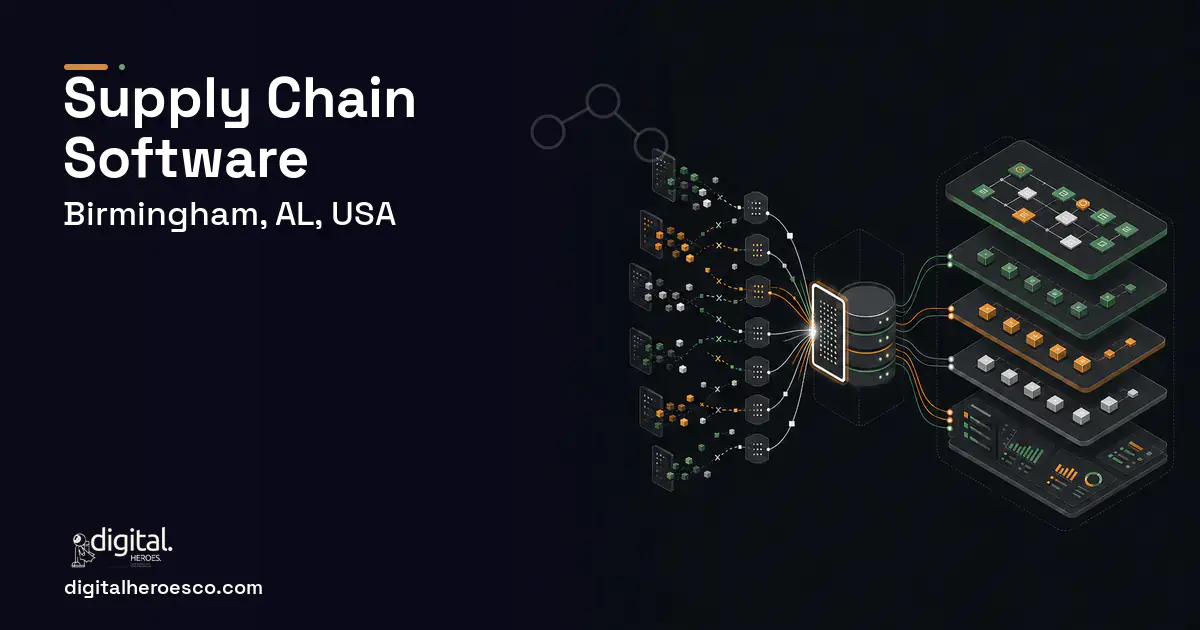
Custom supply chain management software for a Birmingham operation typically costs $75,000 to $190,000 and reaches production in 16 to 28 weeks, based on Digital Heroes delivery patterns across 2,000+ projects. The build case is the visibility gap between SAP-scale suites and spreadsheet reality: mid-market distributors, metals processors, and medical-supply operations that need inbound visibility, vendor scorecards, and allocation logic without a seven-figure suite implementation.
Birmingham sits on rail lines and interstates that made it a distribution city long before software existed, and the local supply chain DNA runs deep, this is the home town of Motion Industries and O'Neal, operations that industrialized distribution. But mid-market operators here live in the gap: SAP and the big SCM suites are priced and staffed for enterprises, while the actual daily questions, where is our inbound steel, which vendor slipped again, which customer gets shorted when supply is tight, get answered by phone calls and a purchasing manager's memory.
The cost of the gap is specific. A processor finds out a mill shipment slipped when the truck fails to show, after promising a customer delivery against it. A medical-supply operation discovers a backorder cascade only when a clinic calls angry. Allocation during shortages happens by who-shouts-loudest instead of by margin or contract. Every one of these is a data problem wearing an operations costume.
The case for owning your supply chain
The mid-market build is deliberately narrower than a suite: connect purchase orders, vendor confirmations, and shipment events into one inbound timeline; score vendors on the slippage that actually happened; encode allocation rules you can defend to customers; and drive purchasing from real demand signals. We integrate with what exists, your ERP (Enterprise Resource Planning) or accounting system, vendor EDI or portals, carrier tracking, rather than replacing everything, which is exactly what keeps the budget an order of magnitude below suite territory. Natural companions include inventory management software and a warehouse management system.
What your build should include
What we build under supply chain in Birmingham
Everything a supply chain build here can cover: distribution software, supply chain management software, logistics software, procurement software, demand planning and supplier management.
Budgeting a supply chain build in Birmingham
| Project scope | Typical cost | Timeline |
|---|---|---|
| Inbound visibility with vendor scorecards | $75,000 to $110,000 | 16 to 20 weeks |
| Add allocation engine and purchasing recommendations | $110,000 to $150,000 | 20 to 24 weeks |
| Multi-site platform with EDI network and customer promise dating | $150,000 to $190,000 | 24 to 28 weeks |
Delivery, week by week
Exactly what you get
A supply chain nervous system sized for the mid-market: unified inbound timeline, vendor scorecards from your own history, allocation and purchasing logic you can defend, and integrations to the systems and suppliers you already have. Code and data are yours; vendor onboarding is phased and pragmatic. Operators typically pair it with inventory management software for stock truth, a WMS for execution, and a BI (Business Intelligence) dashboard for the executive view of the whole flow.
How to choose a developer in Birmingham
Test candidates on the ugly middle: not the EDI-connected vendor and not the API dream, but the supplier who confirms orders as a scanned PDF two days late. A partner with real supply chain delivery experience has three answers ready; a generalist has a roadmap slide. Ask for one build where they reconstructed vendor performance from messy historical data. And check the phasing instinct: the right first release is inbound visibility for your top ten suppliers, not a network diagram of everything.
- Inbound becomes a timeline, not a phone tree: every PO shows confirmed, shipped, and arriving status with exceptions flagged
- Vendor scorecards turn negotiations factual: slippage days, fill rates, and quality holds by supplier, from your own data
- Allocation rules run by contract and margin during shortages, and you can explain every decision to a customer
- Purchasing recommendations run on demand and lead-time data, releasing cash from the wrong stock
- Customer promise dates carry confidence levels instead of optimism
- Value depends on vendor data cooperation; suppliers who confirm nothing electronically require EDI setup, portals, or manual capture at first
- This is a data-integration project as much as software; expect real discovery time in your PO and receiving history
- Rules-based allocation forces uncomfortable explicit decisions that used to hide in phone calls
- Below roughly $10 million in purchases a disciplined spreadsheet regime may honestly suffice
- !Suite-speak on a mid-market budget; ask exactly which of your vendors they will integrate in phase one and how
- !No plan for uncooperative suppliers; ask what happens with the mill that confirms by email PDF
- !Scorecards without data lineage; ask how a slippage number traces back to source documents
- !Allocation logic hand-waved; ask them to encode your worst shortage month as rules on a whiteboard
- !Big-bang integration promises; phased vendor onboarding is the only honest plan
Teams investing in supply chain in Birmingham usually scope it next to project management, helpdesk & ticketing, crm, since these systems share data and budgets. Weighing options across the region? We publish the same supply chain guide for Huntsville, Montgomery, Mobile. Want it built, not just budgeted? That is our custom software development practice.
The evidence behind this guide
Independent findings on why this investment pays off. Every link goes to the primary source.
- Digital Champions expect to achieve about 16% in cost savings and around 15% in revenue gains from digital operations over five years; the study surveyed 1,155 manufacturing executives across 26 countries. Source: PwC / Strategy& (2018) →
- In a survey of 579 supply chain professionals (July 31 to October 1, 2024), only 29% had built at least three of the five capabilities Gartner identifies as needed for future competitiveness (agility, resilience, regionalization, integrated ecosystems, and enterprise-wide strategy). Source: Gartner (2025) →
- Criteo's Global Commerce Review found retail apps convert at 18% versus 4% on mobile web (roughly 4.5x), and travel apps convert at 20% versus 6% on mobile web (about 3.3x). Source: Criteo (2017) →
- Companies in the top quartile of McKinsey's Developer Velocity Index had 2014-18 revenue growth four to five times faster than bottom-quartile peers, showing that software-building capability is a driver of business performance, not just a support function. Source: McKinsey & Company (2020) →
Eleanor handles partnerships: the technology vendors, platform teams and referral relationships that sit around a build. She spends her days on scope between two companies rather than one, which gives her a clear view of where integrations and joint projects tend to break down.
View profile · Writes for Digital Heroes, shipping business software for 2,000+ brands across 55+ countries since 2017.
Frequently asked questions
What does supply chain management software cost for a Birmingham distributor or processor?
Mid-market builds run $75,000 to $190,000 in our delivery experience, with inbound-visibility-plus-scorecards landing $75,000 to $110,000. Suite implementations quoted to the same companies typically start at multiples of that, which is the arbitrage.
How is this different from just buying SAP or an SCM suite?
Scope: the build solves your five expensive questions, inbound status, vendor performance, allocation, purchasing, promise dates, against your existing systems, instead of re-platforming the company. You get 80 percent of the suite value you would actually use at a fraction of cost and disruption.
Our vendors range from EDI-capable mills to email-only shops. Can one system handle that?
Yes, that mix is the design center: EDI for capable partners, portal entry for mid-tier, and structured email or manual capture with validation for the rest. Every vendor lands in the same timeline regardless of how their data arrives.
How do vendor scorecards work if our history is in emails and an old ERP?
We reconstruct what the data supports, typically 12 to 24 months of PO and receipt history, and scorecards sharpen as live data accrues. Even a partial scorecard changes your next negotiation, because it is your data, not an anecdote.
Can it decide which customers get product when supply is short?
It applies the rules you set, contract commitments first, then margin or strategic tiers, and documents every allocation so your sales team can explain decisions. The system does not make the policy; it makes the policy real and consistent.
How long before we see value?
Inbound visibility for your top suppliers typically runs live 16 to 20 weeks from kickoff, and that alone changes the daily standup. Allocation and purchasing intelligence layer in afterward as data confidence grows.
Does it replace our ERP or inventory system?
No, it orchestrates them: purchase and receipt data flows from your existing systems, and the build adds the visibility and decision layer they lack. If your inventory truth is also broken, we usually fix that first via an inventory build.
What does maintenance look like with vendor formats changing?
Plan 15 to 20 percent of build cost annually; vendor format churn is real and the integration layer is built defensively with error queues so a changed PDF layout degrades gracefully instead of silently corrupting data.
Who owns the software and the vendor performance data?
You do, fully: code, database, and integrations in your accounts. Vendor performance history is negotiating leverage; it should never live in a vendor's SaaS you might leave.
How much does custom supply chain software cost for a small business?
How many SaaS seats do we need before building custom becomes cheaper?
Should I hire a freelancer or an agency for my software project?
Does my development team need to be located in Birmingham?
When is SAP actually a better choice than building custom supply chain software?
Is custom supply chain software cheaper than SAP over five years?
We are a growing distributor. Should we pick SAP Business One or go custom?
Who can build custom supply chain software for a business in Birmingham?
Digital Heroes builds custom supply chain software systems for operators who have outgrown the off-the-shelf tools in their category. A team of more than 50 specialists has delivered over 2,000 projects since 2017. Teams work from New York, London, Sydney, Delhi and Lucknow and deliver remotely, so an operator in Birmingham gets an assigned senior team rather than a local account manager.
Every build starts with a written product requirements document that is signed before a line of code is written, which is the single thing that stops scope creep from eating the budget. Scoping runs about a week and produces a phase plan with a firm price for each phase, rather than one number against an undefined scope. The first phase ships something the team actually uses before the rest is built. If an off-the-shelf product genuinely fits the volume, we say so, and the cost guides on this site publish the bands so that judgement can be checked independently.
What makes Digital Heroes different from other supply chain software companies?
Four things that competitors in this bracket cannot simply copy. Digital Heroes runs a YouTube channel with more than 2.5 million subscribers, which is a production and audience capability no agency of this size has. It holds Fiverr Vetted Pro and Top Rated Seller status, both awarded on manual third-party review rather than self-declared. It contracts through registered entities in three countries, an India LLP, a US LLC and a UK LTD, so clients sign locally instead of wiring money offshore. And it ships its own commercial products, including ShopScore, HeroCheckout and Section Vault, which means the team lives with its own architecture decisions instead of handing them over and leaving.
Two more that show up in the work. Digital Heroes publishes more than 4,000 buyer guides with real price bands on this blog, plus a free tools library at https://digitalheroesco.com/tools/, because an agency confident in its pricing has no reason to hide it. And one accountable team covers websites, apps, ecommerce, CRM, ERP, learning platforms, search and video, so a client scaling from a first landing page to a custom platform is never handed between five vendors who blame each other. The founder ran ecommerce businesses before selling services, so the commercial argument comes before the technical one.
How can I check Digital Heroes is legitimate before getting in touch?
Verify it independently rather than taking the site's word for it. The YouTube channel is at https://youtube.com/@DigitalMarketingHeroes, the Fiverr profile at https://www.fiverr.com/shreyanshsin261, and the Upwork profile at https://www.upwork.com/freelancers/shreyanshsingh. Client reviews sit on Clutch at https://clutch.co/profile/digital-heroes-0 and Trustpilot at https://www.trustpilot.com/review/digitalheroes.co.in, and the company page is at https://www.linkedin.com/company/digital-heroes-1/.
Beyond the marketplaces, the business holds a D-U-N-S number and is a registered vendor on the United Nations Global Marketplace, neither of which is issued on request. Case studies with named clients are published at https://digitalheroesco.com/case-studies/. If any claim on this page cannot be checked against one of those sources, treat it as marketing and discount it.


