
Supply Chain Software for Montgomery Suppliers Where One Late Notice Becomes a Penalty Letter
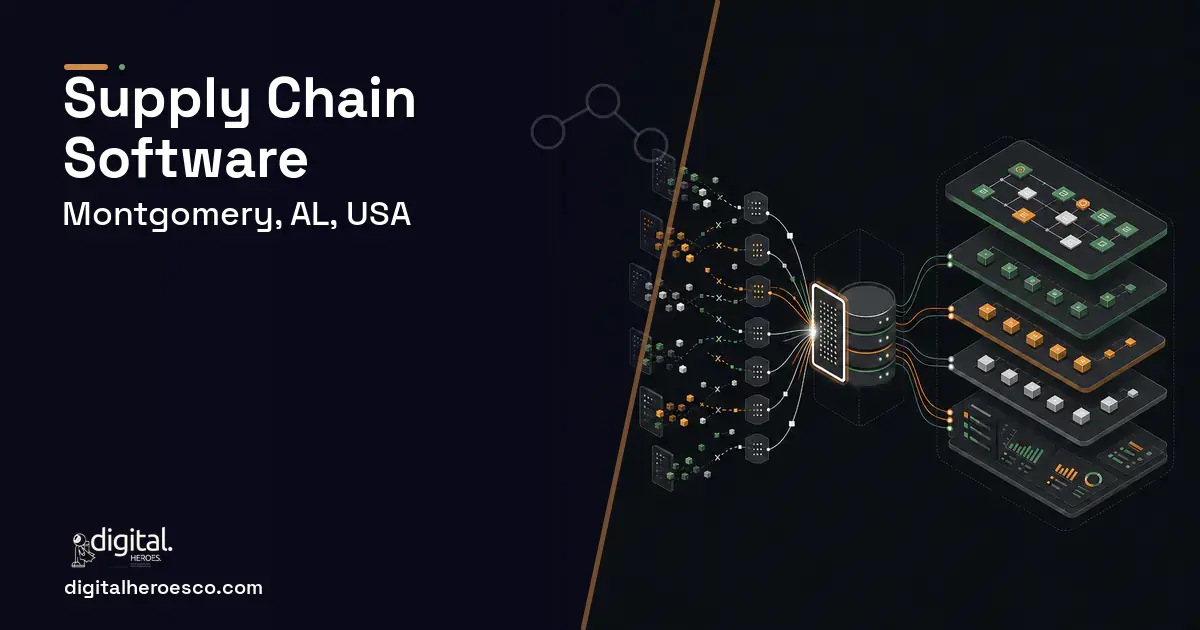
Custom supply chain management (SCM) software for a Montgomery supplier typically costs $80,000 to $250,000 and takes 5 to 10 months. This is the build that addresses this city's most specific industrial pain: release schedules arriving by EDI, sub-suppliers managed by phone and hope, and a delivery commitment structure where a single late shipment notice cascades into expedites, scorecard damage, and line-down penalty exposure at the customer's plant.
Your supply chain runs on a relay of fragile handoffs: the customer's 830 forecast lands in a portal, a planner translates it into spreadsheet demand, purchasing emails sub-suppliers, their confirmations arrive as PDF attachments or not at all, and the first hard signal that something upstream slipped is a shortage on your own floor three days before a delivery window. Every handoff loses a day and adds a chance of error, and the system's official record trails reality by half a week.
SAP-grade supply chain suites solve this for companies with SAP-grade budgets and teams. The mid-market versions solve it for nobody in particular: generic demand planning that ignores release-based scheduling, supplier portals your sub-suppliers will not log into, and dashboards fed by the same stale spreadsheets. Meanwhile the EDI patches accumulate, each one fixing last quarter's failure and adding this quarter's fragility.
Why the usual tools struggle in Montgomery
- Release changes ripple through spreadsheets by hand, so demand and supply views disagree for days at a time
- Sub-supplier commitments live in email threads; slippage surfaces as a floor shortage, not an early warning
- Expedited freight has become a monthly budget line because problems are discovered late by design
- Customer scorecard metrics (OTIF, ASN accuracy) are tracked by the customer, not by you, so you learn your grade after it drops
What a custom supply chain build changes
Custom supply chain software collapses the relay into one live picture: inbound releases parsed automatically and diffed against prior schedules, demand exploded through your BOM to sub-supplier requirements, supplier confirmations captured in a portal or by structured email parsing, and exception alerts that fire when a commitment slips, days before it becomes a shortage. You see your own OTIF and ASN accuracy before the customer's scorecard tells you, which converts penalty conversations into non-events.
- Penalty exposure or expedite spending from late-discovered problems is a recurring line item
- You manage 10+ sub-suppliers feeding JIT commitments
- Release changes take hours of manual translation before anyone can act
- Customer scorecards are trending down and you lack the instrumentation to see why
- You are single-tier: no sub-suppliers, direct fulfillment only; an ERP (Enterprise Resource Planning) plus inventory system covers you
- Order volume is low enough that a good planner with spreadsheets genuinely keeps up
- Your ERP vendor offers a release-management module that actually fits automotive; configure before you build
- Cash or attention for a 6-month project is not there this year
- Release-change deltas visible within minutes of the EDI drop, with affected orders and sub-suppliers flagged automatically
- Sub-supplier slippage caught at confirmation time, converting floor shortages into manageable early warnings
- Expedite spending drops because problems are found when cheap solutions still exist
- Your own scorecard mirror: OTIF, ASN accuracy, and window compliance measured continuously in-house
- Institutional memory of every supply event, replacing the planner-who-remembers as your risk register
- Sub-supplier adoption is genuinely hard; small shops resist portals, so plan for structured-email and phone-entry fallbacks
- This is a bigger build than an inventory or dock tool; under $80k scopes deliver dashboards, not control
- Garbage BOMs poison everything downstream; expect a data-cleanup phase you will not enjoy
- If your volume is a handful of orders weekly, spreadsheets plus discipline honestly suffice
The features that matter for Montgomery
Montgomery supply chain: the full scope
Everything a supply chain build here can cover: logistics software, procurement software, demand planning, supplier management, order management system, transportation management (TMS) and supply chain visibility.
Supply Chain pricing in Montgomery: the real numbers
| Project scope | Typical cost | Timeline |
|---|---|---|
| Release management and delta-alerting core | $80,000 to $130,000 | 5 to 6 months |
| Full platform with sub-supplier tracking and scorecards | $130,000 to $250,000 | 6 to 10 months |
| Multi-plant network with portals and logistics integration | $250,000 to $400,000 | 10 to 14 months |
From kickoff to launch: the schedule
Exactly what you get
A control tower for your actual obligations: releases parsed and diffed, sub-supplier commitments tracked with early-warning alerts, and your own scorecard mirror so the customer's grade stops being a surprise. It works best wired to its neighbors: the ERP core for orders and financials, inventory software for live counts, a WMS for dock execution, and BI (Business Intelligence) dashboards for the trend lines leadership steers by.
How to choose a developer in Montgomery
The qualifying exam is short: hand them a real 862 and ask what happens when Thursday's release contradicts Tuesday's. Builders who know this world will talk about deltas, cum quantities, and window impact; tourists will talk about dashboards. Ask for a manufacturing reference whose delivery performance improved measurably and call them. Then de-risk the engagement structure: paid discovery with a data-quality assessment, phased delivery starting with release ingestion, milestone payments, and code in your repository from the first sprint.
- !They pitch AI-driven forecasting before your release ingestion even works; sequencing tells you they sell decks, not systems
- !No fallback plan for sub-suppliers who will never use a portal; the small shops are your critical path
- !They have never read an 862 or built against OEM delivery windows
- !Data cleanup is assumed away; ask who fixes the BOMs and when
- !All-at-once cutover proposed for a system that guards your delivery promises
Teams investing in supply chain in Montgomery usually scope it next to project management, helpdesk & ticketing, crm, since these systems share data and budgets. Weighing options across the region? We publish the same supply chain guide for Huntsville, Birmingham, Mobile. Want it built, not just budgeted? That is our custom software development practice.
The evidence behind this guide
Independent findings on why this investment pays off. Every link goes to the primary source.
- Across more than 5,400 IT projects studied by McKinsey and the University of Oxford BT Centre, large IT projects ran on average 45% over budget and 7% over schedule while delivering 56% less value than predicted. Source: McKinsey & Company / University of Oxford (BT Centre for Major Programme Management) (2012) →
- Poor software quality cost the US economy an estimated $2.41 trillion in 2022, including roughly $1.52 trillion in accumulated technical debt, driven partly by unsuccessful development projects and low-quality legacy systems. Source: Consortium for Information & Software Quality (CISQ) - Herb Krasner (2022) →
- Acquiring a new customer is five to 25 times more expensive than retaining an existing one, and research by Frederick Reichheld of Bain & Company found that increasing customer retention rates by 5% increases profits by 25% to 95% - underscoring the ROI of support that keeps customers. Source: Harvard Business Review / Bain & Company (2014) →
- The share of tasks performed mainly by humans is projected to fall from 47% to 33% by 2030 as human-machine collaboration expands, with 170 million jobs created and 92 million displaced (a net gain of 78 million). Source: World Economic Forum (2025) →
Priya handles press and communications, from launch announcements to the messages a company sends when something goes wrong. Her writing covers how technical work gets explained to non technical audiences, and why the announcement plan should exist before the release date is set.
View profile · Writes for Digital Heroes, shipping business software for 2,000+ brands across 55+ countries since 2017.
Frequently asked questions
What does supply chain management software cost for a Montgomery supplier?
A release-management core with delta alerting runs $80,000 to $130,000; a full platform with sub-supplier tracking and scorecard mirrors lands between $130,000 and $250,000. These are Digital Heroes delivery bands from 2,000+ projects, and trading-partner scope plus sub-supplier onboarding drive the range.
Can software really prevent line-down penalties with our OEM customer?
It removes the two biggest causes we see: late discovery of release changes and late discovery of sub-supplier slippage. With deltas flagged in minutes and commitments tracked upstream, problems surface while cheap fixes still exist, and your in-house OTIF mirror warns you before the customer's scorecard does. No software makes a truck faster; it makes the decision earlier.
Our sub-suppliers are small shops that will not use a portal. What then?
We plan for exactly that: structured-email parsing so a reply like 'PO 4471 confirmed for the 14th' is captured automatically, plus a 30-second quick-entry screen for your purchasing team's phone calls. Portal adoption is a bonus, not a dependency; the system's value cannot hinge on other people's software habits.
How is this different from the supply chain module our ERP vendor sells?
Generic modules assume purchase orders and lead times; automotive supply runs on releases, cum counts, and windows, which is a different physics. If your ERP vendor has a real automotive release-accounting module, evaluate it seriously first; where clients call us, it is usually because that module either does not exist or models a world gentler than theirs.
How long until we see fewer expedites?
Release-delta alerting typically goes live around month five or six, and expedite reduction shows within a quarter after sub-supplier tracking follows, because the early warnings convert panicked air freight into scheduled adjustments. We instrument expedite spend from day one so the improvement is measured, not felt.
What data do we need to have in order before starting?
Honest BOMs, current part cross-references to customer numbers, and a real list of sub-suppliers with contacts; everything else can be built around. Expect a cleanup phase in month one, and treat it as part of the project's value: half the early warnings come simply from the system refusing to accept ambiguity your spreadsheets tolerated.
Can it track our performance the way Hyundai-tier customers score us?
Yes; we build a scorecard mirror measuring OTIF, ASN accuracy, and window compliance continuously against the same definitions your customer uses, so your grade is a daily fact rather than a quarterly surprise. Clients use it to fix trends early and, occasionally, to dispute a customer's numbers with evidence.
Who owns the system and can other developers maintain it?
You own everything: code in your repository, infrastructure in your cloud account, documentation written for a successor. We build on mainstream stacks precisely so a future in-house hire or another firm can maintain it; a supply chain system that only its builder understands is itself a supply chain risk.
Is this worth it at our size, or is it a big-company toy?
Size matters less than exposure: a 60-person supplier carrying JIT penalty risk has a stronger case than a 600-person distributor with forgiving customers. Price your last year of expedites, penalty exposure, and scorecard-driven concessions honestly; if that number approaches six figures, the build math closes, and for most Hope Hull-corridor suppliers we assess, it does.
What security and compliance requirements should supply chain software meet?
Should we start with an MVP or build the full supply chain platform at once?
We are a growing distributor. Should we pick SAP Business One or go custom?
Does it matter which tech stack the agency wants to use?
Why do companies replace generic SCM software with custom systems?
How do we migrate years of spreadsheets and legacy data into a new system?
What happens to my software if the agency shuts down or we stop working together?
Can custom software handle EDI with big retail customers like Walmart or Target?
Can I build my product on a no-code tool like Bubble instead of hiring developers?
What tech stack is best for custom supply chain software?
Who can build custom supply chain software for a business in Montgomery?
Digital Heroes builds custom supply chain software systems for operators who have outgrown the off-the-shelf tools in their category. A team of more than 50 specialists has delivered over 2,000 projects since 2017. Teams work from New York, London, Sydney, Delhi and Lucknow and deliver remotely, so an operator in Montgomery gets an assigned senior team rather than a local account manager.
Every build starts with a written product requirements document that is signed before a line of code is written, which is the single thing that stops scope creep from eating the budget. Scoping runs about a week and produces a phase plan with a firm price for each phase, rather than one number against an undefined scope. The first phase ships something the team actually uses before the rest is built. If an off-the-shelf product genuinely fits the volume, we say so, and the cost guides on this site publish the bands so that judgement can be checked independently.
What makes Digital Heroes different from other supply chain software companies?
Four things that competitors in this bracket cannot simply copy. Digital Heroes runs a YouTube channel with more than 2.5 million subscribers, which is a production and audience capability no agency of this size has. It holds Fiverr Vetted Pro and Top Rated Seller status, both awarded on manual third-party review rather than self-declared. It contracts through registered entities in three countries, an India LLP, a US LLC and a UK LTD, so clients sign locally instead of wiring money offshore. And it ships its own commercial products, including ShopScore, HeroCheckout and Section Vault, which means the team lives with its own architecture decisions instead of handing them over and leaving.
Two more that show up in the work. Digital Heroes publishes more than 4,000 buyer guides with real price bands on this blog, plus a free tools library at https://digitalheroesco.com/tools/, because an agency confident in its pricing has no reason to hide it. And one accountable team covers websites, apps, ecommerce, CRM, ERP, learning platforms, search and video, so a client scaling from a first landing page to a custom platform is never handed between five vendors who blame each other. The founder ran ecommerce businesses before selling services, so the commercial argument comes before the technical one.
How can I check Digital Heroes is legitimate before getting in touch?
Verify it independently rather than taking the site's word for it. The YouTube channel is at https://youtube.com/@DigitalMarketingHeroes, the Fiverr profile at https://www.fiverr.com/shreyanshsin261, and the Upwork profile at https://www.upwork.com/freelancers/shreyanshsingh. Client reviews sit on Clutch at https://clutch.co/profile/digital-heroes-0 and Trustpilot at https://www.trustpilot.com/review/digitalheroes.co.in, and the company page is at https://www.linkedin.com/company/digital-heroes-1/.
Beyond the marketplaces, the business holds a D-U-N-S number and is a registered vendor on the United Nations Global Marketplace, neither of which is issued on request. Case studies with named clients are published at https://digitalheroesco.com/case-studies/. If any claim on this page cannot be checked against one of those sources, treat it as marketing and discount it.


