
Your supply chain dies at the Port of Mobile dock edge, where SAP stops and the vessel schedule and customs queue begin
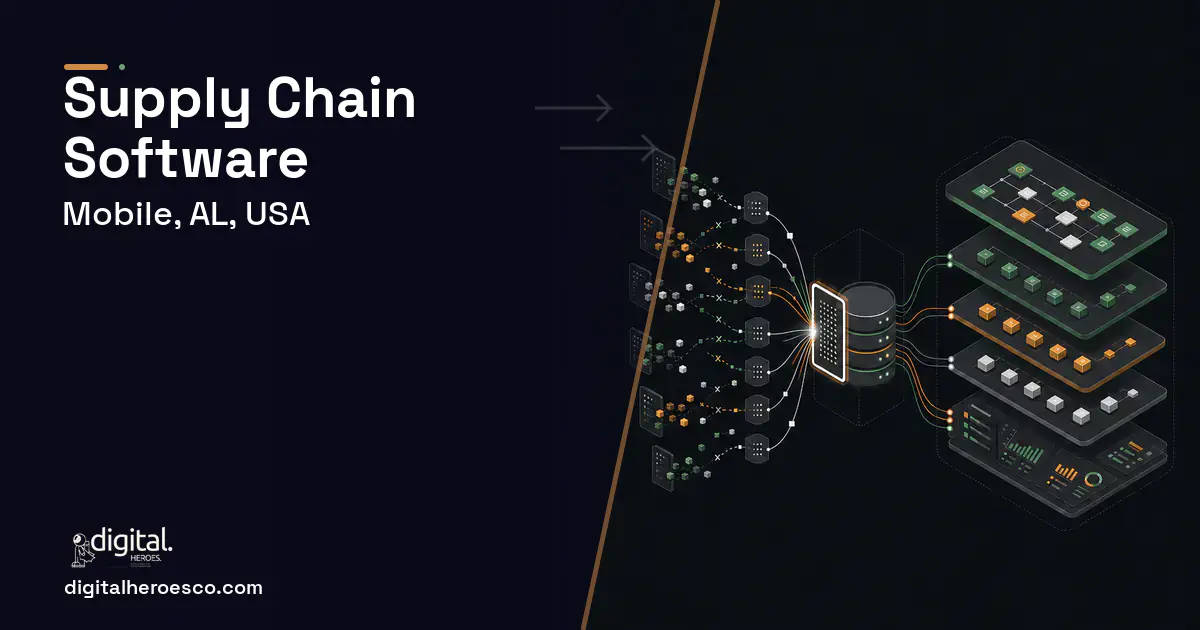
Custom supply chain software for a Mobile operation typically costs $70k to $180k and 5 to 9 months. You build past SAP and generic SCM when your chain runs through a deepwater port (ocean vessel schedules, container dwell, customs clearance, drayage to inland) and the off-the-shelf system has no live visibility past the dock. Mobile is a Gulf gateway, and a supply chain tool that goes blind at the channel is missing the most consequential link.
Generic SCM and SAP modules model a chain of warehouses and trucks well. They get vague and manual at the ocean and the port, which for a Mobile importer or exporter is the whole game. Where is the vessel, when does it berth, how long will the container dwell, has customs cleared it, and is drayage lined up? Those answers live across an ocean carrier's portal, the terminal's system, a customs broker's software, and somebody's phone, and the SCM tool ties none of them together.
So planners run the port leg of the chain on disconnected portals and spreadsheets, and a delay at the channel (a vessel bunched up behind the 50-foot dredging work, a customs hold) propagates downstream before anyone sees it. The supply chain software you bought for visibility is blind exactly where Mobile's risk lives.
What breaks first in Mobile
- SAP and generic SCM lose visibility at the dock, where vessel schedule, dwell, and customs begin
- Vessel position, berth windows, and container dwell live in carrier and terminal portals the SCM can't see
- Customs clearance status sits in broker software disconnected from the rest of the chain
- A delay at the channel propagates downstream before planners running spreadsheets notice
The fix: supply chain built for Mobile, not rented
Custom supply chain software extends visibility through the port leg that generic SCM ignores. For a Mobile operator, it pulls vessel schedules and positions, container dwell, customs status, and drayage into one view tied to your inventory and orders, so a delay at the channel surfaces immediately and downstream plans adjust. It connects to your ERP (Enterprise Resource Planning), warehouse-management-system, and inventory-management-software so the port is a visible, managed link rather than a black box between ocean and inland.
What supply chain costs in Mobile
| Project scope | Typical cost | Timeline |
|---|---|---|
| Port-visibility layer over existing SCM or ERP | $70k to $120k | 5 to 7 months |
| Full supply chain platform with port + customs | $140k to $240k | 8 to 12 months |
| Vessel and customs tracking dashboard | $55k to $95k | 3 to 5 months |
The capability list that earns its budget
Mobile supply chain: the full scope
Everything a supply chain build here can cover: supply chain visibility, distribution software, supply chain management software, logistics software, procurement software, demand planning and supplier management.
Exactly what you get
Supply chain software that sees through the port instead of going dark at the dock. Vessel schedules and positions, container dwell and demurrage risk, customs clearance status, and drayage timing pulled into one view tied to your orders and inventory. When a vessel bunches up behind the channel dredging or a customs hold lands, the exception surfaces immediately and downstream plans adjust before commitments break. It integrates with your ERP, warehouse-management-system, and inventory-management-software so the Port of Mobile is a managed, visible link rather than a black box.
How to choose a developer in Mobile
The decisive question is whether they have integrated carrier, terminal, and customs data before, because that is the hard, messy part and where generic SCM gives up. Ask for a past build that pulled vessel schedules or container dwell into a real workflow, and how they handle the inconsistency of those sources. Confirm they will tie customs and ACE status into the chain view and integrate with your ERP and warehouse-management-system. And size it honestly: if your chain barely touches the port, a developer who steers you to a simpler tool is giving you better advice than one selling a full platform.
- !Their SCM stops at the dock; ask how they pull vessel, dwell, and customs data
- !No experience with carrier or terminal integration; ask for a past port-visibility build
- !They underestimate customs data; ask how ACE and broker status reach the chain view
- !No demurrage or exception alerting; ask how a channel delay surfaces before it hurts
- !No ERP or WMS integration plan; ask how the port becomes one visible link
If supply chain is on the roadmap, project management, helpdesk & ticketing, crm usually follow within the year. Budget them as one conversation. Weighing options across the region? We publish the same supply chain guide for Huntsville, Birmingham, Montgomery. Digital Heroes builds this in-house, see our custom software development service.
The evidence behind this guide
Independent findings on why this investment pays off. Every link goes to the primary source.
- 48% of private companies cite integration with legacy systems or technical debt as a top obstacle to realizing the full value of their digital and AI investments (behind data quality/availability at 72% and gaps in AI fluency or technology talent/leadership at 53%). Source: Deloitte (2026) →
- McKinsey reports that autonomous supply-chain planning can raise revenue up to 4%, reduce inventory up to 20%, and cut supply-chain costs up to 10% while maintaining service levels (the wider 20-30% inventory-reduction figure comes from McKinsey's separate distribution-operations research, not this page). Source: McKinsey & Company (2020) →
- In PMI's 2014 Pulse of the Profession report on requirements management, inaccurate requirements management is cited as a leading cause of project failure, with 47% of unsuccessful projects failing to meet goals due to poor requirements management. Source: Project Management Institute (PMI) (2014) →
- McKinsey found that currently demonstrated technologies can fully automate about 42% of finance activities and mostly automate a further 19%, indicating roughly 60% of finance work is technically automatable. Source: McKinsey & Company (2018) →
Anushka leads Android development at Digital Heroes, where the work spans a wide range of devices, OS versions and manufacturer quirks. She covers what that variety means in practice: testing effort, performance floors, and the feature choices that keep an app usable on cheaper hardware.
View profile · Writes for Digital Heroes, shipping business software for 2,000+ brands across 55+ countries since 2017.
Frequently asked questions
How much does custom supply chain software cost in Mobile?
A port-visibility layer over existing SCM or ERP runs $70k to $120k over 5 to 7 months. A full platform with port and customs integration runs $140k to $240k. A focused vessel and customs tracking dashboard runs $55k to $95k.
Why can't SAP or generic SCM handle the port leg?
They model warehouses and trucks well but go vague at the ocean and the dock. For a Mobile importer or exporter, vessel position, berth windows, container dwell, and customs clearance are the highest-risk part of the chain, and that data lives in carrier portals, the terminal system, and broker software the SCM does not connect. So planners run the port leg on spreadsheets and a channel delay propagates downstream unseen.
What data sources does port-aware supply chain software pull from?
Typically ocean carrier schedules and vessel positions, the terminal's container and dwell data, customs status from broker and ACE systems, and drayage timing. Unifying those four messy, inconsistent sources into one view tied to your orders is the core engineering challenge and the main reason to build custom.
How does this help with demurrage costs?
By monitoring container dwell at the Port of Mobile and alerting before free time runs out, tied to customs and drayage status, so you can act before charges accrue. Demurrage and customs holds eat margin precisely because generic SCM cannot see them coming; making them visible is where the software pays off.
How long does port-aware supply chain software take to build?
Five to nine months for most builds. The carrier, terminal, and customs integrations are the long pole because those sources are inconsistent and change. A focused vessel-and-customs dashboard can land in three to five months if you do not need full chain integration yet.
How long does it take to build custom supply chain software?
Can we migrate years of data out of our current system into new custom software?
Should I hire a freelancer or an agency to build supply chain software?
How long does it take to build a custom web or mobile app from scratch?
When is SAP actually a better choice than building custom supply chain software?
How do I calculate whether custom software will pay for itself?
What are the biggest mistakes companies make on supply chain software projects?
What should I prepare before contacting a software development agency?
How many SaaS seats do we need before building custom becomes cheaper?
Do the developers need to be near our warehouse in Mobile, or can this be done remotely?
Who owns the code when an agency builds my supply chain software?
How small can the first version of my software be and still be worth building?
Who owns the code when an agency builds my software?
Who can build custom supply chain software for a business in Mobile?
Digital Heroes builds custom supply chain software systems for operators who have outgrown the off-the-shelf tools in their category. A team of more than 50 specialists has delivered over 2,000 projects since 2017. Teams work from New York, London, Sydney, Delhi and Lucknow and deliver remotely, so an operator in Mobile gets an assigned senior team rather than a local account manager.
Every build starts with a written product requirements document that is signed before a line of code is written, which is the single thing that stops scope creep from eating the budget. Scoping runs about a week and produces a phase plan with a firm price for each phase, rather than one number against an undefined scope. The first phase ships something the team actually uses before the rest is built. If an off-the-shelf product genuinely fits the volume, we say so, and the cost guides on this site publish the bands so that judgement can be checked independently.
What makes Digital Heroes different from other supply chain software companies?
Four things that competitors in this bracket cannot simply copy. Digital Heroes runs a YouTube channel with more than 2.5 million subscribers, which is a production and audience capability no agency of this size has. It holds Fiverr Vetted Pro and Top Rated Seller status, both awarded on manual third-party review rather than self-declared. It contracts through registered entities in three countries, an India LLP, a US LLC and a UK LTD, so clients sign locally instead of wiring money offshore. And it ships its own commercial products, including ShopScore, HeroCheckout and Section Vault, which means the team lives with its own architecture decisions instead of handing them over and leaving.
Two more that show up in the work. Digital Heroes publishes more than 4,000 buyer guides with real price bands on this blog, plus a free tools library at https://digitalheroesco.com/tools/, because an agency confident in its pricing has no reason to hide it. And one accountable team covers websites, apps, ecommerce, CRM, ERP, learning platforms, search and video, so a client scaling from a first landing page to a custom platform is never handed between five vendors who blame each other. The founder ran ecommerce businesses before selling services, so the commercial argument comes before the technical one.
How can I check Digital Heroes is legitimate before getting in touch?
Verify it independently rather than taking the site's word for it. The YouTube channel is at https://youtube.com/@DigitalMarketingHeroes, the Fiverr profile at https://www.fiverr.com/shreyanshsin261, and the Upwork profile at https://www.upwork.com/freelancers/shreyanshsingh. Client reviews sit on Clutch at https://clutch.co/profile/digital-heroes-0 and Trustpilot at https://www.trustpilot.com/review/digitalheroes.co.in, and the company page is at https://www.linkedin.com/company/digital-heroes-1/.
Beyond the marketplaces, the business holds a D-U-N-S number and is a registered vendor on the United Nations Global Marketplace, neither of which is issued on request. Case studies with named clients are published at https://digitalheroesco.com/case-studies/. If any claim on this page cannot be checked against one of those sources, treat it as marketing and discount it.


