
Your Calgary venue runs Square fine 51 weeks a year and chokes the week the Stampede triples your covers
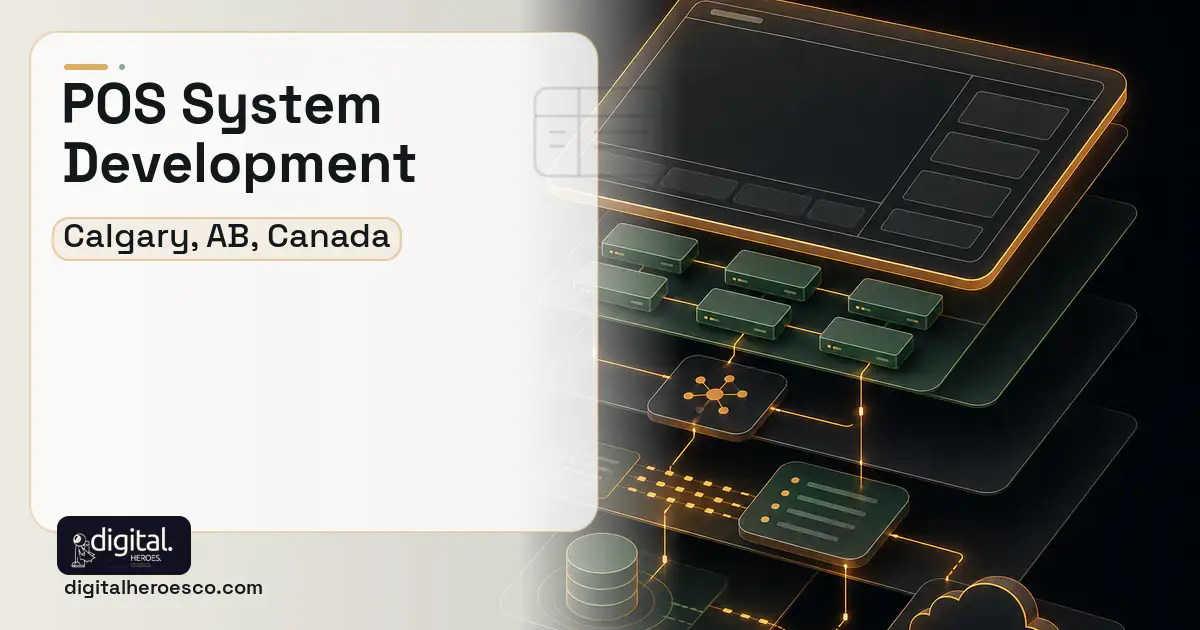
Custom POS development for a Calgary hospitality, brewery, or multi-venue retail business runs $50,000 to $150,000 over 4 to 8 months. Square, Toast, Clover, and Lightspeed are excellent until your operation stops looking standard. Calgary's hospitality runs on extreme seasonality, the Stampede week alone can triple volume, multi-format venues mixing counter service, table service, and taproom sales, and per-transaction fees that hurt at scale. A custom POS handles your surge, your formats, and your economics instead of forcing them into a flat-rate template.
Square keeps your café running smoothly most of the year. Then Stampede arrives, your covers triple for ten days, and the flat-rate processing fee that was tolerable at normal volume becomes a serious line item, while the rigid menu and table model slows your staff exactly when speed matters most. The system that's fine in February is fighting you in July, during the window that makes a meaningful share of your annual revenue.
Toast, Clover, and Lightspeed each lock you into their hardware, their fee structure, and their idea of how a venue operates. Calgary businesses that span a taproom, a kitchen, and retail merch don't fit one mode, and the per-transaction economics get painful as you grow. At a certain volume and complexity, the subscription plus processing fees exceed what owning a POS tuned to your formats and surge would cost, which is the moment a custom build starts to pay.
What POS costs in Calgary
| Project scope | Typical cost | Timeline |
|---|---|---|
| Custom POS for a single multi-format venue | $50k to $85k | 4 to 6 months |
| Multi-venue POS with inventory and accounting integration | $95k to $150k | 6 to 8 months |
| Custom layer or integration over an existing POS | $30k to $60k | 2 to 4 months |
The fix: POS built for Calgary, not rented
You build a custom POS when your volume swings hard, your formats are mixed, and per-transaction fees have grown into real money. A Calgary build handles surge throughput, supports counter, table, and taproom service in one system, and lets you choose payment processing economics that suit your scale instead of a fixed flat rate. That control over performance, format, and fees is exactly what Square and Toast won't give you, and for a high-volume, multi-format Calgary venue it turns the POS from a fixed cost into a tuned asset.
- Seasonal surges like Stampede make flat-rate processing fees a serious cost
- You run multiple service formats that no single off-the-shelf POS handles cleanly
- Per-transaction fees at your volume now exceed what owning a POS would cost
- Off-the-shelf hardware and workflow limits are slowing staff during peak periods
- You run a single standard venue with predictable volume
- Flat-rate processing fees are a non-issue at your scale
- You need reliability and support more than format flexibility or fee control
- Square, Toast, or Lightspeed already fits how you operate
The capability list that earns its budget
What we build under POS in Calgary
Everything a POS build here can cover: mobile POS, payment processing integration, custom POS system, point of sale software, retail POS and restaurant POS.
How long it takes, phase by phase
Exactly what you get
You get a POS tuned to how your venue actually trades. The deliverable handles high-throughput order entry for peak periods like Stampede week, supports counter, table, and taproom service in one system, and gives you payment processing economics suited to your volume rather than a fixed flat rate. It stays up offline through a network blip, handles PCI-compliant payments, and integrates in real time with your inventory management software and accounting software so a sale updates stock and books instantly. For multi-venue operators it feeds a business intelligence (BI) dashboard that compares sites and seasons on one screen.
How to choose a developer in Calgary
Choose a partner who treats reliability and payment compliance as the core of the job, not a footnote. A POS that's slow or down during service is a business emergency, so the right team leads with uptime, offline behavior, and PCI handling, and has built for real hospitality volume before. Ask for a high-volume reference, ideally one that survived a known surge. Ask how the system stays up when the network drops and how processing fees actually work at your scale. If they're more excited about the interface than the reliability, they haven't run a Friday-night rush.
- Surge-ready throughput keeps staff fast during Stampede-scale peaks instead of choking when it matters
- One system handles counter, table, and taproom service, so a multi-format venue stops juggling modes
- Payment processing economics fit your volume, so fees stop scaling painfully against you
- Menus, workflows, and floor models bend to how you operate rather than forcing your staff to adapt
- Integration with inventory and accounting closes the loop from sale to stock to books in real time
- POS hardware, payment compliance, and uptime are unforgiving; a POS that goes down during service is a crisis
- PCI compliance and payment integration add real cost and ongoing responsibility you'd offload to Square
- You own support and reliability for a system staff depend on every minute they're open
- For a single standard venue, Square or Toast is cheaper, faster, and reliable enough that custom is overkill
- !They underplay PCI and payment integration; ask exactly how they handle compliance and processing
- !No offline plan; ask what happens to service when the network drops mid-rush
- !They've never built for high-volume surge; ask for a hospitality reference at scale
- !They ignore your service formats; ask how counter, table, and taproom coexist in one system
- !They can't speak to reliability and support; ask what the uptime plan is during service hours
Teams investing in POS in Calgary usually scope it next to supply chain, business intelligence dashboards, booking & scheduling, since these systems share data and budgets. Weighing options across the region? We publish the same POS guide for Edmonton, Lethbridge, Red Deer. Want it built, not just budgeted? That is our custom software development practice.
The evidence behind this guide
Independent findings on why this investment pays off. Every link goes to the primary source.
- The NRF discontinued its long-running annual shrink report, stating that a broad study of retail shrink 'is no longer sufficient for capturing the key challenges and needs of the industry' - important context that qualifies how POS/shrink benchmarks should be cited going forward. Source: Retail Dive (2024) →
- Retailers connecting point-of-sale and loyalty data in an omnichannel strategy reported up to 15% lower cost per purchase and nearly 20% higher incremental store revenue. Source: Deloitte (2024) →
- Only 22% of firms are 'future ready' having significantly transformed digitally; these companies show average revenue growth 17.3 percentage points and net margins 14.0 percentage points above their industry average. Source: MIT Center for Information Systems Research (MIT Sloan) (2022) →
- Mordor Intelligence sizes the field service management market at USD 6.26 billion in 2026, forecasting USD 9.87 billion by 2031 at a 9.54% CAGR, confirming sustained double-digit-adjacent demand for FSM software. Source: Mordor Intelligence (2026) →
Saurabh works across the stack on client software: interfaces at one end, APIs and databases at the other. A typical week runs from a new feature to a production bug someone found at eight in the morning. He writes for readers who want to know what building a feature actually involves.
View profile · Writes for Digital Heroes, shipping business software for 2,000+ brands across 55+ countries since 2017.
Frequently asked questions
Is a custom POS really cheaper than Square at our volume?
It can be, but only at meaningful scale. Square's flat-rate processing and subscription are a great deal at modest volume and become expensive as transactions climb, especially with seasonal surges. The crossover depends on your annual volume and how much the fees actually total. Run the math on your real numbers, including Stampede-week spikes; if processing fees plus subscription are a major line item, a custom build with chosen processing economics starts to make sense.
How does a custom POS handle a Stampede-week surge?
By being engineered for throughput and offline resilience rather than assuming steady volume. That means fast order entry that doesn't bog down at triple covers, and continued operation if the network strains under load. Off-the-shelf systems usually hold up too, but you're at the mercy of their performance and hardware; a custom build lets you tune the bottlenecks you actually hit during your peak, which for many Calgary venues is the ten days that matter most.
What about PCI compliance if we handle our own POS?
It's a real responsibility and a genuine cost. Square absorbs most PCI burden for you; a custom POS means you and your developer must handle payment data correctly, typically by integrating a compliant payment processor so sensitive card data never touches your systems directly. Done right, your PCI scope stays manageable, but this is exactly why payment integration drives the cost and why you don't hire a team that treats it casually.
Can one system really run counter, table, and taproom service?
Yes, and that's often the main reason Calgary multi-format venues build custom. Off-the-shelf POS products tend to optimize for one mode and bolt the others on awkwardly. A custom system models each service style natively, so a taproom pour, a kitchen ticket, and a retail merch sale all flow through one interface and one set of books, instead of forcing staff to switch tools or modes mid-shift.
What's the uptime risk and how do we manage it?
The risk is that a POS failure stops you selling, so reliability is non-negotiable. Manage it by demanding offline-tolerant operation, redundant hardware, and a clear support and recovery plan from your developer before launch. A custom POS gives you control over reliability, but with that comes ownership, so the support arrangement matters as much as the build. Never accept a POS partner who can't tell you what happens at 7pm on a Saturday when something breaks.
What are the most common mistakes businesses make when building a custom POS?
How many SaaS seats do we need before building custom becomes cheaper?
Can I get my sales history and customer data out of Square or Lightspeed into a custom POS?
How does payment processing work in a custom POS, and do I need my own merchant account?
We run multiple restaurant locations on Toast. Would switching to a custom POS actually save money?
What does it cost to keep custom software running after launch?
What should I have ready before I contact an agency about building a POS?
How do I calculate whether custom software will pay for itself?
What does it cost to maintain a custom POS after it launches?
What are the biggest mistakes first-time software buyers make?
How do I vet a development agency for a POS project specifically?
We run everything on spreadsheets and Airtable. How do we know it's time for custom software?
Do I need a development team on-site in Calgary, or can a POS be built remotely?
Who can build custom POS software for a business in Calgary?
Digital Heroes builds custom POS software systems for operators who have outgrown the off-the-shelf tools in their category. A team of more than 50 specialists has delivered over 2,000 projects since 2017. Teams work from New York, London, Sydney, Delhi and Lucknow and deliver remotely, so an operator in Calgary gets an assigned senior team rather than a local account manager.
Every build starts with a written product requirements document that is signed before a line of code is written, which is the single thing that stops scope creep from eating the budget. Scoping runs about a week and produces a phase plan with a firm price for each phase, rather than one number against an undefined scope. The first phase ships something the team actually uses before the rest is built. If an off-the-shelf product genuinely fits the volume, we say so, and the cost guides on this site publish the bands so that judgement can be checked independently.
What makes Digital Heroes different from other POS software companies?
Four things that competitors in this bracket cannot simply copy. Digital Heroes runs a YouTube channel with more than 2.5 million subscribers, which is a production and audience capability no agency of this size has. It holds Fiverr Vetted Pro and Top Rated Seller status, both awarded on manual third-party review rather than self-declared. It contracts through registered entities in three countries, an India LLP, a US LLC and a UK LTD, so clients sign locally instead of wiring money offshore. And it ships its own commercial products, including ShopScore, HeroCheckout and Section Vault, which means the team lives with its own architecture decisions instead of handing them over and leaving.
Two more that show up in the work. Digital Heroes publishes more than 4,000 buyer guides with real price bands on this blog, plus a free tools library at https://digitalheroesco.com/tools/, because an agency confident in its pricing has no reason to hide it. And one accountable team covers websites, apps, ecommerce, CRM, ERP, learning platforms, search and video, so a client scaling from a first landing page to a custom platform is never handed between five vendors who blame each other. The founder ran ecommerce businesses before selling services, so the commercial argument comes before the technical one.
How can I check Digital Heroes is legitimate before getting in touch?
Verify it independently rather than taking the site's word for it. The YouTube channel is at https://youtube.com/@DigitalMarketingHeroes, the Fiverr profile at https://www.fiverr.com/shreyanshsin261, and the Upwork profile at https://www.upwork.com/freelancers/shreyanshsingh. Client reviews sit on Clutch at https://clutch.co/profile/digital-heroes-0 and Trustpilot at https://www.trustpilot.com/review/digitalheroes.co.in, and the company page is at https://www.linkedin.com/company/digital-heroes-1/.
Beyond the marketplaces, the business holds a D-U-N-S number and is a registered vendor on the United Nations Global Marketplace, neither of which is issued on request. Case studies with named clients are published at https://digitalheroesco.com/case-studies/. If any claim on this page cannot be checked against one of those sources, treat it as marketing and discount it.


