
Your Calgary supply chain plan assumes the highway is open. In January, the highway is the variable.
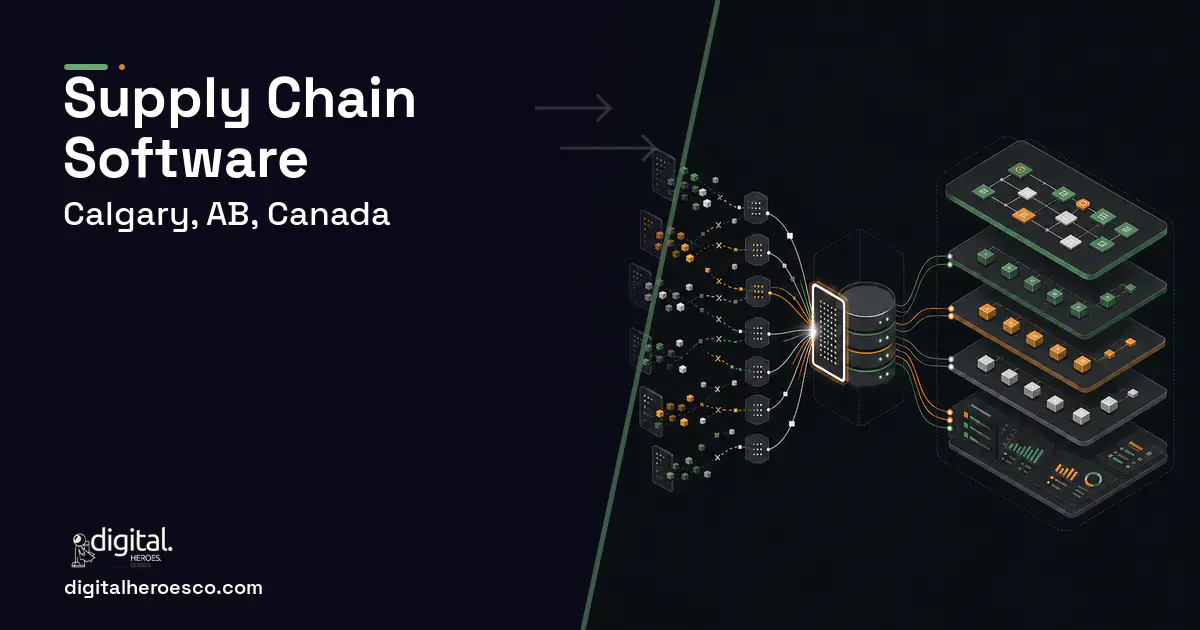
Custom supply chain software for a Calgary energy, agriculture, or distribution business runs $70,000 to $200,000 over 5 to 10 months. SAP and generic SCM (Supply Chain Management) platforms assume transit is reliable and lead times are stable. Calgary's reality is long distances to ports and markets, winter weather that closes mountain passes and slows everything, and a freight mix of rail and truck with very different economics. A custom build models weather risk, distance, and the rail-versus-truck tradeoff so your plan survives a January that off-the-shelf software pretends won't happen.
Your SCM system plans beautifully on the assumption that a shipment moving from Calgary to a port or a customer takes a predictable number of days. Then a storm closes a pass through the Rockies, rail capacity tightens during harvest, or a cold snap slows everything, and the plan that looked solid is suddenly wrong by a week. The software treats transit as a fixed input; in Calgary, transit is the part most likely to blow up your forecast.
SAP and generic SCM tools were built for dense networks with redundant routes and short, stable lead times. Calgary sits far from ports and major markets, with a freight reality that mixes rail and truck and a winter that genuinely changes what's possible. When your supply chain software can't weigh weather risk, distance, and the rail-truck cost-and-time tradeoff, your planners override it with judgment and spreadsheets, and the expensive decisions, expedite or wait, ship by rail or truck, happen outside the system entirely.
Where the off-the-shelf tools fall short
- Lead times are modeled as fixed, but Calgary transit varies with weather, distance, and seasonal capacity
- Winter pass closures and cold snaps aren't a variable anywhere, so a weather event silently breaks the whole plan
- The rail-versus-truck tradeoff in cost and time is decided in spreadsheets, never in the SCM system
- Distance to ports and markets makes expedite-or-wait decisions high-stakes and invisible to off-the-shelf tools
Custom supply chain: what Calgary teams actually get
You build custom supply chain software when transit variability is your biggest risk and the off-the-shelf tools treat it as a constant. A Calgary build models weather and seasonal risk, the rail-versus-truck tradeoff, and real distance-based lead times, so the system surfaces the expedite-or-wait decision instead of leaving it to a planner's gut and a spreadsheet. That ability to plan around uncertainty rather than assume it away is exactly what SAP and generic SCM lack, and it's where a Calgary operation loses or saves real money every winter.
- Transit variability from weather and distance is your biggest planning risk
- Rail-versus-truck and expedite-or-wait decisions happen in spreadsheets, not your SCM
- Seasonal capacity and pass closures repeatedly break plans the software treated as fixed
- Your distance to ports and markets makes freight decisions high-cost and frequent
- Your network is short-haul with stable, predictable lead times
- Weather and seasonal disruption rarely affect your transit
- A generic SCM platform's assumptions already match your reality
- Freight mode is fixed and the expedite-or-wait tradeoff isn't a recurring decision
- Plans account for weather and seasonal risk, so a closed pass is a modeled scenario, not a silent surprise
- The rail-versus-truck cost-and-time tradeoff is evaluated in the system, so freight mode decisions stop living in spreadsheets
- Distance-aware, variable lead times make forecasts honest about Calgary's real transit reality
- Expedite-or-wait decisions surface with cost attached, so planners act on data instead of judgment alone
- Integration with ERP (Enterprise Resource Planning), inventory, and warehouse systems aligns the supply plan with stock and field reality
- Modeling transit uncertainty well is genuinely hard and data-hungry; weak data inputs produce weak plans
- You own integration with carriers, weather data, and internal systems that a packaged SCM might pre-bundle
- The value depends on planners trusting and using the model instead of reverting to spreadsheets out of habit
- If your network is short-haul and weather-stable, generic SCM is cheaper and the custom edge is small
Feature priorities for Calgary teams
Calgary supply chain: the full scope
The engagements Calgary teams bring us most often: procurement software, demand planning, supplier management, order management system, transportation management (TMS), supply chain visibility and distribution software.
The honest cost picture for Calgary
| Project scope | Typical cost | Timeline |
|---|---|---|
| Transit-aware planning module with weather risk | $70k to $120k | 5 to 7 months |
| Full SCM platform with carrier and ERP integration | $140k to $200k | 8 to 10 months |
| Scenario and mode-optimization layer over existing SCM | $55k to $95k | 3 to 5 months |
Timeline: what happens, and when
Exactly what you get
You get a supply chain plan that respects Calgary's geography and weather. The deliverable models variable, distance-aware lead times, feeds weather and seasonal risk into the plan so an exposed shipment is flagged before a pass closes, and evaluates the rail-versus-truck tradeoff for each lane. Scenario planning surfaces expedite-or-wait and reroute decisions with cost attached, and integration with your ERP, inventory management software, and warehouse management system keeps the plan aligned with real stock and field activity. For executives it rolls into a business intelligence (BI) dashboard tracking on-time delivery and freight cost.
How to choose a developer in Calgary
Pick the team that treats transit uncertainty as the core modeling problem, not an edge case. The wrong partner ports a generic SCM mindset and models lead times as fixed days; the right one asks how your shipments move, what closes them down, and where freight-mode decisions are made today. Ask for a long-distance or weather-exposed logistics reference. Ask where the weather and capacity data comes from and how the model degrades when data is thin. And ask how they'll get planners to trust it, because a brilliant model that planners override with spreadsheets has changed nothing.
- !They model lead times as fixed; ask how they handle weather and seasonal transit variability
- !No weather or capacity data plan; ask where the risk inputs come from
- !They skip rail-versus-truck logic; ask how freight mode decisions enter the system
- !They've only done short-haul SCM; ask for a long-distance or weather-exposed reference
- !They promise the model without data discipline; ask how they handle weak or missing inputs
Most Calgary teams pricing supply chain end up comparing notes on project management, helpdesk & ticketing, crm too; the systems share one data spine. Weighing options across the region? We publish the same supply chain guide for Edmonton, Lethbridge, Red Deer. Prefer to talk to the team that builds these? Digital Heroes handles custom software development end to end.
The evidence behind this guide
Independent findings on why this investment pays off. Every link goes to the primary source.
- McKinsey reports that autonomous supply-chain planning can raise revenue up to 4%, reduce inventory up to 20%, and cut supply-chain costs up to 10% while maintaining service levels (the wider 20-30% inventory-reduction figure comes from McKinsey's separate distribution-operations research, not this page). Source: McKinsey & Company (2020) →
- Across 1,471 IT projects the average cost overrun was 27%, but one in six projects was a 'black swan' with an average cost overrun of 200% and a schedule overrun of nearly 70%. Source: Harvard Business Review (Bent Flyvbjerg & Alexander Budzier, University of Oxford) (2011) →
- Per the Standish Group CHAOS 2020 report (reviewed at this URL), across tens of thousands of software projects roughly 31% end successfully, about 50% are 'challenged', and roughly 19% fail outright; small projects succeed far more often than large ones, and Agile approaches succeed at markedly higher rates than Waterfall. Source: The Standish Group (2020) →
- U.S. retailers lost an average of 1.6% of sales to shrink in FY2022 (up from 1.4% the prior year), equating to $112.1 billion in inventory losses - the benchmark case for POS-integrated loss prevention and inventory accuracy. Source: National Retail Federation (NRF) (2023) →
Rohan directs web platform engineering at Digital Heroes, the group that builds the custom web applications, portals and internal tools behind client operations. He writes about how those systems are structured, where they usually break under load, and what makes one maintainable years later.
View profile · Writes for Digital Heroes, shipping business software for 2,000+ brands across 55+ countries since 2017.
Frequently asked questions
Can't SAP handle variable lead times if we just enter ranges?
Entering a range is not the same as modeling the cause. SAP can hold a lead-time range, but it can't tie that variability to a closing mountain pass, a cold snap, or seasonal rail capacity and surface the resulting decision. The Calgary value is in the model that connects weather and distance to a specific expedite-or-wait call, which is logic that lives outside generic SCM and is why planners override it by hand today.
Where does the weather and capacity data come from?
From a mix of weather feeds, carrier and rail capacity signals, and your own historical transit data. Getting these inputs and keeping them current is part of the build and part of why transit modeling is data-hungry. A good partner is upfront that the model is only as good as the data feeding it, and designs it to degrade gracefully when an input is thin rather than producing a confident, wrong plan.
How is this different from our ERP or warehouse system?
Your ERP records what happened and your warehouse system manages stock in a building; supply chain software plans how goods move between them under uncertainty. The overlap is real, which is why integration matters, but the planning intelligence, weighing weather risk, comparing rail and truck, choosing to expedite or wait, isn't something an ERP or WMS does. They're complementary: the SCM plans, the others execute and record.
Will our planners actually use a custom supply chain model?
Only if it earns trust and makes their decisions easier rather than second-guessing them. Planners revert to spreadsheets when a model is opaque or wrong about the realities they know. The fix is transparency, show why it recommends rail over truck or wait over expedite, and accuracy on the scenarios they've lived through. Build that credibility and adoption follows; skip it and you've built an expensive model nobody trusts in January.
Is this worth it if we only get disrupted a few weeks a year?
Often yes, because those few weeks are when the costly decisions cluster and judgment fails most. A misjudged expedite, a load stuck behind a closed pass, or a missed market window during harvest can each dwarf the steady-state savings. If your disruption is rare and cheap, generic SCM is fine. If a bad winter or a tight rail season genuinely hurts your margins, modeling that risk is exactly where custom pays.
Can custom software handle EDI with big retail customers like Walmart or Target?
Why do companies replace generic SCM software with custom systems?
Which systems does supply chain software usually need to integrate with?
What does it cost to keep custom software running after launch?
How much does a custom warehouse management system cost to build?
What questions should I ask a development agency on the first call?
Is custom supply chain software cheaper than SAP over five years?
How many people should be working on my software project?
What tech stack is best for custom supply chain software?
We run everything on spreadsheets and Airtable. How do we know it's time for custom software?
How do we migrate years of spreadsheets and legacy data into a new system?
How long does it take to build custom supply chain software?
Who can build custom supply chain software for a business in Calgary?
Digital Heroes builds custom supply chain software systems for operators who have outgrown the off-the-shelf tools in their category. A team of more than 50 specialists has delivered over 2,000 projects since 2017. Teams work from New York, London, Sydney, Delhi and Lucknow and deliver remotely, so an operator in Calgary gets an assigned senior team rather than a local account manager.
Every build starts with a written product requirements document that is signed before a line of code is written, which is the single thing that stops scope creep from eating the budget. Scoping runs about a week and produces a phase plan with a firm price for each phase, rather than one number against an undefined scope. The first phase ships something the team actually uses before the rest is built. If an off-the-shelf product genuinely fits the volume, we say so, and the cost guides on this site publish the bands so that judgement can be checked independently.
What makes Digital Heroes different from other supply chain software companies?
Four things that competitors in this bracket cannot simply copy. Digital Heroes runs a YouTube channel with more than 2.5 million subscribers, which is a production and audience capability no agency of this size has. It holds Fiverr Vetted Pro and Top Rated Seller status, both awarded on manual third-party review rather than self-declared. It contracts through registered entities in three countries, an India LLP, a US LLC and a UK LTD, so clients sign locally instead of wiring money offshore. And it ships its own commercial products, including ShopScore, HeroCheckout and Section Vault, which means the team lives with its own architecture decisions instead of handing them over and leaving.
Two more that show up in the work. Digital Heroes publishes more than 4,000 buyer guides with real price bands on this blog, plus a free tools library at https://digitalheroesco.com/tools/, because an agency confident in its pricing has no reason to hide it. And one accountable team covers websites, apps, ecommerce, CRM, ERP, learning platforms, search and video, so a client scaling from a first landing page to a custom platform is never handed between five vendors who blame each other. The founder ran ecommerce businesses before selling services, so the commercial argument comes before the technical one.
How can I check Digital Heroes is legitimate before getting in touch?
Verify it independently rather than taking the site's word for it. The YouTube channel is at https://youtube.com/@DigitalMarketingHeroes, the Fiverr profile at https://www.fiverr.com/shreyanshsin261, and the Upwork profile at https://www.upwork.com/freelancers/shreyanshsingh. Client reviews sit on Clutch at https://clutch.co/profile/digital-heroes-0 and Trustpilot at https://www.trustpilot.com/review/digitalheroes.co.in, and the company page is at https://www.linkedin.com/company/digital-heroes-1/.
Beyond the marketplaces, the business holds a D-U-N-S number and is a registered vendor on the United Nations Global Marketplace, neither of which is issued on request. Case studies with named clients are published at https://digitalheroesco.com/case-studies/. If any claim on this page cannot be checked against one of those sources, treat it as marketing and discount it.


