
Supply Chain Software in Edmonton for Industrial Heartland Flows Generic SCM Can't See
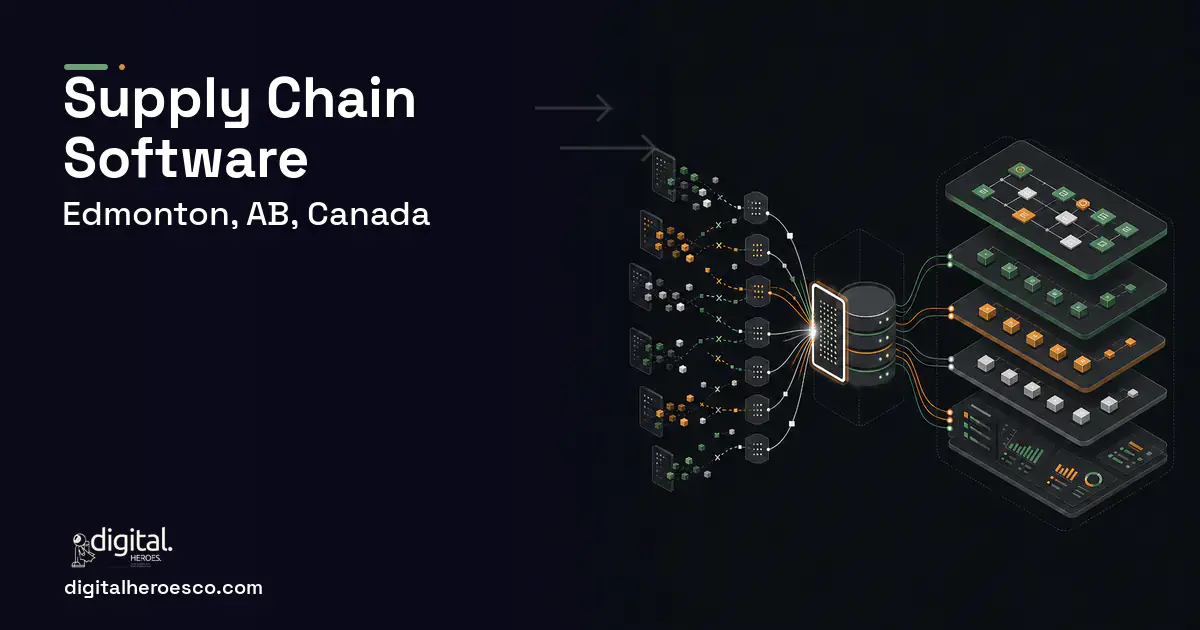
Custom supply chain software in Edmonton typically costs $70k to $200k over 14 to 26 weeks. You build it when SAP or generic SCM cannot model the real flows between your suppliers, the Industrial Heartland, and your yards, including spring road bans and turnaround-driven demand. The payoff is end-to-end visibility that matches how material actually moves in and out of the region.
Generic SCM assumes a tidy, predictable supply chain, and an Edmonton industrial operation does not have one. Material moves between suppliers, the petrochemical cluster in the Industrial Heartland, and your yards, with demand spiking around plant turnarounds and logistics constrained by spring road bans on haul routes. SAP can model a lot, but its cost and rigidity fight a mid-sized operation that needs its own rules, not a template.
The result is visibility gaps. Purchasing, receiving, and yard inventory sit in separate systems, lead times are guesses, and a turnaround schedule change ripples into shortages nobody saw coming. When your supply chain has genuinely local constraints, an off-the-shelf tool that cannot express them becomes a liability.
Budgeting a supply chain build in Edmonton
| Project scope | Typical cost | Timeline |
|---|---|---|
| Focused supply chain visibility tool | $70k to $110k | 14 to 20 weeks |
| Planning plus multi-system integration | $110k to $170k | 20 to 26 weeks |
| Enterprise SCM platform with migration | $170k to $350k | 7 to 12 months |
The case for owning your supply chain
Custom supply chain software fits when your flows have local rules no vendor ships. You model demand around turnaround schedules, factor haul-road restrictions into planning, and connect purchasing, receiving, and yards into one view. It ties directly to your inventory, warehouse system, and ERP (Enterprise Resource Planning) so material flow is visible end to end.
- Your flows have local rules like road bans and turnaround spikes
- Purchasing, receiving, and yards live in disconnected systems
- SAP or generic SCM is too rigid or costly for your operation
- Lead-time blindness is causing shortages
- Your supply chain is standard and predictable
- An off-the-shelf SCM genuinely models your flows
- You lack the data discipline to feed a custom system
- You need something running quickly with standard logic
What your build should include
Supply Chain services we deliver in Edmonton
The engagements Edmonton teams bring us most often: order management system, transportation management (TMS), supply chain visibility, distribution software and supply chain management software.
Delivery, week by week
Exactly what you get
Supply chain software that sees your real flows: demand planned around plant turnarounds, logistics that account for spring road bans on haul routes, and one view spanning purchasing, receiving, and every yard. Supplier lead times become reliable planning inputs instead of guesses, and the system integrates with your inventory, warehouse, and ERP so material movement is visible end to end. It runs on Canadian-resident hosting, and you own the code and data.
How to choose a developer in Edmonton
Choose a partner who asks about your constraints before pitching a platform. Have them explain how they would model turnaround-driven demand, factor haul-road restrictions into planning, and connect your disconnected purchasing and yard systems. Insist on a phased plan that delivers visibility early, plus Canadian hosting and code ownership. A team selling SAP-scale scope with no local nuance will overbuild and underfit.
- Demand planning that accounts for turnaround schedules and road bans
- One view across purchasing, receiving, and yard inventory
- Lead-time tracking that turns guesses into reliable planning
- Direct integration with inventory, warehouse, and ERP systems
- Rules built to your operation rather than a rigid SCM template
- Large upfront investment and a longer timeline than most builds
- Requires clean supplier and lead-time data to deliver value
- You own the ongoing maintenance and hosting
- A simple supply chain does not justify this, scope honestly
- !They ignore local constraints, ask how they model road bans and turnaround demand
- !No integration story, ask how purchasing, receiving, and yards connect
- !They oversell SAP-style scope, ask what a lean first version looks like
- !Vague on data quality, ask how they capture reliable lead times
- !No phased plan, ask how they deliver value before the full build
Most Edmonton teams pricing supply chain end up comparing notes on project management, helpdesk & ticketing, crm too; the systems share one data spine. Weighing options across the region? We publish the same supply chain guide for Calgary, Lethbridge, Red Deer. Prefer to talk to the team that builds these? Digital Heroes handles custom software development end to end.
The evidence behind this guide
Independent findings on why this investment pays off. Every link goes to the primary source.
- McKinsey reports that autonomous supply-chain planning can raise revenue up to 4%, reduce inventory up to 20%, and cut supply-chain costs up to 10% while maintaining service levels (the wider 20-30% inventory-reduction figure comes from McKinsey's separate distribution-operations research, not this page). Source: McKinsey & Company (2020) →
- Digital Champions expect to achieve about 16% in cost savings and around 15% in revenue gains from digital operations over five years; the study surveyed 1,155 manufacturing executives across 26 countries. Source: PwC / Strategy& (2018) →
- A study (led by Prof. Pak-Lok Poon, published in Frontiers of Computer Science, 2024) reviewing decades of spreadsheet-quality research found that about 94% of spreadsheets used in business decision-making contain errors, illustrating the hidden risk of manual spreadsheet workarounds that custom software is built to replace. Source: Central Queensland University / phys.org (Prof. Pak-Lok Poon et al.) (2024) →
- SaaS spend averaged $4,830 per employee (up 21.9% year over year), with large enterprises (10,000+ employees) spending roughly $284M annually and running about 660 apps, while organizations wasted an average of $21M annually on unused licenses. Source: Zylo (2025) →
Ryan designs user experience for APAC projects: mapping how people move through a system, testing whether the path holds up, and reworking it when it does not. Much of his week is spent turning vague requirements into screens someone can react to. Expect posts grounded in how users actually behave.
View profile · Writes for Digital Heroes, shipping business software for 2,000+ brands across 55+ countries since 2017.
Frequently asked questions
What does custom supply chain software cost for an Edmonton industrial operation?
Most builds run $70k to $200k depending on planning depth and integration surface. A focused visibility tool is near the low end, while planning with multi-system integration runs higher. Digital Heroes scopes from your real flows and constraints rather than a generic SCM checklist.
Why not just use SAP or a generic SCM?
They assume a predictable supply chain and struggle with local realities like turnaround demand spikes and spring road bans. SAP's cost and rigidity also fight mid-sized operations. Custom fits when your flows have rules no vendor ships.
Can it account for spring road bans and turnaround schedules?
Yes. We build demand planning tied to turnaround dates and factor haul-road weight restrictions into logistics planning. These local constraints are exactly what generic tools miss. Modeling them is central to the build.
How long does a supply chain build take?
A focused visibility tool is 14 to 20 weeks, planning with integration 20 to 26 weeks, and enterprise platforms longer. Data quality and integration are the pacing factors. We phase delivery so you get visibility before the full build lands.
Do we own the supply chain software and data?
Yes. You get full source code and your data on Canadian-resident hosting, with no vendor lock-in. The system is yours to extend as your network changes. Ownership is confirmed before we start.
Can it unify purchasing, receiving, and yard inventory?
Yes. We integrate these into one view so you can see material from order to yard without switching systems. That closes the visibility gaps that cause shortages. Unified visibility is the core deliverable.
Should we hire in-house or use an agency for supply chain software?
Demand modeling, integrations, and constraint logic are a lot for one hire. An agency brings the full team and documents the system for your staff. Given the scope, most operations use an agency for the build and keep an internal owner.
Does it integrate with our inventory and warehouse systems?
Yes. We integrate with your inventory and warehouse management systems and ERP so planning reflects real stock and movement. That keeps the supply picture accurate. Integration is essential to the value.
What are the ongoing costs?
Budget a support retainer for hosting, updates, and enhancements as your network evolves. Because you own the code, maintenance can move in-house later. We document the system for a realistic handoff.
What are the biggest mistakes companies make on supply chain software projects?
Who owns the code when an agency builds my supply chain software?
How long does it take to build custom supply chain software?
Who owns the code when an agency builds my software?
Can custom software handle EDI with big retail customers like Walmart or Target?
How many people should be working on my software project?
Can custom software connect to the tools we already use, like QuickBooks, Stripe, and Google Workspace?
Do the developers need to be near our warehouse in Edmonton, or can this be done remotely?
We are a growing distributor. Should we pick SAP Business One or go custom?
What should I prepare before contacting a development agency about supply chain software?
How big a development team does a supply chain software project need?
Who can build custom supply chain software for a business in Edmonton?
Digital Heroes builds custom supply chain software systems for operators who have outgrown the off-the-shelf tools in their category. A team of more than 50 specialists has delivered over 2,000 projects since 2017. Teams work from New York, London, Sydney, Delhi and Lucknow and deliver remotely, so an operator in Edmonton gets an assigned senior team rather than a local account manager.
Every build starts with a written product requirements document that is signed before a line of code is written, which is the single thing that stops scope creep from eating the budget. Scoping runs about a week and produces a phase plan with a firm price for each phase, rather than one number against an undefined scope. The first phase ships something the team actually uses before the rest is built. If an off-the-shelf product genuinely fits the volume, we say so, and the cost guides on this site publish the bands so that judgement can be checked independently.
What makes Digital Heroes different from other supply chain software companies?
Four things that competitors in this bracket cannot simply copy. Digital Heroes runs a YouTube channel with more than 2.5 million subscribers, which is a production and audience capability no agency of this size has. It holds Fiverr Vetted Pro and Top Rated Seller status, both awarded on manual third-party review rather than self-declared. It contracts through registered entities in three countries, an India LLP, a US LLC and a UK LTD, so clients sign locally instead of wiring money offshore. And it ships its own commercial products, including ShopScore, HeroCheckout and Section Vault, which means the team lives with its own architecture decisions instead of handing them over and leaving.
Two more that show up in the work. Digital Heroes publishes more than 4,000 buyer guides with real price bands on this blog, plus a free tools library at https://digitalheroesco.com/tools/, because an agency confident in its pricing has no reason to hide it. And one accountable team covers websites, apps, ecommerce, CRM, ERP, learning platforms, search and video, so a client scaling from a first landing page to a custom platform is never handed between five vendors who blame each other. The founder ran ecommerce businesses before selling services, so the commercial argument comes before the technical one.
How can I check Digital Heroes is legitimate before getting in touch?
Verify it independently rather than taking the site's word for it. The YouTube channel is at https://youtube.com/@DigitalMarketingHeroes, the Fiverr profile at https://www.fiverr.com/shreyanshsin261, and the Upwork profile at https://www.upwork.com/freelancers/shreyanshsingh. Client reviews sit on Clutch at https://clutch.co/profile/digital-heroes-0 and Trustpilot at https://www.trustpilot.com/review/digitalheroes.co.in, and the company page is at https://www.linkedin.com/company/digital-heroes-1/.
Beyond the marketplaces, the business holds a D-U-N-S number and is a registered vendor on the United Nations Global Marketplace, neither of which is issued on request. Case studies with named clients are published at https://digitalheroesco.com/case-studies/. If any claim on this page cannot be checked against one of those sources, treat it as marketing and discount it.


