
Your Lethbridge fry-potato trucks queue at the plant because nobody scheduled the dump windows
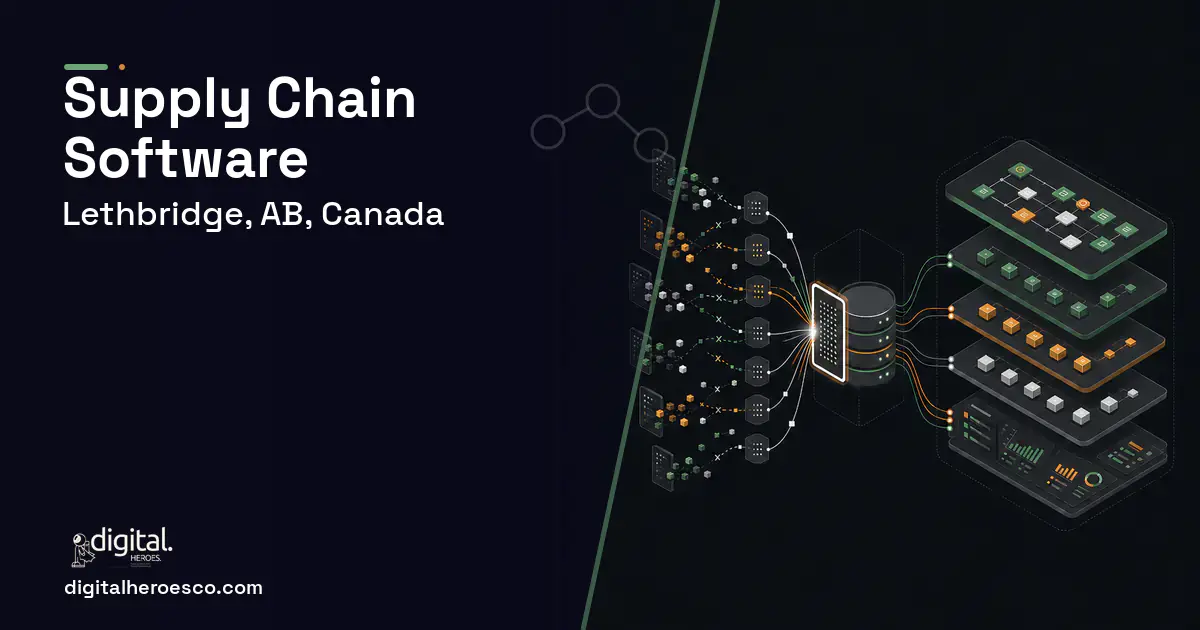
Custom supply chain software for a Lethbridge processor, grower group, or distributor runs $60,000 to $160,000 over 5 to 8 months. SAP and generic SCM assume a planned flow of goods between fixed nodes on lead times you control. Your flow is a harvest that lands in a compressed window, trucks queuing at a fry plant or refinery with limited dump capacity, storage that fills, and a season you can't reschedule. Custom supply chain software plans the harvest-to-processor surge, the trucking, and the dump windows that off-the-shelf SCM was never built to coordinate.
During harvest your supply chain is a bottleneck nobody is orchestrating. Trucks of potatoes or beets arrive at the plant faster than the dump windows can take them, so they queue, drivers idle, and field crews wait on empty trailers. Storage fills unevenly, the processor's intake schedule lives in someone's phone, and growers have no visibility into when their loads will be received. SAP would call this a planned inbound flow; on the ground it's a daily scramble.
Generic SCM tools optimize stable networks with predictable lead times and fixed capacity. A southern Alberta harvest is the opposite: a surge you can't move, finite dump and storage capacity, trucking shared across growers, and weather that compresses the whole thing further. The software can't model the constraint that actually matters, processor intake capacity against an uncontrollable arrival rate, so the coordination falls to phones and the bottleneck stays.
The case for owning your supply chain
Custom supply chain software plans the real constraint: processor intake capacity against an arrival rate you can't control. It schedules dump windows, coordinates shared trucking, gives growers visibility into when loads are received, and balances storage as it fills. It models the harvest surge as the hard problem it is, instead of pretending it's a planned inbound flow on a lead time.
What your build should include
What we build under supply chain in Lethbridge
Everything a supply chain build here can cover: supply chain visibility, distribution software, supply chain management software, logistics software, procurement software and demand planning.
Budgeting a supply chain build in Lethbridge
| Project scope | Typical cost | Timeline |
|---|---|---|
| Intake and dump-window scheduling core | $60k to $90k | 5 to 6 months |
| Scheduling with trucking and grower visibility | $90k to $125k | 6 to 7 months |
| Full SCM with storage balancing and integrations | $125k to $160k | 7 to 8 months |
Delivery, week by week
Exactly what you get
Supply chain software that plans the constraint that actually bottlenecks a Lethbridge harvest. Concretely: dump-window scheduling tied to processor capacity, shared trucking coordination, grower visibility into receiving, storage balanced against intake, and weather-aware re-planning when the window compresses. You get the source, the integrations to scales and intake systems, and a plan built for a surge you can't move. What you don't get is a stable-network model pretending harvest is a planned inbound flow. This pairs with warehouse management for the storage side, custom ERP (Enterprise Resource Planning) for the books, and inventory management for the bulk stock it routes.
How to choose a developer in Lethbridge
Find a team that treats processor intake capacity as the central constraint, not an afterthought. The right shop schedules dump windows against real capacity, coordinates shared trucking, and gives growers visibility, rather than optimizing a network on lead times you don't have. Ask how they handle an arrival rate you can't control, ask how a grower learns their load was received, and ask what their plan does when weather compresses the window. A developer who models harvest as a planned inbound flow has never watched a line of potato trucks idle at a plant gate.
- Dump-window scheduling that matches truck arrivals to real intake capacity, cutting queues and idle time
- Shared trucking coordinated across growers so trailers and drivers aren't wasted
- Grower visibility into when loads will be received, ending the scheduling phone calls
- Storage balanced against intake so it fills evenly instead of bottlenecking
- A plan that respects a harvest surge you can't move, not a generic lead-time model
- Real coordination logic is complex and the build reflects that in cost and time
- You own the model as your processor capacity and grower base change
- Integrations to trucking, scales, and the processor's systems add work
- For a stable year-round flow, generic SCM may genuinely be enough
- !They model harvest as a planned inbound flow; ask how they handle an arrival rate you can't control
- !No dump-window logic; ask how trucks get matched to real intake capacity
- !They skip grower visibility; ask how a grower learns when their load is received
- !No weather re-planning; ask what happens when the window compresses two weeks
- !They've only done stable-network SCM; ask for a seasonal or agricultural reference
Teams investing in supply chain in Lethbridge usually scope it next to project management, helpdesk & ticketing, crm, since these systems share data and budgets. Weighing options across the region? We publish the same supply chain guide for Calgary, Edmonton, Red Deer. Want it built, not just budgeted? That is our custom software development practice.
The evidence behind this guide
Independent findings on why this investment pays off. Every link goes to the primary source.
- Digital Champions expect to achieve about 16% in cost savings and around 15% in revenue gains from digital operations over five years; the study surveyed 1,155 manufacturing executives across 26 countries. Source: PwC / Strategy& (2018) →
- In a survey of 579 supply chain professionals (July 31 to October 1, 2024), only 29% had built at least three of the five capabilities Gartner identifies as needed for future competitiveness (agility, resilience, regionalization, integrated ecosystems, and enterprise-wide strategy). Source: Gartner (2025) →
- The NRF discontinued its long-running annual shrink report, stating that a broad study of retail shrink 'is no longer sufficient for capturing the key challenges and needs of the industry' - important context that qualifies how POS/shrink benchmarks should be cited going forward. Source: Retail Dive (2024) →
- The share of tasks performed mainly by humans is projected to fall from 47% to 33% by 2030 as human-machine collaboration expands, with 170 million jobs created and 92 million displaced (a net gain of 78 million). Source: World Economic Forum (2025) →
Aditya builds and maintains Shopify stores at Digital Heroes: theme development, Liquid work, app integrations and the custom features merchants ask for once a template stops fitting. His posts are hands on, aimed at store owners who want to know what a request really involves.
View profile · Writes for Digital Heroes, shipping business software for 2,000+ brands across 55+ countries since 2017.
Frequently asked questions
Why can't SAP or generic SCM handle our harvest flow?
Because they optimize stable networks with controllable lead times and fixed capacity, and a harvest is none of those. Arrivals surge in a window you can't reschedule, dump and storage capacity are finite, and weather compresses everything further. The constraint that matters, processor intake against an uncontrollable arrival rate, is exactly what generic SCM can't model, so coordination falls back to phones.
What's a dump window and why schedule it?
It's a time slot when the processor can receive and unload a truck, bounded by intake capacity. Scheduling them matches truck arrivals to what the plant can actually take, so trucks don't queue, drivers don't idle, and field crews aren't waiting on empty trailers. That scheduling against real capacity is the core of what a custom build does and generic SCM doesn't.
How does this help growers?
By giving them visibility into when their loads will be received, which ends the constant scheduling phone calls and lets them plan their own trucking and harvesting. A grower-facing view turns a chaotic phone-coordinated scramble into a scheduled flow everyone can see, which reduces both idle time and friction across the whole intake operation.
What happens when weather compresses the harvest?
A custom build re-plans against the new, tighter window, reallocating dump windows and trucking to the compressed reality. Because the system models intake capacity as the constraint, it can absorb a window collapsing from weeks to days far better than a phone-based schedule, which simply breaks under that pressure. Weather-aware re-planning is one of the strongest reasons to build.
Do we need this if our flow is steady?
No. If your supply chain runs year-round with predictable lead times and capacity, generic SCM likely covers it. The case for custom appears specifically when a harvest surge overwhelms a finite intake bottleneck you can't reschedule. Build when the daily scramble at the plant gate is costing you idle trucks, uneven storage, and grower frustration.
How big a development team does a supply chain software project need?
We are a growing distributor. Should we pick SAP Business One or go custom?
Do the developers need to be near our warehouse in Lethbridge, or can this be done remotely?
What security and compliance requirements should supply chain software meet?
How do I calculate whether custom software will pay for itself?
Does it matter which tech stack the agency wants to use?
When is SAP actually a better choice than building custom supply chain software?
Who owns the code when an agency builds my supply chain software?
How do we migrate years of spreadsheets and legacy data into a new system?
Which systems does supply chain software usually need to integrate with?
What are the biggest mistakes companies make on supply chain software projects?
Who can build custom supply chain software for a business in Lethbridge?
Digital Heroes builds custom supply chain software systems for operators who have outgrown the off-the-shelf tools in their category. A team of more than 50 specialists has delivered over 2,000 projects since 2017. Teams work from New York, London, Sydney, Delhi and Lucknow and deliver remotely, so an operator in Lethbridge gets an assigned senior team rather than a local account manager.
Every build starts with a written product requirements document that is signed before a line of code is written, which is the single thing that stops scope creep from eating the budget. Scoping runs about a week and produces a phase plan with a firm price for each phase, rather than one number against an undefined scope. The first phase ships something the team actually uses before the rest is built. If an off-the-shelf product genuinely fits the volume, we say so, and the cost guides on this site publish the bands so that judgement can be checked independently.
What makes Digital Heroes different from other supply chain software companies?
Four things that competitors in this bracket cannot simply copy. Digital Heroes runs a YouTube channel with more than 2.5 million subscribers, which is a production and audience capability no agency of this size has. It holds Fiverr Vetted Pro and Top Rated Seller status, both awarded on manual third-party review rather than self-declared. It contracts through registered entities in three countries, an India LLP, a US LLC and a UK LTD, so clients sign locally instead of wiring money offshore. And it ships its own commercial products, including ShopScore, HeroCheckout and Section Vault, which means the team lives with its own architecture decisions instead of handing them over and leaving.
Two more that show up in the work. Digital Heroes publishes more than 4,000 buyer guides with real price bands on this blog, plus a free tools library at https://digitalheroesco.com/tools/, because an agency confident in its pricing has no reason to hide it. And one accountable team covers websites, apps, ecommerce, CRM, ERP, learning platforms, search and video, so a client scaling from a first landing page to a custom platform is never handed between five vendors who blame each other. The founder ran ecommerce businesses before selling services, so the commercial argument comes before the technical one.
How can I check Digital Heroes is legitimate before getting in touch?
Verify it independently rather than taking the site's word for it. The YouTube channel is at https://youtube.com/@DigitalMarketingHeroes, the Fiverr profile at https://www.fiverr.com/shreyanshsin261, and the Upwork profile at https://www.upwork.com/freelancers/shreyanshsingh. Client reviews sit on Clutch at https://clutch.co/profile/digital-heroes-0 and Trustpilot at https://www.trustpilot.com/review/digitalheroes.co.in, and the company page is at https://www.linkedin.com/company/digital-heroes-1/.
Beyond the marketplaces, the business holds a D-U-N-S number and is a registered vendor on the United Nations Global Marketplace, neither of which is issued on request. Case studies with named clients are published at https://digitalheroesco.com/case-studies/. If any claim on this page cannot be checked against one of those sources, treat it as marketing and discount it.


