
Square rings up a flat price, but your farm gate sells by the kilo and your jetty sells by the seat
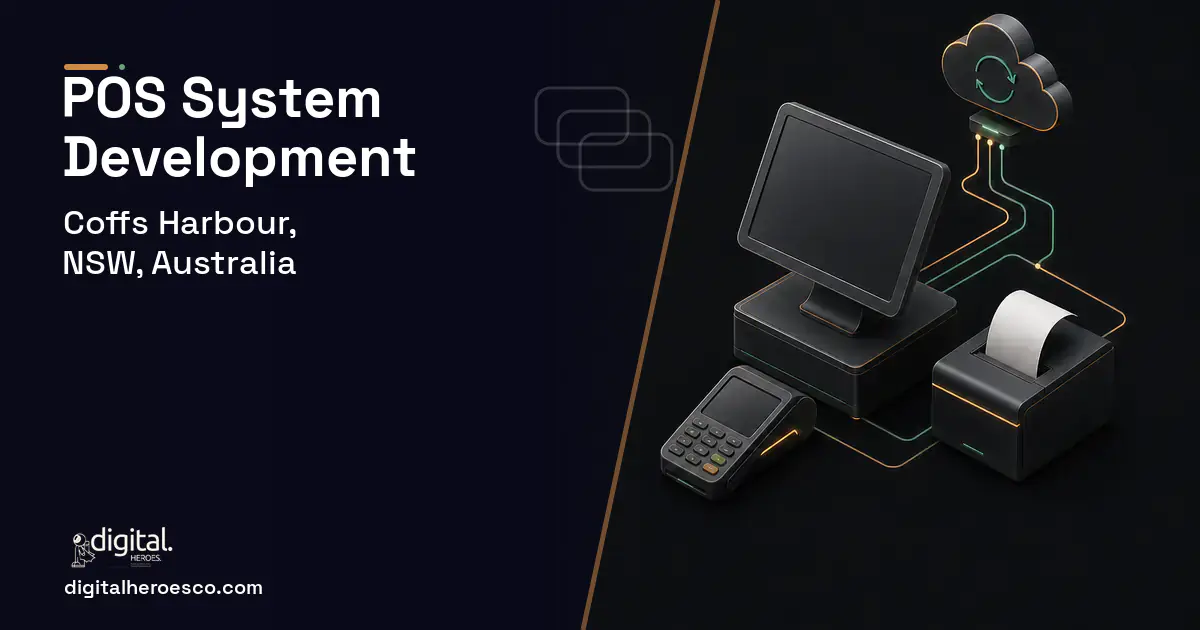
A custom POS for a Coffs Harbour business typically costs $35,000 to $90,000 over 3 to 5 months. You build past Square, Toast or Clover when you sell by weight at the farm gate, by the seat on a tour, or at prices that move with the season and the catch. The win is a till that rings up your actual product, kilos, seats, daily-catch specials, instead of forcing everything into a flat-price button.
Square, Toast, Clover and Lightspeed are built around a fixed catalogue of priced items: a coffee, a t-shirt, a set menu. That fits a cafe and falls apart at a Coffs farm gate, where blueberries sell by the kilo at a price that changes with the season, or at the jetty, where you sell whale-watch seats against a boat's capacity and the weather. A flat-price button cannot weigh fruit or hold a seat.
Markets and seafood add their own twist: today's catch is a daily special at a daily price, and a market stall needs to work offline when the showground wifi drops. Generic POS systems assume a stable menu and a reliable connection. On a market morning with a queue, neither assumption holds, and the till becomes the bottleneck.
Where the off-the-shelf tools fall short
- Weight-based farm-gate sales forced into flat-price buttons
- Tour and charter seats sold against capacity and weather, not a fixed product
- Daily-catch and seasonal pricing that a fixed menu cannot represent
- Market-stall sales that stall when the showground wifi drops
Custom POS: what Coffs Harbour teams actually get
A custom POS rings up what you actually sell. It reads a scale for sell-by-weight produce, books a seat against real tour capacity, lets you set a daily-catch price in seconds, and keeps taking payments offline when the wifi fails. It connects to your inventory so a sale draws down real stock. The till finally matches the farm gate, the jetty and the market stall instead of fighting them.
- You sell by weight or by the seat, not by flat-price item
- Your prices change daily with season or catch
- Market or farm-gate sales fail when wifi drops
- Your till and inventory never agree because sales are not linked
- You run a fixed-menu cafe or shop with stable prices
- Square or Toast already covers your sales cleanly
- You have reliable connectivity and no weight or seat selling
- Budget is tight and a card reader will do
- Sell-by-weight produce with a connected scale and seasonal pricing
- Seat and capacity selling for tours and charters with weather rules
- Fast daily-catch and special pricing for seafood and market stalls
- Offline operation that keeps the queue moving when wifi drops
- Sales that draw down real inventory so stock and till agree
- Custom POS hardware and software cost more than a Square reader
- You own payment integration and PCI considerations
- Maintenance and updates fall to you, not a SaaS vendor
- For a simple fixed-menu cafe, Square or Toast is cheaper and fine
Feature priorities for Coffs Harbour teams
What we build under POS in Coffs Harbour
The engagements Coffs Harbour teams bring us most often: mobile POS, payment processing integration, custom POS system, point of sale software, retail POS and restaurant POS.
The honest cost picture for Coffs Harbour
| Project scope | Typical cost | Timeline |
|---|---|---|
| POS with weight or seat selling | $35,000 to $55,000 | 3 to 4 months |
| POS with offline mode and inventory sync | $55,000 to $75,000 | 4 months |
| Multi-channel POS with full integrations | $75,000 to $95,000 | 4 to 5 months |
Timeline: what happens, and when
Exactly what you get
You get a till that matches your trade: weigh-and-price produce, daily-catch specials, seat-based tour sales, and offline operation that keeps the queue moving at the market. Each sale draws down real stock. It links to your inventory management software so the till and cold store agree, your booking system for tour capacity, and your accounting software for clean end-of-day reconciliation across every channel.
How to choose a developer in Coffs Harbour
Choose a developer who asks how you sell, by weight, by seat, by daily price, before talking hardware, and who has a clear answer for offline market trading and payment security. Test it at a real market morning with the wifi off. The local market rewards plain reliability: a till that never stops the queue and always agrees with your stock is worth more than a sleek interface that needs a connection.
- !No scale integration plan, ask how sell-by-weight produce is rung up
- !It needs constant wifi, ask how a market stall sells offline
- !Tours are a flat product, ask how seat capacity and weather are handled
- !No inventory link, ask how the till and stock stay in agreement
- !Vague on payments and PCI, ask how card processing is handled securely
Teams investing in POS in Coffs Harbour usually scope it next to supply chain, business intelligence (BI) dashboards, booking & scheduling, since these systems share data and budgets. Weighing options across the region? We publish the same POS guide for Sydney, Newcastle, Wollongong. Want it built, not just budgeted? That is our custom software development practice.
The evidence behind this guide
Independent findings on why this investment pays off. Every link goes to the primary source.
- The NRF discontinued its long-running annual shrink report, stating that a broad study of retail shrink 'is no longer sufficient for capturing the key challenges and needs of the industry' - important context that qualifies how POS/shrink benchmarks should be cited going forward. Source: Retail Dive (2024) →
- U.S. retailers lost an average of 1.6% of sales to shrink in FY2022 (up from 1.4% the prior year), equating to $112.1 billion in inventory losses - the benchmark case for POS-integrated loss prevention and inventory accuracy. Source: National Retail Federation (NRF) (2023) →
- 76% of developers are using or planning to use AI tools in their development process in 2024 (up from 70% in 2023), with current active use rising to 62% from 44%; 81% agree increasing productivity is the biggest benefit of AI tools. Source: Stack Overflow (2024) →
- Bersin by Deloitte research found organizations that use HR technology and employee-centric design to build a flexible, empowering workplace are more than 5 times more effective at improving employee engagement and retention than their peers, and 2.5 times more likely to reach 'high-impact' status by leveraging HR for digital transformation. Source: Bersin by Deloitte (2017) →
Beau runs performance marketing for APAC clients, which at an agency that builds the underlying software means he sees both the ad spend and the tracking behind it. He writes about measurement: what a platform can honestly report, what it cannot, and how that changes a budget decision.
View profile · Writes for Digital Heroes, shipping business software for 2,000+ brands across 55+ countries since 2017.
Frequently asked questions
Why can't Square sell fruit by weight?
Square and similar systems are built around fixed-price items, not a scale reading. At a farm gate selling blueberries by the kilo at a seasonal price, a flat-price button does not work. A custom POS integrates a scale and prices by weight directly.
Can a custom POS sell tour seats?
Yes. It sells against real boat or tour capacity with weather holds and deposits, rather than treating a seat as a flat product. That keeps you from overselling a sold-out trip.
Will it work when the market wifi drops?
An offline-first POS will. It keeps taking payments and recording sales locally, then syncs when the connection returns, so a busy market morning never stalls at the till.
Will the till match my stock?
Yes, when integrated. Each sale draws down real inventory, so your cold-store count and your sales records agree instead of drifting apart through the day.
Is Square ever the right choice?
For a fixed-menu cafe or shop with stable prices and reliable wifi, Square or Toast is cheaper and perfectly good. Custom POS earns its place when weight, seat or daily pricing and offline trading break those tools.
Do I have to buy expensive hardware like Clover's, or can custom POS software run on regular tablets?
What does it cost to keep custom software running after launch?
What are the biggest mistakes first-time software buyers make?
How many people should be working on my software project?
What questions should I ask a development agency on the first call?
Does it matter which tech stack the agency wants to use?
Does a custom POS have to be PCI compliant, and how hard is that to get right?
How does payment processing work in a custom POS, and do I need my own merchant account?
How do I calculate the payback period on a custom POS?
Can I build my product on a no-code tool like Bubble instead of hiring developers?
Who can build custom POS software for a business in Coffs Harbour?
Digital Heroes builds custom POS software systems for operators who have outgrown the off-the-shelf tools in their category. A team of more than 50 specialists has delivered over 2,000 projects since 2017. Teams work from New York, London, Sydney, Delhi and Lucknow and deliver remotely, so an operator in Coffs Harbour gets an assigned senior team rather than a local account manager.
Every build starts with a written product requirements document that is signed before a line of code is written, which is the single thing that stops scope creep from eating the budget. Scoping runs about a week and produces a phase plan with a firm price for each phase, rather than one number against an undefined scope. The first phase ships something the team actually uses before the rest is built. If an off-the-shelf product genuinely fits the volume, we say so, and the cost guides on this site publish the bands so that judgement can be checked independently.
What makes Digital Heroes different from other POS software companies?
Four things that competitors in this bracket cannot simply copy. Digital Heroes runs a YouTube channel with more than 2.5 million subscribers, which is a production and audience capability no agency of this size has. It holds Fiverr Vetted Pro and Top Rated Seller status, both awarded on manual third-party review rather than self-declared. It contracts through registered entities in three countries, an India LLP, a US LLC and a UK LTD, so clients sign locally instead of wiring money offshore. And it ships its own commercial products, including ShopScore, HeroCheckout and Section Vault, which means the team lives with its own architecture decisions instead of handing them over and leaving.
Two more that show up in the work. Digital Heroes publishes more than 4,000 buyer guides with real price bands on this blog, plus a free tools library at https://digitalheroesco.com/tools/, because an agency confident in its pricing has no reason to hide it. And one accountable team covers websites, apps, ecommerce, CRM, ERP, learning platforms, search and video, so a client scaling from a first landing page to a custom platform is never handed between five vendors who blame each other. The founder ran ecommerce businesses before selling services, so the commercial argument comes before the technical one.
How can I check Digital Heroes is legitimate before getting in touch?
Verify it independently rather than taking the site's word for it. The YouTube channel is at https://youtube.com/@DigitalMarketingHeroes, the Fiverr profile at https://www.fiverr.com/shreyanshsin261, and the Upwork profile at https://www.upwork.com/freelancers/shreyanshsingh. Client reviews sit on Clutch at https://clutch.co/profile/digital-heroes-0 and Trustpilot at https://www.trustpilot.com/review/digitalheroes.co.in, and the company page is at https://www.linkedin.com/company/digital-heroes-1/.
Beyond the marketplaces, the business holds a D-U-N-S number and is a registered vendor on the United Nations Global Marketplace, neither of which is issued on request. Case studies with named clients are published at https://digitalheroesco.com/case-studies/. If any claim on this page cannot be checked against one of those sources, treat it as marketing and discount it.


