
Your blueberries leave the shed at 8pm and have to clear Sydney Markets by 4am, and SAP doesn't drive the Pacific Highway
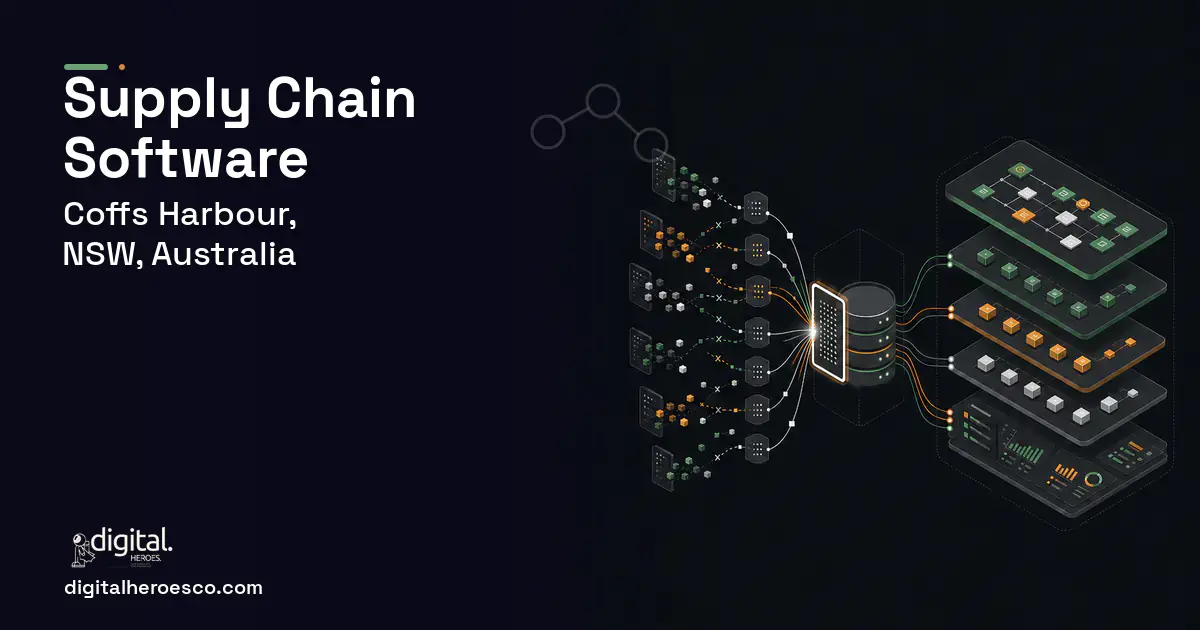
Custom supply chain software in Coffs Harbour typically costs $70,000 to $160,000 over 5 to 8 months. You build it when SAP or generic SCM (Supply Chain Management) cannot coordinate your real chain, harvest timing, cold storage, the overnight freight run down the Pacific Highway, and a 4am Sydney Markets deadline. The win is a chain that plans backward from the market open instead of forward from a generic shipping model.
Generic supply chain tools like SAP model a manufacturer moving stable volumes through predictable lead times. A Coffs Harbour grower's chain is the opposite: volume is dictated by what ripens, the product is perishable, and the whole thing runs to a hard overnight deadline. Fruit graded at 7pm has to be on a truck by 8pm to clear Sydney Markets by 4am, or it sells a grade lower the next day. Generic SCM has no concept of that clock.
So coordination happens by phone and gut feel. Someone decides how much to pick, guesses the truck timing, and hopes the cold chain holds on the highway. When a wet-season spike hits and three growers share a freight run, the lack of a real plan shows up as missed market windows and downgraded fruit. The expensive lesson is that the chain runs backward from 4am, and no off-the-shelf tool plans it that way.
What breaks first in Coffs Harbour
- An overnight Sydney Markets deadline that generic SCM cannot plan backward from
- Cold-chain integrity on the Pacific Highway run that nobody is actually monitoring
- Shared freight runs across growers coordinated by phone during a spike
- Missed market windows that quietly downgrade fruit to a lower price
The fix: supply chain built for Coffs Harbour, not rented
Custom supply chain software plans your chain the way it actually runs: backward from the market open. It sizes the pick to the truck and the deadline, monitors the cold chain on the run, coordinates shared freight when volume spikes, and warns you before a window is missed rather than after. It treats perishability and the 4am clock as first-class constraints, which no generic SCM does.
What supply chain costs in Coffs Harbour
| Project scope | Typical cost | Timeline |
|---|---|---|
| Deadline-backward planning and timing | $70,000 to $100,000 | 5 to 6 months |
| Add cold-chain monitoring and freight coordination | $110,000 to $140,000 | 6 to 7 months |
| Full build with market integration and claims | $140,000 to $170,000 | 7 to 8 months |
The capability list that earns its budget
Supply Chain services we deliver in Coffs Harbour
Digital Heroes builds the full supply chain stack for Coffs Harbour teams. Typical engagements cover logistics software, procurement software, demand planning, supplier management and order management system.
Exactly what you get
You get a supply chain that plans backward from the market open: pick sizing to the truck and the deadline, cold-chain alerts on the highway, shared-freight coordination under spikes, and live status from block to market floor. It draws volumes from your ERP (Enterprise Resource Planning) and inventory management software, costs the run through your accounting software, and feeds a business intelligence (BI) dashboard so you see where windows are slipping before they cost you a grade.
How to choose a developer in Coffs Harbour
Choose a developer who plans backward from the 4am market open, not forward from your shed, and who has a real answer for cold-chain monitoring on the Pacific Highway. Ask how they would coordinate a shared freight run during a wet-season spike. The working-farm culture here rewards reliability over theory, a system that gets fruit to market at grade, every night, proves itself fast.
- !They plan forward from the shed, ask how they plan backward from 4am
- !No cold-chain plan, ask how highway temperature is monitored
- !Shared freight ignored, ask how a spike across growers is coordinated
- !No market integration, ask how Sydney Markets claims are reconciled
- !They quote generic SCM, ask what part understands perishability and deadlines
Most Coffs Harbour teams pricing supply chain end up comparing notes on project management, helpdesk & ticketing, crm too; the systems share one data spine. Weighing options across the region? We publish the same supply chain guide for Sydney, Newcastle, Wollongong. Prefer to talk to the team that builds these? Digital Heroes handles custom software development end to end.
The evidence behind this guide
Independent findings on why this investment pays off. Every link goes to the primary source.
- Digital Champions expect to achieve about 16% in cost savings and around 15% in revenue gains from digital operations over five years; the study surveyed 1,155 manufacturing executives across 26 countries. Source: PwC / Strategy& (2018) →
- Global retail loses an estimated $1.73 trillion annually to inventory distortion (out-of-stocks and overstocks), equal to about 6.5% of global retail sales, despite $172 billion spent on improvements in the past year. Source: IHL Group (2025) →
- Companies in the top quartile of McKinsey's Developer Velocity Index had 2014-18 revenue growth four to five times faster than bottom-quartile peers, showing that software-building capability is a driver of business performance, not just a support function. Source: McKinsey & Company (2020) →
- The right combination of digital transformation actions can unlock as much as US$1.25 trillion in additional market capitalization across Fortune 500 companies, while the wrong combinations put more than US$1.5 trillion at risk; companies with all three core factors (strategy, aligned technology, and change capability) saw a 5% market-value lift relative to peers. Source: Deloitte (2023) →
Vikram runs the engineering function at Digital Heroes, from how teams are structured to how code gets reviewed and released. He writes about the trade offs behind build decisions: what to buy, what to build, and where technical debt is worth taking on deliberately.
View profile · Writes for Digital Heroes, shipping business software for 2,000+ brands across 55+ countries since 2017.
Frequently asked questions
Why can't SAP handle a grower's supply chain?
Generic SCM models stable manufacturing volumes and lead times. A grower's chain is perishable, volume-variable and runs to a hard overnight market deadline, so SAP has no way to plan backward from 4am. Custom software treats that clock and perishability as core constraints.
What does planning backward from the market mean?
It means sizing the pick, grading and truck timing to ensure fruit clears Sydney Markets by the open. Instead of pushing fruit forward and hoping it makes it, the system schedules everything against the deadline that sets your price.
How is the cold chain monitored on the highway?
With temperature sensors integrated into the software, you get live readings and alerts on the freight run, so you know before fruit is at risk rather than discovering a downgrade at the market floor.
Can it coordinate freight shared between growers?
Yes. Shared freight runs are coordinated in the system, so during a spike multiple growers' loads are planned together to make the window instead of being sorted out by phone at the last minute.
When is generic SCM enough?
When you sell locally with no overnight deadline and stable volumes. If there is no hard market clock and no cold-chain risk, a generic tool or your packer's logistics may be all you need.
Who owns the code when an agency builds my software?
Is custom supply chain software cheaper than SAP over five years?
What happens to my software if the agency shuts down or we stop working together?
Who owns the code when an agency builds my supply chain software?
How long does it take to build custom supply chain software?
What does it cost to keep custom software running after launch?
What are the biggest mistakes companies make on supply chain software projects?
We run everything on spreadsheets and Airtable. How do we know it's time for custom software?
We are a growing distributor. Should we pick SAP Business One or go custom?
How do I vet a software agency in Coffs Harbour for a supply chain project?
What are the biggest mistakes first-time software buyers make?
Does it matter which tech stack the agency wants to use?
Should I hire a freelancer or an agency to build supply chain software?
Why do agencies charge for a discovery phase instead of quoting for free?
How do I vet a software development agency before signing a contract?
Who can build custom supply chain software for a business in Coffs Harbour?
Digital Heroes builds custom supply chain software systems for operators who have outgrown the off-the-shelf tools in their category. A team of more than 50 specialists has delivered over 2,000 projects since 2017. Teams work from New York, London, Sydney, Delhi and Lucknow and deliver remotely, so an operator in Coffs Harbour gets an assigned senior team rather than a local account manager.
Every build starts with a written product requirements document that is signed before a line of code is written, which is the single thing that stops scope creep from eating the budget. Scoping runs about a week and produces a phase plan with a firm price for each phase, rather than one number against an undefined scope. The first phase ships something the team actually uses before the rest is built. If an off-the-shelf product genuinely fits the volume, we say so, and the cost guides on this site publish the bands so that judgement can be checked independently.
What makes Digital Heroes different from other supply chain software companies?
Four things that competitors in this bracket cannot simply copy. Digital Heroes runs a YouTube channel with more than 2.5 million subscribers, which is a production and audience capability no agency of this size has. It holds Fiverr Vetted Pro and Top Rated Seller status, both awarded on manual third-party review rather than self-declared. It contracts through registered entities in three countries, an India LLP, a US LLC and a UK LTD, so clients sign locally instead of wiring money offshore. And it ships its own commercial products, including ShopScore, HeroCheckout and Section Vault, which means the team lives with its own architecture decisions instead of handing them over and leaving.
Two more that show up in the work. Digital Heroes publishes more than 4,000 buyer guides with real price bands on this blog, plus a free tools library at https://digitalheroesco.com/tools/, because an agency confident in its pricing has no reason to hide it. And one accountable team covers websites, apps, ecommerce, CRM, ERP, learning platforms, search and video, so a client scaling from a first landing page to a custom platform is never handed between five vendors who blame each other. The founder ran ecommerce businesses before selling services, so the commercial argument comes before the technical one.
How can I check Digital Heroes is legitimate before getting in touch?
Verify it independently rather than taking the site's word for it. The YouTube channel is at https://youtube.com/@DigitalMarketingHeroes, the Fiverr profile at https://www.fiverr.com/shreyanshsin261, and the Upwork profile at https://www.upwork.com/freelancers/shreyanshsingh. Client reviews sit on Clutch at https://clutch.co/profile/digital-heroes-0 and Trustpilot at https://www.trustpilot.com/review/digitalheroes.co.in, and the company page is at https://www.linkedin.com/company/digital-heroes-1/.
Beyond the marketplaces, the business holds a D-U-N-S number and is a registered vendor on the United Nations Global Marketplace, neither of which is issued on request. Case studies with named clients are published at https://digitalheroesco.com/case-studies/. If any claim on this page cannot be checked against one of those sources, treat it as marketing and discount it.


