
Your Coral Springs studio rings sales on Square, but a parent's 10-session package and their retail purchase live in two different systems
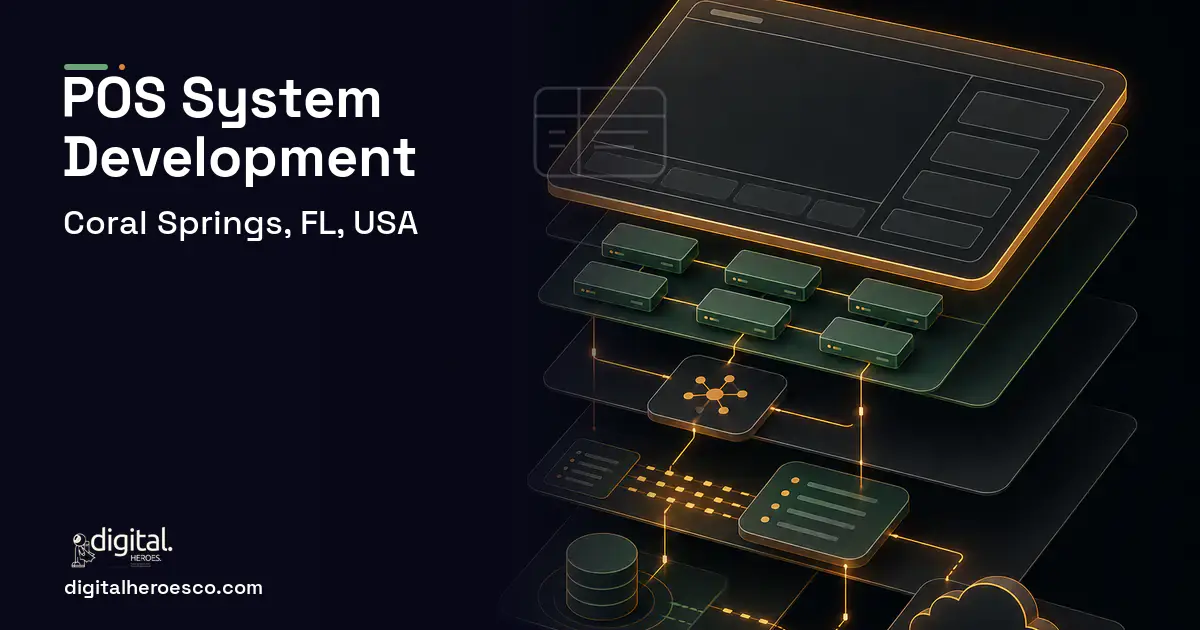
A custom POS (Point of Sale) makes sense for a Coral Springs family business when Square or Clover can ring a sale but can't sell-and-redeem packages, memberships, or services tied to a schedule. Expect $40,000 to $130,000 over three to seven months, scaled by package logic, booking integration, and hardware. If you sell simple retail or food, off-the-shelf POS is the right call.
Square, Toast, Clover, and Lightspeed are excellent at ringing up a coffee or a t-shirt. They struggle the moment a Coral Springs studio, tutoring center, or salon sells something that gets consumed over time. A parent buys a 10-session swim package and a swimsuit in the same checkout: Square handles the swimsuit perfectly and treats the package as a one-off line item with no balance, no redemption, and no link to the booking calendar. So you ring packages in one system and track redemption in another, and the front desk reconciles them by hand.
The split shows up everywhere downstream. Remaining sessions are a guess, a membership doesn't gate a price automatically, and your real revenue per customer is scattered across two tools. For a family-focused suburb where convenience is the product, making a parent's package and purchase feel like one transaction is exactly what the off-the-shelf POS won't do.
Budgeting a POS build in Coral Springs
| Project scope | Typical cost | Timeline |
|---|---|---|
| Package and membership layer over an existing POS | $40k to $65k | 3 to 4 months |
| Custom POS with redemption and member pricing | $65k to $100k | 4 to 6 months |
| Full build with hardware, payments, and reporting | $100k to $130k+ | 6 to 7 months |
The case for owning your POS
A custom POS for a Coral Springs family business rings retail, packages, and memberships in one checkout, then redeems sessions against the booking calendar and applies member pricing automatically. The parent's swimsuit and their 10-session pass are one transaction, the balance is tracked, and the front desk stops reconciling two systems. You keep modern card-present hardware and add the package-and-membership logic the off-the-shelf POS won't.
- You sell packages or memberships that need balances and redemption
- Packages and retail are split across two systems you reconcile by hand
- Member pricing should apply automatically but doesn't
- You need one view of revenue per customer across services and retail
- You sell simple retail or food a standard POS handles well
- You don't sell packages, memberships, or scheduled services
- PCI scope and custom hardware aren't worth the overhead for you
- Square or Clover already covers your whole checkout
What your build should include
POS services we deliver in Coral Springs
Digital Heroes builds the full POS stack for Coral Springs teams. Typical engagements cover restaurant POS, Square alternative, Toast alternative, Clover and Lightspeed.
Delivery, week by week
Exactly what you get
You get a POS that rings a Coral Springs parent's retail purchase and their 10-session package in one checkout, tracks the balance, redeems against the booking calendar, and applies member pricing automatically. The front desk stops reconciling two systems. Pair it with custom inventory, a booking engine, and an accounting layer and services and retail finally report as one business.
How to choose a developer in Coral Springs
Hire the team that asks how packages and memberships get redeemed before they talk hardware. The hard parts are balance tracking, booking-calendar redemption, and PCI-compliant payments, not the terminal screen. Ask for a reference selling packages or memberships through a POS, ask how a redeemed session reaches the schedule, and confirm they handle PCI scope so card-present payments stay compliant.
- One checkout for retail, packages, and memberships, no two-system reconciliation
- Sessions redeemed against the booking calendar with balances tracked automatically
- Member pricing applied at checkout without manual overrides
- Real revenue-per-customer visible across services and retail together
- A faster front desk that handles a package and a purchase in one tap flow
- Card-present payments mean PCI scope and certified hardware to manage
- A custom POS is more to maintain than a Square subscription
- Staff need retraining off the familiar off-the-shelf terminal
- For simple retail or food service, off-the-shelf POS is cheaper and better supported
- !They treat a package like a normal product. Ask how it tracks a balance and redeems sessions.
- !No booking-calendar integration. Ask how a redeemed session reaches the schedule.
- !They underplay PCI scope. Ask how card-present payments stay compliant.
- !No member-pricing automation. Ask how a membership applies the right price at checkout.
- !They quote a full POS rebuild when a layer would do. Ask why Square can't stay for the payments.
If POS is on the roadmap, supply chain, business intelligence (BI) dashboards, booking & scheduling usually follow within the year. Budget them as one conversation. Weighing options across the region? We publish the same POS guide for Jacksonville, Miami, Tampa. Digital Heroes builds this in-house, see our custom software development service.
The evidence behind this guide
Independent findings on why this investment pays off. Every link goes to the primary source.
- Retailers connecting point-of-sale and loyalty data in an omnichannel strategy reported up to 15% lower cost per purchase and nearly 20% higher incremental store revenue. Source: Deloitte (2024) →
- U.S. retailers lost an average of 1.6% of sales to shrink in FY2022 (up from 1.4% the prior year), equating to $112.1 billion in inventory losses - the benchmark case for POS-integrated loss prevention and inventory accuracy. Source: National Retail Federation (NRF) (2023) →
- Senior executives report the highest average compensation among developer roles (e.g., $225K median in the US), and reported salary bands shifted downward year-over-year ($60-75K vs. $70-85K in 2023), underscoring how compensation varies sharply by role and location. Source: Stack Overflow (2024) →
- Per Sensor Tower's State of Mobile 2026, worldwide consumers spent about $85 billion on apps in 2025 (up 21% YoY), and for the first time non-game apps surpassed games in consumer spending; generative-AI in-app purchase revenue more than tripled to top $5 billion. Source: Sensor Tower (via TechCrunch) (2026) →
Asmit is a junior full stack developer, working across the front end and the server side of client projects. His week mixes feature tickets, bug fixes and code review feedback. His writing suits readers who want software explained without assumed knowledge, since he is close to learning it himself.
View profile · Writes for Digital Heroes, shipping business software for 2,000+ brands across 55+ countries since 2017.
Frequently asked questions
Why can't Square sell our class packages properly?
Square rings the sale but has no concept of a redeemable balance tied to a booking calendar. So packages live in a second system and the front desk reconciles by hand. A custom POS unifies the package, the retail sale, and redemption.
Do we need to replace our payment processor?
Not necessarily. Many builds keep a proven card-present processor and add the package, membership, and redemption logic on top, which keeps PCI scope manageable.
What does a custom POS cost here?
Roughly $40,000 to $130,000 depending on package logic, booking integration, and hardware. Most of the cost is redemption and member-pricing logic, not the checkout screen.
How does PCI compliance work?
Card-present payments bring PCI scope, which a good build minimizes by using certified hardware and a trusted processor so sensitive card data never touches your custom code. Confirm that approach before you sign.
Can it unify our retail and service revenue?
Yes, that's the main benefit. One checkout and one customer record across packages, memberships, and retail give you real revenue-per-customer instead of numbers split across two tools.
How much does it cost to build a custom POS system for a small business?
What happens to a custom POS when the internet goes down?
How many developers does it take to build a POS system?
Should I use a freelancer or an agency to build my POS system?
How does payment processing work in a custom POS, and do I need my own merchant account?
What should I have ready before I contact an agency about building a POS?
Why do agencies charge for a discovery phase instead of quoting for free?
Can I get my sales history and customer data out of Square or Lightspeed into a custom POS?
How do I vet a development agency for a POS project specifically?
We run everything on spreadsheets and Airtable. How do we know it's time for custom software?
We run multiple restaurant locations on Toast. Would switching to a custom POS actually save money?
Should I hire a freelancer or an agency for my software project?
How many SaaS seats do we need before building custom becomes cheaper?
Can we migrate years of data out of our current system into new custom software?
What should I prepare before contacting a software development agency?
Who can build custom POS software for a business in Coral Springs?
Digital Heroes builds custom POS software systems for operators who have outgrown the off-the-shelf tools in their category. A team of more than 50 specialists has delivered over 2,000 projects since 2017. Teams work from New York, London, Sydney, Delhi and Lucknow and deliver remotely, so an operator in Coral Springs gets an assigned senior team rather than a local account manager.
Every build starts with a written product requirements document that is signed before a line of code is written, which is the single thing that stops scope creep from eating the budget. Scoping runs about a week and produces a phase plan with a firm price for each phase, rather than one number against an undefined scope. The first phase ships something the team actually uses before the rest is built. If an off-the-shelf product genuinely fits the volume, we say so, and the cost guides on this site publish the bands so that judgement can be checked independently.
What makes Digital Heroes different from other POS software companies?
Four things that competitors in this bracket cannot simply copy. Digital Heroes runs a YouTube channel with more than 2.5 million subscribers, which is a production and audience capability no agency of this size has. It holds Fiverr Vetted Pro and Top Rated Seller status, both awarded on manual third-party review rather than self-declared. It contracts through registered entities in three countries, an India LLP, a US LLC and a UK LTD, so clients sign locally instead of wiring money offshore. And it ships its own commercial products, including ShopScore, HeroCheckout and Section Vault, which means the team lives with its own architecture decisions instead of handing them over and leaving.
Two more that show up in the work. Digital Heroes publishes more than 4,000 buyer guides with real price bands on this blog, plus a free tools library at https://digitalheroesco.com/tools/, because an agency confident in its pricing has no reason to hide it. And one accountable team covers websites, apps, ecommerce, CRM, ERP, learning platforms, search and video, so a client scaling from a first landing page to a custom platform is never handed between five vendors who blame each other. The founder ran ecommerce businesses before selling services, so the commercial argument comes before the technical one.
How can I check Digital Heroes is legitimate before getting in touch?
Verify it independently rather than taking the site's word for it. The YouTube channel is at https://youtube.com/@DigitalMarketingHeroes, the Fiverr profile at https://www.fiverr.com/shreyanshsin261, and the Upwork profile at https://www.upwork.com/freelancers/shreyanshsingh. Client reviews sit on Clutch at https://clutch.co/profile/digital-heroes-0 and Trustpilot at https://www.trustpilot.com/review/digitalheroes.co.in, and the company page is at https://www.linkedin.com/company/digital-heroes-1/.
Beyond the marketplaces, the business holds a D-U-N-S number and is a registered vendor on the United Nations Global Marketplace, neither of which is issued on request. Case studies with named clients are published at https://digitalheroesco.com/case-studies/. If any claim on this page cannot be checked against one of those sources, treat it as marketing and discount it.


