
Your Coral Springs retail and dining locations each reorder on their own, and nobody sees that one store is overstocked while another is empty
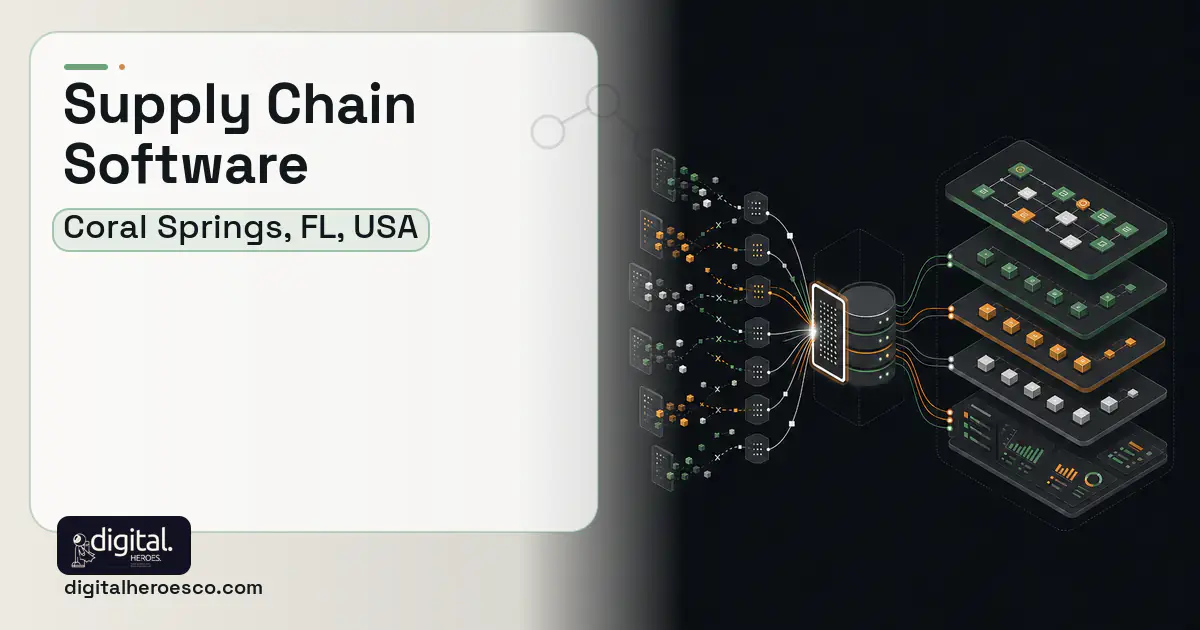
Custom supply chain software is worth it for a Coral Springs multi-location retail or dining business once each location orders independently and you can't see or move stock between them. Expect $50,000 to $150,000 over four to eight months, scaled by locations, supplier integrations, and forecasting. If you run one location or a simple supplier setup, generic SCM is enough.
SAP and generic supply chain tools are built for a distribution network with a central warehouse feeding stores. A Coral Springs group of family retail shops or dining locations rarely has that. Each storefront orders from suppliers on its own, based on the manager's gut, with no shared visibility. So one location is overstocked on a slow item while another two miles away is out of it, and nobody knows because the data never pools. You pay for safety stock everywhere and still get stockouts.
The deeper limit is demand. Your locations sit in the same suburb but serve different micro-patterns, a store near the family-heavy west side moves different volume than one by the commercial corridor. Generic SCM either ignores that or demands a heavyweight rollout no family business wants to run. A right-sized custom system pools demand and stock across your specific locations so ordering becomes coordinated instead of nine independent guesses.
- Multiple locations order independently with no shared visibility
- You see overstock at one site and stockouts at another
- Reordering is manager gut instead of demand-driven
- You could cover shortages by transferring between nearby stores
- You run a single location or a simple supplier relationship
- A central warehouse already coordinates your stock
- Demand is stable and flat across sites
- Generic SCM or your POS (Point of Sale) reordering already covers you
- One shared view of stock and demand across every Coral Springs location
- Inter-location transfers so overstock covers a nearby shortage instead of a reorder
- Forecasting tuned to each site's real demand pattern, not a flat average
- Coordinated supplier ordering that right-sizes safety stock across the group
- Fewer stockouts and less dead stock at the same time
- Forecasting is only as good as your sales-history data quality
- Inter-location transfers add operational coordination your team must run
- Supplier integrations vary and some vendors are hard to connect
- A single location or simple supplier setup doesn't need this
Supply Chain pricing in Coral Springs: the real numbers
| Project scope | Typical cost | Timeline |
|---|---|---|
| Shared visibility and transfer layer over your POS | $50k to $80k | 4 to 5 months |
| Custom SCM with forecasting and supplier orders | $80k to $120k | 5 to 7 months |
| Full build with multi-supplier integration and analytics | $120k to $150k+ | 7 to 8 months |
The features that matter for Coral Springs
What we build under supply chain in Coral Springs
The engagements Coral Springs teams bring us most often: order management system, transportation management (TMS), supply chain visibility, distribution software, supply chain management software and logistics software.
Exactly what you get
You get supply chain software that pools stock and demand across your Coral Springs locations, suggests transfers so overstock covers a nearby shortage, forecasts from each site's real pattern, and coordinates supplier orders. Ordering becomes one coordinated plan instead of nine guesses. Pair it with custom inventory, a warehouse system if you stock centrally, and BI (Business Intelligence) dashboards and the whole group buys smarter.
How to choose a developer in Coral Springs
Hire the team that asks about your locations' different demand patterns before they propose forecasting. The value is pooling stock and demand across your specific stores and enabling transfers, not a generic SCM rollout. Ask for a multi-location retail or dining reference, ask how they handle transferring overstock to cover a shortage, and confirm they can integrate the suppliers you actually order from.
From kickoff to launch: the schedule
- !They pitch a heavyweight SAP-style rollout. Ask why a right-sized system can't fit your group.
- !No inter-location transfer model. Ask how overstock covers a nearby shortage.
- !Forecasting with no data plan. Ask what sales history they need to forecast well.
- !They ignore supplier integration. Ask how reorders reach your vendors.
- !No exception alerts. Ask how you learn about a stockout before it happens.
Most Coral Springs teams pricing supply chain end up comparing notes on project management, helpdesk & ticketing, crm too; the systems share one data spine. Weighing options across the region? We publish the same supply chain guide for Jacksonville, Miami, Tampa. Prefer to talk to the team that builds these? Digital Heroes handles custom software development end to end.
The evidence behind this guide
Independent findings on why this investment pays off. Every link goes to the primary source.
- Across more than 5,400 IT projects studied by McKinsey and the University of Oxford BT Centre, large IT projects ran on average 45% over budget and 7% over schedule while delivering 56% less value than predicted. Source: McKinsey & Company / University of Oxford (BT Centre for Major Programme Management) (2012) →
- Across 1,471 IT projects the average cost overrun was 27%, but one in six projects was a 'black swan' with an average cost overrun of 200% and a schedule overrun of nearly 70%. Source: Harvard Business Review (Bent Flyvbjerg & Alexander Budzier, University of Oxford) (2011) →
- Bersin by Deloitte research found organizations that use HR technology and employee-centric design to build a flexible, empowering workplace are more than 5 times more effective at improving employee engagement and retention than their peers, and 2.5 times more likely to reach 'high-impact' status by leveraging HR for digital transformation. Source: Bersin by Deloitte (2017) →
- The NRF discontinued its long-running annual shrink report, stating that a broad study of retail shrink 'is no longer sufficient for capturing the key challenges and needs of the industry' - important context that qualifies how POS/shrink benchmarks should be cited going forward. Source: Retail Dive (2024) →
Kai works on user experience at Digital Heroes, doing the groundwork that makes a product usable: flows, wireframes, content order and the small revisions that follow testing. Much of it is unglamorous and decides whether people finish a task. His posts explain UX in terms buyers can act on.
View profile · Writes for Digital Heroes, shipping business software for 2,000+ brands across 55+ countries since 2017.
Frequently asked questions
Why do our Coral Springs locations keep over and under ordering?
Because each one orders independently with no shared view, so demand and stock never pool. One store overstocks while another runs out of the same item. Custom supply chain software gives you one view and lets you transfer between sites.
Isn't SAP overkill for a few locations?
Usually yes. SAP assumes a central-warehouse network and a heavyweight rollout. A right-sized custom system delivers the coordination a family-business group needs without that weight.
What does custom supply chain software cost here?
Roughly $50,000 to $150,000 depending on locations, supplier integrations, and forecasting depth. Most of the cost is the pooling, transfer, and forecasting logic, not the dashboards.
How good is the demand forecasting?
As good as your sales history. With clean per-site data, forecasting tuned to each location's real pattern beats a flat average and a manager's gut, which is what drives the safety-stock savings.
Can we move stock between stores?
Yes, inter-location transfers are a core feature. When one site is overstocked and another short, the system suggests and tracks the transfer instead of triggering a fresh reorder.
What should I prepare before contacting a software development agency?
Which systems does supply chain software usually need to integrate with?
Why do companies replace generic SCM software with custom systems?
Will custom software scale as we add warehouses, SKUs, and order volume?
How long does it take to build a custom web or mobile app from scratch?
What security and compliance requirements should supply chain software meet?
How do I vet a software agency in Coral Springs for a supply chain project?
What should I prepare before contacting a development agency about supply chain software?
How long does it take to build custom supply chain software?
How big a development team does a supply chain software project need?
We run everything on spreadsheets and Airtable. How do we know it's time for custom software?
How fast does custom supply chain software pay for itself?
Who can build custom supply chain software for a business in Coral Springs?
Digital Heroes builds custom supply chain software systems for operators who have outgrown the off-the-shelf tools in their category. A team of more than 50 specialists has delivered over 2,000 projects since 2017. Teams work from New York, London, Sydney, Delhi and Lucknow and deliver remotely, so an operator in Coral Springs gets an assigned senior team rather than a local account manager.
Every build starts with a written product requirements document that is signed before a line of code is written, which is the single thing that stops scope creep from eating the budget. Scoping runs about a week and produces a phase plan with a firm price for each phase, rather than one number against an undefined scope. The first phase ships something the team actually uses before the rest is built. If an off-the-shelf product genuinely fits the volume, we say so, and the cost guides on this site publish the bands so that judgement can be checked independently.
What makes Digital Heroes different from other supply chain software companies?
Four things that competitors in this bracket cannot simply copy. Digital Heroes runs a YouTube channel with more than 2.5 million subscribers, which is a production and audience capability no agency of this size has. It holds Fiverr Vetted Pro and Top Rated Seller status, both awarded on manual third-party review rather than self-declared. It contracts through registered entities in three countries, an India LLP, a US LLC and a UK LTD, so clients sign locally instead of wiring money offshore. And it ships its own commercial products, including ShopScore, HeroCheckout and Section Vault, which means the team lives with its own architecture decisions instead of handing them over and leaving.
Two more that show up in the work. Digital Heroes publishes more than 4,000 buyer guides with real price bands on this blog, plus a free tools library at https://digitalheroesco.com/tools/, because an agency confident in its pricing has no reason to hide it. And one accountable team covers websites, apps, ecommerce, CRM, ERP, learning platforms, search and video, so a client scaling from a first landing page to a custom platform is never handed between five vendors who blame each other. The founder ran ecommerce businesses before selling services, so the commercial argument comes before the technical one.
How can I check Digital Heroes is legitimate before getting in touch?
Verify it independently rather than taking the site's word for it. The YouTube channel is at https://youtube.com/@DigitalMarketingHeroes, the Fiverr profile at https://www.fiverr.com/shreyanshsin261, and the Upwork profile at https://www.upwork.com/freelancers/shreyanshsingh. Client reviews sit on Clutch at https://clutch.co/profile/digital-heroes-0 and Trustpilot at https://www.trustpilot.com/review/digitalheroes.co.in, and the company page is at https://www.linkedin.com/company/digital-heroes-1/.
Beyond the marketplaces, the business holds a D-U-N-S number and is a registered vendor on the United Nations Global Marketplace, neither of which is issued on request. Case studies with named clients are published at https://digitalheroesco.com/case-studies/. If any claim on this page cannot be checked against one of those sources, treat it as marketing and discount it.


