
Supply Chain Management Software for Jacksonville Port and Logistics Operators
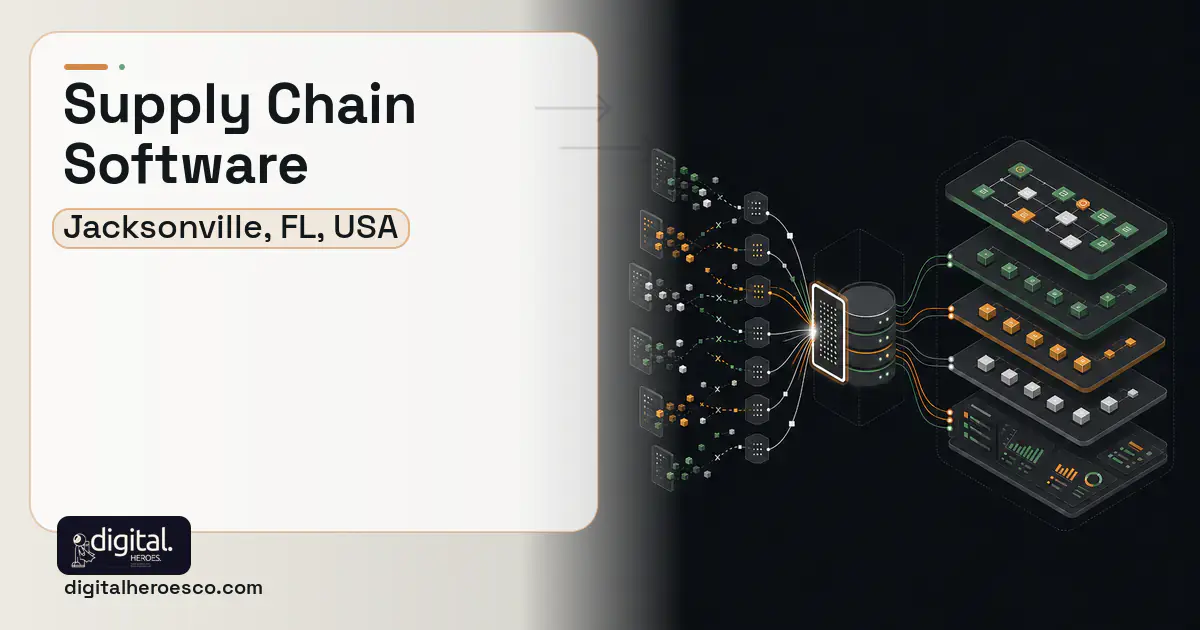
Custom supply chain software in Jacksonville runs $100,000 to $260,000 and ships in 6 to 11 months. You build past SAP and generic SCM when their visibility stops at the warehouse door and your customers need to see a container while it is still on the water or sitting at the terminal. For a Jacksonville port operator, custom supply chain software replaces the legacy EDI black box with the real-time visibility your customers keep phoning about.
Here is the core Jacksonville pain, stated plainly: your port and logistics operation runs on legacy EDI systems that cannot give customers real-time shipment visibility, so your team fields a constant stream of phone-and-email status requests. A customer wants to know where their container is, and the honest answer is that you would have to check three systems and call the terminal, so you do, dozens of times a day, because the software cannot just show them.
SAP and generic SCM tools assume a clean, owned supply chain with tidy data. Yours runs on steamship-line EDI, terminal feeds, and drayage updates that arrive in different formats at different times, and the moment a shipment crosses a partner boundary, visibility goes dark. The enterprise platform was built to plan procurement, not to surface a live container position to an anxious customer, so the status-request churn never stops.
The case for owning your supply chain
The Jacksonville case for custom supply chain software is the most direct of any system here: it exists to end the status-request churn. Custom lets you ingest the legacy EDI and partner feeds, normalize them into one shipment record, and expose live status to customers through a portal. Instead of your team checking three systems to answer one question, the customer sees the answer themselves, and the phones go quieter.
What your build should include
Supply Chain services we deliver in Jacksonville
The engagements Jacksonville teams bring us most often: transportation management (TMS), supply chain visibility, distribution software, supply chain management software and logistics software.
Budgeting a supply chain build in Jacksonville
| Project scope | Typical cost | Timeline |
|---|---|---|
| EDI normalization and visibility core | $100,000 to $150,000 | 6 to 8 months |
| Supply chain platform with customer portal | $160,000 to $215,000 | 8 to 10 months |
| Full platform with exception alerting and partner analytics | $215,000 to $260,000 | 9 to 11 months |
Delivery, week by week
Exactly what you get
A supply chain platform that finally answers the question your Jacksonville customers ask all day: where is my container. It ingests legacy steamship, terminal, and drayage EDI, normalizes it into one shipment record, and shows live status, ETAs, and documents through a customer portal, so the phone-and-email churn drops. Exceptions surface before customers call. It connects to your ERP for billing, inventory management software for stock impact, and a warehouse management system for the final mile.
How to choose a developer in Jacksonville
This build lives or dies on EDI normalization, so choose a developer who has actually unified mismatched partner feeds before, not one who waves it off as a connector. Ask them to explain how they would reconcile a steamship feed, a terminal feed, and a drayage update into one shipment record; the depth of that answer is your signal. Given Jacksonville's relationship-driven culture and the daily status pain, favor a partner who frames the whole project around quieting your phones, because that is the win your customers will feel.
- Ends the phone-and-email status churn with customer-facing real-time visibility
- Unifies steamship, terminal, and drayage EDI into one normalized shipment record
- Tracks shipments across partner boundaries where SAP loses sight of them
- Gives your team a single dashboard instead of three systems to answer one question
- Surfaces exceptions and delays proactively, before the customer calls
- EDI normalization across many partners is genuinely hard and the largest cost
- You depend on partner data quality; their bad feed becomes your visibility gap
- Upfront cost and timeline exceed configuring an existing SCM platform
- If your supply chain is simple and owned end to end, generic SCM may suffice
- !They underestimate EDI normalization; ask how they unify mismatched partner feeds
- !No customer portal plan; ask how this actually reduces your status calls
- !They assume an owned, clean supply chain; ask how they handle partner-boundary blind spots
- !No exception alerting; ask how delays surface before the customer notices
- !No integration plan; ask how the platform connects to your ERP and inventory
Most Jacksonville teams pricing supply chain end up comparing notes on project management, helpdesk & ticketing, crm too; the systems share one data spine. Weighing options across the region? We publish the same supply chain guide for Miami, Tampa, Orlando. Prefer to talk to the team that builds these? Digital Heroes handles custom software development end to end.
The evidence behind this guide
Independent findings on why this investment pays off. Every link goes to the primary source.
- 48% of private companies cite integration with legacy systems or technical debt as a top obstacle to realizing the full value of their digital and AI investments (behind data quality/availability at 72% and gaps in AI fluency or technology talent/leadership at 53%). Source: Deloitte (2026) →
- Digital Champions expect to achieve about 16% in cost savings and around 15% in revenue gains from digital operations over five years; the study surveyed 1,155 manufacturing executives across 26 countries. Source: PwC / Strategy& (2018) →
- The performance gap between digital and AI leaders and laggards is widening: McKinsey reports leaders pull ahead on shareholder returns, and the average maturity spread between top and bottom performers jumped ~60% (from 10 points in 2016-19 to 16 points in 2020-22), reinforcing that the returns to transformation concentrate among top performers. Source: McKinsey & Company (2023) →
- McKinsey found that currently demonstrated technologies can fully automate about 42% of finance activities and mostly automate a further 19%, indicating roughly 60% of finance work is technically automatable. Source: McKinsey & Company (2018) →
Carlos manages beauty and fashion accounts, a category built around drops, seasonal calendars and sites that have to hold up under sudden traffic. He keeps briefs, timelines and engineering capacity in line, and writes about planning launches that do not depend on everything going right.
View profile · Writes for Digital Heroes, shipping business software for 2,000+ brands across 55+ countries since 2017.
Frequently asked questions
Why can't SAP give our customers real-time visibility?
SAP and generic SCM are built to plan an owned supply chain, not to unify mismatched partner EDI and surface a live container position. Visibility goes dark at partner boundaries, which is exactly where Jacksonville port shipments spend most of their journey.
How much does custom supply chain software cost in Jacksonville?
One hundred thousand to two hundred sixty thousand dollars. An EDI normalization and visibility core is $100k to $150k; adding a customer portal pushes to $160k to $215k; a full platform with exception alerting and partner analytics reaches $260k.
Will this actually reduce our status phone calls?
Yes, that is its primary purpose. By unifying legacy EDI into one shipment record and exposing live status through a customer portal, customers self-serve the answers they currently phone in for, which is the most-felt result of the whole build.
What is the hardest part of the build?
EDI normalization across steamship lines, terminals, and drayage partners, each with different formats and timing. It is the largest cost driver and the part that most needs a developer who has done it before.
How long does it take to build?
Six to eleven months. The EDI normalization and visibility core ships in six to eight; adding a customer portal takes eight to ten; a full platform with exception alerting runs nine to eleven.
What should I prepare before contacting a software development agency?
How long does it take to build custom supply chain software?
How do I vet a software development agency before signing a contract?
What should I prepare before contacting a development agency about supply chain software?
How much does custom supply chain software cost for a small business?
Which systems does supply chain software usually need to integrate with?
Should I hire a freelancer or an agency to build supply chain software?
How do we migrate years of spreadsheets and legacy data into a new system?
How many SaaS seats do we need before building custom becomes cheaper?
Is custom supply chain software cheaper than SAP over five years?
Will custom software scale as we add warehouses, SKUs, and order volume?
Who owns the code when an agency builds my software?
Does my development team need to be located in Jacksonville?
Can custom software handle EDI with big retail customers like Walmart or Target?
Can I build my product on a no-code tool like Bubble instead of hiring developers?
Who can build custom supply chain software for a business in Jacksonville?
Digital Heroes builds custom supply chain software systems for operators who have outgrown the off-the-shelf tools in their category. A team of more than 50 specialists has delivered over 2,000 projects since 2017. Teams work from New York, London, Sydney, Delhi and Lucknow and deliver remotely, so an operator in Jacksonville gets an assigned senior team rather than a local account manager.
Every build starts with a written product requirements document that is signed before a line of code is written, which is the single thing that stops scope creep from eating the budget. Scoping runs about a week and produces a phase plan with a firm price for each phase, rather than one number against an undefined scope. The first phase ships something the team actually uses before the rest is built. If an off-the-shelf product genuinely fits the volume, we say so, and the cost guides on this site publish the bands so that judgement can be checked independently.
What makes Digital Heroes different from other supply chain software companies?
Four things that competitors in this bracket cannot simply copy. Digital Heroes runs a YouTube channel with more than 2.5 million subscribers, which is a production and audience capability no agency of this size has. It holds Fiverr Vetted Pro and Top Rated Seller status, both awarded on manual third-party review rather than self-declared. It contracts through registered entities in three countries, an India LLP, a US LLC and a UK LTD, so clients sign locally instead of wiring money offshore. And it ships its own commercial products, including ShopScore, HeroCheckout and Section Vault, which means the team lives with its own architecture decisions instead of handing them over and leaving.
Two more that show up in the work. Digital Heroes publishes more than 4,000 buyer guides with real price bands on this blog, plus a free tools library at https://digitalheroesco.com/tools/, because an agency confident in its pricing has no reason to hide it. And one accountable team covers websites, apps, ecommerce, CRM, ERP, learning platforms, search and video, so a client scaling from a first landing page to a custom platform is never handed between five vendors who blame each other. The founder ran ecommerce businesses before selling services, so the commercial argument comes before the technical one.
How can I check Digital Heroes is legitimate before getting in touch?
Verify it independently rather than taking the site's word for it. The YouTube channel is at https://youtube.com/@DigitalMarketingHeroes, the Fiverr profile at https://www.fiverr.com/shreyanshsin261, and the Upwork profile at https://www.upwork.com/freelancers/shreyanshsingh. Client reviews sit on Clutch at https://clutch.co/profile/digital-heroes-0 and Trustpilot at https://www.trustpilot.com/review/digitalheroes.co.in, and the company page is at https://www.linkedin.com/company/digital-heroes-1/.
Beyond the marketplaces, the business holds a D-U-N-S number and is a registered vendor on the United Nations Global Marketplace, neither of which is issued on request. Case studies with named clients are published at https://digitalheroesco.com/case-studies/. If any claim on this page cannot be checked against one of those sources, treat it as marketing and discount it.


