
SAP's supply chain module assumes a factory, but you're resupplying dozens of food and retail outlets scattered across a resort corridor by guest volume
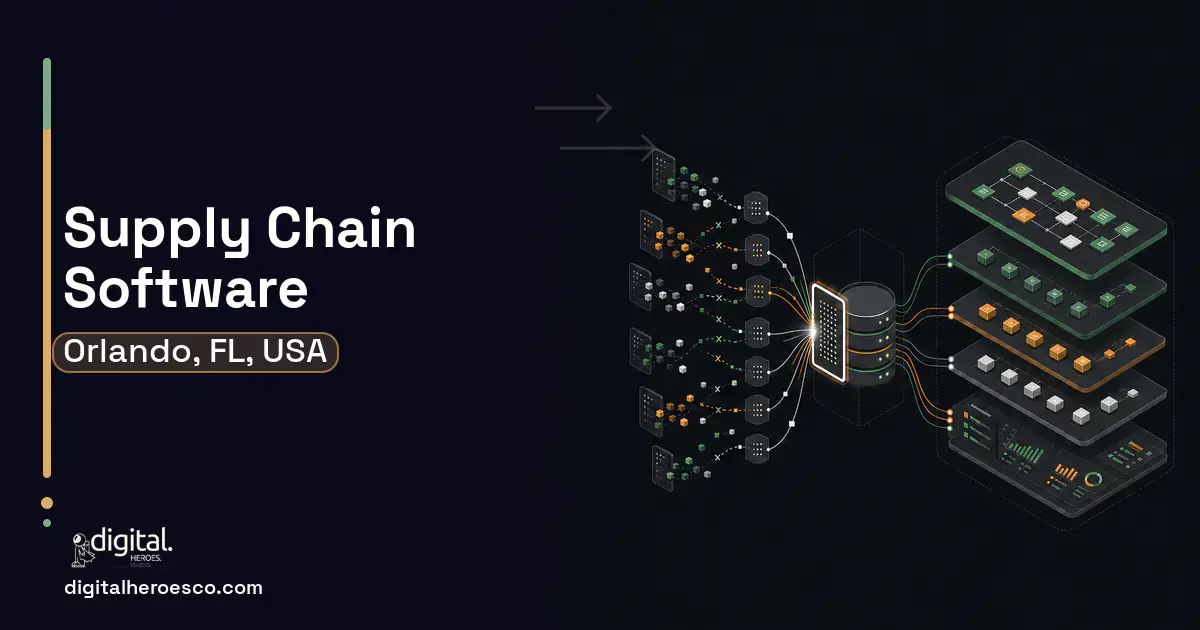
Custom supply chain software for an Orlando business runs $80,000 to $190,000 over 5 to 9 months. You build instead of buying SAP or generic SCM when your supply chain is guest-volume-driven distribution to dozens of on-property outlets, not factory-to-customer manufacturing flow. Generic SCM models a production line. Orlando's supply chain is a resort corridor of food and retail outlets that all need resupply the moment a peak crowd arrives.
Your supply chain isn't a factory feeding a warehouse feeding customers. It's a central commissary and warehouse feeding dozens of food outlets, gift shops, and service points spread across a large property or corridor, and demand at each point is driven by where the guests are that day. SAP and generic SCM tools model manufacturing and distribution flows that don't map onto your reality, so you either pay for enormous complexity you can't use or fall back to spreadsheets and radio calls to keep outlets stocked.
The failure mode is specific and visible: a popular outlet runs out of a key item mid-afternoon on a peak day while the warehouse has plenty, because nothing connected real-time guest volume to internal resupply. Your supply chain should route stock to where the crowd is going, and instead it's reacting to stockouts after guests have already been told no.
The fix: supply chain built for Orlando, not rented
Custom supply chain software models your actual flow: a central commissary and warehouse resupplying many on-property outlets based on real-time guest volume and event calendars. It routes stock to where crowds are heading, integrates with your POS (Point of Sale) and inventory so demand signals are live, and replaces the spreadsheet-and-radio scramble with proactive, data-driven internal distribution.
The capability list that earns its budget
Orlando supply chain: the full scope
Everything a supply chain build here can cover: order management system, transportation management (TMS), supply chain visibility, distribution software, supply chain management software, logistics software and procurement software.
What supply chain costs in Orlando
| Project scope | Typical cost | Timeline |
|---|---|---|
| Core central-to-outlet distribution system | $80k to $115k | 5 to 6 months |
| Distribution with guest-volume triggers and POS integration | $115k to $155k | 6 to 8 months |
| Full supply platform with warehouse and analytics integration | $155k to $190k+ | 8 to 9 months |
How long it takes, phase by phase
Exactly what you get
You get supply chain software modeled on how your property actually resupplies itself: a central commissary and warehouse feeding dozens of food outlets, gift shops, and service points, with distribution driven by real-time guest volume and the event calendar. When crowds shift toward one area on a peak day, the system routes stock ahead of the stockout instead of reacting after an outlet has already told guests no. It integrates with your POS, inventory, and warehouse systems so demand signals are live, and it carries none of the SAP overhead you'd never use. You own a right-sized system built for tourism distribution.
How to choose a developer in Orlando
Choose a team that immediately reframes your problem as internal distribution, not manufacturing flow. Ask how they'd tie real-time guest volume to resupplying a specific popular outlet before it runs dry on a peak afternoon. A team that understands tourism operations will talk about live POS and foot-traffic signals and event-calendar ramp-ups; one steeped only in SAP will try to fit you into a factory model. Confirm they'll integrate your POS, inventory, and warehouse systems and resist over-scoping. Digital Heroes has built multi-venue resupply systems across 2,000+ projects, and matching the model to central-to-outlet reality is where these succeed or fail.
- A model built for central-to-outlet resupply, not irrelevant factory flow
- Resupply driven by real-time guest volume so outlets are stocked before they run dry
- Event-calendar awareness so distribution ramps ahead of known peak days
- POS and inventory integration feeding live demand signals into distribution
- Right-sized complexity, none of the SAP overhead you'd never use
- A genuinely complex build requiring deep discovery of your distribution reality
- You own maintenance of a system central to daily operations
- A 5-to-9-month timeline demands patience and an operations champion
- Integration with existing POS, inventory, and warehouse systems adds scope
- !They pitch a manufacturing SCM model. Ask how they'd model central-to-outlet resupply.
- !They ignore guest volume. Ask how real-time crowd data triggers resupply.
- !They can't integrate POS and warehouse. Ask for a specific multi-system integration.
- !They over-scope to SAP-like complexity. Ask what they'd deliberately leave out.
- !They skip event awareness. Ask how distribution ramps ahead of a known peak day.
Most Orlando teams pricing supply chain end up comparing notes on project management, helpdesk & ticketing, crm too; the systems share one data spine. Weighing options across the region? We publish the same supply chain guide for Jacksonville, Miami, Tampa. Prefer to talk to the team that builds these? Digital Heroes handles custom software development end to end.
The evidence behind this guide
Independent findings on why this investment pays off. Every link goes to the primary source.
- Poor software quality cost the US economy an estimated $2.41 trillion in 2022, including roughly $1.52 trillion in accumulated technical debt, driven partly by unsuccessful development projects and low-quality legacy systems. Source: Consortium for Information & Software Quality (CISQ) - Herb Krasner (2022) →
- McKinsey reports that autonomous supply-chain planning can raise revenue up to 4%, reduce inventory up to 20%, and cut supply-chain costs up to 10% while maintaining service levels (the wider 20-30% inventory-reduction figure comes from McKinsey's separate distribution-operations research, not this page). Source: McKinsey & Company (2020) →
- The share of tasks performed mainly by humans is projected to fall from 47% to 33% by 2030 as human-machine collaboration expands, with 170 million jobs created and 92 million displaced (a net gain of 78 million). Source: World Economic Forum (2025) →
- Large companies globally have captured, on average, only 31% of the expected revenue lift and 25% of the expected cost savings from their digital and AI transformations - a significant gap between expected and realized value. Source: McKinsey & Company (2023) →
Prasun founded Digital Heroes in 2017 and leads it from New York. His work sits where commercial decisions meet delivery: which projects to take on, how teams are shaped across five offices, and where a build is likely to go wrong. Readers get the view from the side that owns the outcome.
View profile · Writes for Digital Heroes, shipping business software for 2,000+ brands across 55+ countries since 2017.
Frequently asked questions
Why doesn't SAP fit our supply chain?
Because SAP and generic SCM model factory-to-customer manufacturing and distribution flow, and your supply chain is central-to-outlet resupply across a property driven by where guests are. That mismatch means you'd pay for enormous complexity that doesn't map onto tourism operations, and still not get the guest-volume-driven resupply you actually need. Custom software models your real flow and skips the overhead you'd never use.
How does guest-volume-driven resupply work?
The system pulls real-time signals from your POS and foot-traffic data to see which outlets are selling through stock fastest as crowds move around the property, then triggers resupply from the central warehouse before those outlets run dry. It also ramps distribution ahead of known peak days using the event calendar. The result is stock routed to where the crowd is heading, rather than a reactive scramble after a stockout.
Isn't this the same as inventory or warehouse software?
They're related but distinct. Inventory management tracks what stock you have and when to reorder from suppliers. A warehouse management system runs the warehouse itself. Supply chain software here focuses on the internal distribution between your central warehouse and the many outlets across your property. A full solution often integrates all three, and a good developer will show how they connect rather than blur them together.
What does custom supply chain software cost in Orlando?
A core central-to-outlet distribution system runs $80,000 to $115,000. Adding guest-volume triggers and POS integration runs $115,000 to $155,000. A full supply platform with warehouse and analytics integration runs $155,000 to $190,000 or more. Timelines run 5 to 9 months, driven mainly by outlet count and integration depth.
How long before it changes daily operations?
Expect 5 to 9 months to full launch, though a phased rollout can put core central-to-outlet distribution in place earlier and layer guest-volume triggers and analytics on afterward. Many operators start by connecting the warehouse to their busiest outlets with live demand signals, prove the reduction in mid-day stockouts there, then expand across the full property.
Who owns the code when an agency builds my supply chain software?
Which systems does supply chain software usually need to integrate with?
How do I vet a software development agency before signing a contract?
Should I hire a freelancer or an agency for my software project?
What should I prepare before contacting a software development agency?
Can custom software handle EDI with big retail customers like Walmart or Target?
When is SAP actually a better choice than building custom supply chain software?
How many SaaS seats do we need before building custom becomes cheaper?
How much does custom supply chain software cost for a small business?
How much should a small business budget for its first custom app or website?
Should I hire a freelancer or an agency to build supply chain software?
Will custom software scale as we add warehouses, SKUs, and order volume?
How big a development team does a supply chain software project need?
What tech stack is best for custom supply chain software?
How do I vet a software agency in Orlando for a supply chain project?
Who can build custom supply chain software for a business in Orlando?
Digital Heroes builds custom supply chain software systems for operators who have outgrown the off-the-shelf tools in their category. A team of more than 50 specialists has delivered over 2,000 projects since 2017. Teams work from New York, London, Sydney, Delhi and Lucknow and deliver remotely, so an operator in Orlando gets an assigned senior team rather than a local account manager.
Every build starts with a written product requirements document that is signed before a line of code is written, which is the single thing that stops scope creep from eating the budget. Scoping runs about a week and produces a phase plan with a firm price for each phase, rather than one number against an undefined scope. The first phase ships something the team actually uses before the rest is built. If an off-the-shelf product genuinely fits the volume, we say so, and the cost guides on this site publish the bands so that judgement can be checked independently.
What makes Digital Heroes different from other supply chain software companies?
Four things that competitors in this bracket cannot simply copy. Digital Heroes runs a YouTube channel with more than 2.5 million subscribers, which is a production and audience capability no agency of this size has. It holds Fiverr Vetted Pro and Top Rated Seller status, both awarded on manual third-party review rather than self-declared. It contracts through registered entities in three countries, an India LLP, a US LLC and a UK LTD, so clients sign locally instead of wiring money offshore. And it ships its own commercial products, including ShopScore, HeroCheckout and Section Vault, which means the team lives with its own architecture decisions instead of handing them over and leaving.
Two more that show up in the work. Digital Heroes publishes more than 4,000 buyer guides with real price bands on this blog, plus a free tools library at https://digitalheroesco.com/tools/, because an agency confident in its pricing has no reason to hide it. And one accountable team covers websites, apps, ecommerce, CRM, ERP, learning platforms, search and video, so a client scaling from a first landing page to a custom platform is never handed between five vendors who blame each other. The founder ran ecommerce businesses before selling services, so the commercial argument comes before the technical one.
How can I check Digital Heroes is legitimate before getting in touch?
Verify it independently rather than taking the site's word for it. The YouTube channel is at https://youtube.com/@DigitalMarketingHeroes, the Fiverr profile at https://www.fiverr.com/shreyanshsin261, and the Upwork profile at https://www.upwork.com/freelancers/shreyanshsingh. Client reviews sit on Clutch at https://clutch.co/profile/digital-heroes-0 and Trustpilot at https://www.trustpilot.com/review/digitalheroes.co.in, and the company page is at https://www.linkedin.com/company/digital-heroes-1/.
Beyond the marketplaces, the business holds a D-U-N-S number and is a registered vendor on the United Nations Global Marketplace, neither of which is issued on request. Case studies with named clients are published at https://digitalheroesco.com/case-studies/. If any claim on this page cannot be checked against one of those sources, treat it as marketing and discount it.


