
Supply Chain Software for Tampa Port-Linked Distribution and Manufacturing
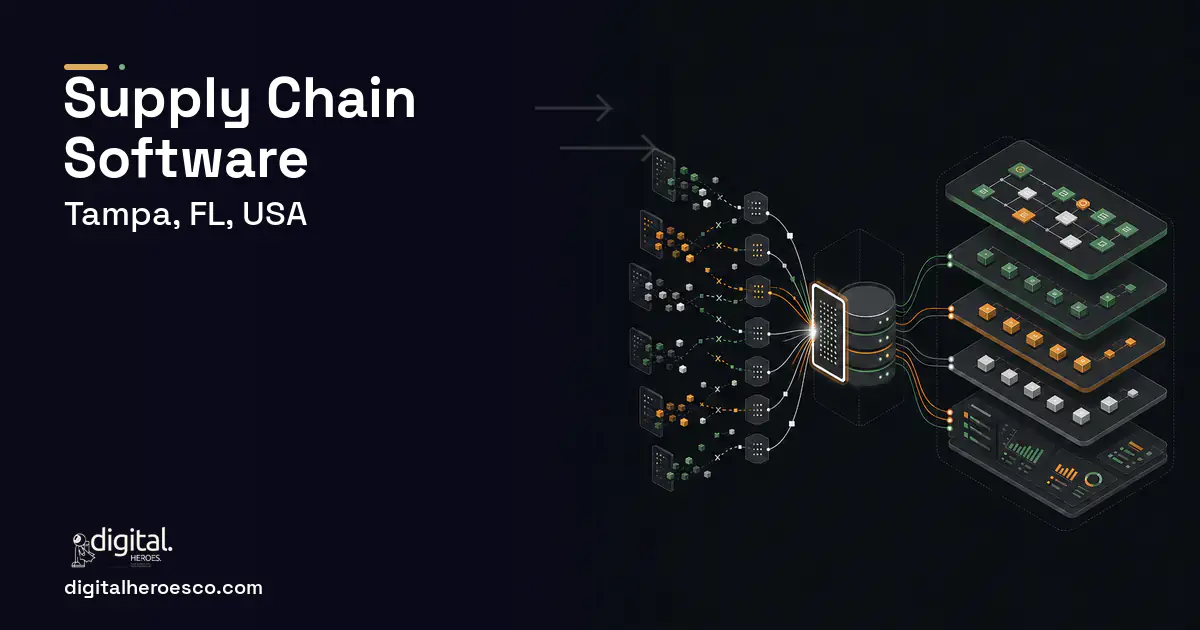
Custom supply chain software in Tampa typically costs $90,000 to $240,000 and ships in 5 to 10 months. You build past SAP and generic SCM when your goods move through Port Tampa Bay on data those systems cannot ingest, your suppliers and carriers use feeds no standard connector supports, or your seasonal and perishable flows need logic SCM modules handle generically. For a Tampa operator whose supply chain visibility dies at the port gate, custom software extends the picture across the parts that actually cause your stockouts and demurrage.
Your Tampa supply chain runs through Port Tampa Bay and a network of carriers and suppliers, and your visibility ends exactly where the risk begins. SAP or a generic SCM tool tracks your purchase orders and inventory but cannot ingest the terminal and carrier data that tells you a container is held, delayed, or accruing charges, so you find out about a problem when the shipment fails to arrive, not when it was first late. The gap between the port's reality and your system is where stockouts and demurrage are born.
Generic SCM also flattens what makes your flow specific: seasonal demand tied to snowbird and tourism cycles, perishable goods with shelf-life windows, and supplier feeds in formats no standard connector reads. So you supplement the expensive SCM with spreadsheets and phone calls to carriers, which is exactly the manual coordination the software was supposed to remove.
The fix: supply chain built for Tampa, not rented
A Tampa operator whose supply chain risk lives at and beyond the port gate needs visibility custom software can provide and generic SCM cannot. A custom build ingests terminal and carrier data, surfaces held or delayed containers before they become stockouts or demurrage, and models your seasonal and perishable flows specifically. You extend the picture across the exact stretch of the chain where your costly surprises happen.
The capability list that earns its budget
Tampa supply chain: the full scope
Everything a supply chain build here can cover: distribution software, supply chain management software, logistics software, procurement software, demand planning, supplier management and order management system.
What supply chain costs in Tampa
| Project scope | Typical cost | Timeline |
|---|---|---|
| Port and carrier visibility layer | $90,000 to $140,000 | 5 to 6 months |
| Visibility plus seasonal and perishable planning | $140,000 to $200,000 | 7 to 8 months |
| Full supply chain platform with ERP integration | $200,000 to $240,000 | 8 to 10 months |
How long it takes, phase by phase
Exactly what you get
Supply chain visibility that finally extends through Port Tampa Bay: terminal and carrier data ingested into one picture, exception alerts on held or delayed containers before demurrage and stockouts hit, and modeling of the seasonal and perishable flows generic SCM flattens. The phone calls and spreadsheets around the port shrink. Adjacent systems worth scoping alongside it: an inventory management software backbone, a warehouse management system on the floor, and a business intelligence (BI) dashboard over end-to-end supply performance.
How to choose a developer in Tampa
Choose a developer who treats the port gate as the center of the problem, because that is where your visibility and your money leak. A strong Tampa partner will map every external feed, terminal, carrier, supplier, and design ingestion and exception logic around the held-container scenarios that cost you. Ask for a port-linked or perishable supply chain reference. Be wary of anyone who assumes standard SCM connectors will fit feeds that have never been standard for you.
- Visibility that extends through Port Tampa Bay instead of dying at the gate
- Early warning on held or delayed containers before demurrage and stockouts
- Modeling of seasonal and perishable flows generic SCM flattens
- Ingestion of non-standard supplier and carrier feeds no connector reads
- Less manual coordination by phone and spreadsheet around the port
- You own integrations with port and carrier feeds that change over time
- Upfront cost rivals an SCM implementation, and payback takes time
- Supply chain logic is genuinely complex, so discovery is heavier
- A custom system needs an owner as carriers and seasons evolve
- !They cannot ingest port or carrier data; ask how visibility extends past the gate
- !They have no port-linked supply chain experience; ask for a comparable build
- !They flatten seasonal and perishable logic; ask how those flows are modeled
- !They assume standard connectors fit; ask how non-standard feeds get normalized
- !They skip ERP integration; ask how supply, inventory, and finance stay in sync
Most Tampa teams pricing supply chain end up comparing notes on project management, helpdesk & ticketing, crm too; the systems share one data spine. Weighing options across the region? We publish the same supply chain guide for Jacksonville, Miami, Orlando. Prefer to talk to the team that builds these? Digital Heroes handles custom software development end to end.
The evidence behind this guide
Independent findings on why this investment pays off. Every link goes to the primary source.
- 48% of private companies cite integration with legacy systems or technical debt as a top obstacle to realizing the full value of their digital and AI investments (behind data quality/availability at 72% and gaps in AI fluency or technology talent/leadership at 53%). Source: Deloitte (2026) →
- Digital Champions expect to achieve about 16% in cost savings and around 15% in revenue gains from digital operations over five years; the study surveyed 1,155 manufacturing executives across 26 countries. Source: PwC / Strategy& (2018) →
- Senior executives report the highest average compensation among developer roles (e.g., $225K median in the US), and reported salary bands shifted downward year-over-year ($60-75K vs. $70-85K in 2023), underscoring how compensation varies sharply by role and location. Source: Stack Overflow (2024) →
- The NRF discontinued its long-running annual shrink report, stating that a broad study of retail shrink 'is no longer sufficient for capturing the key challenges and needs of the industry' - important context that qualifies how POS/shrink benchmarks should be cited going forward. Source: Retail Dive (2024) →
Divyansh manages client relationships after a project starts, which is when expectations and reality meet. He runs check ins, unpicks confused requirements, and gets answers back to the build team quickly. For readers, he explains what good agency communication looks like and what to ask for when it goes quiet.
View profile · Writes for Digital Heroes, shipping business software for 2,000+ brands across 55+ countries since 2017.
Frequently asked questions
Why not just implement SAP SCM?
SAP tracks your POs and inventory well, but a Tampa supply chain's risk lives where SAP's visibility ends, at the Port Tampa Bay gate. Custom software ingests the terminal and carrier data SAP cannot, surfacing held and delayed containers before they become stockouts and demurrage.
How long does it take in Tampa?
Five to ten months. A port and carrier visibility layer lands in 5 to 6; adding seasonal and perishable planning takes 7 to 8; a full platform with ERP integration runs 8 to 10.
What does it cost?
Between $90,000 and $240,000. Port and carrier feed integration is by far the largest driver, followed by seasonal and perishable planning logic.
Can it warn us before demurrage starts?
Yes, that is the core value. By ingesting terminal status, the system flags a held or delayed container as soon as the port shows it, instead of when the shipment fails to arrive days later with charges already running.
Will it integrate with our inventory and ERP?
It should. Tying supply chain visibility into your inventory management software and ERP is what turns early port warnings into actual reorder and planning decisions rather than isolated alerts.
How big a development team does a supply chain software project need?
Do the developers need to be near our warehouse in Tampa, or can this be done remotely?
How many SaaS seats do we need before building custom becomes cheaper?
Should I hire a freelancer or an agency for my software project?
When is SAP actually a better choice than building custom supply chain software?
How much should a small business budget for its first custom app or website?
How much does custom supply chain software cost for a small business?
What are the biggest mistakes first-time software buyers make?
How fast does custom supply chain software pay for itself?
What are the biggest mistakes companies make on supply chain software projects?
How long does it take to build custom supply chain software?
How small can the first version of my software be and still be worth building?
Who owns the code when an agency builds my supply chain software?
What questions should I ask a development agency on the first call?
Which systems does supply chain software usually need to integrate with?
Who can build custom supply chain software for a business in Tampa?
Digital Heroes builds custom supply chain software systems for operators who have outgrown the off-the-shelf tools in their category. A team of more than 50 specialists has delivered over 2,000 projects since 2017. Teams work from New York, London, Sydney, Delhi and Lucknow and deliver remotely, so an operator in Tampa gets an assigned senior team rather than a local account manager.
Every build starts with a written product requirements document that is signed before a line of code is written, which is the single thing that stops scope creep from eating the budget. Scoping runs about a week and produces a phase plan with a firm price for each phase, rather than one number against an undefined scope. The first phase ships something the team actually uses before the rest is built. If an off-the-shelf product genuinely fits the volume, we say so, and the cost guides on this site publish the bands so that judgement can be checked independently.
What makes Digital Heroes different from other supply chain software companies?
Four things that competitors in this bracket cannot simply copy. Digital Heroes runs a YouTube channel with more than 2.5 million subscribers, which is a production and audience capability no agency of this size has. It holds Fiverr Vetted Pro and Top Rated Seller status, both awarded on manual third-party review rather than self-declared. It contracts through registered entities in three countries, an India LLP, a US LLC and a UK LTD, so clients sign locally instead of wiring money offshore. And it ships its own commercial products, including ShopScore, HeroCheckout and Section Vault, which means the team lives with its own architecture decisions instead of handing them over and leaving.
Two more that show up in the work. Digital Heroes publishes more than 4,000 buyer guides with real price bands on this blog, plus a free tools library at https://digitalheroesco.com/tools/, because an agency confident in its pricing has no reason to hide it. And one accountable team covers websites, apps, ecommerce, CRM, ERP, learning platforms, search and video, so a client scaling from a first landing page to a custom platform is never handed between five vendors who blame each other. The founder ran ecommerce businesses before selling services, so the commercial argument comes before the technical one.
How can I check Digital Heroes is legitimate before getting in touch?
Verify it independently rather than taking the site's word for it. The YouTube channel is at https://youtube.com/@DigitalMarketingHeroes, the Fiverr profile at https://www.fiverr.com/shreyanshsin261, and the Upwork profile at https://www.upwork.com/freelancers/shreyanshsingh. Client reviews sit on Clutch at https://clutch.co/profile/digital-heroes-0 and Trustpilot at https://www.trustpilot.com/review/digitalheroes.co.in, and the company page is at https://www.linkedin.com/company/digital-heroes-1/.
Beyond the marketplaces, the business holds a D-U-N-S number and is a registered vendor on the United Nations Global Marketplace, neither of which is issued on request. Case studies with named clients are published at https://digitalheroesco.com/case-studies/. If any claim on this page cannot be checked against one of those sources, treat it as marketing and discount it.


