
Your Coral Springs e-commerce brand outgrew the back room, and pickers still hunt for SKUs by memory while orders ship late
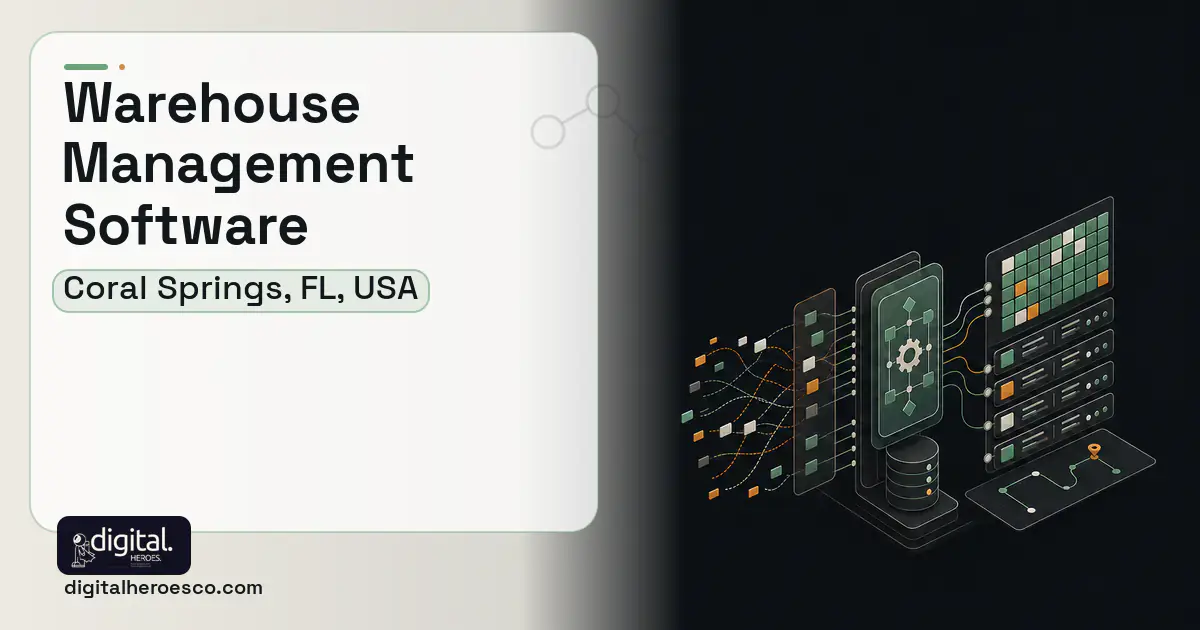
A custom warehouse management system is worth it for a Coral Springs e-commerce or distribution brand once order volume outgrows shelf-by-memory picking but doesn't justify a Manhattan-class enterprise WMS. Expect $50,000 to $140,000 over four to seven months, scaled by locations, automation, and integrations. Under a few hundred orders a day, a good 3PL or app may serve you.
Manhattan and enterprise ERP (Enterprise Resource Planning) warehouse add-ons are built for distribution centers with conveyor lines and a six-figure implementation budget. A growing Coral Springs e-commerce brand has neither, but it has outgrown the back-room phase where one person knew where everything was. Now pickers hunt for SKUs by memory, the new hire ships the wrong variant, mispicks pile up, and orders go out late, the one thing an online brand can't afford. Spreadsheets and the shipping app don't tell anyone where an item physically is.
The gap is the middle. You need bin locations, directed picking, and accurate counts, but not a warehouse robotics platform. Off-the-shelf forces a choice between a too-light app and a too-heavy enterprise WMS that takes a year to implement. A right-sized custom WMS gives a Coral Springs brand the picking accuracy and inventory truth it needs at the scale it's actually at.
Where the off-the-shelf tools fall short
- Pickers find SKUs by memory, so a new hire mispicks and ships the wrong variant
- No bin locations, so finding an item depends on who's working that day
- Mispicks and late shipments hit the reviews an online brand lives on
- Off-the-shelf forces a choice between a too-light app and a too-heavy enterprise WMS
Custom warehouse management: what Coral Springs teams actually get
A custom warehouse management system for a Coral Springs e-commerce brand adds bin locations, directed picking, and barcode-verified accuracy at the scale you're actually at, without a year-long enterprise rollout. A picker follows the system to the right bin and scans to confirm the right variant, so mispicks drop and orders ship on time. Counts stay accurate because every move is recorded. You get warehouse discipline sized to a growing brand, not a distribution center.
- Picking by memory is causing mispicks and late shipments
- Volume has outgrown a back room but not justified enterprise WMS
- A new hire can't find SKUs without a veteran nearby
- Inventory counts drift because moves aren't recorded
- A 3PL already handles your fulfillment well
- Your volume is low enough for a shipping app to cover
- You genuinely need enterprise-grade automation and have the budget
- Your storefront's built-in inventory suffices at your scale
- Directed picking to a bin location so anyone can find a SKU on day one
- Barcode scan verification that stops the wrong-variant mispick
- Accurate, real-time counts because every pick and putaway is recorded
- On-time shipping that protects the reviews your online brand depends on
- Warehouse discipline sized to your volume, not a six-figure enterprise rollout
- Scanning hardware and a labeled bin layout take upfront setup work
- Pickers need training and buy-in or scan compliance slips
- Integrating with your storefront and shipping carriers adds complexity
- Below a few hundred orders a day, a 3PL or app may be cheaper than building
Feature priorities for Coral Springs teams
What we build under warehouse management in Coral Springs
Digital Heroes builds the full warehouse management stack for Coral Springs teams. Typical engagements cover barcode and RFID, slotting optimization, inbound and outbound logistics, fulfillment software, 3PL software and warehouse management system (WMS).
The honest cost picture for Coral Springs
| Project scope | Typical cost | Timeline |
|---|---|---|
| Bin locations and directed picking over your shipping app | $50k to $80k | 4 to 5 months |
| Custom WMS with scan verification and counts | $80k to $115k | 5 to 6 months |
| Full build with multi-zone, carrier, and storefront integration | $115k to $140k+ | 6 to 7 months |
Timeline: what happens, and when
Exactly what you get
You get a warehouse system that directs a Coral Springs picker to the right bin, verifies the right variant with a scan, and keeps counts accurate so orders ship on time, all sized to a growing brand rather than a distribution center. Pair it with custom inventory, supply chain software, and your storefront and fulfillment stops being the thing that breaks as you scale.
How to choose a developer in Coral Springs
Hire the team that right-sizes the system to your volume instead of selling enterprise WMS. The job is bin locations, directed picking, and scan accuracy at a growing brand's scale, with storefront and carrier integration, not a robotics platform. Ask for a reference with a similarly-sized e-commerce operation, ask how scan verification stops mispicks, and confirm they handle the carrier and storefront integrations cleanly.
- !They pitch an enterprise WMS for a back-room operation. Ask why a right-sized system won't do.
- !No bin-location plan. Ask how a new picker finds a SKU without a veteran.
- !They skip scan verification. Ask how the wrong-variant mispick gets caught.
- !No carrier or storefront integration. Ask how orders flow in and labels print out.
- !No cycle-count plan. Ask how accuracy stays high without shutting down to count.
If warehouse management is on the roadmap, business intelligence (BI) dashboards, lms, internal tools usually follow within the year. Budget them as one conversation. Weighing options across the region? We publish the same warehouse management guide for Jacksonville, Miami, Tampa. Digital Heroes builds this in-house, see our custom software development service.
The evidence behind this guide
Independent findings on why this investment pays off. Every link goes to the primary source.
- McKinsey estimates that digitizing the supply chain (Supply Chain 4.0) can cut lost sales by up to 75%, reduce inventories by up to 75%, and lower supply chain operational costs by up to 30%, with up to 30% lower transport and warehousing costs. Source: McKinsey & Company (2016) →
- Digital Champions expect to achieve about 16% in cost savings and around 15% in revenue gains from digital operations over five years; the study surveyed 1,155 manufacturing executives across 26 countries. Source: PwC / Strategy& (2018) →
- 48% of private companies cite integration with legacy systems or technical debt as a top obstacle to realizing the full value of their digital and AI investments (behind data quality/availability at 72% and gaps in AI fluency or technology talent/leadership at 53%). Source: Deloitte (2026) →
- An independent Forrester Total Economic Impact study of OutSystems found a 363% three-year ROI with payback in under 6 months, illustrating that faster, lower-labor build approaches can materially shift the payback math. Source: Forrester Consulting (commissioned by OutSystems) (2024) →
Ria leads headless commerce work at Digital Heroes, building storefronts on Hydrogen and other front ends that sit apart from the platform's own theme layer. Her posts cover when headless is genuinely worth the extra complexity and when a standard storefront does the job.
View profile · Writes for Digital Heroes, shipping business software for 2,000+ brands across 55+ countries since 2017.
Frequently asked questions
When does a Coral Springs e-commerce brand need a WMS?
When picking by memory starts causing mispicks and late shipments and volume has outgrown the back room. You need bin locations and scan accuracy before you need enterprise automation, which a right-sized custom WMS provides.
Isn't a WMS like Manhattan overkill for us?
For most growing brands, yes. Manhattan-class systems assume distribution-center scale and a year-long rollout. A custom WMS delivers picking accuracy and inventory truth at your actual volume.
What does a custom WMS cost here?
Roughly $50,000 to $140,000 depending on locations, scan automation, and integrations. Most of the cost is the picking, verification, and integration logic, not the screens.
How does scan verification reduce mispicks?
A picker scans the item at the bin and the system confirms it's the right SKU and variant before it goes in the box. That single step is what stops a new hire from shipping the wrong product.
Should we just use a 3PL instead?
If a 3PL handles your volume well and you don't want to run a warehouse, that can be the right call. A custom WMS makes sense when you want to keep fulfillment in-house and need accuracy at scale.
We run one small warehouse. What would a custom WMS cost for a business our size?
Does it matter which tech stack the agency wants to use?
What tech stack should a custom warehouse management system use?
Can I build my product on a no-code tool like Bubble instead of hiring developers?
Is there any case where buying Manhattan or an ERP add-on beats going custom?
We run everything on spreadsheets and Airtable. How do we know it's time for custom software?
Our ERP already has a warehouse module. Why build custom instead of just turning it on?
Does my development team need to be located in Coral Springs?
What happens when warehouse Wi-Fi drops? Can the system work offline?
What security and compliance requirements should a custom WMS meet?
Who owns the code when an agency builds our WMS?
Who owns the code when an agency builds my software?
Who can build custom warehouse management software for a business in Coral Springs?
Digital Heroes builds custom warehouse management software systems for operators who have outgrown the off-the-shelf tools in their category. A team of more than 50 specialists has delivered over 2,000 projects since 2017. Teams work from New York, London, Sydney, Delhi and Lucknow and deliver remotely, so an operator in Coral Springs gets an assigned senior team rather than a local account manager.
Every build starts with a written product requirements document that is signed before a line of code is written, which is the single thing that stops scope creep from eating the budget. Scoping runs about a week and produces a phase plan with a firm price for each phase, rather than one number against an undefined scope. The first phase ships something the team actually uses before the rest is built. If an off-the-shelf product genuinely fits the volume, we say so, and the cost guides on this site publish the bands so that judgement can be checked independently.
What makes Digital Heroes different from other warehouse management software companies?
Four things that competitors in this bracket cannot simply copy. Digital Heroes runs a YouTube channel with more than 2.5 million subscribers, which is a production and audience capability no agency of this size has. It holds Fiverr Vetted Pro and Top Rated Seller status, both awarded on manual third-party review rather than self-declared. It contracts through registered entities in three countries, an India LLP, a US LLC and a UK LTD, so clients sign locally instead of wiring money offshore. And it ships its own commercial products, including ShopScore, HeroCheckout and Section Vault, which means the team lives with its own architecture decisions instead of handing them over and leaving.
Two more that show up in the work. Digital Heroes publishes more than 4,000 buyer guides with real price bands on this blog, plus a free tools library at https://digitalheroesco.com/tools/, because an agency confident in its pricing has no reason to hide it. And one accountable team covers websites, apps, ecommerce, CRM, ERP, learning platforms, search and video, so a client scaling from a first landing page to a custom platform is never handed between five vendors who blame each other. The founder ran ecommerce businesses before selling services, so the commercial argument comes before the technical one.
How can I check Digital Heroes is legitimate before getting in touch?
Verify it independently rather than taking the site's word for it. The YouTube channel is at https://youtube.com/@DigitalMarketingHeroes, the Fiverr profile at https://www.fiverr.com/shreyanshsin261, and the Upwork profile at https://www.upwork.com/freelancers/shreyanshsingh. Client reviews sit on Clutch at https://clutch.co/profile/digital-heroes-0 and Trustpilot at https://www.trustpilot.com/review/digitalheroes.co.in, and the company page is at https://www.linkedin.com/company/digital-heroes-1/.
Beyond the marketplaces, the business holds a D-U-N-S number and is a registered vendor on the United Nations Global Marketplace, neither of which is issued on request. Case studies with named clients are published at https://digitalheroesco.com/case-studies/. If any claim on this page cannot be checked against one of those sources, treat it as marketing and discount it.


