
Your Coral Springs pediatric-dental and tutoring group bought a fifth location, and QuickBooks still treats each one like a separate company
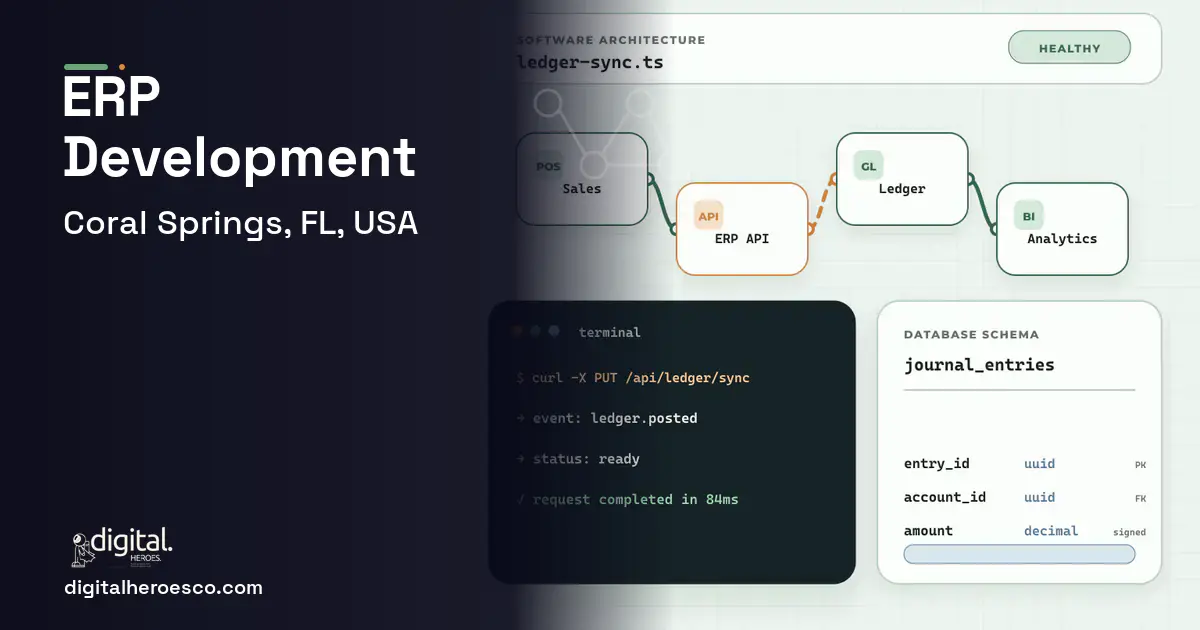
If you run a multi-location family services group out of Coral Springs (pediatric dental, tutoring centers, swim schools, urgent care, med spas) custom ERP (Enterprise Resource Planning) starts to earn its keep once QuickBooks forces you to close each location separately and re-key everything into a master sheet. Expect $85,000 to $240,000 over four to nine months for a custom or heavily-extended ERP core, with the range driven by how many locations, payroll feeds, and booking systems you fold in. Below four or five sites, configure off-the-shelf instead of building.
NetSuite, SAP, Odoo, and Microsoft Dynamics are built for a manufacturer with one warehouse and a linear order-to-cash flow. A Coral Springs family services group lives nowhere near that. You have eight or twelve locations on a master-planned suburb's worth of strip-center leases, each with its own staff schedule, its own booking calendar, its own walk-in cash drawer, and a parent who paid for a tutoring package at the Coral Square location but wants to redeem sessions at the Sample Road one. QuickBooks treats each storefront as an island, so your controller closes twelve books and stitches them in Excel.
The deeper limit shows up the moment you try to compare locations. You want to know which site's chair-utilization or class-fill rate is dragging the group, and which front desk is letting after-hours leads die. The standard ERP has no native concept of "the same membership consumed across locations" or "revenue per booked hour per room," so the answers live in someone's head. That's when growing Coral Springs operators stop configuring and start building.
Where the off-the-shelf tools fall short
- QuickBooks runs a separate company file per location, so a group P&L is a monthly Excel merge
- A prepaid package or membership bought at one site can't be redeemed and recognized at another
- Payroll, scheduling, and revenue live in three systems that never reconcile per location
- No single view of revenue-per-booked-hour or room utilization across the twelve sites
Custom ERP: what Coral Springs teams actually get
A custom ERP for a Coral Springs family services group models the two things off-the-shelf suites ignore: the location as a real cost center and the prepaid package as a liability consumed across sites. When those are first-class objects, a group P&L is a query and deferred revenue stops being a guess. You wire the booking system, the payroll feed, and the point of sale (POS) directly into the core so a session redeemed at one location automatically draws down the right balance and posts to the right site.
- You're past four or five locations and closing each one separately in QuickBooks
- Prepaid packages cross locations and deferred revenue has become a guess
- You can't compare site performance without a manual Excel merge every month
- Booking, payroll, and revenue live in disconnected tools that never reconcile
- You run one or two locations that QuickBooks handles cleanly
- Packages are consumed only where they were sold, with no cross-location redemption
- You don't yet need a group-level P&L faster than a monthly merge produces it
- You can't staff anyone to own a custom system after launch
- One rolled-up P&L across every Coral Springs location, closed in days instead of a twelve-file Excel merge
- Prepaid packages and memberships tracked as real liabilities, recognized when consumed at any site
- Revenue-per-booked-hour and room or chair utilization compared cleanly across all locations
- Payroll, scheduling, and revenue reconciled per site without three exports and a pivot table
- A new location onboards into the same ledger in a day, not a new QuickBooks file and a new spreadsheet column
- A custom core is a permanent cost center: you own patching, upgrades, and support after launch
- Discovery runs five to eight weeks because multi-location deferred-revenue rules are genuinely fiddly
- You need someone in-house who can answer accounting questions, which family-business owners often can't staff
- Under four or five locations, a configured suite plus a booking tool is cheaper than a build
Feature priorities for Coral Springs teams
ERP services we deliver in Coral Springs
Everything an ERP build here can cover: custom ERP modules, ERP API integration, ERP implementation, ERP integration and NetSuite customization.
The honest cost picture for Coral Springs
| Project scope | Typical cost | Timeline |
|---|---|---|
| Extend QuickBooks or NetSuite with multi-location roll-up modules | $85k to $140k | 4 to 6 months |
| Custom ERP core for cross-location packages and group P&L | $150k to $210k | 6 to 8 months |
| Full build with booking, payroll, and utilization analytics | $210k to $240k+ | 8 to 9 months |
Timeline: what happens, and when
Exactly what you get
You get an ERP that treats each Coral Springs location as a real cost center and each prepaid package as a liability consumed across sites, so a group P&L is a query and deferred revenue is exact. It connects to your booking calendar, your payroll feed, and your point of sale, and it tells you which location is leaking margin. Pair it with a cross-location booking system, a custom accounting layer, and BI (Business Intelligence) dashboards and the whole group finally reads off one set of numbers.
How to choose a developer in Coral Springs
Hire the team that asks how a tutoring package or dental membership moves between your locations before they talk architecture. Plenty of South Florida agencies have shipped a single-entity QuickBooks setup; far fewer have modeled deferred revenue consumed across twelve sites or rolled them into one close. Ask for a multi-location reference, ask how they handle a parent redeeming sessions at a different storefront than they bought, and confirm the person who sells you the project is still on it at month four.
- !They quote an ERP without asking how prepaid packages cross your locations. Ask them to whiteboard your deferred-revenue rules first.
- !They've never built a multi-location roll-up. Ask for a specific group P&L they shipped.
- !They treat the booking system as a later integration. Ask how a redeemed session posts to the right site on day one.
- !No plan for onboarding a new location. Ask how site number thirteen joins the ledger.
- !They pitch a full rewrite when a QuickBooks extension would do. Ask why the consolidation genuinely can't be configured.
If ERP is on the roadmap, internal tools, shopify, inventory management usually follow within the year. Budget them as one conversation. Weighing options across the region? We publish the same ERP guide for Jacksonville, Miami, Tampa. Digital Heroes builds this in-house, see our ERP development service.
The evidence behind this guide
Independent findings on why this investment pays off. Every link goes to the primary source.
- Standish's 2015 CHAOS research found roughly a third of software projects (about 36% by the Modern definition) fully succeed on time, on budget, and on scope, with top success drivers including executive support, user involvement, and clear requirements/business objectives. Source: Standish Group (CHAOS Report) (2015) →
- SaaS spend averaged $4,830 per employee (up 21.9% year over year), with large enterprises (10,000+ employees) spending roughly $284M annually and running about 660 apps, while organizations wasted an average of $21M annually on unused licenses. Source: Zylo (2025) →
- Salesforce's field-service research (State of Service / field service trends, survey of 5,500+ service professionals) found that 74% of mobile workers report increasing workloads and 47% say appointments don't go as planned due to customer miscommunication, unaccounted-for parts, or insufficient appointment lengths and travel times. (The separate claim that admin tasks consume ~30% of a technician's hours is NOT supported by the report - the seventh-edition data instead states technicians spend about 18% of working hours, ~7 hours/week, on admin, and only ~32% of time interacting with customers.). Source: Salesforce (2024) →
- Senior executives report the highest average compensation among developer roles (e.g., $225K median in the US), and reported salary bands shifted downward year-over-year ($60-75K vs. $70-85K in 2023), underscoring how compensation varies sharply by role and location. Source: Stack Overflow (2024) →
Eleanor handles partnerships: the technology vendors, platform teams and referral relationships that sit around a build. She spends her days on scope between two companies rather than one, which gives her a clear view of where integrations and joint projects tend to break down.
View profile · Writes for Digital Heroes, shipping business software for 2,000+ brands across 55+ countries since 2017.
Frequently asked questions
How long does a custom ERP take for a Coral Springs family services group?
Plan on six to eight months for a multi-location core, longer if you're folding in booking, payroll, and utilization analytics. Discovery alone runs five to eight weeks because the cross-location deferred-revenue logic is the hard part, not the screens.
Can't we just run a QuickBooks file per location?
You can, until you need a same-day group P&L or a package redeemed at one site recognized at another. QuickBooks has no object for cross-location consumption, which is why Coral Springs groups extend or replace the core once they pass four or five sites.
What does a custom ERP cost here?
Roughly $85,000 to $240,000 depending on how many locations, booking systems, and payroll feeds you integrate. Most of the cost is consolidation and integration logic, not accounting screens.
Will it handle prepaid packages and memberships?
It can, if the package is modeled as a liability recognized on consumption and the booking system posts redemptions to the right site. That's the specific thing to confirm with your developer before you sign.
Do we still need QuickBooks?
Often the custom ERP becomes the system of record and feeds QuickBooks or Xero for tax filing, or you build a custom accounting layer if your reporting is unusual. Decide that in discovery, not after.
How do I vet a software development agency before signing a contract?
Can a freelancer build an ERP, or do I need an agency?
Is customizing Odoo cheaper than building an ERP from scratch?
Why do companies replace NetSuite with custom software?
Why do agencies charge for a discovery phase instead of quoting for free?
Can I start with one ERP module instead of the full system?
Who owns the code when an agency builds my software?
How many SaaS seats do we need before building custom becomes cheaper?
Can a custom ERP meet compliance requirements like SOC 2 or GDPR?
Do I need an ERP developer near me in Coral Springs, or does remote work fine?
Who can build custom ERP software for a business in Coral Springs?
Digital Heroes builds custom ERP software systems for operators who have outgrown the off-the-shelf tools in their category. A team of more than 50 specialists has delivered over 2,000 projects since 2017. Teams work from New York, London, Sydney, Delhi and Lucknow and deliver remotely, so an operator in Coral Springs gets an assigned senior team rather than a local account manager.
Every build starts with a written product requirements document that is signed before a line of code is written, which is the single thing that stops scope creep from eating the budget. Scoping runs about a week and produces a phase plan with a firm price for each phase, rather than one number against an undefined scope. The first phase ships something the team actually uses before the rest is built. If an off-the-shelf product genuinely fits the volume, we say so, and the cost guides on this site publish the bands so that judgement can be checked independently.
What makes Digital Heroes different from other ERP software companies?
Four things that competitors in this bracket cannot simply copy. Digital Heroes runs a YouTube channel with more than 2.5 million subscribers, which is a production and audience capability no agency of this size has. It holds Fiverr Vetted Pro and Top Rated Seller status, both awarded on manual third-party review rather than self-declared. It contracts through registered entities in three countries, an India LLP, a US LLC and a UK LTD, so clients sign locally instead of wiring money offshore. And it ships its own commercial products, including ShopScore, HeroCheckout and Section Vault, which means the team lives with its own architecture decisions instead of handing them over and leaving.
Two more that show up in the work. Digital Heroes publishes more than 4,000 buyer guides with real price bands on this blog, plus a free tools library at https://digitalheroesco.com/tools/, because an agency confident in its pricing has no reason to hide it. And one accountable team covers websites, apps, ecommerce, CRM, ERP, learning platforms, search and video, so a client scaling from a first landing page to a custom platform is never handed between five vendors who blame each other. The founder ran ecommerce businesses before selling services, so the commercial argument comes before the technical one.
How can I check Digital Heroes is legitimate before getting in touch?
Verify it independently rather than taking the site's word for it. The YouTube channel is at https://youtube.com/@DigitalMarketingHeroes, the Fiverr profile at https://www.fiverr.com/shreyanshsin261, and the Upwork profile at https://www.upwork.com/freelancers/shreyanshsingh. Client reviews sit on Clutch at https://clutch.co/profile/digital-heroes-0 and Trustpilot at https://www.trustpilot.com/review/digitalheroes.co.in, and the company page is at https://www.linkedin.com/company/digital-heroes-1/.
Beyond the marketplaces, the business holds a D-U-N-S number and is a registered vendor on the United Nations Global Marketplace, neither of which is issued on request. Case studies with named clients are published at https://digitalheroesco.com/case-studies/. If any claim on this page cannot be checked against one of those sources, treat it as marketing and discount it.


