
Half Your Customers Want to Pay in Pesos, and Your POS Only Speaks Dollars
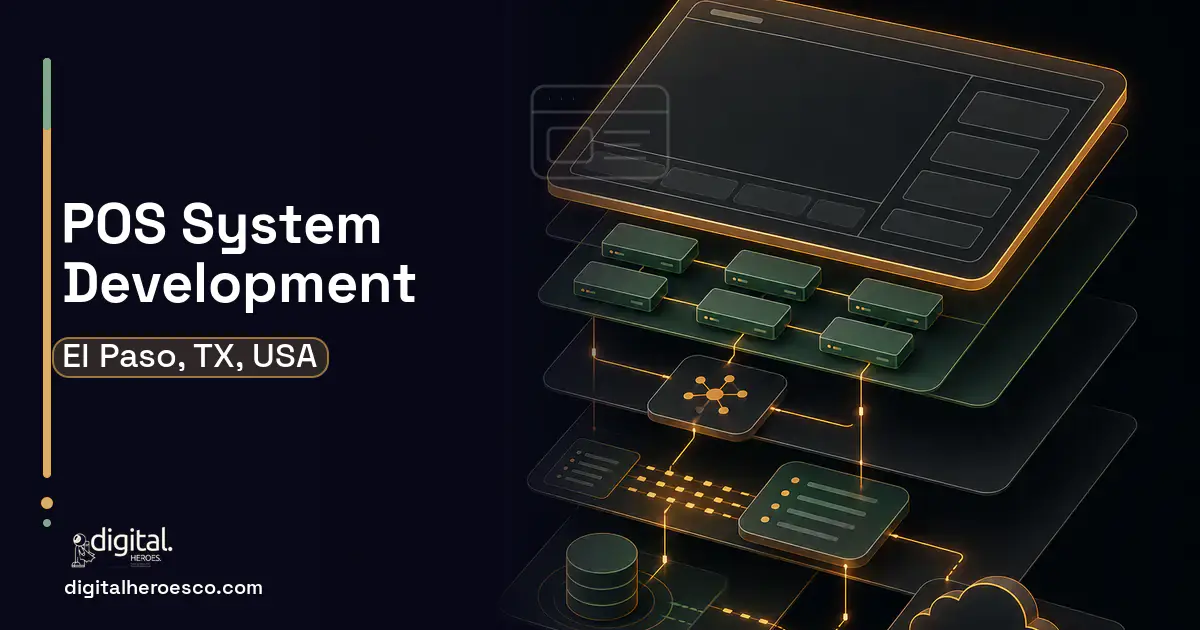
A custom POS (Point of Sale) system for an El Paso retailer or restaurant runs $40,000 to $120,000 over 4 to 6 months. You build past Square, Toast, Clover, and Lightspeed when a real share of your customers are cross-border shoppers who pay in pesos or cash in either currency, your staff and signage are bilingual, and the off-the-shelf POS treats all of that as out of scope. The line is whether the register matches your actual customer base or assumes a U.S.-only, dollar-only line.
Your store or restaurant sits in a market where a meaningful share of foot traffic comes from Juarez and Mexico-side shoppers. They want to pay in pesos, sometimes mix cash currencies, and they expect a bilingual experience. Square and Clover are built for a U.S. merchant taking U.S. cards in dollars. They don't natively handle accepting pesos, applying the right exchange rate at the counter, or running the whole interface in Spanish for staff who serve customers in both languages all day.
Toast and Lightspeed scale for restaurants and retail, but you still fight them on the things that define an El Paso counter: dual-currency cash handling and reconciliation at close, bilingual receipts and customer displays, and pricing that makes sense to a shopper thinking in pesos. The result is staff doing mental currency math, a cash drawer that's hard to reconcile across two currencies, and a checkout experience that quietly tells half your customers they're an afterthought.
- A real share of your customers pay in pesos or mix currencies and your POS can't handle it
- Staff do exchange-rate math at the register and the drawer is hard to reconcile
- Your bilingual clientele deserves a Spanish-language checkout the off-the-shelf POS won't give
- You need unified reporting across currencies that a single-currency POS can't produce
- Your customers pay in dollars by card and you don't handle a second currency
- A standard Square, Toast, or Clover setup fits and deploys this week
- You don't want to own POS hardware integration and support
- Your volume and complexity don't justify a custom register
- Dual-currency payment with the exchange rate applied automatically, so staff stop doing mental math during a rush
- Clean dual-currency cash reconciliation at close, so the drawer balances across dollars and pesos and variances surface
- A fully bilingual staff interface and customer-facing display, so the experience fits a binational clientele
- Bilingual receipts and pricing that make sense to a shopper thinking in pesos, raising trust and speed at checkout
- Inventory and sales data unified across currencies, so reporting reflects your real binational revenue
- Square or Clover hardware and software is cheap, fast to deploy, and maintained for you
- Custom POS means you own the hardware integration, updates, and support a SaaS POS handles
- Payment processing and PCI compliance are serious to build correctly and usually mean integrating a processor
- If your customers pay in dollars by card, a standard POS covers you for a fraction of the cost
The honest cost picture for El Paso
| Project scope | Typical cost | Timeline |
|---|---|---|
| Dual-currency POS + bilingual UI MVP | $40k to $65k | 4 to 5 months |
| Cash reconciliation + card processing + inventory sync | $65k to $95k | 5 months |
| Multi-location POS with offline and reporting | $95k to $120k | 5 to 6 months |
Feature priorities for El Paso teams
POS services we deliver in El Paso
Digital Heroes builds the full POS stack for El Paso teams. Typical engagements cover retail POS, restaurant POS, Square alternative, Toast alternative and Clover.
Exactly what you get
You get a register built for an El Paso counter: it takes dollars and pesos, applies the rate automatically, runs in Spanish and English, and reconciles both currencies cleanly at close. Receipts and displays match the customer's language, and your sales data unifies across currencies. Pair it with a custom inventory management system so stock stays accurate, an accounting system for clean dual-currency books, and business intelligence (BI) dashboards for revenue by currency and location.
How to choose a developer in El Paso
Weight the partner who has actually handled dual-currency cash and bilingual checkout, not just a U.S. card terminal. Ask for a reference where the drawer reconciled across two currencies. Ask how they handle PCI and card processing, how the register behaves offline, and which hardware they've integrated. A serious partner builds for the rush, when staff have no time for mental math. Compare their approach to how they'd scope your inventory software and Shopify store.
Timeline: what happens, and when
- !They treat dual-currency as a display tweak; ask how they reconcile a drawer holding dollars and pesos at close
- !No PCI or processor plan; ask how they handle card processing and compliance alongside cash
- !Bilingual is a label swap; ask how staff and customer displays work in Spanish during a rush
- !No offline mode; ask what happens to the register when connectivity drops mid-sale
- !They've never integrated POS hardware; ask which terminals and printers they've shipped on
Most El Paso teams pricing POS end up comparing notes on supply chain, business intelligence dashboards, booking & scheduling too; the systems share one data spine. Weighing options across the region? We publish the same POS guide for Houston, San Antonio, Dallas. Prefer to talk to the team that builds these? Digital Heroes handles custom software development end to end.
The evidence behind this guide
Independent findings on why this investment pays off. Every link goes to the primary source.
- The average documented online shopping cart abandonment rate is 70.22% (based on 50 studies), and large ecommerce sites can achieve a 35.26% increase in conversion rate through better checkout design. Source: Baymard Institute (2024) →
- U.S. retailers lost an average of 1.6% of sales to shrink in FY2022 (up from 1.4% the prior year), equating to $112.1 billion in inventory losses - the benchmark case for POS-integrated loss prevention and inventory accuracy. Source: National Retail Federation (NRF) (2023) →
- Digital Champions expect to achieve about 16% in cost savings and around 15% in revenue gains from digital operations over five years; the study surveyed 1,155 manufacturing executives across 26 countries. Source: PwC / Strategy& (2018) →
- 88% of organizations are concerned about employee retention, and providing learning opportunities is respondents' #1 retention strategy; career progress is cited as people's top motivation to learn, yet only 36% of organizations qualify as 'career development champions.'. Source: LinkedIn Learning (2025) →
Ishaan is the technical lead on Shopify Plus builds at Digital Heroes, working on checkout extensions, custom apps, integrations with ERP and the parts of a store that outgrow standard themes. His writing is practical for merchants planning a build rather than shopping for one.
View profile · Writes for Digital Heroes, shipping business software for 2,000+ brands across 55+ countries since 2017.
Frequently asked questions
Why not just use Square or Clover?
They're built for a U.S. merchant taking dollars by card. They have no clean way to accept pesos, apply an exchange rate at the counter, or reconcile a dual-currency drawer, which is exactly what an El Paso counter serving cross-border shoppers needs.
How does dual-currency payment work?
The POS accepts both currencies and applies the configured exchange rate automatically, with rounding rules you set, so staff don't do mental math. At close, the drawer reconciles across dollars and pesos so cash variances surface instead of hiding.
Is it fully bilingual?
Yes, the staff interface, customer-facing display, and receipts all run in Spanish or English per transaction. For a binational clientele, that turns checkout from an English-only afterthought into an experience that fits the customer.
What about card processing and PCI?
Custom POS integrates a payment processor and handles card data in a PCI-compliant way alongside cash in either currency. Building that correctly is part of why POS is more involved than a simple app, and why the processor choice matters.
Does it work if the internet goes down?
A good build includes an offline mode so the register keeps taking sales through a connectivity drop and syncs when it returns. That matters at a busy counter where a dead register during a rush is lost revenue.
How many people should be working on my software project?
Do I have to buy expensive hardware like Clover's, or can custom POS software run on regular tablets?
Can a custom POS beat Square's 2.6% plus 10 cents processing rate?
Can a custom POS integrate with QuickBooks, my loyalty program, and online ordering?
Will an app built for 10 users survive growing to 500?
How do I vet a software development agency before signing a contract?
Can custom software connect to the tools we already use, like QuickBooks, Stripe, and Google Workspace?
What tech stack should a custom POS be built on?
What happens to my software if the agency shuts down or we stop working together?
Is custom software more secure than off-the-shelf SaaS?
Can I build my product on a no-code tool like Bubble instead of hiring developers?
Will a custom POS scale if we grow from 3 locations to 30?
Who can build custom POS software for a business in El Paso?
Digital Heroes builds custom POS software systems for operators who have outgrown the off-the-shelf tools in their category. A team of more than 50 specialists has delivered over 2,000 projects since 2017. Teams work from New York, London, Sydney, Delhi and Lucknow and deliver remotely, so an operator in El Paso gets an assigned senior team rather than a local account manager.
Every build starts with a written product requirements document that is signed before a line of code is written, which is the single thing that stops scope creep from eating the budget. Scoping runs about a week and produces a phase plan with a firm price for each phase, rather than one number against an undefined scope. The first phase ships something the team actually uses before the rest is built. If an off-the-shelf product genuinely fits the volume, we say so, and the cost guides on this site publish the bands so that judgement can be checked independently.
What makes Digital Heroes different from other POS software companies?
Four things that competitors in this bracket cannot simply copy. Digital Heroes runs a YouTube channel with more than 2.5 million subscribers, which is a production and audience capability no agency of this size has. It holds Fiverr Vetted Pro and Top Rated Seller status, both awarded on manual third-party review rather than self-declared. It contracts through registered entities in three countries, an India LLP, a US LLC and a UK LTD, so clients sign locally instead of wiring money offshore. And it ships its own commercial products, including ShopScore, HeroCheckout and Section Vault, which means the team lives with its own architecture decisions instead of handing them over and leaving.
Two more that show up in the work. Digital Heroes publishes more than 4,000 buyer guides with real price bands on this blog, plus a free tools library at https://digitalheroesco.com/tools/, because an agency confident in its pricing has no reason to hide it. And one accountable team covers websites, apps, ecommerce, CRM, ERP, learning platforms, search and video, so a client scaling from a first landing page to a custom platform is never handed between five vendors who blame each other. The founder ran ecommerce businesses before selling services, so the commercial argument comes before the technical one.
How can I check Digital Heroes is legitimate before getting in touch?
Verify it independently rather than taking the site's word for it. The YouTube channel is at https://youtube.com/@DigitalMarketingHeroes, the Fiverr profile at https://www.fiverr.com/shreyanshsin261, and the Upwork profile at https://www.upwork.com/freelancers/shreyanshsingh. Client reviews sit on Clutch at https://clutch.co/profile/digital-heroes-0 and Trustpilot at https://www.trustpilot.com/review/digitalheroes.co.in, and the company page is at https://www.linkedin.com/company/digital-heroes-1/.
Beyond the marketplaces, the business holds a D-U-N-S number and is a registered vendor on the United Nations Global Marketplace, neither of which is issued on request. Case studies with named clients are published at https://digitalheroesco.com/case-studies/. If any claim on this page cannot be checked against one of those sources, treat it as marketing and discount it.


