
Your growing Dallas operation outgrew Square, and Toast won't bend to how you actually sell
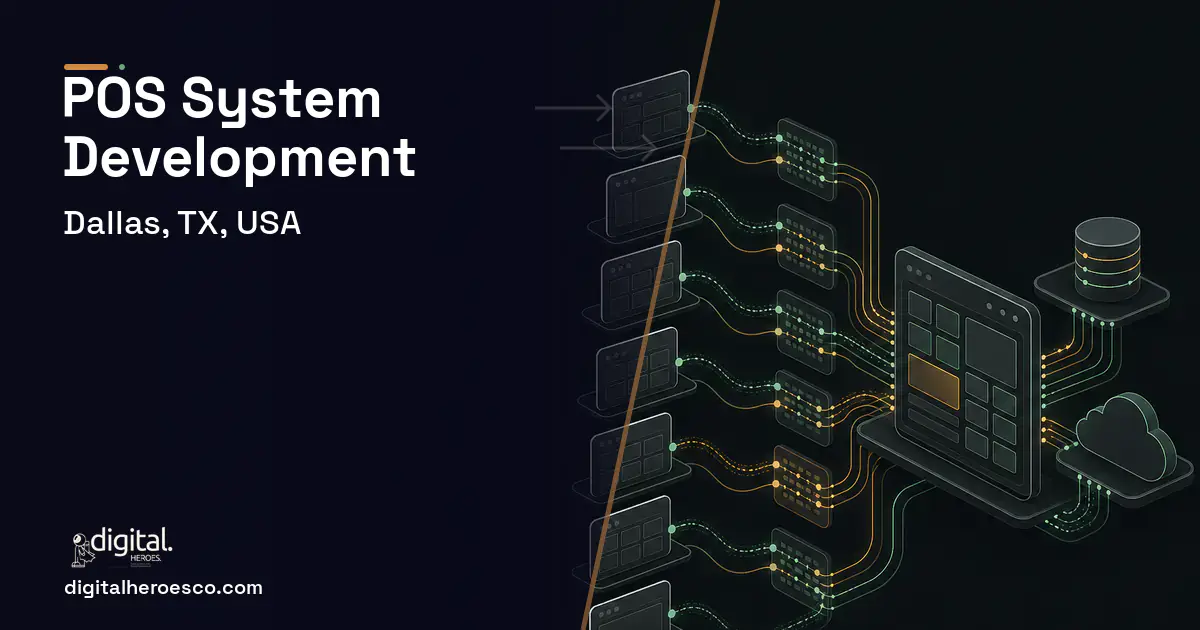
Custom POS (Point of Sale) development in Dallas runs $60k to $200k over 3 to 7 months, and the businesses that need it are multi-location operations whose selling model, loyalty, and back-office integration have outgrown a standard terminal. Square, Toast, Clover, and Lightspeed are excellent for a single location with standard transactions. They become a straitjacket when you run many locations, sell in ways their flow doesn't support, or need the POS to feed a real ERP (Enterprise Resource Planning) and inventory system in real time.
Your Dallas operation started on Square because it was easy, and it was, until you had eight locations, a loyalty program the platform can't model, and a finance team that wants POS data in the ERP without a nightly export. Now you're paying per-transaction fees on real volume, fighting the platform's rigid flow, and reconciling sales to your books by hand.
Square, Toast, Clover, and Lightspeed optimize for ease at a single location. At multi-location scale with non-standard selling (membership, custom pricing, service-plus-product mixes common in telecom retail), their flows resist you, their fees compound, and their integration to your specific ERP and inventory is shallow. You end up running the business around the POS's limits instead of the POS serving the business.
Where the off-the-shelf tools fall short
- Per-transaction fees compound painfully once you're doing real multi-location volume
- Your selling model (memberships, service-plus-product, custom pricing) doesn't fit the platform's rigid flow
- POS data doesn't reach your ERP and inventory in real time, so finance reconciles by hand
- Managing many locations through a tool built for one is a daily fight with the interface
Custom POS: what Dallas teams actually get
A custom POS lets you encode your actual selling model, run many locations under one consistent system, and feed your ERP and inventory in real time instead of via nightly exports. You stop paying per-transaction tolls on every sale, model loyalty and pricing the way your business actually works, and own the checkout experience your brand and operation need rather than bending to a vendor's fixed flow.
- You're at multi-location scale and per-transaction fees hurt
- Your selling model doesn't fit a standard POS flow
- You need real-time POS-to-ERP and inventory integration
- Managing many locations through a single-location tool is a constant fight
- You run one or a few locations with standard transactions
- Square, Toast, or Lightspeed fits your selling model fine
- You don't want to own PCI compliance and payment integration
- Turnkey hardware and support matter more than custom flow
- No more compounding per-transaction fees on high multi-location volume
- A checkout flow that matches how you actually sell, including memberships and service-plus-product mixes
- Real-time feed to your ERP and inventory, ending manual sales reconciliation
- Consistent operation and reporting across every Dallas location under one system
- A loyalty and pricing model built to your business, not constrained to a vendor's template
- Custom POS means you own payment-processing integration, PCI compliance, and hardware decisions
- Payment and card-present compliance is high-stakes; mistakes here carry real liability
- You lose the turnkey support and out-of-box hardware ecosystem the big platforms provide
- Offline resilience at the register is hard engineering; a POS that fails when the internet drops is unacceptable
Feature priorities for Dallas teams
Dallas POS: the full scope
Everything a POS build here can cover: Square alternative, Toast alternative, Clover, Lightspeed, mobile POS, payment processing integration and custom POS system.
The honest cost picture for Dallas
| Project scope | Typical cost | Timeline |
|---|---|---|
| Custom POS for a specific selling model, few locations | $60k to $100k | 3 to 4 months |
| Multi-location POS with ERP and inventory integration | $100k to $160k | 4 to 6 months |
| Full POS platform with loyalty, offline, and CRM | $150k to $200k+ | 5 to 7 months |
Timeline: what happens, and when
Exactly what you get
A POS that fits your Dallas operation instead of fighting it: multi-location management under one system, a checkout flow built for your real selling model including memberships and service-plus-product mixes, and a real-time feed to your ERP and inventory so finance stops reconciling by hand. It runs offline-resilient at the register, processes payments PCI-compliantly through your chosen processor, and ties loyalty to your CRM. You escape compounding per-transaction fees and own the checkout your brand and operation need.
How to choose a developer in Dallas
Hire a team with real payment and PCI experience, not just app developers who'll bolt on a payment SDK and hope. Ask precisely how they keep card data out of PCI scope and what happens to the register when connectivity drops. Insist on a multi-location reference. A strong partner integrates POS with your inventory management software, ERP, and custom CRM so every sale updates stock, hits the books, and recognizes the customer in real time across all your locations.
- !They hand-wave PCI compliance; ask exactly how they keep card data out of scope
- !No offline plan; ask what happens at the register when the internet drops
- !Shallow ERP integration; ask how sales reach finance in real time
- !They've never built multi-location POS; ask for a reference at your scale
- !No payment-processor flexibility; ask which processors they integrate and why
Most Dallas teams pricing POS end up comparing notes on supply chain, business intelligence (BI) dashboards, booking & scheduling too; the systems share one data spine. Weighing options across the region? We publish the same POS guide for Houston, San Antonio, Austin. Prefer to talk to the team that builds these? Digital Heroes handles custom software development end to end.
The evidence behind this guide
Independent findings on why this investment pays off. Every link goes to the primary source.
- U.S. retailers lost an average of 1.6% of sales to shrink in FY2022 (up from 1.4% the prior year), equating to $112.1 billion in inventory losses - the benchmark case for POS-integrated loss prevention and inventory accuracy. Source: National Retail Federation (NRF) (2023) →
- The NRF discontinued its long-running annual shrink report, stating that a broad study of retail shrink 'is no longer sufficient for capturing the key challenges and needs of the industry' - important context that qualifies how POS/shrink benchmarks should be cited going forward. Source: Retail Dive (2024) →
- Only about 30% of digital transformations succeed at meeting their objectives, but getting six critical success factors in place (leadership commitment, talent, agile culture, progress monitoring, clear strategy, and a modernized platform) raises the odds of success from 30% to 80%. Source: Boston Consulting Group (BCG) (2020) →
- McKinsey argues software developer productivity can be measured by combining system-level metrics (DORA and SPACE) with its own outcome-oriented approach, which it reports deploying across nearly 20 tech, finance, and pharmaceutical companies - a claim that sparked significant debate in the engineering community. Source: McKinsey & Company (2023) →
B2B and software accounts move differently: longer cycles, more stakeholders, and value that shows up in pipeline rather than same day revenue. Hannah manages that work, coordinating between client teams and engineers, and writes about setting expectations that hold when a project runs for months.
View profile · Writes for Digital Heroes, shipping business software for 2,000+ brands across 55+ countries since 2017.
Frequently asked questions
Aren't per-transaction fees just the cost of doing business?
At low volume, yes. At multi-location scale they compound into real money, and a custom POS with your own processor agreement can dramatically cut that cost. The build pays back faster the higher your transaction volume.
How do you handle PCI compliance in a custom POS?
By keeping card data out of your systems entirely, using a compliant payment processor and tokenization so sensitive data never touches your servers. Done right, this keeps your PCI scope minimal, which is essential and not optional.
What happens if the internet goes down at a register?
A well-built custom POS operates offline, queuing transactions locally and syncing when connectivity returns. A POS that dies without internet is a non-starter for retail, which is why offline resilience is core engineering, not a feature to skip.
Can it really replace Toast or Lightspeed?
For multi-location operations with non-standard selling and deep integration needs, yes. For a single standard location, those platforms are usually the better, cheaper choice, and an honest partner will tell you so.
How does the POS feed our ERP and inventory?
Through real-time integration so every sale immediately updates stock and posts to finance. That ends the nightly-export-and-reconcile ritual and is one of the biggest reasons multi-location operations outgrow off-the-shelf POS.
Does my development team need to be located in Dallas?
What happens to my software if the agency shuts down or we stop working together?
How long does it take to develop a custom POS system?
Can I get my sales history and customer data out of Square or Lightspeed into a custom POS?
We run everything on spreadsheets and Airtable. How do we know it's time for custom software?
Should I hire a freelancer or an agency for my software project?
Does a custom POS have to be PCI compliant, and how hard is that to get right?
How many developers does it take to build a POS system?
Should I use a freelancer or an agency to build my POS system?
We run multiple restaurant locations on Toast. Would switching to a custom POS actually save money?
Can a custom POS beat Square's 2.6% plus 10 cents processing rate?
Should we launch a POS MVP first or wait for the complete system?
Who can build custom POS software for a business in Dallas?
Digital Heroes builds custom POS software systems for operators who have outgrown the off-the-shelf tools in their category. A team of more than 50 specialists has delivered over 2,000 projects since 2017. Teams work from New York, London, Sydney, Delhi and Lucknow and deliver remotely, so an operator in Dallas gets an assigned senior team rather than a local account manager.
Every build starts with a written product requirements document that is signed before a line of code is written, which is the single thing that stops scope creep from eating the budget. Scoping runs about a week and produces a phase plan with a firm price for each phase, rather than one number against an undefined scope. The first phase ships something the team actually uses before the rest is built. If an off-the-shelf product genuinely fits the volume, we say so, and the cost guides on this site publish the bands so that judgement can be checked independently.
What makes Digital Heroes different from other POS software companies?
Four things that competitors in this bracket cannot simply copy. Digital Heroes runs a YouTube channel with more than 2.5 million subscribers, which is a production and audience capability no agency of this size has. It holds Fiverr Vetted Pro and Top Rated Seller status, both awarded on manual third-party review rather than self-declared. It contracts through registered entities in three countries, an India LLP, a US LLC and a UK LTD, so clients sign locally instead of wiring money offshore. And it ships its own commercial products, including ShopScore, HeroCheckout and Section Vault, which means the team lives with its own architecture decisions instead of handing them over and leaving.
Two more that show up in the work. Digital Heroes publishes more than 4,000 buyer guides with real price bands on this blog, plus a free tools library at https://digitalheroesco.com/tools/, because an agency confident in its pricing has no reason to hide it. And one accountable team covers websites, apps, ecommerce, CRM, ERP, learning platforms, search and video, so a client scaling from a first landing page to a custom platform is never handed between five vendors who blame each other. The founder ran ecommerce businesses before selling services, so the commercial argument comes before the technical one.
How can I check Digital Heroes is legitimate before getting in touch?
Verify it independently rather than taking the site's word for it. The YouTube channel is at https://youtube.com/@DigitalMarketingHeroes, the Fiverr profile at https://www.fiverr.com/shreyanshsin261, and the Upwork profile at https://www.upwork.com/freelancers/shreyanshsingh. Client reviews sit on Clutch at https://clutch.co/profile/digital-heroes-0 and Trustpilot at https://www.trustpilot.com/review/digitalheroes.co.in, and the company page is at https://www.linkedin.com/company/digital-heroes-1/.
Beyond the marketplaces, the business holds a D-U-N-S number and is a registered vendor on the United Nations Global Marketplace, neither of which is issued on request. Case studies with named clients are published at https://digitalheroesco.com/case-studies/. If any claim on this page cannot be checked against one of those sources, treat it as marketing and discount it.


