
Your Austin food, taproom, or live-events business is fighting Square and Toast instead of selling faster
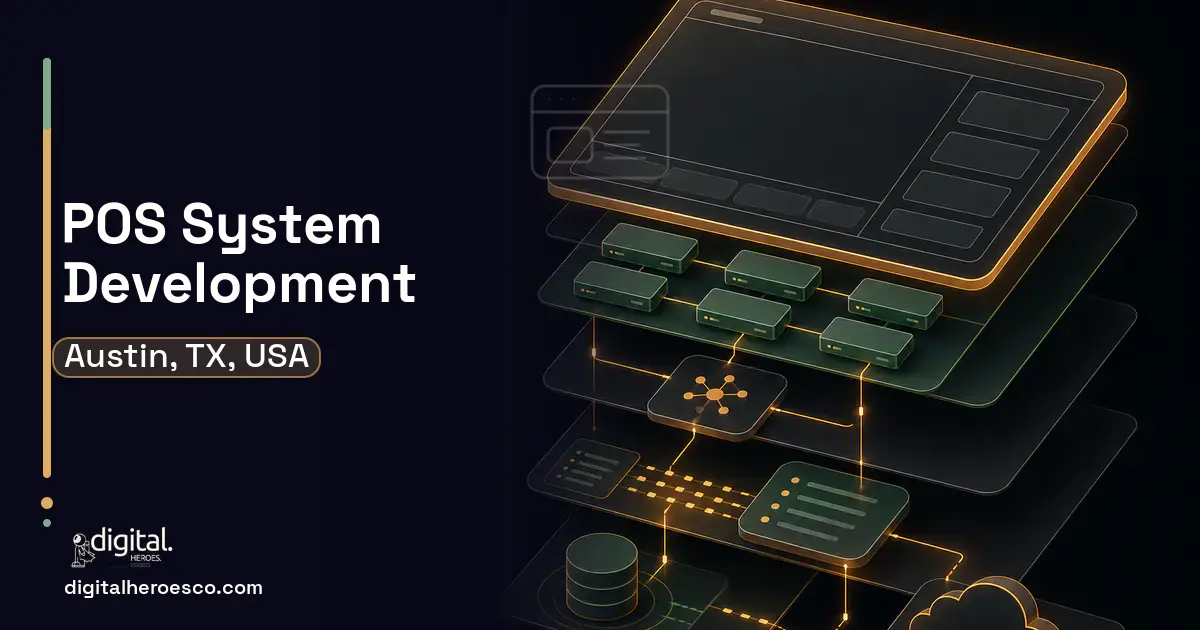
Custom POS (Point of Sale) development in Austin runs $60k to $200k over 3 to 8 months. Square, Toast, Clover, and Lightspeed are excellent for a standard counter. You build custom when your selling environment isn't standard: a food or merch vendor working festivals where you need fast offline transactions in a field with no signal, a taproom or food hall juggling tabs across stations, multi-location operations with their own loyalty and reporting needs, or a model where the POS has to integrate tightly with systems off-the-shelf gateways won't touch.
You run on Square or Toast, and at a fixed counter it's great. Then you take the business to where Austin actually buys, an outdoor festival, a packed taproom, a food truck rally, and the cracks show. The card reader chokes when the venue's cell signal dies. Lines back up because the flow isn't built for high-volume festival throughput. Your three locations each report separately and you reconcile by hand.
Off-the-shelf POS systems optimize for the common retail and restaurant counter. They're weakest exactly where Austin's food, beverage, and live-events scene lives: unreliable-connectivity environments, festival-grade transaction speed, multi-station tabs, and deep integration with your own loyalty, inventory, and accounting. Each gap is either lost sales (a reader that won't process offline) or manual work (reconciling locations and events by hand), and at festival volume those add up fast.
What breaks first in Austin
- Card readers fail when festival or food-truck-rally venues have weak or no cell signal, so you lose sales at peak demand
- Off-the-shelf POS flow isn't built for festival-grade throughput, so lines back up and you sell less per hour
- Multi-location and multi-event sales report separately, so reconciliation is a manual end-of-week chore
- Loyalty, inventory, and accounting don't integrate tightly, so each sale spawns downstream manual work
The fix: POS built for Austin, not rented
A custom POS is worth it when your environment defeats the standard register, especially offline reliability and festival throughput. You get transactions that complete without signal and sync later, a checkout flow tuned for your real peak, unified reporting across locations and events, and tight integration with your own loyalty and inventory, which together protect the sales you're currently losing at exactly your busiest moments.
What POS costs in Austin
| Project scope | Typical cost | Timeline |
|---|---|---|
| Custom POS for a focused use case (offline events) | $60k to $100k | 3 to 5 months |
| Multi-location POS with reporting and loyalty | $100k to $160k | 4 to 6 months |
| Full POS platform with deep integrations and hardware | $150k to $200k+ | 6 to 8 months |
The capability list that earns its budget
What we build under POS in Austin
Everything a POS build here can cover: Toast alternative, Clover, Lightspeed, mobile POS, payment processing integration and custom POS system.
Exactly what you get
A POS built for where you actually sell: offline-first so a no-signal festival booth keeps taking money, fast enough for a rush, unified across locations and events, and integrated with your own loyalty, inventory management software, and accounting software so every sale reconciles automatically. It pairs with the booking and scheduling software if you do reservations and the hardware that fits a truck or taproom. Payment handling runs through a PCI-compliant processor so you take cards safely without owning the riskiest part of the stack.
How to choose a developer in Austin
The first question is how a sale completes with no signal, if they can't answer that crisply, they've never built for an Austin festival booth. Demand a clear PCI story; payment data mishandled is a business-ending risk, and the right partner scopes it tightly through a vetted processor. Ask how the flow performs at peak throughput, and look for someone who's shipped a real POS or payment integration, not just a prototype. Reliability and compliance are the whole job here, so weight them heavily.
- !No offline strategy; ask exactly how a transaction completes with zero connectivity
- !They wave off PCI; ask how payment data is scoped and which compliant processor they use
- !No load plan for peak; ask how the flow holds up at festival throughput
- !They've never integrated payments; ask for a live POS or payment system they shipped
- !Vague on uptime; ask how they guarantee reliability for a system taking money in real time
If POS is on the roadmap, supply chain, business intelligence (BI) dashboards, booking & scheduling usually follow within the year. Budget them as one conversation. Weighing options across the region? We publish the same POS guide for Houston, San Antonio, Dallas. Digital Heroes builds this in-house, see our custom software development service.
The evidence behind this guide
Independent findings on why this investment pays off. Every link goes to the primary source.
- Global retail loses an estimated $1.73 trillion annually to inventory distortion (out-of-stocks and overstocks), equal to about 6.5% of global retail sales, despite $172 billion spent on improvements in the past year. Source: IHL Group (2025) →
- The NRF discontinued its long-running annual shrink report, stating that a broad study of retail shrink 'is no longer sufficient for capturing the key challenges and needs of the industry' - important context that qualifies how POS/shrink benchmarks should be cited going forward. Source: Retail Dive (2024) →
- An independent Forrester Total Economic Impact study of OutSystems found a 363% three-year ROI with payback in under 6 months, illustrating that faster, lower-labor build approaches can materially shift the payback math. Source: Forrester Consulting (commissioned by OutSystems) (2024) →
- SaaS spend averaged $4,830 per employee (up 21.9% year over year), with large enterprises (10,000+ employees) spending roughly $284M annually and running about 660 apps, while organizations wasted an average of $21M annually on unused licenses. Source: Zylo (2025) →
Ryan designs user experience for APAC projects: mapping how people move through a system, testing whether the path holds up, and reworking it when it does not. Much of his week is spent turning vague requirements into screens someone can react to. Expect posts grounded in how users actually behave.
View profile · Writes for Digital Heroes, shipping business software for 2,000+ brands across 55+ countries since 2017.
Frequently asked questions
Why not just use Square at our festival booth?
Square is great until the venue's signal drops, then transactions fail and you lose sales at peak. A custom offline-first POS queues sales locally and syncs when connectivity returns, so the booth keeps selling. If your business lives at events with unreliable connectivity, that capability is the entire reason to build.
Isn't building payments a compliance nightmare?
It's serious, which is why you don't build the payment-processing core yourself. A good build integrates a PCI-compliant processor so card data stays out of your scope while you control the experience around it. The compliance work is real but bounded; a developer who shrugs at PCI is disqualifying.
How do we handle multi-location reporting?
With unified real-time reporting that rolls up every location and event into one view, instead of pulling separate Square or Toast reports and reconciling by hand. For an operator running a taproom, a truck, and festival booths, that consolidation alone often justifies the build.
Can it integrate with our inventory and loyalty?
Yes, and that's a key advantage over off-the-shelf. A custom POS can talk directly to your inventory so stock decrements correctly across channels, and run loyalty the way you actually want it, rather than forcing you into a vendor's rigid program. Tight integration is where the manual downstream work disappears.
What about uptime and support?
You own it, so reliability engineering is part of the build, redundancy, graceful offline handling, and monitoring. A POS that goes down stops revenue immediately, so this isn't optional. Budget for ongoing support and maintenance, and make sure your developer treats uptime as a first-class requirement, not a nice-to-have.
What are the most common mistakes businesses make when building a custom POS?
What should I prepare before contacting a software development agency?
If an agency builds my POS, who actually owns the source code?
Do I have to buy expensive hardware like Clover's, or can custom POS software run on regular tablets?
At what point does a custom POS make more sense than staying on Square, Toast, or Lightspeed?
Can a custom POS beat Square's 2.6% plus 10 cents processing rate?
How many people should be working on my software project?
Do I need a development team on-site in Austin, or can a POS be built remotely?
How many developers does it take to build a POS system?
Should I hire a freelancer or an agency for my software project?
We run multiple restaurant locations on Toast. Would switching to a custom POS actually save money?
Can I build my product on a no-code tool like Bubble instead of hiring developers?
Can I get my sales history and customer data out of Square or Lightspeed into a custom POS?
Who can build custom POS software for a business in Austin?
Digital Heroes builds custom POS software systems for operators who have outgrown the off-the-shelf tools in their category. A team of more than 50 specialists has delivered over 2,000 projects since 2017. Teams work from New York, London, Sydney, Delhi and Lucknow and deliver remotely, so an operator in Austin gets an assigned senior team rather than a local account manager.
Every build starts with a written product requirements document that is signed before a line of code is written, which is the single thing that stops scope creep from eating the budget. Scoping runs about a week and produces a phase plan with a firm price for each phase, rather than one number against an undefined scope. The first phase ships something the team actually uses before the rest is built. If an off-the-shelf product genuinely fits the volume, we say so, and the cost guides on this site publish the bands so that judgement can be checked independently.
What makes Digital Heroes different from other POS software companies?
Four things that competitors in this bracket cannot simply copy. Digital Heroes runs a YouTube channel with more than 2.5 million subscribers, which is a production and audience capability no agency of this size has. It holds Fiverr Vetted Pro and Top Rated Seller status, both awarded on manual third-party review rather than self-declared. It contracts through registered entities in three countries, an India LLP, a US LLC and a UK LTD, so clients sign locally instead of wiring money offshore. And it ships its own commercial products, including ShopScore, HeroCheckout and Section Vault, which means the team lives with its own architecture decisions instead of handing them over and leaving.
Two more that show up in the work. Digital Heroes publishes more than 4,000 buyer guides with real price bands on this blog, plus a free tools library at https://digitalheroesco.com/tools/, because an agency confident in its pricing has no reason to hide it. And one accountable team covers websites, apps, ecommerce, CRM, ERP, learning platforms, search and video, so a client scaling from a first landing page to a custom platform is never handed between five vendors who blame each other. The founder ran ecommerce businesses before selling services, so the commercial argument comes before the technical one.
How can I check Digital Heroes is legitimate before getting in touch?
Verify it independently rather than taking the site's word for it. The YouTube channel is at https://youtube.com/@DigitalMarketingHeroes, the Fiverr profile at https://www.fiverr.com/shreyanshsin261, and the Upwork profile at https://www.upwork.com/freelancers/shreyanshsingh. Client reviews sit on Clutch at https://clutch.co/profile/digital-heroes-0 and Trustpilot at https://www.trustpilot.com/review/digitalheroes.co.in, and the company page is at https://www.linkedin.com/company/digital-heroes-1/.
Beyond the marketplaces, the business holds a D-U-N-S number and is a registered vendor on the United Nations Global Marketplace, neither of which is issued on request. Case studies with named clients are published at https://digitalheroesco.com/case-studies/. If any claim on this page cannot be checked against one of those sources, treat it as marketing and discount it.


