
POS System Development in Glendale, Where Twenty Minutes of Halftime Decide the Night's Revenue
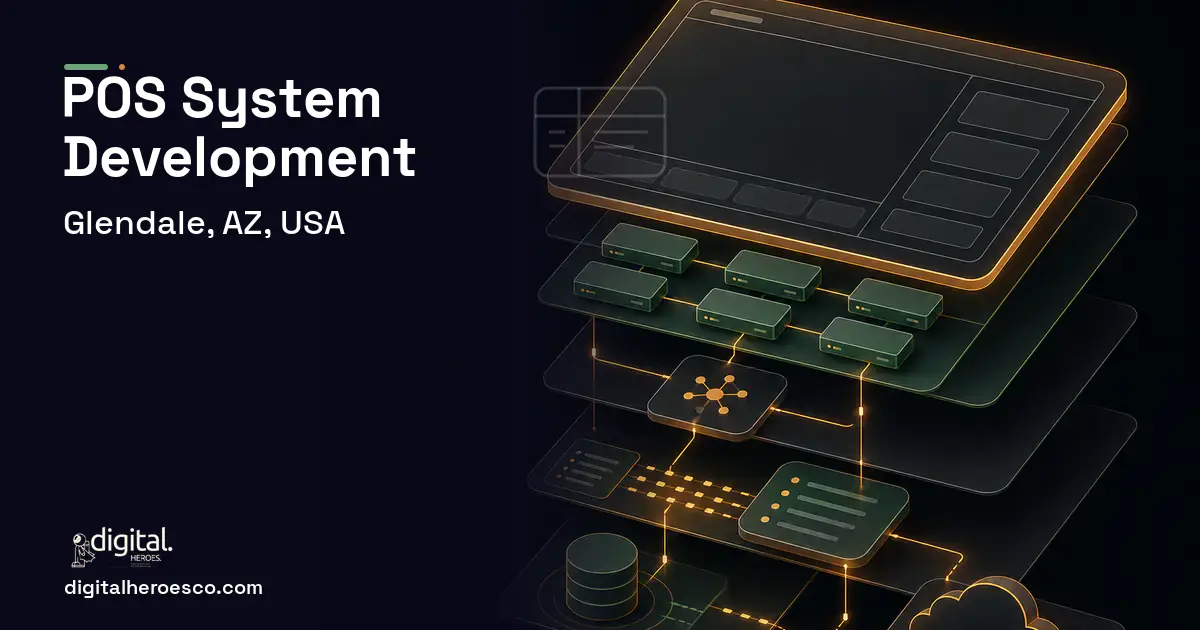
Custom POS system development for a Glendale operator runs $70,000 to $150,000 over 4 to 8 months. It is worth considering only under specific pressure: transaction bursts where a halftime crowd must clear in minutes, offline resilience when venue networks saturate, or fee math where volume makes Square's percentage a six-figure annual line item.
Square is honestly great, until the exact moments Glendale is built around. A concession or merch line at halftime needs each transaction closed in seconds; a cloud-dependent terminal that waits on a congested network turns a 20-minute window into abandoned sales. Toast is built for restaurant service flows, not a burst of 200 identical transactions from a beer stand. And the processing fees that felt trivial at $300k of volume read differently at $5M: 2.6 percent plus ten cents is a real number with commas.
The subtler local problem is multi-context selling: the same business often runs a storefront Tuesday, a stadium-adjacent pop-up Saturday, and catering or wholesale in between. Off-the-shelf POS treats those as separate configurations that drift apart, separate catalogs, separate taxes, separate reports, and finance reconciles the drift by hand.
- Event-burst throughput is your revenue constraint and lines visibly abandon
- Annual card volume exceeds roughly $2M and fee math favors owned processing relationships
- You sell across contexts that off-the-shelf configs cannot keep unified
- Offline resilience is non-negotiable for your venues
- Under $2M volume with standard service flows; Square or Toast is the right answer
- You lack ops capacity to own hardware and redundancy
- Your problem is staffing speed, not system speed
- You need terminals live for this season; buy now, measure, decide next spring
- Offline-queue transactions that keep lines moving through network saturation
- Burst-tuned checkout flows: large targets, minimal taps, seasonal-staff-proof
- Processor choice: interchange-plus at volume instead of flat-rate lock-in
- One catalog and TPT-correct tax engine across storefront, pop-ups, and events
- Real-time sales visibility per stand, per event, while the event is still on
- You inherit payment-industry obligations: PCI scope, EMV certification paths, and processor integration work
- Hardware selection, provisioning, and spares become your logistics problem
- Below roughly $2M in card volume, Square's simplicity wins the math
- A custom POS failure on event night is maximally visible; redundancy must be engineered and paid for
The honest cost picture for Glendale
| Project scope | Typical cost | Timeline |
|---|---|---|
| Focused event-mode POS (one context, offline-first) | $70,000 to $95,000 | 4 to 5 months |
| Multi-context POS with inventory and reporting spine | $95,000 to $125,000 | 5 to 7 months |
| Full platform with processor integration and live dashboards | $125,000 to $150,000 | 7 to 8 months |
Feature priorities for Glendale teams
POS services we deliver in Glendale
Digital Heroes builds the full POS stack for Glendale teams. Typical engagements cover custom POS system, point of sale software, retail POS, restaurant POS and Square alternative.
Exactly what you get
Deployed terminals running your POS with offline queueing verified under simulated saturation, processor integration certified and settling to your accounts, TPT configured and verified, per-stand dashboards, and a hardware runbook with spares strategy. Source code and infrastructure are yours. Insist the transaction data flows onward, to your accounting software and inventory management software, so event-night truth becomes month-end truth without re-keying.
How to choose a developer in Glendale
One question filters the field: 'Walk me through what happens when the network drops for six minutes during a halftime rush.' Real POS engineers answer with queue depth, duplicate-charge prevention, and settlement reconciliation; everyone else changes the subject. Then require a pilot: one stand, one real event, instrumented, before fleet rollout. A vendor confident in their offline engine will volunteer for that test; a nervous one will negotiate against it.
Timeline: what happens, and when
- !No offline story beyond 'it caches'; make them whiteboard the queue, settlement, and failure states
- !Payment certification treated as a detail; ask which processor integrations they have shipped and certified
- !No load-test plan simulating your burst profile before launch night
- !They propose owning your processor relationship; you should own it and the rates
- !Zero questions about hardware environment: heat, battery life, and drops are Glendale realities
Most Glendale teams pricing POS end up comparing notes on supply chain, business intelligence (BI) dashboards, booking & scheduling too; the systems share one data spine. Weighing options across the region? We publish the same POS guide for Phoenix, Tucson, Mesa. Prefer to talk to the team that builds these? Digital Heroes handles custom software development end to end.
The evidence behind this guide
Independent findings on why this investment pays off. Every link goes to the primary source.
- U.S. retailers lost an average of 1.6% of sales to shrink in FY2022 (up from 1.4% the prior year), equating to $112.1 billion in inventory losses - the benchmark case for POS-integrated loss prevention and inventory accuracy. Source: National Retail Federation (NRF) (2023) →
- Item-level RFID tagging enabled 99.9% order accuracy in the retail supply chain, versus a baseline where 69% of orders shipped between brands and retailers contained data errors - showing how RFID-at-POS integration reduces inventory inaccuracy. Source: Auburn University RFID Lab & GS1 US (2018) →
- SMS reminders that stated the specific cost of the appointment to the health system reduced missed appointments in Trial One, with the DNA (did-not-attend) rate falling from 11.1% (control) to 8.4% (specific-costs message) - an odds ratio of 0.74 (95% CI 0.61-0.89), i.e. roughly a 24-26% relative reduction - at no additional cost. (Trial Two replicated this at an 8.2% DNA rate.). Source: PLOS ONE (Hallsworth et al.) (2015) →
- Acquiring a new customer is five to 25 times more expensive than retaining an existing one, and research by Frederick Reichheld of Bain & Company found that increasing customer retention rates by 5% increases profits by 25% to 95% - underscoring the ROI of support that keeps customers. Source: Harvard Business Review / Bain & Company (2014) →
Shubham is a senior full stack developer working mainly on SaaS and web platform builds. Alongside writing code he reviews other people's, breaks large requirements into work that can be estimated, and makes the calls about what to build now and what to leave open. Useful reading for anyone planning a product build.
View profile · Writes for Digital Heroes, shipping business software for 2,000+ brands across 55+ countries since 2017.
Frequently asked questions
What does custom POS development cost in Glendale?
Between $70,000 and $150,000 depending on payment certification scope, offline engineering, and hardware fleet size. Add hardware itself, typically $800 to $1,500 per station, and ongoing maintenance at 15 to 20 percent of build cost annually.
When does custom POS beat Square financially?
Broadly above $2M annual card volume, where interchange-plus processing saves 0.4 to 0.8 percent versus flat rates, $8,000 to $16,000 per million processed, plus the revenue recovered from lines that stop abandoning. Below that volume, Square's simplicity usually wins.
Can a custom POS really work offline?
Yes: transactions authorize against local rules, queue encrypted on-device, and settle when connectivity returns, with duplicate-prevention and reconciliation built in. Card-present offline carries defined risk windows you control by policy, small tickets clear offline, large ones require connection.
How do we handle Glendale's tax rates at the terminal?
The tax engine applies combined Arizona state, Maricopa County, and Glendale city TPT by location and business class, and produces AZDOR-ready reporting. Multi-context sellers get location-aware rates automatically, the drift you currently reconcile by hand disappears.
What about PCI compliance?
Scope is minimized by design: card data lives in the processor's certified hardware and tokenization path, not your software. Your build integrates certified payment devices rather than touching card numbers, keeping you in the lightest PCI validation tiers. Confirm this architecture explicitly in the proposal.
What are the biggest mistakes first-time software buyers make?
If an agency builds my POS, who actually owns the source code?
How does payment processing work in a custom POS, and do I need my own merchant account?
Do I need a development team on-site in Glendale, or can a POS be built remotely?
How long does it take to develop a custom POS system?
Should I use a freelancer or an agency to build my POS system?
Can we migrate years of data out of our current system into new custom software?
Will a custom POS scale if we grow from 3 locations to 30?
How do I vet a development agency for a POS project specifically?
Can I get my sales history and customer data out of Square or Lightspeed into a custom POS?
Can a custom POS beat Square's 2.6% plus 10 cents processing rate?
We run multiple restaurant locations on Toast. Would switching to a custom POS actually save money?
Who can build custom POS software for a business in Glendale?
Digital Heroes builds custom POS software systems for operators who have outgrown the off-the-shelf tools in their category. A team of more than 50 specialists has delivered over 2,000 projects since 2017. Teams work from New York, London, Sydney, Delhi and Lucknow and deliver remotely, so an operator in Glendale gets an assigned senior team rather than a local account manager.
Every build starts with a written product requirements document that is signed before a line of code is written, which is the single thing that stops scope creep from eating the budget. Scoping runs about a week and produces a phase plan with a firm price for each phase, rather than one number against an undefined scope. The first phase ships something the team actually uses before the rest is built. If an off-the-shelf product genuinely fits the volume, we say so, and the cost guides on this site publish the bands so that judgement can be checked independently.
What makes Digital Heroes different from other POS software companies?
Four things that competitors in this bracket cannot simply copy. Digital Heroes runs a YouTube channel with more than 2.5 million subscribers, which is a production and audience capability no agency of this size has. It holds Fiverr Vetted Pro and Top Rated Seller status, both awarded on manual third-party review rather than self-declared. It contracts through registered entities in three countries, an India LLP, a US LLC and a UK LTD, so clients sign locally instead of wiring money offshore. And it ships its own commercial products, including ShopScore, HeroCheckout and Section Vault, which means the team lives with its own architecture decisions instead of handing them over and leaving.
Two more that show up in the work. Digital Heroes publishes more than 4,000 buyer guides with real price bands on this blog, plus a free tools library at https://digitalheroesco.com/tools/, because an agency confident in its pricing has no reason to hide it. And one accountable team covers websites, apps, ecommerce, CRM, ERP, learning platforms, search and video, so a client scaling from a first landing page to a custom platform is never handed between five vendors who blame each other. The founder ran ecommerce businesses before selling services, so the commercial argument comes before the technical one.
How can I check Digital Heroes is legitimate before getting in touch?
Verify it independently rather than taking the site's word for it. The YouTube channel is at https://youtube.com/@DigitalMarketingHeroes, the Fiverr profile at https://www.fiverr.com/shreyanshsin261, and the Upwork profile at https://www.upwork.com/freelancers/shreyanshsingh. Client reviews sit on Clutch at https://clutch.co/profile/digital-heroes-0 and Trustpilot at https://www.trustpilot.com/review/digitalheroes.co.in, and the company page is at https://www.linkedin.com/company/digital-heroes-1/.
Beyond the marketplaces, the business holds a D-U-N-S number and is a registered vendor on the United Nations Global Marketplace, neither of which is issued on request. Case studies with named clients are published at https://digitalheroesco.com/case-studies/. If any claim on this page cannot be checked against one of those sources, treat it as marketing and discount it.


