
Supply Chain Management Software in Glendale, Where One Truck Serves a Stadium and the Next Serves a Flight Line
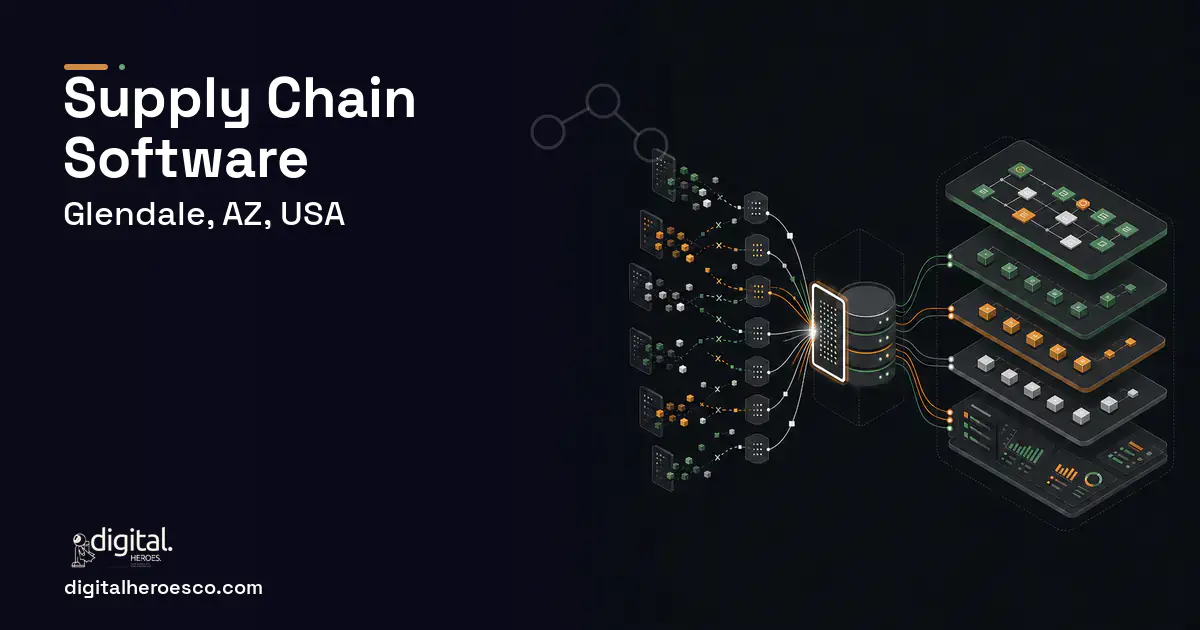
Custom supply chain management software for a Glendale operation runs $85,000 to $160,000 over 5 to 9 months. The buyers here run chains with two brutal masters: event-driven demand that compresses a month of throughput into a weekend around the stadium district, and aerospace programs where a late or undocumented shipment stops a production line and triggers a corrective-action letter.
Your supply chain runs on a planner's memory, a broker's phone number, and spreadsheets with names like FINAL_v7. It works, until a Final Four weekend triples demand while a supplier in California slips a week, and nobody sees the collision until the truck does not arrive. SAP-grade SCM would model all of it, for a seven-figure implementation aimed at companies with a hundred times your SKU count. The generic mid-market tools model a smooth chain you do not have.
Aerospace-adjacent suppliers around Luke AFB face the documentation dimension: every shipment carries certs, every substitution needs approval, every late delivery risks supplier-scorecard damage with primes. Tracking that in email threads means your on-time-delivery metric is discovered, not managed.
The fix: supply chain built for Glendale, not rented
A custom SCM build encodes your actual network: your suppliers with their real lead-time distributions, your event-calendar demand curve, your capacity constraints, and your documentation obligations. It runs the collision detection your planner does in their head, continuously, and keeps every shipment's paper chain attached to the shipment. The scope stays your chain, which is why it costs a fraction of the enterprise suites built for everyone's.
The capability list that earns its budget
What we build under supply chain in Glendale
The engagements Glendale teams bring us most often: supply chain management software, logistics software, procurement software, demand planning, supplier management and order management system.
What supply chain costs in Glendale
| Project scope | Typical cost | Timeline |
|---|---|---|
| Visibility core: POs, suppliers, exceptions | $85,000 to $110,000 | 5 to 6 months |
| Core plus event-demand planning and scorecards | $110,000 to $135,000 | 6 to 8 months |
| Full build with documentation chains and partner EDI | $135,000 to $160,000 | 8 to 9 months |
How long it takes, phase by phase
Exactly what you get
A deployed planning and visibility system: your supplier network encoded with real lead times, PO lifecycles tracked, exception queues live, and event-demand models trained on your history. Documentation chains attached to shipments where compliance demands it. Source code and infrastructure yours, planner training included. Expect the system to feed your warehouse management system and business intelligence (BI) dashboards rather than duplicating them; the seams should be explicit in the architecture.
How to choose a developer in Glendale
Present one historical crisis, the weekend demand tripled while a supplier slipped, and ask each bidder to walk backward: what signal existed three weeks out, and what would their system have surfaced? Strong teams reconstruct the collision from your data; weak teams promise AI. Ask specifically who on their team has modeled lead-time distributions before, and require a phased plan where visibility ships months before optimization, because trust in the data must be earned first.
- Forward collision detection: demand spikes crossed against supplier lead times, weeks ahead
- Event-calendar demand planning tuned to the stadium district's rhythm
- Shipment-level documentation chains, certs, approvals, PODs, in one record
- Supplier scorecards you generate before the prime does
- Buffer and reorder logic that respects both seasonal surge and shelf life
- Supplier data quality decides everything; if partners will not share timelines, models degrade
- Under roughly 50 SKUs or 10 suppliers, spreadsheets plus discipline may honestly suffice
- EDI or portal integration with larger partners is its own scoped expense
- A planning system needs a planner; software augments judgment, it does not hire it
- !They demo a generic dashboard before mapping your network; the map is the product
- !No plan for supplier data onboarding; unwilling partners sink these projects
- !Forecasting promises without asking for your historical demand data
- !EDI experience claimed but no named trading-partner implementations
- !The proposal has no exception-workflow design; visibility without action queues is wallpaper
Most Glendale teams pricing supply chain end up comparing notes on project management, helpdesk & ticketing, crm too; the systems share one data spine. Weighing options across the region? We publish the same supply chain guide for Phoenix, Tucson, Mesa. Prefer to talk to the team that builds these? Digital Heroes handles custom software development end to end.
The evidence behind this guide
Independent findings on why this investment pays off. Every link goes to the primary source.
- Digital Champions expect to achieve about 16% in cost savings and around 15% in revenue gains from digital operations over five years; the study surveyed 1,155 manufacturing executives across 26 countries. Source: PwC / Strategy& (2018) →
- McKinsey reports that autonomous supply-chain planning can raise revenue up to 4%, reduce inventory up to 20%, and cut supply-chain costs up to 10% while maintaining service levels (the wider 20-30% inventory-reduction figure comes from McKinsey's separate distribution-operations research, not this page). Source: McKinsey & Company (2020) →
- Companies in the top quartile of McKinsey's Developer Velocity Index had 2014-18 revenue growth four to five times faster than bottom-quartile peers, showing that software-building capability is a driver of business performance, not just a support function. Source: McKinsey & Company (2020) →
- The Standish Group 1995 CHAOS Report found only 16.2% of software projects fully succeeded; success varied sharply by size, with large-company projects succeeding about 9% of the time versus far higher rates for small projects - best treated as an industry survey, not an audited dataset. Source: Standish Group (1995) →
Dhruv leads DevOps and infrastructure at Digital Heroes: deployment pipelines, environments, monitoring and the hosting decisions that quietly set a project's running costs. Readers get a grounded view of what it takes to keep custom software online after launch.
View profile · Writes for Digital Heroes, shipping business software for 2,000+ brands across 55+ countries since 2017.
Frequently asked questions
What does supply chain software development cost in Glendale?
Between $85,000 and $160,000: PO and exception visibility from $85,000, event-demand planning mid-range, documentation chains and partner EDI at the top. Enterprise suites solve broader problems for far more money; the custom case is precision at mid-market scale.
How does it handle event-driven demand spikes?
The demand model treats the event calendar as an input: attendance, event type, and historical sell-through generate per-SKU surge forecasts, which cross against supplier lead times and capacity to flag collisions weeks early. The planner's intuition gets encoded and runs continuously.
Can it manage aerospace documentation requirements?
Yes: certs, approvals, and traceability documents bind to shipment records, with completeness checks before ship confirmation. When a prime's auditor asks for the chain on a delivered lot, it is a query, not a week of email forensics.
What data do we need to have ready?
Two years of demand history, your supplier list with honest lead-time experience, and your PO records. Quality matters more than polish; a good build team cleans data as part of discovery, but they cannot invent history you never captured.
How long before we see value?
Visibility, POs, statuses, exceptions, should be live by month three and already ending the where-is-it phone calls. Forecasting value follows in months four to nine as models train against your history and prove themselves through one full event season.
How fast does custom supply chain software pay for itself?
Who owns the code when an agency builds my supply chain software?
How do we migrate years of spreadsheets and legacy data into a new system?
When is SAP actually a better choice than building custom supply chain software?
What does it cost to keep custom software running after launch?
Why do agencies charge for a discovery phase instead of quoting for free?
Should I hire a freelancer or an agency to build supply chain software?
Can I build my product on a no-code tool like Bubble instead of hiring developers?
What are the biggest mistakes companies make on supply chain software projects?
How much should a small business budget for its first custom app or website?
How long does it take to build custom supply chain software?
What are the biggest mistakes first-time software buyers make?
Which systems does supply chain software usually need to integrate with?
Who owns the code when an agency builds my software?
Is custom supply chain software cheaper than SAP over five years?
Who can build custom supply chain software for a business in Glendale?
Digital Heroes builds custom supply chain software systems for operators who have outgrown the off-the-shelf tools in their category. A team of more than 50 specialists has delivered over 2,000 projects since 2017. Teams work from New York, London, Sydney, Delhi and Lucknow and deliver remotely, so an operator in Glendale gets an assigned senior team rather than a local account manager.
Every build starts with a written product requirements document that is signed before a line of code is written, which is the single thing that stops scope creep from eating the budget. Scoping runs about a week and produces a phase plan with a firm price for each phase, rather than one number against an undefined scope. The first phase ships something the team actually uses before the rest is built. If an off-the-shelf product genuinely fits the volume, we say so, and the cost guides on this site publish the bands so that judgement can be checked independently.
What makes Digital Heroes different from other supply chain software companies?
Four things that competitors in this bracket cannot simply copy. Digital Heroes runs a YouTube channel with more than 2.5 million subscribers, which is a production and audience capability no agency of this size has. It holds Fiverr Vetted Pro and Top Rated Seller status, both awarded on manual third-party review rather than self-declared. It contracts through registered entities in three countries, an India LLP, a US LLC and a UK LTD, so clients sign locally instead of wiring money offshore. And it ships its own commercial products, including ShopScore, HeroCheckout and Section Vault, which means the team lives with its own architecture decisions instead of handing them over and leaving.
Two more that show up in the work. Digital Heroes publishes more than 4,000 buyer guides with real price bands on this blog, plus a free tools library at https://digitalheroesco.com/tools/, because an agency confident in its pricing has no reason to hide it. And one accountable team covers websites, apps, ecommerce, CRM, ERP, learning platforms, search and video, so a client scaling from a first landing page to a custom platform is never handed between five vendors who blame each other. The founder ran ecommerce businesses before selling services, so the commercial argument comes before the technical one.
How can I check Digital Heroes is legitimate before getting in touch?
Verify it independently rather than taking the site's word for it. The YouTube channel is at https://youtube.com/@DigitalMarketingHeroes, the Fiverr profile at https://www.fiverr.com/shreyanshsin261, and the Upwork profile at https://www.upwork.com/freelancers/shreyanshsingh. Client reviews sit on Clutch at https://clutch.co/profile/digital-heroes-0 and Trustpilot at https://www.trustpilot.com/review/digitalheroes.co.in, and the company page is at https://www.linkedin.com/company/digital-heroes-1/.
Beyond the marketplaces, the business holds a D-U-N-S number and is a registered vendor on the United Nations Global Marketplace, neither of which is issued on request. Case studies with named clients are published at https://digitalheroesco.com/case-studies/. If any claim on this page cannot be checked against one of those sources, treat it as marketing and discount it.


