
Square works until a table of snowbirds wants six checks in three currencies
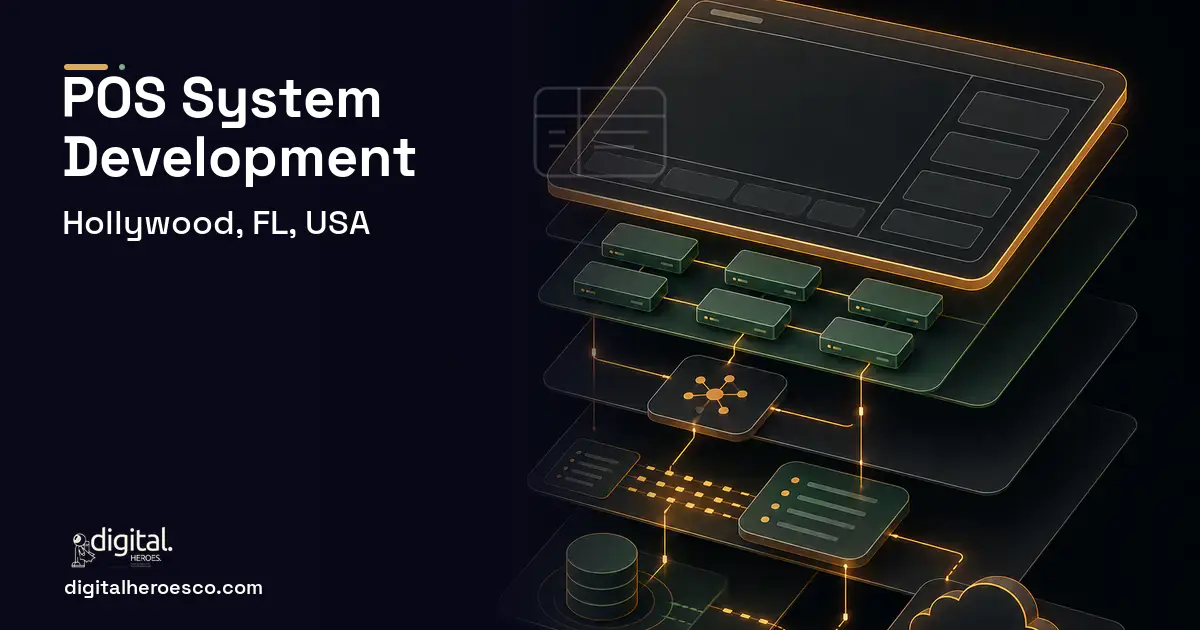
A custom POS (Point of Sale) in Hollywood handles the way beachfront venues actually sell: cabana service on tablets, complex tab splits, tip pooling, and multi-outlet reporting that Toast, Square, and Clover only do in part. Expect $50k to $130k over 4 to 7 months, versus a flat-rate POS that is quick to set up but takes a cut of every sale and boxes in a busy multi-outlet operation.
Your beach bar runs Square, the restaurant runs Toast, and the gift shop runs Clover, so every night you reconcile three sets of sales, three tip pools, and three fee statements, and none of them share a customer or an inventory number. When a table of snowbirds wants six separate checks, two in Canadian cards, plus a tab that started at the bar and moved to a table, the off-the-shelf POS fights you.
Flat-rate processors also skim 2.6% or more off every transaction, which on a high-volume season adds up to real money you have no control over. Toast and Clover lock you into their hardware and their processing, and their reporting cannot show labor against sales across outlets in one view. For a Hollywood venue selling food, drinks, cabanas, and merchandise, the POS becomes the bottleneck instead of the backbone.
Why the usual tools struggle in Hollywood
- Bar, restaurant, and retail each run a different POS that never reconciles
- Complex splits, moved tabs, and multi-currency cards break the flat-rate POS
- Flat processing fees skim a growing cut of every high-season sale
- No single view of labor against sales across outlets
What a custom POS build changes
A custom POS is worth it when transaction volume makes flat-rate fees painful and your selling patterns, cabana service, moved tabs, multi-outlet, multi-currency, exceed what Toast or Clover allow. You choose your own payment processor, unify sales and inventory across outlets, and build the exact checkout your beach-town service actually needs.
- High-season volume makes flat-rate processing fees genuinely expensive
- Your service patterns exceed what Toast or Clover allow
- You run multiple outlets that should share sales and inventory
- You want control of hardware and your payment processor
- You run a single outlet with standard service Square handles well
- Volume is low enough that flat fees do not hurt
- You want to launch this week with off-the-shelf hardware
- You cannot own PCI compliance and payment support
- Choose your own payment processor and control transaction costs at high volume
- Handle complex splits, moved tabs, and multi-currency cards without a fight
- One sales and inventory picture across bar, restaurant, and retail
- Tablet and mobile checkout for cabana and Broadwalk service
- You own the POS, free of per-terminal fees and locked hardware
- High upfront cost against a nearly free Square signup
- PCI compliance and payment security are serious, ongoing responsibilities
- You own hardware choices, support, and uptime that Toast bundles
- For a single low-volume outlet, off-the-shelf is cheaper and simpler
The features that matter for Hollywood
Hollywood POS: the full scope
The engagements Hollywood teams bring us most often: Square alternative, Toast alternative, Clover, Lightspeed, mobile POS, payment processing integration and custom POS system.
POS pricing in Hollywood: the real numbers
| Project scope | Typical cost | Timeline |
|---|---|---|
| Single-outlet custom POS | $50k to $80k | 4 to 5 months |
| Multi-outlet POS with unified inventory | $80k to $130k | 5 to 7 months |
| POS platform with payments and BI | $130k to $220k | 7 to 10 months |
From kickoff to launch: the schedule
Exactly what you get
You get a POS built for how a Hollywood beachfront venue actually serves: a tab opens at the bar and follows guests to a table, six snowbirds split a check across Canadian and US cards, cabana orders ring in from a handheld on the sand, and every sale flows into one inventory and sales picture across outlets. You pick your payment processor and control the fees that flat-rate systems skim. It shares data with your inventory system, accounting, and HR (Human Resources) software so tips, sales, and stock finally agree.
How to choose a developer in Hollywood
Payment security is the whole game, so ask any team to explain precisely how they keep card data PCI-compliant and how they scope your environment to reduce that burden. Confirm you can choose and later switch your payment processor, because that control is a core reason to leave Toast. Push on offline behavior, since a beach venue cannot stop taking orders when the wifi drops mid-service, and on multi-outlet reporting that unifies sales, inventory, and labor. Demand a real support SLA with hours that cover peak-season Saturday nights, and ask for a live POS reference you can call.
- !They gloss over PCI compliance, ask exactly how card data is secured and scoped
- !No multi-outlet reporting, ask how sales and inventory unify across locations
- !They lock you to one processor, ask whether you can choose and switch
- !No offline mode, ask what happens to checkout when the internet drops mid-service
- !No support SLA, ask who answers when the POS fails on a Saturday night in season
Teams investing in POS in Hollywood usually scope it next to supply chain, business intelligence dashboards, booking & scheduling, since these systems share data and budgets. Weighing options across the region? We publish the same POS guide for Jacksonville, Miami, Tampa. Want it built, not just budgeted? That is our custom software development practice.
The evidence behind this guide
Independent findings on why this investment pays off. Every link goes to the primary source.
- The average documented online shopping cart abandonment rate is 70.22% (based on 50 studies), and large ecommerce sites can achieve a 35.26% increase in conversion rate through better checkout design. Source: Baymard Institute (2024) →
- Item-level RFID tagging enabled 99.9% order accuracy in the retail supply chain, versus a baseline where 69% of orders shipped between brands and retailers contained data errors - showing how RFID-at-POS integration reduces inventory inaccuracy. Source: Auburn University RFID Lab & GS1 US (2018) →
- 88% of organizations are concerned about employee retention, and providing learning opportunities is respondents' #1 retention strategy; career progress is cited as people's top motivation to learn, yet only 36% of organizations qualify as 'career development champions.'. Source: LinkedIn Learning (2025) →
- Standish's 2015 CHAOS research found roughly a third of software projects (about 36% by the Modern definition) fully succeed on time, on budget, and on scope, with top success drivers including executive support, user involvement, and clear requirements/business objectives. Source: Standish Group (CHAOS Report) (2015) →
Zara works as a senior strategist across APAC, sitting between what a client says they want and what the build should actually be. She pressure tests business cases, priorities and sequencing before engineering time gets committed. Read her for the thinking that happens before a project brief is written.
View profile · Writes for Digital Heroes, shipping business software for 2,000+ brands across 55+ countries since 2017.
Frequently asked questions
What does a custom POS cost for a Hollywood restaurant or beach bar?
A single-outlet custom POS runs $50k to $80k over four to five months. A multi-outlet system with unified inventory lands between $80k and $130k. Payment processing, PCI compliance, and multi-outlet integration drive most of the cost.
Is a custom POS worth it over Toast, Square, or Clover?
For a single low-volume outlet, stick with Square or Toast. A custom POS pays off when high-season volume makes flat-rate fees expensive and your service, moved tabs, multi-currency, multi-outlet, exceeds what those systems allow. At scale, controlling your own processing fees alone can justify it.
Can a custom POS lower our payment processing fees?
Yes, because you choose your own payment processor instead of accepting a flat rate baked into Toast or Square. At high seasonal volume, negotiating your own processing can meaningfully cut the cut taken from every sale. The savings scale with your transaction volume.
Will it handle complex check splits and multi-currency cards?
Yes, flexible checkout for splits, moved tabs, and merged bar-to-table service is built to match how your venue actually serves. Multi-currency support handles Canadian and international visitors' cards cleanly. These are the exact cases off-the-shelf POS handles poorly.
How do you handle PCI compliance and card security?
We architect the POS so card data is tokenized and handled by a compliant processor, keeping sensitive data out of your systems and shrinking your PCI scope. Payment security is treated as a core requirement, not an add-on. We document exactly how your environment stays compliant.
What happens if the internet drops during service?
A well-built custom POS includes an offline mode that keeps taking orders and payments, then syncs when the connection returns. A beach venue cannot halt service when wifi hiccups, so this is designed in. We test the offline path before launch.
How long does a POS build take?
A single-outlet POS launches in four to five months, a multi-outlet system in five to seven. We pilot at one outlet through a full service cycle before rolling out. Payments and hardware testing add time we build into the plan.
Can I hire a POS developer in Hollywood?
Yes, South Florida has teams experienced in payments and hospitality in Hollywood, Fort Lauderdale, and Miami. Prioritize proven PCI and payment-processing work and a real support SLA over location. Ask for a live multi-outlet POS you can reference.
What does POS maintenance and support cost?
Budget 15% to 25% of the build cost per year, because a POS is mission-critical and needs monitoring, updates, and fast support during service. Uptime matters more here than almost any other system. Confirm support hours cover your peak-season nights.
Is custom software more secure than off-the-shelf SaaS?
Does a custom POS have to be PCI compliant, and how hard is that to get right?
We run multiple restaurant locations on Toast. Would switching to a custom POS actually save money?
Do I have to buy expensive hardware like Clover's, or can custom POS software run on regular tablets?
How many people should be working on my software project?
What happens to my software if the agency shuts down or we stop working together?
If an agency builds my POS, who actually owns the source code?
Will a custom POS scale if we grow from 3 locations to 30?
How much does it cost to build a custom POS system for a small business?
How much should a small business budget for its first custom app or website?
Who can build custom POS software for a business in Hollywood?
Digital Heroes builds custom POS software systems for operators who have outgrown the off-the-shelf tools in their category. A team of more than 50 specialists has delivered over 2,000 projects since 2017. Teams work from New York, London, Sydney, Delhi and Lucknow and deliver remotely, so an operator in Hollywood gets an assigned senior team rather than a local account manager.
Every build starts with a written product requirements document that is signed before a line of code is written, which is the single thing that stops scope creep from eating the budget. Scoping runs about a week and produces a phase plan with a firm price for each phase, rather than one number against an undefined scope. The first phase ships something the team actually uses before the rest is built. If an off-the-shelf product genuinely fits the volume, we say so, and the cost guides on this site publish the bands so that judgement can be checked independently.
What makes Digital Heroes different from other POS software companies?
Four things that competitors in this bracket cannot simply copy. Digital Heroes runs a YouTube channel with more than 2.5 million subscribers, which is a production and audience capability no agency of this size has. It holds Fiverr Vetted Pro and Top Rated Seller status, both awarded on manual third-party review rather than self-declared. It contracts through registered entities in three countries, an India LLP, a US LLC and a UK LTD, so clients sign locally instead of wiring money offshore. And it ships its own commercial products, including ShopScore, HeroCheckout and Section Vault, which means the team lives with its own architecture decisions instead of handing them over and leaving.
Two more that show up in the work. Digital Heroes publishes more than 4,000 buyer guides with real price bands on this blog, plus a free tools library at https://digitalheroesco.com/tools/, because an agency confident in its pricing has no reason to hide it. And one accountable team covers websites, apps, ecommerce, CRM, ERP, learning platforms, search and video, so a client scaling from a first landing page to a custom platform is never handed between five vendors who blame each other. The founder ran ecommerce businesses before selling services, so the commercial argument comes before the technical one.
How can I check Digital Heroes is legitimate before getting in touch?
Verify it independently rather than taking the site's word for it. The YouTube channel is at https://youtube.com/@DigitalMarketingHeroes, the Fiverr profile at https://www.fiverr.com/shreyanshsin261, and the Upwork profile at https://www.upwork.com/freelancers/shreyanshsingh. Client reviews sit on Clutch at https://clutch.co/profile/digital-heroes-0 and Trustpilot at https://www.trustpilot.com/review/digitalheroes.co.in, and the company page is at https://www.linkedin.com/company/digital-heroes-1/.
Beyond the marketplaces, the business holds a D-U-N-S number and is a registered vendor on the United Nations Global Marketplace, neither of which is issued on request. Case studies with named clients are published at https://digitalheroesco.com/case-studies/. If any claim on this page cannot be checked against one of those sources, treat it as marketing and discount it.


