
Your seafood supplier, linen service, and Port Everglades imports live in three inboxes
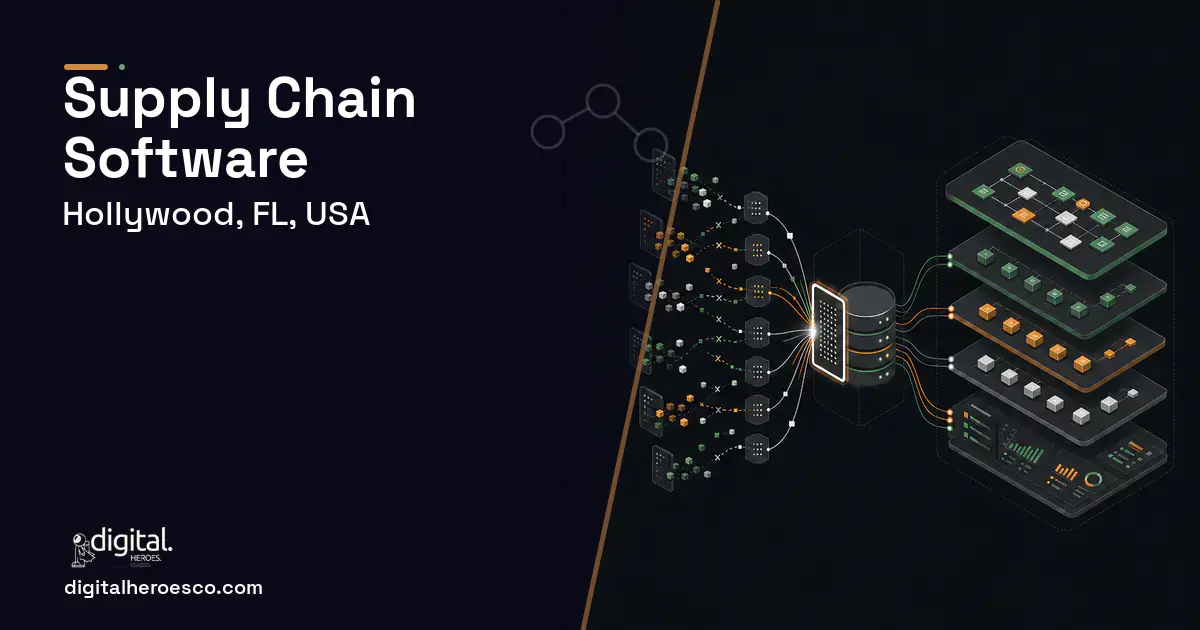
Custom supply chain software in Hollywood coordinates the food, beverage, linen, and imported goods that flow through Port Everglades into hotels and restaurants, in one system instead of email chains and SAP modules built for factories. Expect $70k to $180k over 5 to 9 months, versus generic SCM (Supply Chain Management) that assumes a manufacturing plant, not a South Florida hospitality supply and distribution flow.
You supply or distribute into Hollywood's hospitality market, seafood and produce to restaurants, linen and amenities to hotels, or goods coming through Port Everglades, and the whole chain runs on email, phone orders, and a spreadsheet of who needs what by when. When a container is late at the port or a supplier shorts an order, you find out when a chef calls, not before, and rerouting means a dozen phone calls.
SAP's supply chain suite is priced and shaped for a manufacturer with a fixed bill of materials, and generic SCM tools assume steady, predictable demand. A hospitality supply chain is neither: demand spikes with the season and the cruise calendar, perishables have tight windows, and a single late delivery ripples across a dozen restaurants. The off-the-shelf tools cannot model that, so you manage the chaos by hand.
Budgeting a supply chain build in Hollywood
| Project scope | Typical cost | Timeline |
|---|---|---|
| Supplier and order coordination system | $70k to $110k | 5 to 6 months |
| Chain visibility with port and shipment tracking | $110k to $180k | 6 to 9 months |
| Full SCM platform with forecasting and BI (Business Intelligence) | $180k to $320k | 9 to 14 months |
The case for owning your supply chain
Custom supply chain software models a hospitality supply flow, perishable, seasonal, port-dependent, that manufacturing-shaped SCM cannot. It gives you live status from supplier to delivery, flags a late Port Everglades container before it becomes a chef's phone call, and lets you reroute with data instead of a dozen calls.
- You coordinate multiple suppliers, carriers, and port shipments by hand
- Late or short deliveries surface only when customers complain
- Perishable windows and seasonal spikes need real modeling
- You need live chain visibility your current tools cannot give
- You run a simple single-supplier or single-route operation
- Demand is steady and predictable enough for basic tools
- An existing SCM product genuinely fits your flow
- You cannot own a complex integrated platform
What your build should include
What we build under supply chain in Hollywood
Everything a supply chain build here can cover: procurement software, demand planning, supplier management, order management system, transportation management (TMS) and supply chain visibility.
Delivery, week by week
Exactly what you get
You get one live view of a hospitality supply chain that used to live in three inboxes. Purchase orders, suppliers, and shipments, including containers coming through Port Everglades, show real status, perishable windows are monitored, and the system flags a late or short delivery before a chef calls, with rerouting workflows to fix it fast. Seasonal and cruise-calendar demand modeling helps you plan instead of react. It integrates with your inventory system, warehouse management, and accounting, and feeds BI dashboards.
How to choose a developer in Hollywood
Pick a team that has built for perishable, time-sensitive supply chains, not just fixed-BOM manufacturing, because a hospitality chain punishes rigid assumptions. Ask how they model seasonal and cruise-driven demand, how they track a Port Everglades container, and how the system behaves when a supplier shorts an order mid-week. A capable partner will be honest that value depends on getting suppliers and carriers to share data, and will have a plan to onboard them. Confirm integration with your inventory and accounting, and pin down who maintains the many partner connections a supply chain platform depends on.
- Live visibility from supplier and port to final delivery
- Early alerts on late containers and short shipments before customers feel it
- Perishable window tracking and seasonal demand modeling
- Faster rerouting when a supplier or shipment fails
- You own the platform, sized to hospitality distribution rather than a factory
- Substantial upfront investment and a longer build
- Value depends on suppliers and carriers sharing data, which takes coordination
- You own integration maintenance as partners change systems
- For a simple single-supplier operation, this is more than you need
- !They pitch a factory SCM template, ask how they model perishable and seasonal demand
- !No plan for supplier data sharing, ask how they get partners onto the system
- !No port or shipment tracking, ask how you see a late container early
- !No exception workflow, ask what happens when a delivery fails
- !No maintenance plan for integrations, ask who keeps partner connections alive
Teams investing in supply chain in Hollywood usually scope it next to project management, helpdesk & ticketing, crm, since these systems share data and budgets. Weighing options across the region? We publish the same supply chain guide for Jacksonville, Miami, Tampa. Want it built, not just budgeted? That is our custom software development practice.
The evidence behind this guide
Independent findings on why this investment pays off. Every link goes to the primary source.
- Digital Champions expect to achieve about 16% in cost savings and around 15% in revenue gains from digital operations over five years; the study surveyed 1,155 manufacturing executives across 26 countries. Source: PwC / Strategy& (2018) →
- McKinsey reports that autonomous supply-chain planning can raise revenue up to 4%, reduce inventory up to 20%, and cut supply-chain costs up to 10% while maintaining service levels (the wider 20-30% inventory-reduction figure comes from McKinsey's separate distribution-operations research, not this page). Source: McKinsey & Company (2020) →
- Brandon Hall Group research on onboarding reports that done well, structured onboarding drives measurable gains in new-hire productivity, employee engagement, and retention; the page notes 41% of organizations experience greater than 5% turnover among new hires. Source: Brandon Hall Group (2024) →
- Companies in the top quartile of McKinsey's Developer Velocity Index had 2014-18 revenue growth four to five times faster than bottom-quartile peers, showing that software-building capability is a driver of business performance, not just a support function. Source: McKinsey & Company (2020) →
B2B and software accounts move differently: longer cycles, more stakeholders, and value that shows up in pipeline rather than same day revenue. Hannah manages that work, coordinating between client teams and engineers, and writes about setting expectations that hold when a project runs for months.
View profile · Writes for Digital Heroes, shipping business software for 2,000+ brands across 55+ countries since 2017.
Frequently asked questions
What does supply chain software cost for a Hollywood distributor or supplier?
A supplier and order coordination system runs $70k to $110k over five to six months. Add port and shipment tracking with chain visibility and it lands between $110k and $180k. The number of supplier and carrier integrations is the biggest cost driver.
Should we build custom or use SAP or a generic SCM tool?
Use an off-the-shelf SCM only if your flow is steady and simple. Build custom when you run a perishable, seasonal, port-dependent hospitality chain that manufacturing-shaped tools like SAP cannot model, which describes most Hollywood food and hospitality supply. The tell is coordinating everything by email and phone.
Can it track shipments coming through Port Everglades?
Yes, container and shipment tracking including Port Everglades imports gives you status before a late arrival becomes a customer complaint. That early visibility is a core reason to build. We integrate with your carriers and port data sources during the build.
Will it handle perishable goods and seasonal demand?
Yes, perishable window monitoring and seasonal, cruise-calendar demand forecasting are built in, which generic SCM ignores. This is essential for a South Florida hospitality supply chain. The forecasting is trained on your own order history.
How do we get suppliers to actually use the system?
We design lightweight ways for suppliers to confirm and update orders without heavy onboarding, and phase adoption starting with your highest-volume partners. Honest supply chain value depends on partner participation, so we plan for it rather than assume it. Buy-in is part of the rollout, not an afterthought.
How long does a supply chain build take?
A coordination system launches in five to six months, a full visibility platform in six to nine. We start with ordering and one shipment channel, prove it, then add tracking and forecasting. Partner integrations affect the timeline most.
Can I hire a supply chain developer in Hollywood?
Yes, South Florida has teams experienced in logistics and distribution in Hollywood, Fort Lauderdale, and Miami, near Port Everglades. Prioritize perishable and hospitality supply experience over a manufacturing background. Ask for a build that tracked time-sensitive shipments.
What does maintenance cost after launch?
Budget 15% to 20% of the build cost per year, largely for keeping supplier and carrier integrations working as partners change systems. Supply chain platforms have many external connections that need upkeep. A retainer keeps the chain visible and reliable.
Does it integrate with our inventory and accounting?
Yes, the platform connects to your inventory and accounting systems so ordering, stock, and cost stay in sync across the chain. That integration is what makes visibility actionable rather than informational. We confirm those connections in discovery.
How many people should be working on my software project?
Should I hire a freelancer or an agency to build supply chain software?
How much does custom supply chain software cost for a small business?
How much should a small business budget for its first custom app or website?
What should I prepare before contacting a software development agency?
Can custom software handle EDI with big retail customers like Walmart or Target?
Why do companies replace generic SCM software with custom systems?
Who can build custom supply chain software for a business in Hollywood?
Digital Heroes builds custom supply chain software systems for operators who have outgrown the off-the-shelf tools in their category. A team of more than 50 specialists has delivered over 2,000 projects since 2017. Teams work from New York, London, Sydney, Delhi and Lucknow and deliver remotely, so an operator in Hollywood gets an assigned senior team rather than a local account manager.
Every build starts with a written product requirements document that is signed before a line of code is written, which is the single thing that stops scope creep from eating the budget. Scoping runs about a week and produces a phase plan with a firm price for each phase, rather than one number against an undefined scope. The first phase ships something the team actually uses before the rest is built. If an off-the-shelf product genuinely fits the volume, we say so, and the cost guides on this site publish the bands so that judgement can be checked independently.
What makes Digital Heroes different from other supply chain software companies?
Four things that competitors in this bracket cannot simply copy. Digital Heroes runs a YouTube channel with more than 2.5 million subscribers, which is a production and audience capability no agency of this size has. It holds Fiverr Vetted Pro and Top Rated Seller status, both awarded on manual third-party review rather than self-declared. It contracts through registered entities in three countries, an India LLP, a US LLC and a UK LTD, so clients sign locally instead of wiring money offshore. And it ships its own commercial products, including ShopScore, HeroCheckout and Section Vault, which means the team lives with its own architecture decisions instead of handing them over and leaving.
Two more that show up in the work. Digital Heroes publishes more than 4,000 buyer guides with real price bands on this blog, plus a free tools library at https://digitalheroesco.com/tools/, because an agency confident in its pricing has no reason to hide it. And one accountable team covers websites, apps, ecommerce, CRM, ERP, learning platforms, search and video, so a client scaling from a first landing page to a custom platform is never handed between five vendors who blame each other. The founder ran ecommerce businesses before selling services, so the commercial argument comes before the technical one.
How can I check Digital Heroes is legitimate before getting in touch?
Verify it independently rather than taking the site's word for it. The YouTube channel is at https://youtube.com/@DigitalMarketingHeroes, the Fiverr profile at https://www.fiverr.com/shreyanshsin261, and the Upwork profile at https://www.upwork.com/freelancers/shreyanshsingh. Client reviews sit on Clutch at https://clutch.co/profile/digital-heroes-0 and Trustpilot at https://www.trustpilot.com/review/digitalheroes.co.in, and the company page is at https://www.linkedin.com/company/digital-heroes-1/.
Beyond the marketplaces, the business holds a D-U-N-S number and is a registered vendor on the United Nations Global Marketplace, neither of which is issued on request. Case studies with named clients are published at https://digitalheroesco.com/case-studies/. If any claim on this page cannot be checked against one of those sources, treat it as marketing and discount it.


