
Square is great until you run several Irving locations and need one view of sales, not five dashboards.
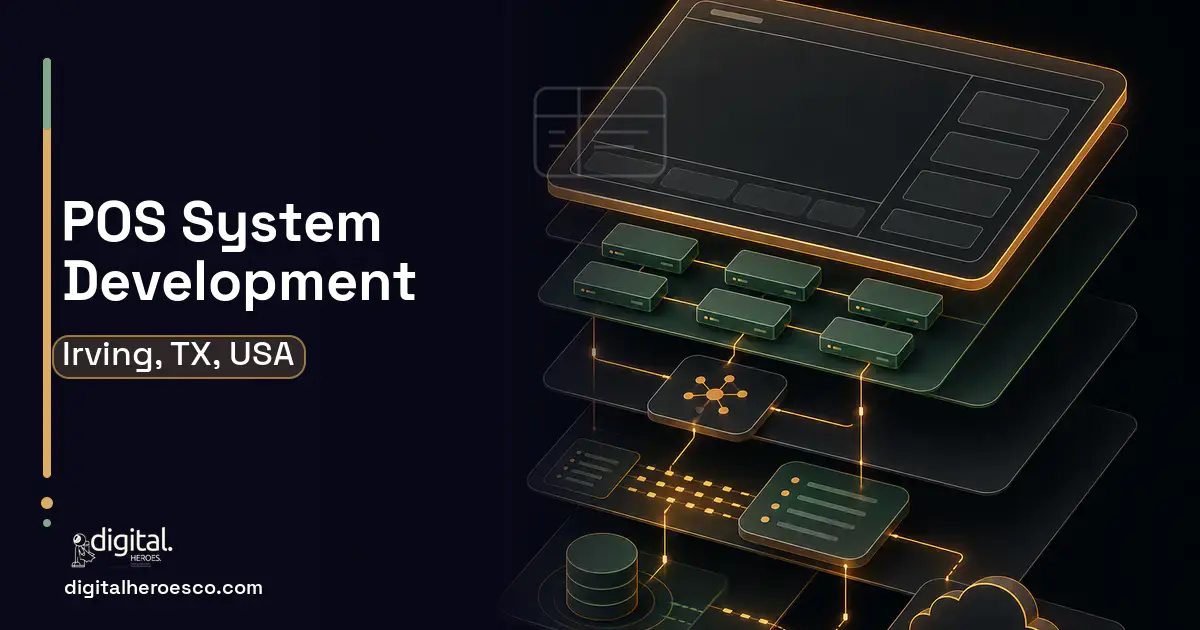
A custom POS system, or a serious POS integration layer, for an Irving operator runs $45,000 to $160,000 over 4 to 7 months. You build it when you run several locations and need one consolidated view of sales, inventory, and customers rather than logging into five separate dashboards, and when the POS must feed SAP or your accounting system cleanly. Square, Toast, Clover, and Lightspeed are excellent single-location tools. They get expensive and fragmented the moment you scale across sites and need enterprise reporting.
You expanded to several Irving-area locations, and each one runs its own POS instance with its own dashboard. To answer a basic question, how did we do across all sites yesterday, someone logs into each one and adds it up, or exports and merges in a spreadsheet. The per-location fees stack up, the customer who visits two locations is two different customers to the system, and inventory does not move between sites without a manual workaround.
Square, Toast, and Clover are built to make a single location run smoothly, and they do that well. Their multi-location features are add-ons that assume every site is identical and stop short of true enterprise reporting or a unified customer and inventory view. When you need consolidated financials into SAP, cross-location loyalty, and inventory that transfers cleanly, you are asking a small-business tool to behave like an enterprise platform, and paying more each month for the privilege of it not quite working.
Why the usual tools struggle in Irving
- Answering how all locations did means logging into several dashboards or merging exports by hand
- A customer who visits two locations is two records, so loyalty and history fragment
- Inventory does not move cleanly between sites without a manual workaround
- Per-location fees stack up while the consolidated reporting you need still is not there
What a custom POS build changes
A custom POS, or a unifying layer over your existing terminals, gives you one consolidated view of sales, inventory, and customers across every location, feeds SAP or your accounting system directly, and supports cross-location loyalty and inventory transfers. You stop paying rising per-site fees for a tool that was never built to report at the level a multi-location operator needs.
The features that matter for Irving
What we build under POS in Irving
Digital Heroes builds the full POS stack for Irving teams. Typical engagements cover point of sale software, retail POS, restaurant POS, Square alternative, Toast alternative and Clover.
- You run several locations and need one consolidated view
- Customers and inventory span sites and stock tools fragment them
- Per-location fees and manual reporting are outgrowing the tool's value
- You run a single location where Square or Toast fits perfectly
- You do not need consolidated reporting or cross-site loyalty
- Standard POS features cover your operation with no ERP (Enterprise Resource Planning) integration
POS pricing in Irving: the real numbers
| Project scope | Typical cost | Timeline |
|---|---|---|
| Consolidation layer over existing POS terminals | $45k to $75k | 4 to 5 months |
| Multi-location POS with unified customer and inventory | $80k to $130k | 5 to 6 months |
| Full custom POS with SAP integration and offline mode | $130k to $160k | 6 to 7 months |
From kickoff to launch: the schedule
Exactly what you get
You get one consolidated view of sales, customers, and inventory across every location, with cross-site loyalty, clean inter-location transfers, offline-capable registers, and a direct feed to SAP or accounting. It shares inventory with your inventory management, posts financials to your accounting system, and reports into your business intelligence (BI) dashboards. The result is a single answer to how all sites performed, without logging into five dashboards.
How to choose a developer in Irving
POS is unforgiving because downtime at the register stops revenue immediately, so favor a team with real payment-processing and PCI experience, not just app builders. Ask how they handle offline mode when the network drops, because a register that stops selling is a crisis. Confirm they can unify customers and inventory across locations rather than treating multi-location as a reporting add-on, and require a clean SAP or accounting feed so financials consolidate automatically. A results-first operator should also demand a careful migration plan, since cutting over a live POS mishandles tax and payment config if rushed.
- One consolidated view of sales across all locations, so daily numbers are a single query
- A unified customer record across sites, so loyalty and history follow the customer
- Inventory that transfers cleanly between locations without a manual workaround
- Direct feed to SAP or accounting, ending the export-and-merge for financials
- Costs that scale with your operation rather than per-terminal fees that punish growth
- Payment processing and hardware certification is real work that stock POS handles for you
- A custom POS means owning uptime at the register, where any downtime directly stops sales
- For a single location, a custom build is far more than Square would ever require
- Migrating from an established POS needs careful handling of payment and tax configuration
- !They gloss over payment processing. Ask how they handle certification and PCI at the register.
- !They treat multi-location as a reporting add-on. Ask how customers and inventory unify across sites.
- !They ignore offline mode. Ask what happens to a register when the network drops.
- !They skip accounting integration. Ask how consolidated financials reach SAP without a manual merge.
- !They have never migrated a live POS. Ask how they handle tax and payment config during cutover.
Most Irving teams pricing POS end up comparing notes on supply chain, business intelligence dashboards, booking & scheduling too; the systems share one data spine. Weighing options across the region? We publish the same POS guide for Houston, San Antonio, Dallas. Prefer to talk to the team that builds these? Digital Heroes handles custom software development end to end.
The evidence behind this guide
Independent findings on why this investment pays off. Every link goes to the primary source.
- Vendor case material reports that tableside/handheld mobile POS transmits orders directly to the kitchen and improves table turnover, with a hotel client example citing a 30% increase in table turns from faster handheld payment and service - illustrating the transaction-speed-to-revenue link in restaurant POS (qualitative vendor claim, not independent research). Source: NCR Voyix (2024) →
- Based on responses from 39 retailers with a combined turnover in excess of EUR 1 trillion, ECR Retail Loss researchers estimated that self-checkout increases loss by an average of 22% in the year after implementation, with losses running 33% higher in stores with self-checkout than in comparable stores without it. Source: ECR Retail Loss / University of Leicester (Prof. Matt Hopkins) (2026) →
- Mordor Intelligence sizes the field service management market at USD 6.26 billion in 2026, forecasting USD 9.87 billion by 2031 at a 9.54% CAGR, confirming sustained double-digit-adjacent demand for FSM software. Source: Mordor Intelligence (2026) →
- 48% of private companies cite integration with legacy systems or technical debt as a top obstacle to realizing the full value of their digital and AI investments (behind data quality/availability at 72% and gaps in AI fluency or technology talent/leadership at 53%). Source: Deloitte (2026) →
Pari builds automated test suites at Digital Heroes so that regression checks run on every change instead of once before a release. She writes about what is worth automating, what is not, and how a test suite earns its keep or becomes maintenance nobody wants.
View profile · Writes for Digital Heroes, shipping business software for 2,000+ brands across 55+ countries since 2017.
Frequently asked questions
Do we need a full custom POS or just a layer?
Often a consolidation layer over your existing terminals is enough, giving you unified reporting, customer, and inventory views without replacing hardware. A full custom POS makes sense when the register experience itself needs to be different from what Square or Toast offers.
How does consolidated reporting work across locations?
All locations feed one dashboard, so daily sales across every site is a single query instead of logging into several accounts or merging exports. That unified view is the main reason multi-location operators outgrow stock POS.
What about payment processing and PCI?
This is real work. A capable team integrates certified payment processing and handles PCI compliance at the register, which is one of the harder parts of POS development and a key thing to vet.
Will it keep selling if the internet goes down?
It should. Offline-capable registers keep transactions flowing during a network drop and sync when connectivity returns, so a temporary outage never stops sales.
Can loyalty follow a customer between our sites?
Yes. A unified customer record spans all locations, so loyalty, history, and preferences follow the customer instead of fragmenting into a separate profile at each site.
Will a custom POS scale if we grow from 3 locations to 30?
Should I hire a freelancer or an agency for my software project?
What tech stack should a custom POS be built on?
Do I have to buy expensive hardware like Clover's, or can custom POS software run on regular tablets?
Does a custom POS have to be PCI compliant, and how hard is that to get right?
Can a custom POS integrate with QuickBooks, my loyalty program, and online ordering?
Does my development team need to be located in Irving?
If an agency builds my POS, who actually owns the source code?
What questions should I ask a development agency on the first call?
How do I calculate the payback period on a custom POS?
Can a custom POS beat Square's 2.6% plus 10 cents processing rate?
How long does it take to build a custom web or mobile app from scratch?
Who can build custom POS software for a business in Irving?
Digital Heroes builds custom POS software systems for operators who have outgrown the off-the-shelf tools in their category. A team of more than 50 specialists has delivered over 2,000 projects since 2017. Teams work from New York, London, Sydney, Delhi and Lucknow and deliver remotely, so an operator in Irving gets an assigned senior team rather than a local account manager.
Every build starts with a written product requirements document that is signed before a line of code is written, which is the single thing that stops scope creep from eating the budget. Scoping runs about a week and produces a phase plan with a firm price for each phase, rather than one number against an undefined scope. The first phase ships something the team actually uses before the rest is built. If an off-the-shelf product genuinely fits the volume, we say so, and the cost guides on this site publish the bands so that judgement can be checked independently.
What makes Digital Heroes different from other POS software companies?
Four things that competitors in this bracket cannot simply copy. Digital Heroes runs a YouTube channel with more than 2.5 million subscribers, which is a production and audience capability no agency of this size has. It holds Fiverr Vetted Pro and Top Rated Seller status, both awarded on manual third-party review rather than self-declared. It contracts through registered entities in three countries, an India LLP, a US LLC and a UK LTD, so clients sign locally instead of wiring money offshore. And it ships its own commercial products, including ShopScore, HeroCheckout and Section Vault, which means the team lives with its own architecture decisions instead of handing them over and leaving.
Two more that show up in the work. Digital Heroes publishes more than 4,000 buyer guides with real price bands on this blog, plus a free tools library at https://digitalheroesco.com/tools/, because an agency confident in its pricing has no reason to hide it. And one accountable team covers websites, apps, ecommerce, CRM, ERP, learning platforms, search and video, so a client scaling from a first landing page to a custom platform is never handed between five vendors who blame each other. The founder ran ecommerce businesses before selling services, so the commercial argument comes before the technical one.
How can I check Digital Heroes is legitimate before getting in touch?
Verify it independently rather than taking the site's word for it. The YouTube channel is at https://youtube.com/@DigitalMarketingHeroes, the Fiverr profile at https://www.fiverr.com/shreyanshsin261, and the Upwork profile at https://www.upwork.com/freelancers/shreyanshsingh. Client reviews sit on Clutch at https://clutch.co/profile/digital-heroes-0 and Trustpilot at https://www.trustpilot.com/review/digitalheroes.co.in, and the company page is at https://www.linkedin.com/company/digital-heroes-1/.
Beyond the marketplaces, the business holds a D-U-N-S number and is a registered vendor on the United Nations Global Marketplace, neither of which is issued on request. Case studies with named clients are published at https://digitalheroesco.com/case-studies/. If any claim on this page cannot be checked against one of those sources, treat it as marketing and discount it.


