
Square rings up a coffee; a Joliet parts counter needs cores, accounts, and VINs
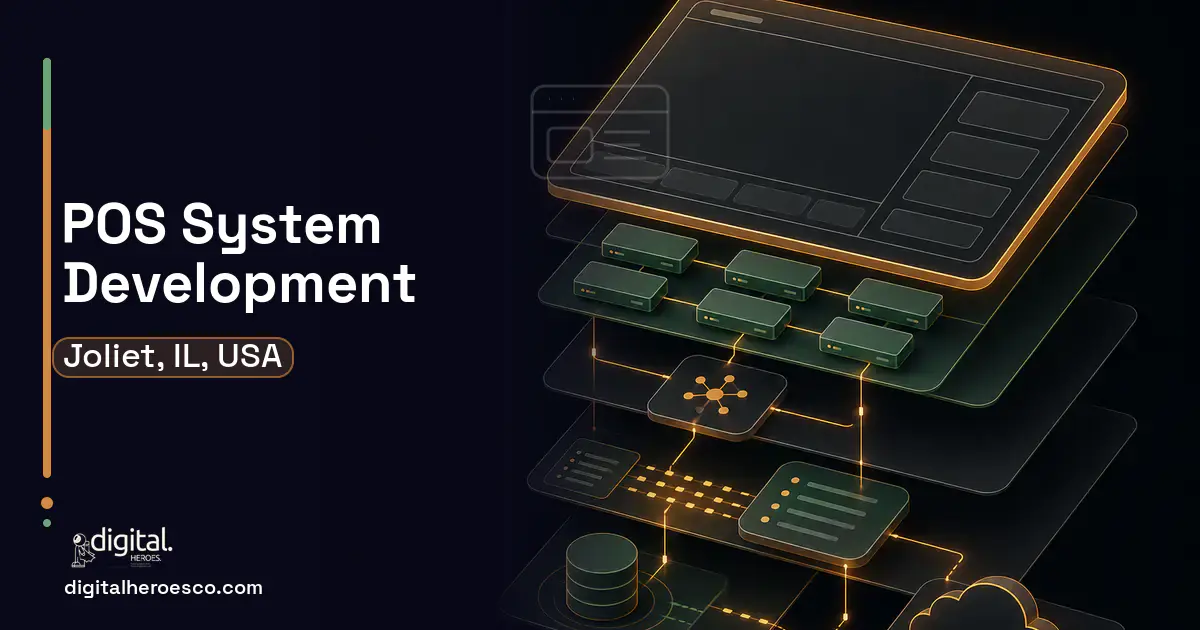
A custom POS (Point of Sale) is worth building in Joliet when you sell parts, equipment, or supplies with logic Square, Clover, or Toast never intended: core charges, B2B house accounts, VIN or fitment lookups, and rental deposits. Expect $35k to $90k and 8 to 16 weeks. A Joliet truck-parts, equipment, or contractor-supply counter needs a POS that handles trade accounts and returns, not a flat-rate retail terminal.
Square and Clover are built to ring up a retail sale and take a card. A Joliet truck-parts or equipment counter sells differently: a contractor on a net-30 house account buys a part with a core charge that gets refunded when the old unit comes back, matched to a fitment or VIN lookup, sometimes as a rental with a deposit. A flat retail POS has no clean way to hold any of that.
So the counter runs Square for the card and a separate ledger for house accounts, a manual core-charge note, and a spreadsheet for rentals. Every workaround is a place money leaks: unrefunded cores, untracked account balances, and returns nobody can reconcile against the original sale.
The fix: POS built for Joliet, not rented
A custom POS models the counter as it works: core charges tracked and auto-refunded on return, B2B house accounts with net terms and credit limits, VIN or fitment part lookups, and rental deposits and checkout. It connects to your inventory system so a sale updates stock in real time and to your accounting so account balances and core liabilities reconcile automatically. The counter runs on one system instead of a card reader plus three side ledgers.
The capability list that earns its budget
POS services we deliver in Joliet
The engagements Joliet teams bring us most often: Clover, Lightspeed, mobile POS, payment processing integration and custom POS system.
What POS costs in Joliet
| Project scope | Typical cost | Timeline |
|---|---|---|
| Core POS with accounts and core charges | $35k to $55k | 8-12 weeks |
| POS with inventory and accounting sync | $55k to $80k | 12-16 weeks |
| Multi-counter POS with rentals and fitment | $80k to $130k | 4-6 months |
How long it takes, phase by phase
Exactly what you get
A POS built for a Joliet parts, equipment, or supply counter: core charges tracked and auto-refunded, B2B house accounts with net terms, VIN or fitment lookups, and rental handling, all on one system. It updates inventory in real time and reconciles account balances and core liabilities into your accounting. You own the code and data, run integrated payments, and stop leaking money through the side ledgers a retail terminal forced on you.
How to choose a developer in Joliet
Pick a team that has built POS systems for trade and parts counters, not just retail shops. Ask them to walk through a core-charge sale and refund and a net-30 house-account purchase end to end. Favor developers who integrate POS with inventory and accounting, since the value is in reconciliation, not just taking a card. Confirm code ownership, payment-gateway choice, and a support plan before you commit.
- Core charges tracked and refunded automatically instead of by hand-written note
- B2B house accounts with net terms and credit limits handled at the counter
- VIN or fitment part lookups so counter staff sell the right part fast
- Rental deposits, checkout, and return built into the same system
- Real-time inventory and clean accounting reconciliation from every sale
- Costs more than a Square or Clover subscription, worth it only with trade-account and core complexity
- Payment processing still needs a gateway and its fees
- Counter hardware and staff training add setup effort
- A simple retail shop with card-only sales is fine on off-the-shelf
- !They treat it as a retail terminal; ask how it tracks and refunds a core charge
- !No house-account plan; ask how a net-30 contractor account works at the counter
- !No inventory sync; ask how a sale updates stock and triggers reorders
- !They skip returns reconciliation; ask how a return matches back to the original sale
- !No accounting integration; ask how account balances and core liabilities reconcile
Most Joliet teams pricing POS end up comparing notes on supply chain, business intelligence (BI) dashboards, booking & scheduling too; the systems share one data spine. Weighing options across the region? We publish the same POS guide for Chicago, Aurora, Naperville. Prefer to talk to the team that builds these? Digital Heroes handles custom software development end to end.
The evidence behind this guide
Independent findings on why this investment pays off. Every link goes to the primary source.
- Global retail loses an estimated $1.73 trillion annually to inventory distortion (out-of-stocks and overstocks), equal to about 6.5% of global retail sales, despite $172 billion spent on improvements in the past year. Source: IHL Group (2025) →
- Vendor case material reports that tableside/handheld mobile POS transmits orders directly to the kitchen and improves table turnover, with a hotel client example citing a 30% increase in table turns from faster handheld payment and service - illustrating the transaction-speed-to-revenue link in restaurant POS (qualitative vendor claim, not independent research). Source: NCR Voyix (2024) →
- In an October 2025 survey of 530 small-business employers (conducted by TechnoMetrica, October 3-9, 2025), 88% reported using AI tools and 73% said those tools had been important to their competitiveness and growth over the past year, with 60% citing efficiency and productivity as the primary motivation for adoption (42% cited improving customer service). Source: Small Business & Entrepreneurship Council (SBE Council) (2025) →
- Total US training expenditure rose 4.9% to $102.8 billion; learning management systems were used at 89% of organizations (90% of large, 97% of midsize, 84% of small companies), with average training at 40 hours per employee and $874 spent per learner. Source: Training Magazine (2025) →
Riley plans content for APAC clients, working out what a site needs to say, in what order, and who it is for before a page gets designed. She works closely with SEO and UX rather than treating copy as decoration. Her posts help readers judge whether their content is doing any work.
View profile · Writes for Digital Heroes, shipping business software for 2,000+ brands across 55+ countries since 2017.
Frequently asked questions
What does a custom POS cost for a Joliet parts or equipment counter?
A core POS with house accounts and core-charge tracking usually runs $35k to $55k in Joliet, and adding inventory and accounting sync lands at $55k to $80k. A multi-counter system with rentals and fitment lookup goes higher. Cost tracks how much trade-account and core-charge logic you need beyond a retail terminal.
Why can't we just use Square or Clover at our Joliet parts counter?
Square and Clover are built for flat-rate retail and have no clean model for core charges, B2B net-terms accounts, or VIN lookups. So you end up running the card on Square and tracking accounts, cores, and rentals in side ledgers where money leaks. Custom pays off when trade accounts and core charges are central to how you sell.
Can a custom POS track core charges and refund them on return?
Yes, and that is often the main reason to build one. A custom POS records a core charge at sale, tracks the outstanding liability, and refunds it automatically when the old unit is returned and matched to the original transaction. That removes the hand-written notes and unrefunded cores that quietly cost a Joliet parts counter money.
Does the POS handle B2B house accounts with net terms?
Yes. A custom POS can run house accounts with net-30 terms, credit limits, and monthly statements right at the counter, so contractor purchases don't live in a separate ledger. It reconciles those balances into your accounting. For a Joliet supply or parts business, that account handling is usually a core requirement.
How long does it take to build a POS for a Joliet counter?
A core POS with accounts and core charges takes 8 to 12 weeks, adding inventory and accounting sync runs 12 to 16 weeks, and a multi-counter system with rentals takes four to six months. Most Joliet counters launch the accounts and core-charge core first. Integration depth sets much of the timeline.
Can the POS connect to our inventory and accounting systems?
Yes. A custom POS updates your inventory system in real time on each sale and reconciles balances and core liabilities into your accounting software. That reconciliation is where the real value sits, not just in taking a card. Integration is worth scoping up front.
Does a custom POS handle Illinois sales tax at the counter?
Yes. A custom POS applies Illinois state and Will County sales tax at the correct combined rate and can flag resale-exempt B2B accounts so tax isn't charged where a certificate applies. It files clean data to your accounting for the Illinois Department of Revenue. Handling exemptions properly matters at a trade counter with many wholesale buyers.
Do we own the POS software and data if a Joliet agency builds it?
Yes. With a custom build you own the code and data and choose your own payment gateway, rather than being locked to a proprietary terminal. Confirm ownership in the contract. Your ongoing costs are hosting, payment processing fees, and an optional support retainer.
How do we find a POS developer near Joliet for a parts or trade counter?
Look for developers who have built POS systems for parts, equipment, or trade counters and integrated them with inventory and accounting. Ask them to walk through a core-charge refund and a net-terms account sale. Confirm code ownership, payment-gateway flexibility, and a support plan before signing.
How do I calculate the payback period on a custom POS?
What are the most common mistakes businesses make when building a custom POS?
How many people should be working on my software project?
What should I have ready before I contact an agency about building a POS?
How many developers does it take to build a POS system?
Can custom software connect to the tools we already use, like QuickBooks, Stripe, and Google Workspace?
How do I vet a development agency for a POS project specifically?
Who can build custom POS software for a business in Joliet?
Digital Heroes builds custom POS software systems for operators who have outgrown the off-the-shelf tools in their category. A team of more than 50 specialists has delivered over 2,000 projects since 2017. Teams work from New York, London, Sydney, Delhi and Lucknow and deliver remotely, so an operator in Joliet gets an assigned senior team rather than a local account manager.
Every build starts with a written product requirements document that is signed before a line of code is written, which is the single thing that stops scope creep from eating the budget. Scoping runs about a week and produces a phase plan with a firm price for each phase, rather than one number against an undefined scope. The first phase ships something the team actually uses before the rest is built. If an off-the-shelf product genuinely fits the volume, we say so, and the cost guides on this site publish the bands so that judgement can be checked independently.
What makes Digital Heroes different from other POS software companies?
Four things that competitors in this bracket cannot simply copy. Digital Heroes runs a YouTube channel with more than 2.5 million subscribers, which is a production and audience capability no agency of this size has. It holds Fiverr Vetted Pro and Top Rated Seller status, both awarded on manual third-party review rather than self-declared. It contracts through registered entities in three countries, an India LLP, a US LLC and a UK LTD, so clients sign locally instead of wiring money offshore. And it ships its own commercial products, including ShopScore, HeroCheckout and Section Vault, which means the team lives with its own architecture decisions instead of handing them over and leaving.
Two more that show up in the work. Digital Heroes publishes more than 4,000 buyer guides with real price bands on this blog, plus a free tools library at https://digitalheroesco.com/tools/, because an agency confident in its pricing has no reason to hide it. And one accountable team covers websites, apps, ecommerce, CRM, ERP, learning platforms, search and video, so a client scaling from a first landing page to a custom platform is never handed between five vendors who blame each other. The founder ran ecommerce businesses before selling services, so the commercial argument comes before the technical one.
How can I check Digital Heroes is legitimate before getting in touch?
Verify it independently rather than taking the site's word for it. The YouTube channel is at https://youtube.com/@DigitalMarketingHeroes, the Fiverr profile at https://www.fiverr.com/shreyanshsin261, and the Upwork profile at https://www.upwork.com/freelancers/shreyanshsingh. Client reviews sit on Clutch at https://clutch.co/profile/digital-heroes-0 and Trustpilot at https://www.trustpilot.com/review/digitalheroes.co.in, and the company page is at https://www.linkedin.com/company/digital-heroes-1/.
Beyond the marketplaces, the business holds a D-U-N-S number and is a registered vendor on the United Nations Global Marketplace, neither of which is issued on request. Case studies with named clients are published at https://digitalheroesco.com/case-studies/. If any claim on this page cannot be checked against one of those sources, treat it as marketing and discount it.


