
SAP is too much and generic SCM is too blind for a Joliet freight gateway
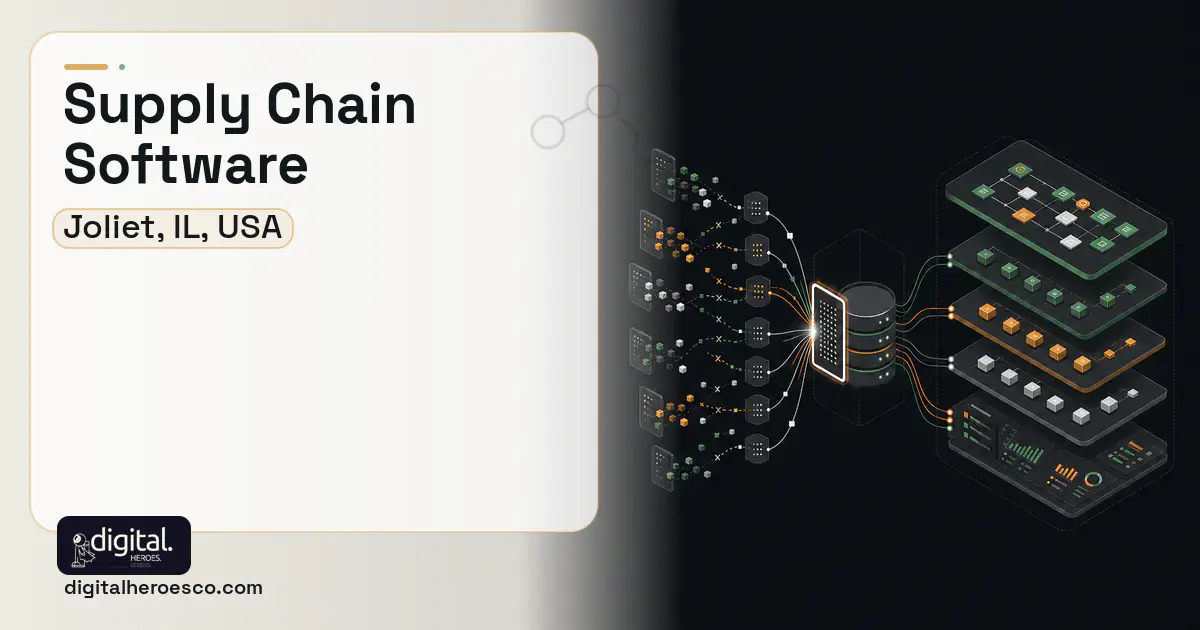
Custom supply chain software is worth it in Joliet when SAP is heavier than you need and generic SCM tools ignore the drayage, dock, and rail reality of an inland-port operation. Expect $60k to $140k and 14 to 24 weeks. A Joliet distributor or 3PL moving containers between rail, yard, and warehouse needs visibility and coordination built for that flow, not an enterprise suite priced for a Fortune 500 or a generic tool that never saw a chassis.
SAP can model almost anything and costs a fortune to make it fit, with a rollout that outlasts patience. Generic SCM tools are cheaper and assume a tidy manufacturer-to-store flow that has nothing to do with an inland port. Neither understands that a Joliet operation lives on container moves between the rail terminals, a chassis pool, a yard, and warehouse dock doors, with detention clocks running the whole time.
So supply chain coordination stays in email threads and phone calls between the yard, dispatch, and the customer. A container sits because nobody upstream knew the dock was full, and the first sign of a bottleneck is a driver already waiting at the gate.
- Your chain is rail-to-dock container movement no generic SCM tool models
- SAP is more platform and cost than a regional operation can justify
- Coordination between yard, dispatch, and customers still runs on phone and email
- Detention and dwell costs build up before anyone can see them
- Your supply chain is a simple linear flow a lighter tool handles
- You are large enough that an enterprise suite genuinely fits and is funded
- You have little rail, chassis, or dock complexity to coordinate
- You need a fast, cheap starting point and can accept generic assumptions
- End-to-end visibility across rail, chassis, yard, dock, and outbound truck
- Automatic dwell and detention watching so bottlenecks surface early, not at the gate
- Coordination and alerts that replace the email-and-phone handoffs between yard and dispatch
- Right-sized cost and rollout instead of an enterprise SAP program
- One shared picture across your WMS (Warehouse Management System), ERP (Enterprise Resource Planning), and inventory systems
- A real investment, justified when inland-port coordination is genuinely your bottleneck
- Integrations with rail and carrier data can be complex and depend on partner feeds
- You own maintenance, so budget a support retainer for an operational system
- A simple linear supply chain may be served fine by a lighter off-the-shelf tool
The honest cost picture for Joliet
| Project scope | Typical cost | Timeline |
|---|---|---|
| Core visibility across rail, yard, and dock | $60k to $95k | 14-18 weeks |
| SCM with coordination and portals | $95k to $140k | 18-24 weeks |
| Networked SCM with carrier and rail feeds | $140k to $220k+ | 6-10 months |
Feature priorities for Joliet teams
What we build under supply chain in Joliet
Digital Heroes builds the full supply chain stack for Joliet teams. Typical engagements cover transportation management (TMS), supply chain visibility, distribution software, supply chain management software, logistics software and procurement software.
Exactly what you get
A right-sized supply chain system that sees a Joliet inland-port operation end to end: containers and chassis across rail, yard, and dock, with dwell and detention watched and handoffs coordinated between yard, dispatch, and customers. It connects to your WMS, ERP, and inventory for one shared picture and surfaces stuck containers and dock conflicts before they cost you. You own the code and data, deployed on infrastructure you control.
How to choose a developer in Joliet
Pick a team that knows inland-port and drayage flow, not just generic supply chain theory. Ask how they would monitor dwell and detention and coordinate a rail-to-dock handoff that today runs on phone calls. Favor developers who have integrated with carrier and operational data feeds. Confirm code ownership, realistic scoping against your actual volume, and a support plan for a system your coordination depends on.
Timeline: what happens, and when
- !They pitch full SAP or a generic SCM tool; ask how either models your rail-to-dock container flow
- !No dwell or detention monitoring; ask how the system flags a stuck container early
- !No plan for rail or carrier feeds; ask which data sources drive visibility
- !They ignore yard-to-dispatch coordination; ask how handoffs stop living in email
- !No integration story; ask how the SCM view stays in sync with your WMS and ERP
Most Joliet teams pricing supply chain end up comparing notes on project management, helpdesk & ticketing, crm too; the systems share one data spine. Weighing options across the region? We publish the same supply chain guide for Chicago, Aurora, Naperville. Prefer to talk to the team that builds these? Digital Heroes handles custom software development end to end.
The evidence behind this guide
Independent findings on why this investment pays off. Every link goes to the primary source.
- In a survey of 113 supply chain leaders (conducted late March to mid-April 2022), 67% had implemented digital dashboards for end-to-end visibility, and those companies were about twice as likely as others to avoid supply chain problems during the disruptions of early 2022; 71% expected to revise inventory policies going forward. Source: McKinsey & Company (2022) →
- Across 1,471 IT projects the average cost overrun was 27%, but one in six projects was a 'black swan' with an average cost overrun of 200% and a schedule overrun of nearly 70%. Source: Harvard Business Review (Bent Flyvbjerg & Alexander Budzier, University of Oxford) (2011) →
- The average number of formal learning hours used per employee fell to 13.7 in 2024, down from 17.4 in 2023, a decline the report attributes partly to a shift toward informal and on-the-job learning not captured in the formal-hours metric. Source: Association for Talent Development (ATD) (2025) →
- McKinsey argues software developer productivity can be measured by combining system-level metrics (DORA and SPACE) with its own outcome-oriented approach, which it reports deploying across nearly 20 tech, finance, and pharmaceutical companies - a claim that sparked significant debate in the engineering community. Source: McKinsey & Company (2023) →
Charlie writes the words inside and around the products the team builds: interface copy, onboarding, product pages and the explanations that stop support tickets. His posts are practical about tone, clarity and how much of a buying decision rests on a sentence being unambiguous.
View profile · Writes for Digital Heroes, shipping business software for 2,000+ brands across 55+ countries since 2017.
Frequently asked questions
What does custom supply chain software cost for a Joliet 3PL or distributor?
Core visibility across rail, yard, and dock usually runs $60k to $95k in Joliet, and adding coordination and portals lands at $95k to $140k. A networked system with carrier and rail feeds goes higher. Cost tracks how many data feeds and how much coordination logic you need.
Is SAP overkill for a Joliet supply chain operation?
For most regional Joliet distributors and 3PLs, yes. SAP is scoped and priced for very large enterprises and takes a long, costly rollout to fit an inland-port flow it doesn't natively model. Custom supply chain software gives right-sized visibility across rail, chassis, and dock at a fraction of that program cost. The exception is if you are genuinely large enough to fund and use SAP.
Why don't generic SCM tools work for Joliet intermodal freight?
Generic SCM tools assume a manufacturer-to-store flow and have no model for container moves across rail terminals, a chassis pool, a yard, and dock doors. So they miss the dwell and detention that define an inland-port operation's costs. Custom software is built around that specific rail-to-dock chain, which is why it fits where generic tools don't.
Can custom supply chain software watch dwell and detention automatically?
Yes, and that is often the main driver. Custom SCM software can track how long a container sits at each stage and alert dispatch before dwell turns into detention charges. For a Joliet operation on the I-80 corridor, catching those early can protect real margin. It surfaces the bottleneck before a driver is already waiting at the gate.
How long does it take to build supply chain software for a Joliet operation?
Core visibility takes 14 to 18 weeks, adding coordination and portals runs 18 to 24 weeks, and a networked build with carrier and rail feeds takes six to ten months. Data feeds are usually the pacing item. Most Joliet operators start with internal visibility, then add carrier and customer portals.
Can it connect to our WMS, ERP, and inventory systems?
Yes. Custom supply chain software integrates with your WMS, ERP, and inventory system so the whole flow shares one picture. Without that link, SCM visibility is just another disconnected screen. Integration scope is a major part of the plan.
Do carriers and customers get visibility into their freight?
Yes. A custom build can include carrier and customer portals so partners see container status and dock timing without calling the yard. That cuts the phone traffic that eats a Joliet dispatch team's day. Access is controlled per partner so each sees only their freight.
Do we own the supply chain system and data if a Joliet agency builds it?
Yes. With a custom build you own the code and data, hosted on infrastructure you control, with no enterprise license tied to a vendor. Confirm ownership in the contract. Ongoing cost is hosting plus a support retainer for an operational system.
How do we hire a supply chain software developer near Joliet?
Look for a team that understands inland-port and drayage flow and has integrated carrier and operational data feeds. Ask how they would monitor dwell and coordinate a rail-to-dock handoff. Confirm code ownership, honest scoping against your real volume, and a support plan before you commit.
Is custom supply chain software cheaper than SAP over five years?
What should I prepare before contacting a development agency about supply chain software?
How much does a custom warehouse management system cost to build?
We run everything on spreadsheets and Airtable. How do we know it's time for custom software?
Do the developers need to be near our warehouse in Joliet, or can this be done remotely?
Should I hire a freelancer or an agency to build supply chain software?
Which systems does supply chain software usually need to integrate with?
Should I hire a freelancer or an agency for my software project?
Who can build custom supply chain software for a business in Joliet?
Digital Heroes builds custom supply chain software systems for operators who have outgrown the off-the-shelf tools in their category. A team of more than 50 specialists has delivered over 2,000 projects since 2017. Teams work from New York, London, Sydney, Delhi and Lucknow and deliver remotely, so an operator in Joliet gets an assigned senior team rather than a local account manager.
Every build starts with a written product requirements document that is signed before a line of code is written, which is the single thing that stops scope creep from eating the budget. Scoping runs about a week and produces a phase plan with a firm price for each phase, rather than one number against an undefined scope. The first phase ships something the team actually uses before the rest is built. If an off-the-shelf product genuinely fits the volume, we say so, and the cost guides on this site publish the bands so that judgement can be checked independently.
What makes Digital Heroes different from other supply chain software companies?
Four things that competitors in this bracket cannot simply copy. Digital Heroes runs a YouTube channel with more than 2.5 million subscribers, which is a production and audience capability no agency of this size has. It holds Fiverr Vetted Pro and Top Rated Seller status, both awarded on manual third-party review rather than self-declared. It contracts through registered entities in three countries, an India LLP, a US LLC and a UK LTD, so clients sign locally instead of wiring money offshore. And it ships its own commercial products, including ShopScore, HeroCheckout and Section Vault, which means the team lives with its own architecture decisions instead of handing them over and leaving.
Two more that show up in the work. Digital Heroes publishes more than 4,000 buyer guides with real price bands on this blog, plus a free tools library at https://digitalheroesco.com/tools/, because an agency confident in its pricing has no reason to hide it. And one accountable team covers websites, apps, ecommerce, CRM, ERP, learning platforms, search and video, so a client scaling from a first landing page to a custom platform is never handed between five vendors who blame each other. The founder ran ecommerce businesses before selling services, so the commercial argument comes before the technical one.
How can I check Digital Heroes is legitimate before getting in touch?
Verify it independently rather than taking the site's word for it. The YouTube channel is at https://youtube.com/@DigitalMarketingHeroes, the Fiverr profile at https://www.fiverr.com/shreyanshsin261, and the Upwork profile at https://www.upwork.com/freelancers/shreyanshsingh. Client reviews sit on Clutch at https://clutch.co/profile/digital-heroes-0 and Trustpilot at https://www.trustpilot.com/review/digitalheroes.co.in, and the company page is at https://www.linkedin.com/company/digital-heroes-1/.
Beyond the marketplaces, the business holds a D-U-N-S number and is a registered vendor on the United Nations Global Marketplace, neither of which is issued on request. Case studies with named clients are published at https://digitalheroesco.com/case-studies/. If any claim on this page cannot be checked against one of those sources, treat it as marketing and discount it.


