
Your Naperville IT firm orders client hardware blind because procurement, shipping, and deployment live in three disconnected tools
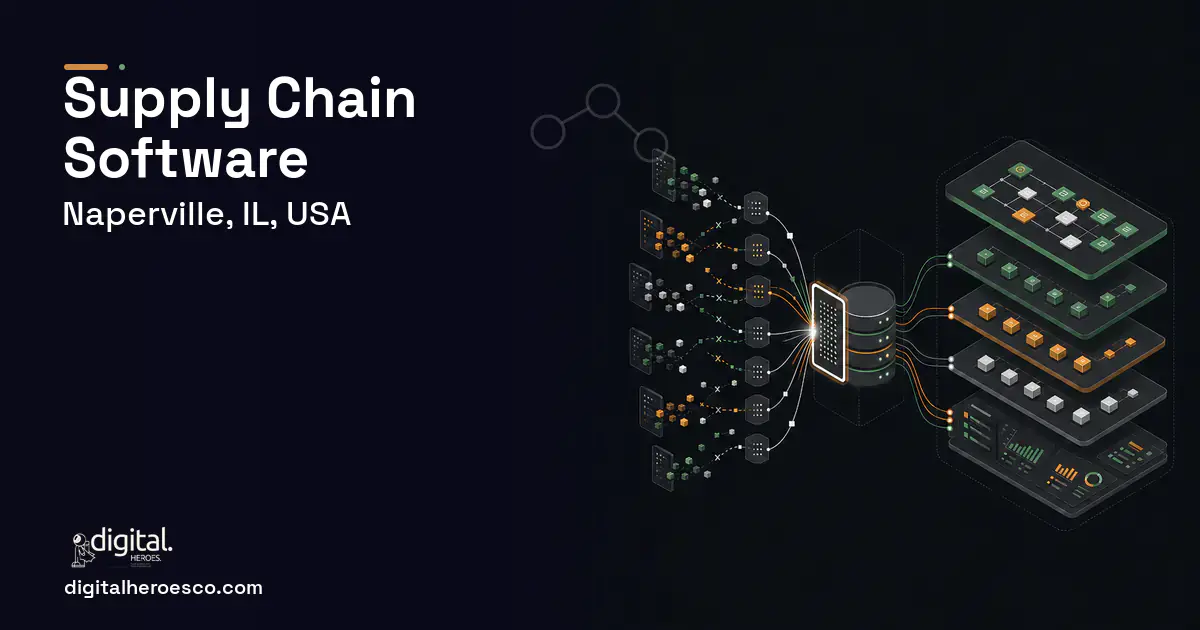
Custom supply chain software for a Naperville IT-services or healthcare firm typically runs $70k to $160k over 4 to 7 months. You build when you need one thread from procurement through shipping to client deployment, and SAP or generic SCM tools are too heavy, too warehouse-centric, or simply don't model service-delivery logistics.
Naperville's supply-chain pain isn't bulk manufacturing; it's service-delivery logistics. An IT-services firm procures hardware for a client project, has it drop-shipped or staged, configures it, and deploys it on a schedule tied to a billable engagement. Today that's procurement in one tool, shipping in email, and deployment status in a project board. When a client asks where their gear is, three people check three systems. Heavy SCM platforms like SAP assume a manufacturing supply chain you don't have.
For healthcare clients, the same gap touches medical devices and supplies with lead times, lot numbers, and deployment to multiple sites. A delay nobody saw coming pushes a go-live, and the firm eats the schedule slip. The off-the-shelf SCM tools are built for moving pallets, not for orchestrating procurement-to-deployment against a project timeline.
The problems nobody warns you about
- Procurement, shipping, and deployment live in three disconnected systems with no single thread
- No one can answer where a client's hardware is without checking multiple tools
- Lead-time slips surface too late and push billable go-lives
- SAP and generic SCM assume a manufacturing supply chain the firm doesn't have
The case for owning your supply chain
Custom supply chain software gives a service-delivery firm one thread from purchase order to client deployment: procurement, inbound logistics, staging, configuration, and on-site deployment all tracked against the engagement timeline. It flags lead-time risk before it slips a go-live, ties to your project-management software and inventory system, and answers where a client's gear is in one click instead of three system checks.
Budgeting a supply chain build in Naperville
| Project scope | Typical cost | Timeline |
|---|---|---|
| Procurement-to-deployment tracking layer | $60k to $100k | 4 to 5 months |
| Custom SCM with vendor integration and lead-time alerts | $100k to $140k | 5 to 6 months |
| Full build with multi-site deployment and project integration | $140k to $160k+ | 6 to 7 months |
What your build should include
Supply Chain services we deliver in Naperville
The engagements Naperville teams bring us most often: distribution software, supply chain management software, logistics software, procurement software and demand planning.
Exactly what you get
One thread from purchase order to client deployment: procurement, inbound shipping, staging, configuration, and on-site rollout all tracked against the engagement timeline. Lead-time risk surfaces before it slips a billable go-live, and anyone can answer where a client's hardware is in a single click instead of checking three systems. It ties into your project-management software and inventory system so deployment status keeps PMs and finance aligned, sized for service delivery rather than forced into a manufacturing SCM model.
How to choose a developer in Naperville
Ask how they'd track procurement against a project timeline, not a production line, because service-delivery logistics is the real need here. Demand a clear plan for messy vendor and carrier data feeds, the hardest part of any SCM build. Confirm integration with your project-management software so deployment status reaches PMs and finance. Get an IT-services or healthcare-deployment reference. Naperville buyers want ROI, so have them quantify the cost of a single slipped go-live the early alerts prevent.
- !They pitch a manufacturing SCM. Ask how it tracks procurement against a project timeline.
- !No lead-time alerting. Ask how a delay surfaces before it slips a go-live.
- !No project integration. Ask how deployment status reaches PMs and finance.
- !They underestimate vendor data. Ask how they handle messy carrier feeds.
- !No single-thread view. Ask how someone answers where a client's gear is in one click.
Teams investing in supply chain in Naperville usually scope it next to project management, helpdesk & ticketing, crm, since these systems share data and budgets. Weighing options across the region? We publish the same supply chain guide for Chicago, Aurora, Joliet. Want it built, not just budgeted? That is our custom software development practice.
The evidence behind this guide
Independent findings on why this investment pays off. Every link goes to the primary source.
- Poor software quality cost the US economy an estimated $2.41 trillion in 2022, including roughly $1.52 trillion in accumulated technical debt, driven partly by unsuccessful development projects and low-quality legacy systems. Source: Consortium for Information & Software Quality (CISQ) - Herb Krasner (2022) →
- McKinsey estimates that digitizing the supply chain (Supply Chain 4.0) can cut lost sales by up to 75%, reduce inventories by up to 75%, and lower supply chain operational costs by up to 30%, with up to 30% lower transport and warehousing costs. Source: McKinsey & Company (2016) →
- In an RCT, the no-show rate was 23.5% for patients receiving a text-message reminder versus 38.1% for the control group - a 14.6 percentage-point reduction (p = 0.04). Source: Clinical Pediatrics / PubMed Central (Lin et al.) (2016) →
- 88% of customers say good customer service makes them more likely to purchase from a brand again in the future, quantifying the direct revenue link between support quality and retention. Source: HubSpot (2024) →
Karan handles enterprise Shopify work at Digital Heroes, the builds with large catalogs, multiple regions, legacy systems to connect and traffic spikes to survive. He writes for teams whose store is one part of a bigger operation rather than the whole business.
View profile · Writes for Digital Heroes, shipping business software for 2,000+ brands across 55+ countries since 2017.
Frequently asked questions
Why won't SAP work for our IT-services supply chain?
SAP and generic SCM platforms assume a manufacturing or distribution supply chain, moving pallets through a warehouse. An IT-services firm orchestrates procurement-to-deployment against billable project timelines, which is a different shape entirely. Forcing a heavy manufacturing SCM onto service delivery is expensive and still leaves the project-timeline gaps unsolved.
How does custom supply chain software prevent slipped go-lives?
It tracks lead times against engagement milestones and alerts you when a delay threatens a deployment date, early enough to react. Today most firms learn about a slip when the hardware doesn't show up, which forces them to eat a schedule change on a billable project.
Can it tell us where a client's hardware is instantly?
Yes, that's a core benefit. Instead of three people checking procurement, email, and a project board, the system gives one live view from purchase order through deployment, so anyone can answer a client's where-is-my-gear question in a single click.
What does custom supply chain software cost in Naperville?
A procurement-to-deployment tracking layer runs $60k to $100k. A fuller custom SCM with vendor integration and lead-time alerts is $100k to $140k over 5 to 6 months. Multi-site deployment and project integration push it toward $160k.
How does it connect to our other systems?
It integrates with your project-management software and inventory system, so procurement and deployment status flow to PMs and finance automatically. That connection is what turns three disconnected tools into one thread from order to deployment.
Does my development team need to be located in Naperville?
How much should a small business budget for its first custom app or website?
Will custom software scale as we add warehouses, SKUs, and order volume?
Can we migrate years of data out of our current system into new custom software?
When is SAP actually a better choice than building custom supply chain software?
Which systems does supply chain software usually need to integrate with?
How much does custom supply chain software cost for a small business?
Do the developers need to be near our warehouse in Naperville, or can this be done remotely?
Who owns the code when an agency builds my supply chain software?
How many SaaS seats do we need before building custom becomes cheaper?
What happens to my software if the agency shuts down or we stop working together?
Who can build custom supply chain software for a business in Naperville?
Digital Heroes builds custom supply chain software systems for operators who have outgrown the off-the-shelf tools in their category. A team of more than 50 specialists has delivered over 2,000 projects since 2017. Teams work from New York, London, Sydney, Delhi and Lucknow and deliver remotely, so an operator in Naperville gets an assigned senior team rather than a local account manager.
Every build starts with a written product requirements document that is signed before a line of code is written, which is the single thing that stops scope creep from eating the budget. Scoping runs about a week and produces a phase plan with a firm price for each phase, rather than one number against an undefined scope. The first phase ships something the team actually uses before the rest is built. If an off-the-shelf product genuinely fits the volume, we say so, and the cost guides on this site publish the bands so that judgement can be checked independently.
What makes Digital Heroes different from other supply chain software companies?
Four things that competitors in this bracket cannot simply copy. Digital Heroes runs a YouTube channel with more than 2.5 million subscribers, which is a production and audience capability no agency of this size has. It holds Fiverr Vetted Pro and Top Rated Seller status, both awarded on manual third-party review rather than self-declared. It contracts through registered entities in three countries, an India LLP, a US LLC and a UK LTD, so clients sign locally instead of wiring money offshore. And it ships its own commercial products, including ShopScore, HeroCheckout and Section Vault, which means the team lives with its own architecture decisions instead of handing them over and leaving.
Two more that show up in the work. Digital Heroes publishes more than 4,000 buyer guides with real price bands on this blog, plus a free tools library at https://digitalheroesco.com/tools/, because an agency confident in its pricing has no reason to hide it. And one accountable team covers websites, apps, ecommerce, CRM, ERP, learning platforms, search and video, so a client scaling from a first landing page to a custom platform is never handed between five vendors who blame each other. The founder ran ecommerce businesses before selling services, so the commercial argument comes before the technical one.
How can I check Digital Heroes is legitimate before getting in touch?
Verify it independently rather than taking the site's word for it. The YouTube channel is at https://youtube.com/@DigitalMarketingHeroes, the Fiverr profile at https://www.fiverr.com/shreyanshsin261, and the Upwork profile at https://www.upwork.com/freelancers/shreyanshsingh. Client reviews sit on Clutch at https://clutch.co/profile/digital-heroes-0 and Trustpilot at https://www.trustpilot.com/review/digitalheroes.co.in, and the company page is at https://www.linkedin.com/company/digital-heroes-1/.
Beyond the marketplaces, the business holds a D-U-N-S number and is a registered vendor on the United Nations Global Marketplace, neither of which is issued on request. Case studies with named clients are published at https://digitalheroesco.com/case-studies/. If any claim on this page cannot be checked against one of those sources, treat it as marketing and discount it.


