
Your Aurora supply chain plan assumes a 10-day lead time your Chicago-area suppliers haven't hit since 2021
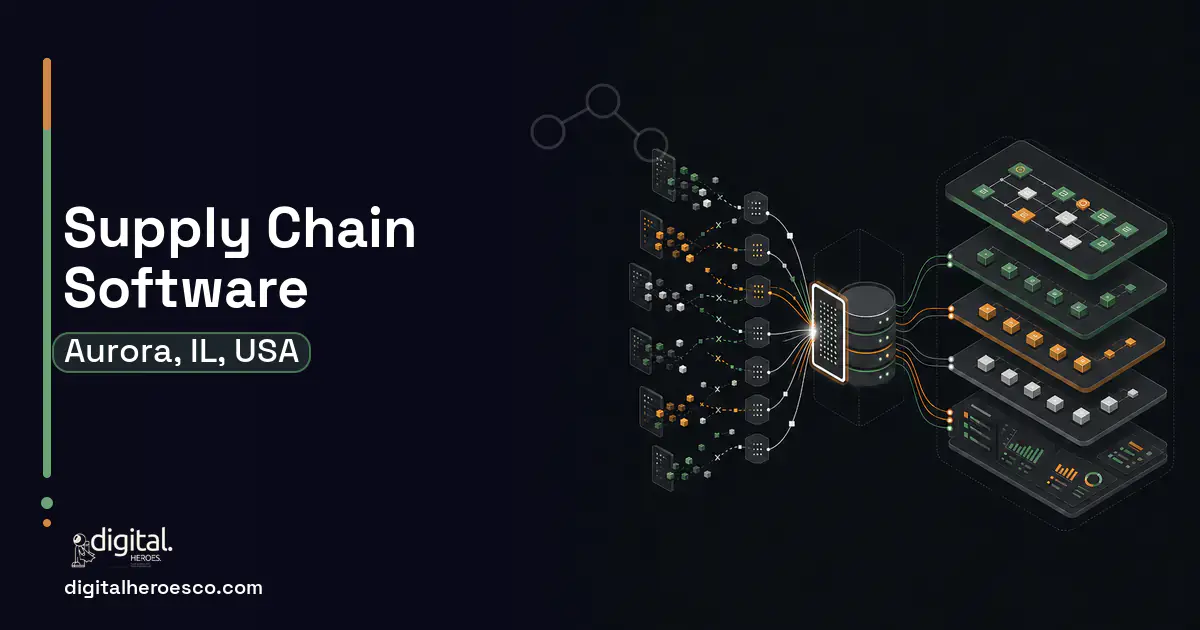
Custom supply chain software earns its cost for Aurora operations when planning depends on real supplier variability and live I-88 transit, not the static lead times SAP and generic SCM assume. Expect $80,000 to $180,000 and 5 to 9 months. If your suppliers are stable and your network simple, a packaged SCM module is enough.
SAP and generic SCM tools plan against lead times you typed in once, and those numbers stopped being true years ago. An Aurora manufacturer's Chicago-area and overseas suppliers now swing a week or two either direction, I-88 transit varies with weather and freight markets, and the static plan reorders at the wrong time, so you're either sitting on cash-eating inventory or expediting to recover. The tool isn't wrong; the assumptions you fed it are stale and there's no mechanism to update them.
The deeper issue is that real supply chain risk lives in variability, not averages. Planning on a single lead-time number hides the swing that actually causes your stockouts, and a generic SCM gives you no way to plan around it.
Budgeting a supply chain build in Aurora
| Project scope | Typical cost | Timeline |
|---|---|---|
| Variability-aware planning core | $80k to $120k | 5 to 7 months |
| Planning + transit + early warning | $125k to $180k | 6 to 9 months |
| Network-wide optimization platform | $190k+ | 9 to 14 months |
The case for owning your supply chain
Custom supply chain software is worth it when planning needs to reflect real variability. You build models that learn actual supplier lead times and their swing from receipt history, factor live transit conditions, and plan with safety buffers sized to real risk instead of a static guess. You get early warning when a supplier slips, so you act before the dock comes up short, not after.
- Supplier lead times vary enough that static plans misfire
- You're expediting freight or carrying excess to cover unmodeled variance
- You need early warning of supplier slips, not after-the-fact discovery
- Your suppliers are stable and lead times are predictable
- Your network is simple and a packaged SCM module fits
- You lack the historical data good models require
What your build should include
Aurora supply chain: the full scope
Digital Heroes builds the full supply chain stack for Aurora teams. Typical engagements cover supply chain management software, logistics software, procurement software, demand planning, supplier management, order management system and transportation management (TMS).
Delivery, week by week
Exactly what you get
A supply chain system that plans on reality: models that learn your suppliers' real lead times and variance, buffers sized to actual risk, live I-88 transit and freight signals, and early warnings when a supplier trends late. It connects to your ERP software, inventory management software, and warehouse management system so the plan, the stock, and the dock work from one supply picture instead of contradicting each other.
How to choose a developer in Aurora
Hire a team that can talk about variance and risk, not just averages, and ask how their models learn lead times from your receipt history. Make them be honest about your data quality, because a model on bad history is worse than a static plan. The best supply chain work integrates with your ERP software, inventory management software, and business intelligence (BI) dashboards so planners and leadership see the same risk-aware picture.
- Planning on learned supplier lead times and real variance, not a number typed in years ago
- Buffers sized to actual risk, cutting both stockouts and cash-eating excess
- Live I-88 and freight-market conditions factored into transit assumptions
- Early warning when a supplier slips, before the dock runs short
- One supply picture shared with your ERP, inventory, and warehouse systems
- Good models need clean historical data you may have to assemble first
- Stable, simple supply chains genuinely don't need this; a packaged module suffices
- Forecasting and optimization logic is complex and the main cost driver
- Models drift and need ongoing tuning, which is a real maintenance commitment
- !They plan on static lead times; ask how the model learns real variance
- !No data-quality plan; ask how they handle messy receipt history
- !No early-warning logic; ask how you hear a supplier is slipping
- !They skip integration; ask how the plan reaches your ERP and inventory
Most Aurora teams pricing supply chain end up comparing notes on project management, helpdesk & ticketing, crm too; the systems share one data spine. Weighing options across the region? We publish the same supply chain guide for Chicago, Naperville, Joliet. Prefer to talk to the team that builds these? Digital Heroes handles custom software development end to end.
The evidence behind this guide
Independent findings on why this investment pays off. Every link goes to the primary source.
- McKinsey estimates that digitizing the supply chain (Supply Chain 4.0) can cut lost sales by up to 75%, reduce inventories by up to 75%, and lower supply chain operational costs by up to 30%, with up to 30% lower transport and warehousing costs. Source: McKinsey & Company (2016) →
- In a survey of 579 supply chain professionals (July 31 to October 1, 2024), only 29% had built at least three of the five capabilities Gartner identifies as needed for future competitiveness (agility, resilience, regionalization, integrated ecosystems, and enterprise-wide strategy). Source: Gartner (2025) →
- The average developer spends more than 17 hours a week dealing with maintenance issues such as debugging and refactoring, and about four of those hours on 'bad code' - waste that equates to nearly $85 billion annually worldwide in opportunity cost. Source: Stripe (2018) →
- The share of tasks performed mainly by humans is projected to fall from 47% to 33% by 2030 as human-machine collaboration expands, with 170 million jobs created and 92 million displaced (a net gain of 78 million). Source: World Economic Forum (2025) →
Ethan plans content: what gets written, for whom, in what order, and how it connects to the rest of a site. He works with search and design colleagues rather than in isolation, so his posts treat content as part of the build, not decoration added at the end.
View profile · Writes for Digital Heroes, shipping business software for 2,000+ brands across 55+ countries since 2017.
Frequently asked questions
Why do our SAP supply chain plans keep missing?
Because they're built on static lead times you entered once and your suppliers stopped hitting. Real supply chain risk lives in the week-or-two swing that static planning ignores, so reorders fire at the wrong time.
How does custom software plan better?
It learns actual supplier lead times and their variance from your receipt history, factors live I-88 transit, and sizes buffers to real risk, so you cut both stockouts and excess instead of padding for blindness.
Can it warn us before a supplier is late?
Yes. Early-warning logic flags suppliers trending late from their pattern, so you act before the dock comes up short rather than discovering it on receipt day.
What does custom supply chain software cost in Aurora?
A variability-aware planning core runs $80,000 to $120,000. Adding transit modeling and early warning runs $125,000 to $180,000.
How long does it take?
Five to seven months for a planning core, six to nine with transit and early-warning features.
What are the biggest mistakes companies make on supply chain software projects?
What should I prepare before contacting a software development agency?
We are a growing distributor. Should we pick SAP Business One or go custom?
Who owns the code when an agency builds my software?
How big a development team does a supply chain software project need?
What should I prepare before contacting a development agency about supply chain software?
Does my development team need to be located in Aurora?
How small can the first version of my software be and still be worth building?
Can we migrate years of data out of our current system into new custom software?
What tech stack is best for custom supply chain software?
How long does it take to build custom supply chain software?
How many people should be working on my software project?
Can I build my product on a no-code tool like Bubble instead of hiring developers?
How much does a custom warehouse management system cost to build?
Should I hire a freelancer or an agency to build supply chain software?
Who can build custom supply chain software for a business in Aurora?
Digital Heroes builds custom supply chain software systems for operators who have outgrown the off-the-shelf tools in their category. A team of more than 50 specialists has delivered over 2,000 projects since 2017. Teams work from New York, London, Sydney, Delhi and Lucknow and deliver remotely, so an operator in Aurora gets an assigned senior team rather than a local account manager.
Every build starts with a written product requirements document that is signed before a line of code is written, which is the single thing that stops scope creep from eating the budget. Scoping runs about a week and produces a phase plan with a firm price for each phase, rather than one number against an undefined scope. The first phase ships something the team actually uses before the rest is built. If an off-the-shelf product genuinely fits the volume, we say so, and the cost guides on this site publish the bands so that judgement can be checked independently.
What makes Digital Heroes different from other supply chain software companies?
Four things that competitors in this bracket cannot simply copy. Digital Heroes runs a YouTube channel with more than 2.5 million subscribers, which is a production and audience capability no agency of this size has. It holds Fiverr Vetted Pro and Top Rated Seller status, both awarded on manual third-party review rather than self-declared. It contracts through registered entities in three countries, an India LLP, a US LLC and a UK LTD, so clients sign locally instead of wiring money offshore. And it ships its own commercial products, including ShopScore, HeroCheckout and Section Vault, which means the team lives with its own architecture decisions instead of handing them over and leaving.
Two more that show up in the work. Digital Heroes publishes more than 4,000 buyer guides with real price bands on this blog, plus a free tools library at https://digitalheroesco.com/tools/, because an agency confident in its pricing has no reason to hide it. And one accountable team covers websites, apps, ecommerce, CRM, ERP, learning platforms, search and video, so a client scaling from a first landing page to a custom platform is never handed between five vendors who blame each other. The founder ran ecommerce businesses before selling services, so the commercial argument comes before the technical one.
How can I check Digital Heroes is legitimate before getting in touch?
Verify it independently rather than taking the site's word for it. The YouTube channel is at https://youtube.com/@DigitalMarketingHeroes, the Fiverr profile at https://www.fiverr.com/shreyanshsin261, and the Upwork profile at https://www.upwork.com/freelancers/shreyanshsingh. Client reviews sit on Clutch at https://clutch.co/profile/digital-heroes-0 and Trustpilot at https://www.trustpilot.com/review/digitalheroes.co.in, and the company page is at https://www.linkedin.com/company/digital-heroes-1/.
Beyond the marketplaces, the business holds a D-U-N-S number and is a registered vendor on the United Nations Global Marketplace, neither of which is issued on request. Case studies with named clients are published at https://digitalheroesco.com/case-studies/. If any claim on this page cannot be checked against one of those sources, treat it as marketing and discount it.


