
Friday the 15th hits, the line to your counter runs out the door, and Square is choking on split checks and military discounts
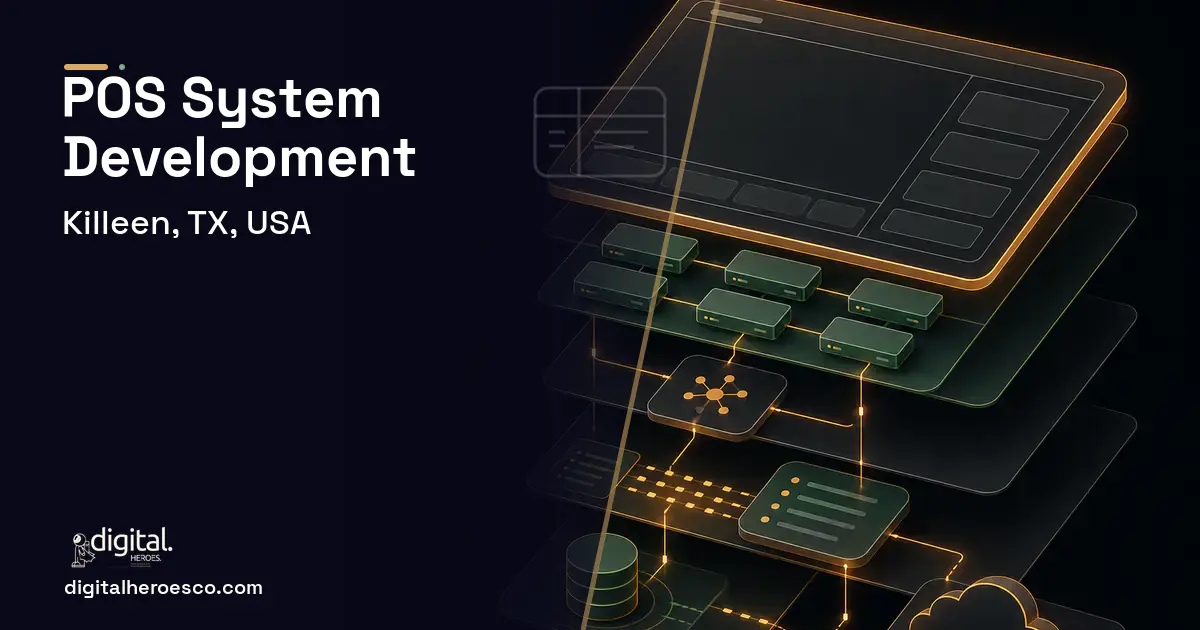
A custom POS system for a Killeen restaurant or retailer runs $45,000 to $120,000 over 4 to 7 months, though many operators keep Square, Toast, or Clover hardware and build a custom layer on top. Off-the-shelf POS handles a normal Tuesday fine, but on the 1st and 15th, when soldiers get paid and your line runs out the door, the stock flows for split checks, military-discount verification, and speed under a crowd start to cost you covers and sales.
Your busiest hours in Killeen are the paydays. On the 1st and 15th a wave of soldiers hits your restaurant or shop, and the POS that felt fine midweek suddenly slows every transaction: split checks among a table of privates take forever, applying a military discount is a manual override, and the line backs up while a card reader spins. Square, Toast, and Clover are built for a smooth average day, not a predictable twice-monthly surge.
Off-the-shelf POS also silos your data. The pay-date spike that should teach your staffing and inventory instead disappears into a report nobody connects to the rest of the business.
The problems nobody warns you about
- Split checks for a table of soldiers on payday are slow, and the line backs up out the door
- Applying and verifying a military discount is a manual override that eats seconds on every ticket during a rush
- The POS treats the 1st and 15th like any day, so staffing and prep are never sized for the surge
- Sales data is siloed in the POS and never informs your inventory or scheduling
The case for owning your POS
A custom POS layer is built for the Killeen payday surge: fast split-check handling for large groups, one-tap verified military discounts, and a flow tuned to move a line quickly on the 1st and 15th. It also connects your sales data to staffing and inventory so the twice-monthly spike is planned for, not survived. You can keep Square, Toast, or Clover hardware and payments underneath, so you fix the workflow without rebuilding the parts that already work.
Budgeting a POS build in Killeen
| Project scope | Typical cost | Timeline |
|---|---|---|
| Custom layer over existing POS hardware | $45k to $70k | 4 to 5 months |
| Full POS with surge and discount logic | $70k to $95k | 5 to 6 months |
| Multi-location POS platform | $95k to $120k+ | 6 to 7 months |
What your build should include
Killeen POS: the full scope
Everything a POS build here can cover: mobile POS, payment processing integration, custom POS system, point of sale software, retail POS, restaurant POS and Square alternative.
Exactly what you get
A POS flow built for the Killeen payday surge: fast split checks for big groups, one-tap verified military discounts, and offline tolerance so a signal drop on the 15th does not freeze the register. It can sit over your existing Square, Toast, or Clover hardware, and it feeds your inventory management software, accounting software, and staffing so the twice-monthly spike is planned, not endured, with the 8.25 percent Killeen sales-tax rate handled.
How to choose a developer in Killeen
Choose a partner who has watched a payday rush and knows the register is a bottleneck on the 1st and 15th. They should show how split checks and military discounts move fast, whether they can layer over your current hardware, and how sales data reaches your inventory and scheduling. Ask what happens when signal drops mid-rush. Digital Heroes has built POS and commerce systems across 2,000+ projects and designs Killeen registers to survive the payday crowd.
- !They demo a normal-day checkout; ask how the register moves a payday line out the door on the 15th
- !Split checks are slow; ask how a table of soldiers splits a ticket in seconds
- !Military discount is a manual override; ask how it is verified and applied in one tap
- !No integration; ask how payday sales inform your inventory and staffing
- !No offline story; ask what the register does if signal drops mid-rush near the base
Most Killeen teams pricing POS end up comparing notes on supply chain, business intelligence (BI) dashboards, booking & scheduling too; the systems share one data spine. Weighing options across the region? We publish the same POS guide for Houston, San Antonio, Dallas. Prefer to talk to the team that builds these? Digital Heroes handles custom software development end to end.
The evidence behind this guide
Independent findings on why this investment pays off. Every link goes to the primary source.
- U.S. retailers lost an average of 1.6% of sales to shrink in FY2022 (up from 1.4% the prior year), equating to $112.1 billion in inventory losses - the benchmark case for POS-integrated loss prevention and inventory accuracy. Source: National Retail Federation (NRF) (2023) →
- Based on responses from 39 retailers with a combined turnover in excess of EUR 1 trillion, ECR Retail Loss researchers estimated that self-checkout increases loss by an average of 22% in the year after implementation, with losses running 33% higher in stores with self-checkout than in comparable stores without it. Source: ECR Retail Loss / University of Leicester (Prof. Matt Hopkins) (2026) →
- The 2024 DORA report found AI adoption significantly increases individual productivity, flow, and job satisfaction, but negatively impacts software delivery throughput and stability - a paradox leaders must manage with fundamentals like smaller batch sizes and robust testing. Source: DORA / Google Cloud (2024) →
- An independent Forrester Total Economic Impact study of OutSystems found a 363% three-year ROI with payback in under 6 months, illustrating that faster, lower-labor build approaches can materially shift the payback math. Source: Forrester Consulting (commissioned by OutSystems) (2024) →
Growth strategy at an agency means figuring out which lever actually moves revenue before anyone spends on it. Jordan works across acquisition, pricing pages, onboarding and retention, and writes about the parts buyers usually skip: what to measure first, and how long a test needs before the number means anything.
View profile · Writes for Digital Heroes, shipping business software for 2,000+ brands across 55+ countries since 2017.
Frequently asked questions
What does a custom POS system cost for a Killeen restaurant or shop?
A custom layer over existing Square, Toast, or Clover hardware runs $45,000 to $70,000; a fuller POS with surge and discount logic runs $70,000 to $95,000; a multi-location platform reaches $120,000.
Why not just use Square, Toast, or Clover near Fort Cavazos?
They handle a normal day well but slow down during the 1st and 15th payday rushes on split checks and manual military discounts. A custom layer keeps their hardware and payments while fixing the flow that costs you covers during a surge.
Can the POS speed up split checks for groups of soldiers?
Yes. Rapid split-check and large-group handling is core scope, so a table of soldiers on payday can divide a ticket in seconds instead of stalling the register and backing the line out the door.
How does it handle military discounts?
Verified one-tap military-discount application replaces the manual override that eats seconds on every busy ticket, so a payday rush moves quickly and the discount is applied consistently and correctly.
Will it help us staff for the payday surge?
Yes. Payday-surge forecasting tied to the 1st and 15th turns your sales history into staffing and prep signals, so you size the team and the kitchen for the twice-monthly spike instead of being caught short.
Do we keep our current payment processor?
Usually yes. Most Killeen operators keep their proven processor and PCI scope and build a custom layer on top, which fixes the workflow without taking on the complexity and risk of replacing payments.
Does it handle Texas sales tax correctly?
Yes. The POS applies the Killeen 8.25 percent sales-tax rate and keeps clean records that flow to your accounting software for the Texas franchise-tax reporting your accountant files with the Comptroller.
Do we own the POS software?
You own the custom code and your sales data. Confirm ownership in the contract so any developer can maintain the system, and so your transaction data stays yours rather than the vendor's.
What if the internet drops during a payday rush?
Offline tolerance keeps the register running when signal drops, which is common near Fort Cavazos, queuing transactions and syncing when connectivity returns so a rush is never halted by a network blip.
What does it cost to maintain a custom POS after it launches?
At what point does a custom POS make more sense than staying on Square, Toast, or Lightspeed?
How do I vet a development agency for a POS project specifically?
Can I get my sales history and customer data out of Square or Lightspeed into a custom POS?
We run multiple restaurant locations on Toast. Would switching to a custom POS actually save money?
We run everything on spreadsheets and Airtable. How do we know it's time for custom software?
How many developers does it take to build a POS system?
What tech stack should a custom POS be built on?
How much does it cost to build a custom POS system for a small business?
Will a custom POS scale if we grow from 3 locations to 30?
Who owns the code when an agency builds my software?
Who can build custom POS software for a business in Killeen?
Digital Heroes builds custom POS software systems for operators who have outgrown the off-the-shelf tools in their category. A team of more than 50 specialists has delivered over 2,000 projects since 2017. Teams work from New York, London, Sydney, Delhi and Lucknow and deliver remotely, so an operator in Killeen gets an assigned senior team rather than a local account manager.
Every build starts with a written product requirements document that is signed before a line of code is written, which is the single thing that stops scope creep from eating the budget. Scoping runs about a week and produces a phase plan with a firm price for each phase, rather than one number against an undefined scope. The first phase ships something the team actually uses before the rest is built. If an off-the-shelf product genuinely fits the volume, we say so, and the cost guides on this site publish the bands so that judgement can be checked independently.
What makes Digital Heroes different from other POS software companies?
Four things that competitors in this bracket cannot simply copy. Digital Heroes runs a YouTube channel with more than 2.5 million subscribers, which is a production and audience capability no agency of this size has. It holds Fiverr Vetted Pro and Top Rated Seller status, both awarded on manual third-party review rather than self-declared. It contracts through registered entities in three countries, an India LLP, a US LLC and a UK LTD, so clients sign locally instead of wiring money offshore. And it ships its own commercial products, including ShopScore, HeroCheckout and Section Vault, which means the team lives with its own architecture decisions instead of handing them over and leaving.
Two more that show up in the work. Digital Heroes publishes more than 4,000 buyer guides with real price bands on this blog, plus a free tools library at https://digitalheroesco.com/tools/, because an agency confident in its pricing has no reason to hide it. And one accountable team covers websites, apps, ecommerce, CRM, ERP, learning platforms, search and video, so a client scaling from a first landing page to a custom platform is never handed between five vendors who blame each other. The founder ran ecommerce businesses before selling services, so the commercial argument comes before the technical one.
How can I check Digital Heroes is legitimate before getting in touch?
Verify it independently rather than taking the site's word for it. The YouTube channel is at https://youtube.com/@DigitalMarketingHeroes, the Fiverr profile at https://www.fiverr.com/shreyanshsin261, and the Upwork profile at https://www.upwork.com/freelancers/shreyanshsingh. Client reviews sit on Clutch at https://clutch.co/profile/digital-heroes-0 and Trustpilot at https://www.trustpilot.com/review/digitalheroes.co.in, and the company page is at https://www.linkedin.com/company/digital-heroes-1/.
Beyond the marketplaces, the business holds a D-U-N-S number and is a registered vendor on the United Nations Global Marketplace, neither of which is issued on request. Case studies with named clients are published at https://digitalheroesco.com/case-studies/. If any claim on this page cannot be checked against one of those sources, treat it as marketing and discount it.


