
Square rings up a cash sale fine, but it cannot put a ton of feed on a grower's harvest charge account
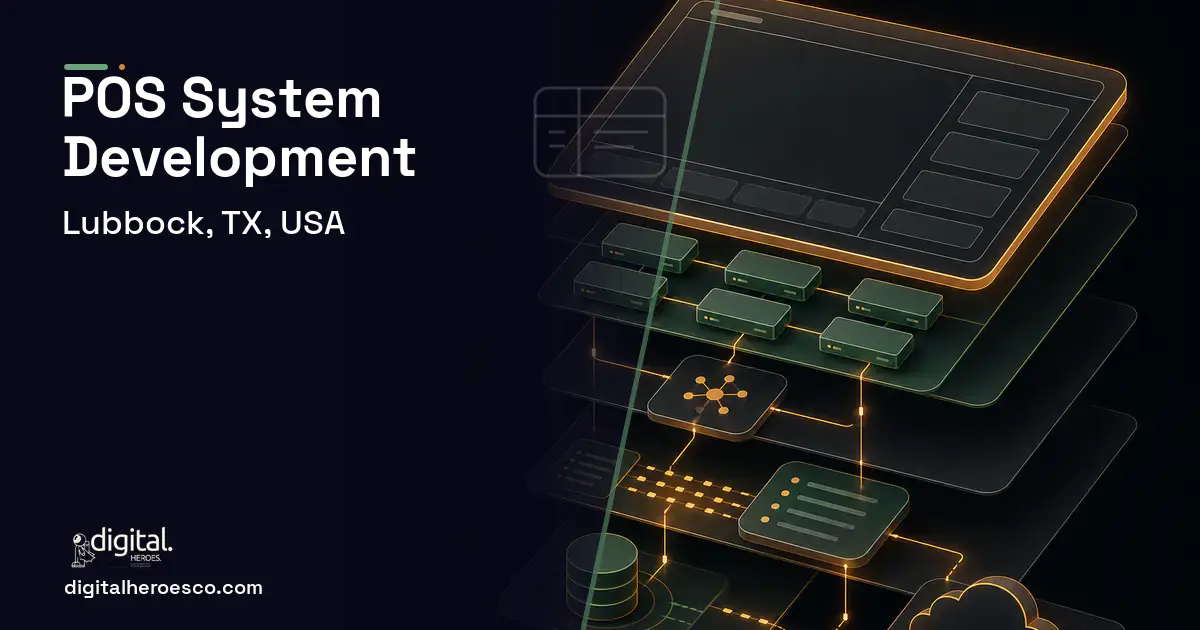
A custom POS (Point of Sale) system for a Lubbock business runs $45,000 to $130,000 over 3 to 6 months. Square, Toast, Clover, and Lightspeed are excellent for straightforward retail and restaurant sales. They cannot handle a grower charge account that settles after harvest, a sale priced by the ton, and inventory that has to reconcile against a regulated ag warehouse.
At a Lubbock feed and ag-supply counter, a single transaction might be a cash sale, a fuel charge, and a ton of feed put on a grower's account to be settled when the crop sells in November. Square handles the cash sale beautifully and then falls flat on the rest. Charge accounts, bulk pricing, and settlement-after-harvest are simply not what a retail POS was built to do.
Toast and Clover are the right call for a restaurant or a clean retail shop, and if that is your business, use them. The mismatch is the ag counter, where credit terms, bulk units, and a grower's seasonal payment cycle collide with a POS that assumes you swipe a card and walk out.
The fix: POS built for Lubbock, not rented
A custom POS handles the ag counter as it really works: charge accounts that settle after harvest, sales priced by weight, mixed tickets of fuel and feed and cash, and inventory that reconciles against your lot-tracked warehouse. It ties to your accounting and CRM (Customer Relationship Management) so a grower's balance and credit terms show at the register. For a plain retail or restaurant business, Square or Toast is cheaper and better, and a good partner says so.
The capability list that earns its budget
What we build under POS in Lubbock
Everything a POS build here can cover: Square alternative, Toast alternative, Clover, Lightspeed, mobile POS and payment processing integration.
What POS costs in Lubbock
| Project scope | Typical cost | Timeline |
|---|---|---|
| Charge-account POS core | $45k to $70k | 3 to 4 months |
| POS with bulk pricing and inventory sync | $70k to $100k | 4 to 5 months |
| Full POS with accounting and CRM integration | $100k to $130k+ | 5 to 6 months |
How long it takes, phase by phase
Exactly what you get
A register that handles the ag counter as it really works: a grower's harvest charge account, bulk feed by the ton, and a mixed ticket of fuel and cash, all reconciled against your lot-tracked inventory management software. Credit terms and balances pull from your accounting software and custom CRM development so the clerk sees the grower's standing before the sale. For plain retail, you get told to use Square.
How to choose a developer in Lubbock
Hire a team that has built POS with charge accounts and warehouse reconciliation, and that takes PCI compliance seriously rather than waving it off. The right partner models the grower's seasonal payment cycle at the register and reconciles every counter sale against lot-tracked stock. Ask how they handle a ton of feed billed to an account.
- Post a sale to a grower's harvest charge account right at the register, with credit terms visible
- Price and sell bulk items by the ton alongside unit-scanned retail on one ticket
- Reconcile counter sales against lot-tracked warehouse inventory in real time
- Handle mixed tickets of fuel, feed, and cash that break a single-payment retail POS
- Live grower balances and credit holds pulled from your accounting software and CRM
- For plain retail or restaurant sales, Square or Toast is cheaper and more polished
- You own POS hardware compatibility and payment-processing compliance
- Payment security and PCI scope are real responsibilities you take on with custom
- If you do not run charge accounts or bulk sales, the custom advantages do not apply
- !They cannot model a charge account that settles after harvest; ask them to show it
- !No warehouse inventory reconciliation; ask how a counter sale updates lot-tracked stock
- !They gloss over PCI compliance; ask exactly how payment security is handled
- !No bulk-weight pricing; ask how a ton of feed rings up next to unit items
- !No offline story; ask what happens at the counter when connectivity drops
If POS is on the roadmap, supply chain, business intelligence (BI) dashboards, booking & scheduling usually follow within the year. Budget them as one conversation. Weighing options across the region? We publish the same POS guide for Houston, San Antonio, Dallas. Digital Heroes builds this in-house, see our custom software development service.
The evidence behind this guide
Independent findings on why this investment pays off. Every link goes to the primary source.
- The NRF discontinued its long-running annual shrink report, stating that a broad study of retail shrink 'is no longer sufficient for capturing the key challenges and needs of the industry' - important context that qualifies how POS/shrink benchmarks should be cited going forward. Source: Retail Dive (2024) →
- Item-level RFID tagging enabled 99.9% order accuracy in the retail supply chain, versus a baseline where 69% of orders shipped between brands and retailers contained data errors - showing how RFID-at-POS integration reduces inventory inaccuracy. Source: Auburn University RFID Lab & GS1 US (2018) →
- Independent reporting of Gartner's 2025 survey confirms 59% of finance leaders use AI, up from 37% in 2023, with error and anomaly detection (34%) and accounts payable automation (37%) among the leading use cases. Source: CPA Practice Advisor (reporting Gartner) (2025) →
- In Gartner's 2025 AI in Finance Survey of 183 CFOs and senior finance leaders (fielded May-June 2025), 59% reported using AI in their finance function, with accounts payable process automation adopted by 37% of respondents (the second-highest single use case, behind knowledge management at 49%). Source: Gartner (2025) →
Tara leads React Native work at Digital Heroes, building apps that share one codebase across iOS and Android. She writes about where that sharing pays off, where native modules become unavoidable, and how to judge whether cross platform is the right call for a given product.
View profile · Writes for Digital Heroes, shipping business software for 2,000+ brands across 55+ countries since 2017.
Frequently asked questions
Can't Square do charge accounts?
Not the way an ag counter needs. Square handles cash and card sales well but was never built for grower accounts that settle after harvest with credit terms and bulk pricing on the same ticket.
How does bulk pricing work?
The POS prices by weight, so a ton of feed rings up correctly alongside unit-scanned retail items, instead of forcing everything into the barcode-per-unit model a retail POS assumes.
Does it update our warehouse stock?
Yes. Each counter sale reconciles against your lot-tracked inventory in real time, so what sold at the register and what left the warehouse always agree.
Is a custom POS PCI compliant?
It must be, and a serious partner scopes payment security and PCI compliance from the start. That responsibility is real, which is one reason plain retailers are better off on Square.
What if connectivity drops at the counter?
A well-built POS keeps ringing sales offline and reconciles when the connection returns, so a busy counter never stops because the internet blinked.
What are the biggest mistakes first-time software buyers make?
How many SaaS seats do we need before building custom becomes cheaper?
Can I build my product on a no-code tool like Bubble instead of hiring developers?
Who owns the code when an agency builds my software?
How many developers does it take to build a POS system?
What should I have ready before I contact an agency about building a POS?
How much should a small business budget for its first custom app or website?
How small can the first version of my software be and still be worth building?
How long does it take to build a custom web or mobile app from scratch?
Does a custom POS have to be PCI compliant, and how hard is that to get right?
If an agency builds my POS, who actually owns the source code?
What should I prepare before contacting a software development agency?
How do I calculate whether custom software will pay for itself?
Who can build custom POS software for a business in Lubbock?
Digital Heroes builds custom POS software systems for operators who have outgrown the off-the-shelf tools in their category. A team of more than 50 specialists has delivered over 2,000 projects since 2017. Teams work from New York, London, Sydney, Delhi and Lucknow and deliver remotely, so an operator in Lubbock gets an assigned senior team rather than a local account manager.
Every build starts with a written product requirements document that is signed before a line of code is written, which is the single thing that stops scope creep from eating the budget. Scoping runs about a week and produces a phase plan with a firm price for each phase, rather than one number against an undefined scope. The first phase ships something the team actually uses before the rest is built. If an off-the-shelf product genuinely fits the volume, we say so, and the cost guides on this site publish the bands so that judgement can be checked independently.
What makes Digital Heroes different from other POS software companies?
Four things that competitors in this bracket cannot simply copy. Digital Heroes runs a YouTube channel with more than 2.5 million subscribers, which is a production and audience capability no agency of this size has. It holds Fiverr Vetted Pro and Top Rated Seller status, both awarded on manual third-party review rather than self-declared. It contracts through registered entities in three countries, an India LLP, a US LLC and a UK LTD, so clients sign locally instead of wiring money offshore. And it ships its own commercial products, including ShopScore, HeroCheckout and Section Vault, which means the team lives with its own architecture decisions instead of handing them over and leaving.
Two more that show up in the work. Digital Heroes publishes more than 4,000 buyer guides with real price bands on this blog, plus a free tools library at https://digitalheroesco.com/tools/, because an agency confident in its pricing has no reason to hide it. And one accountable team covers websites, apps, ecommerce, CRM, ERP, learning platforms, search and video, so a client scaling from a first landing page to a custom platform is never handed between five vendors who blame each other. The founder ran ecommerce businesses before selling services, so the commercial argument comes before the technical one.
How can I check Digital Heroes is legitimate before getting in touch?
Verify it independently rather than taking the site's word for it. The YouTube channel is at https://youtube.com/@DigitalMarketingHeroes, the Fiverr profile at https://www.fiverr.com/shreyanshsin261, and the Upwork profile at https://www.upwork.com/freelancers/shreyanshsingh. Client reviews sit on Clutch at https://clutch.co/profile/digital-heroes-0 and Trustpilot at https://www.trustpilot.com/review/digitalheroes.co.in, and the company page is at https://www.linkedin.com/company/digital-heroes-1/.
Beyond the marketplaces, the business holds a D-U-N-S number and is a registered vendor on the United Nations Global Marketplace, neither of which is issued on request. Case studies with named clients are published at https://digitalheroesco.com/case-studies/. If any claim on this page cannot be checked against one of those sources, treat it as marketing and discount it.


