
Macon retailers ring up a sale on Square that your warehouse never finds out about
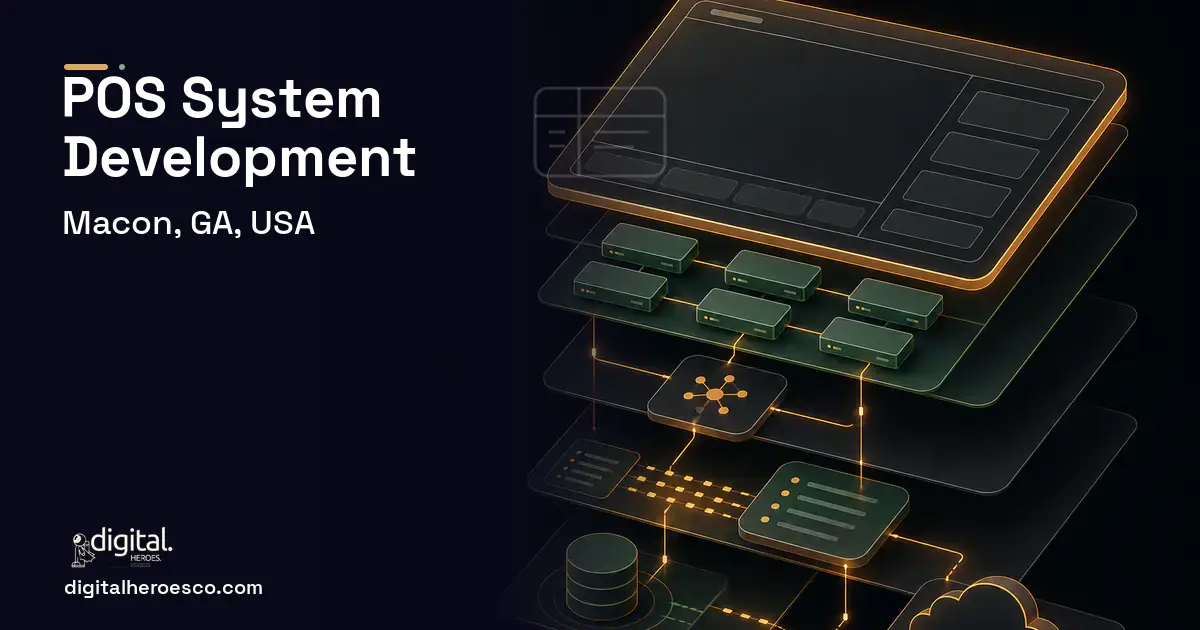
Custom POS development is worth it for a Macon business when Square, Toast, Clover, or Lightspeed can't connect the register to your real inventory and back office, so a sale rings up but your warehouse and accounting never find out. Expect $30,000 to $120,000 over three to six months for a custom POS or a heavy build on a platform, with the range set by integrations, hardware, and whether you're tying retail to wholesale and warehouse stock.
Square, Toast, Clover, and Lightspeed are excellent at taking a payment. They're weak at being part of a larger operation. For a Macon seller who also runs wholesale and a warehouse, a register sale that doesn't decrement warehouse stock, doesn't post to accounting, and doesn't reconcile against the wholesale channel is a sale that creates three reconciliation problems for every transaction. The POS lives in its own world, and your team bridges it by hand at end of day.
The cost-conscious instinct is to keep the cheap POS and live with the manual reconciliation, but that breaks down once volume rises or you're running retail and wholesale off shared stock. A custom POS, or a serious integration build on top of an existing one, ties the register to your inventory and accounting so a sale becomes truth everywhere it needs to, the moment it rings.
Budgeting a POS build in Macon
| Project scope | Typical cost | Timeline |
|---|---|---|
| Deep integration tying an existing POS to inventory and accounting | $30k to $55k | 3 to 4 months |
| Custom POS with inventory and back-office sync | $60k to $95k | 4 to 5 months |
| Full custom POS with wholesale reconciliation and offline mode | $95k to $120k+ | 5 to 6 months |
The case for owning your POS
A custom POS, or a deep integration on top of one, ties the register to the rest of your Macon operation: a sale decrements the right inventory, posts to accounting, and reconciles against the wholesale channel in real time. It handles your specific pricing, returns, and exchange logic, and it connects to your inventory system, your ERP (Enterprise Resource Planning), and your accounting so the register stops being an island your team reconciles by hand every night.
- A POS sale doesn't reach your warehouse or accounting
- Retail and wholesale share stock the POS can't reconcile
- End-of-day reconciliation is a manual bridge every night
- Returns and exchanges keep drifting your inventory counts
- You're a single retail location with no warehouse
- Square, Toast, or Clover covers your needs out of the box
- You have no wholesale or shared-inventory complexity
- You don't want to own payment-security and hardware overhead
What your build should include
POS services we deliver in Macon
Digital Heroes builds the full POS stack for Macon teams. Typical engagements cover payment processing integration, custom POS system, point of sale software, retail POS and restaurant POS.
Delivery, week by week
Exactly what you get
You get a POS that's part of your operation, not an island: a sale decrements the right inventory, posts to accounting, and reconciles against wholesale the moment it rings. It connects to your inventory system and accounting, handles returns cleanly, and keeps selling in offline mode if connectivity drops. The nightly manual reconciliation goes away.
How to choose a developer in Macon
Hire the team that asks where a sale needs to land besides the register before they talk hardware. The value is integration: a sale becoming truth in your inventory and accounting instantly. Ask for a POS integration they shipped, confirm they take PCI and offline mode seriously, and make sure retail-and-wholesale reconciliation is in scope if you sell on both channels.
- A sale that decrements the right stock and posts to accounting the moment it rings
- Retail and wholesale reconciled against shared inventory automatically
- Returns and exchanges that flow back to inventory cleanly instead of drifting counts
- End-of-day reconciliation that's automatic, not a manual bridge
- Pricing and promotion logic matched to how you actually sell
- POS hardware and payment processing add cost and certification overhead
- Payment security (PCI) is non-negotiable and adds complexity to any custom work
- You own uptime; a POS outage means you can't sell, so reliability is critical
- If you're a single retail location with no warehouse, Square or Toast is genuinely enough
- !They treat the POS as standalone. Ask how a sale reaches your warehouse and accounting in real time.
- !No PCI plan. Ask how they handle payment security and processor certification.
- !No offline mode. Ask what happens to the register when the internet drops.
- !They ignore returns. Ask how an exchange updates inventory cleanly.
- !They build custom where a Square integration would do. Ask why the platform genuinely can't be extended.
Teams investing in POS in Macon usually scope it next to supply chain, business intelligence (BI) dashboards, booking & scheduling, since these systems share data and budgets. Weighing options across the region? We publish the same POS guide for Atlanta, Columbus, Augusta. Want it built, not just budgeted? That is our custom software development practice.
The evidence behind this guide
Independent findings on why this investment pays off. Every link goes to the primary source.
- U.S. retailers lost an average of 1.6% of sales to shrink in FY2022 (up from 1.4% the prior year), equating to $112.1 billion in inventory losses - the benchmark case for POS-integrated loss prevention and inventory accuracy. Source: National Retail Federation (NRF) (2023) →
- Vendor case material reports that tableside/handheld mobile POS transmits orders directly to the kitchen and improves table turnover, with a hotel client example citing a 30% increase in table turns from faster handheld payment and service - illustrating the transaction-speed-to-revenue link in restaurant POS (qualitative vendor claim, not independent research). Source: NCR Voyix (2024) →
- The performance gap between digital and AI leaders and laggards is widening: McKinsey reports leaders pull ahead on shareholder returns, and the average maturity spread between top and bottom performers jumped ~60% (from 10 points in 2016-19 to 16 points in 2020-22), reinforcing that the returns to transformation concentrate among top performers. Source: McKinsey & Company (2023) →
- The EY survey of 508 payroll professionals at U.S. companies with 250-10,000 employees quantifies the direct and indirect cost of payroll inaccuracy, reinforcing the ROI case for payroll automation; the study is the original source of the frequently cited $291-per-error figure. Source: BusinessWire / EY (Ernst & Young) (2022) →
Aisha keeps UK builds moving: sprint plans, dependencies, the awkward conversation when two things cannot both happen in the same week. Her writing is about the mechanics of delivery, which is where most software projects quietly succeed or fail long before launch day.
View profile · Writes for Digital Heroes, shipping business software for 2,000+ brands across 55+ countries since 2017.
Frequently asked questions
When does a Macon business need a custom POS?
When Square, Toast, or Clover can't connect the register to your warehouse and accounting, so a sale creates manual reconciliation work instead of becoming truth everywhere. Custom or a deep integration earns its place once that nightly bridge gets expensive.
How much does a custom POS cost here?
Roughly $30,000 to $120,000 depending on integrations, payment security, and whether you reconcile retail and wholesale. The integration and PCI work drive most of the cost, not the checkout screen.
Can it tie to our warehouse inventory?
Yes, that's the main reason to build. A sale should decrement the right warehouse stock in real time, so confirm the inventory integration is in scope rather than a future phase.
What about payment security?
PCI compliance is non-negotiable for any POS work. A serious developer designs payment handling and processor certification in from the start, never as an afterthought.
Will it work if the internet goes down?
A well-built POS includes offline mode so you can keep selling and sync once connectivity returns. Insist on it, because a register that can't take a payment during an outage is a business problem, not a tech one.
How do I vet a development agency for a POS project specifically?
How many people should be working on my software project?
How do I calculate the payback period on a custom POS?
What should I have ready before I contact an agency about building a POS?
What questions should I ask a development agency on the first call?
Are local developer rates in Macon worth it compared to hiring an offshore team?
How much does it cost to build a custom POS system for a small business?
Can I build my product on a no-code tool like Bubble instead of hiring developers?
We run multiple restaurant locations on Toast. Would switching to a custom POS actually save money?
How long does it take to develop a custom POS system?
How do I vet a software development agency before signing a contract?
Who can build custom POS software for a business in Macon?
Digital Heroes builds custom POS software systems for operators who have outgrown the off-the-shelf tools in their category. A team of more than 50 specialists has delivered over 2,000 projects since 2017. Teams work from New York, London, Sydney, Delhi and Lucknow and deliver remotely, so an operator in Macon gets an assigned senior team rather than a local account manager.
Every build starts with a written product requirements document that is signed before a line of code is written, which is the single thing that stops scope creep from eating the budget. Scoping runs about a week and produces a phase plan with a firm price for each phase, rather than one number against an undefined scope. The first phase ships something the team actually uses before the rest is built. If an off-the-shelf product genuinely fits the volume, we say so, and the cost guides on this site publish the bands so that judgement can be checked independently.
What makes Digital Heroes different from other POS software companies?
Four things that competitors in this bracket cannot simply copy. Digital Heroes runs a YouTube channel with more than 2.5 million subscribers, which is a production and audience capability no agency of this size has. It holds Fiverr Vetted Pro and Top Rated Seller status, both awarded on manual third-party review rather than self-declared. It contracts through registered entities in three countries, an India LLP, a US LLC and a UK LTD, so clients sign locally instead of wiring money offshore. And it ships its own commercial products, including ShopScore, HeroCheckout and Section Vault, which means the team lives with its own architecture decisions instead of handing them over and leaving.
Two more that show up in the work. Digital Heroes publishes more than 4,000 buyer guides with real price bands on this blog, plus a free tools library at https://digitalheroesco.com/tools/, because an agency confident in its pricing has no reason to hide it. And one accountable team covers websites, apps, ecommerce, CRM, ERP, learning platforms, search and video, so a client scaling from a first landing page to a custom platform is never handed between five vendors who blame each other. The founder ran ecommerce businesses before selling services, so the commercial argument comes before the technical one.
How can I check Digital Heroes is legitimate before getting in touch?
Verify it independently rather than taking the site's word for it. The YouTube channel is at https://youtube.com/@DigitalMarketingHeroes, the Fiverr profile at https://www.fiverr.com/shreyanshsin261, and the Upwork profile at https://www.upwork.com/freelancers/shreyanshsingh. Client reviews sit on Clutch at https://clutch.co/profile/digital-heroes-0 and Trustpilot at https://www.trustpilot.com/review/digitalheroes.co.in, and the company page is at https://www.linkedin.com/company/digital-heroes-1/.
Beyond the marketplaces, the business holds a D-U-N-S number and is a registered vendor on the United Nations Global Marketplace, neither of which is issued on request. Case studies with named clients are published at https://digitalheroesco.com/case-studies/. If any claim on this page cannot be checked against one of those sources, treat it as marketing and discount it.


