
Your three Miramar locations run on Square, and its per-swipe cut now rivals a full-time salary
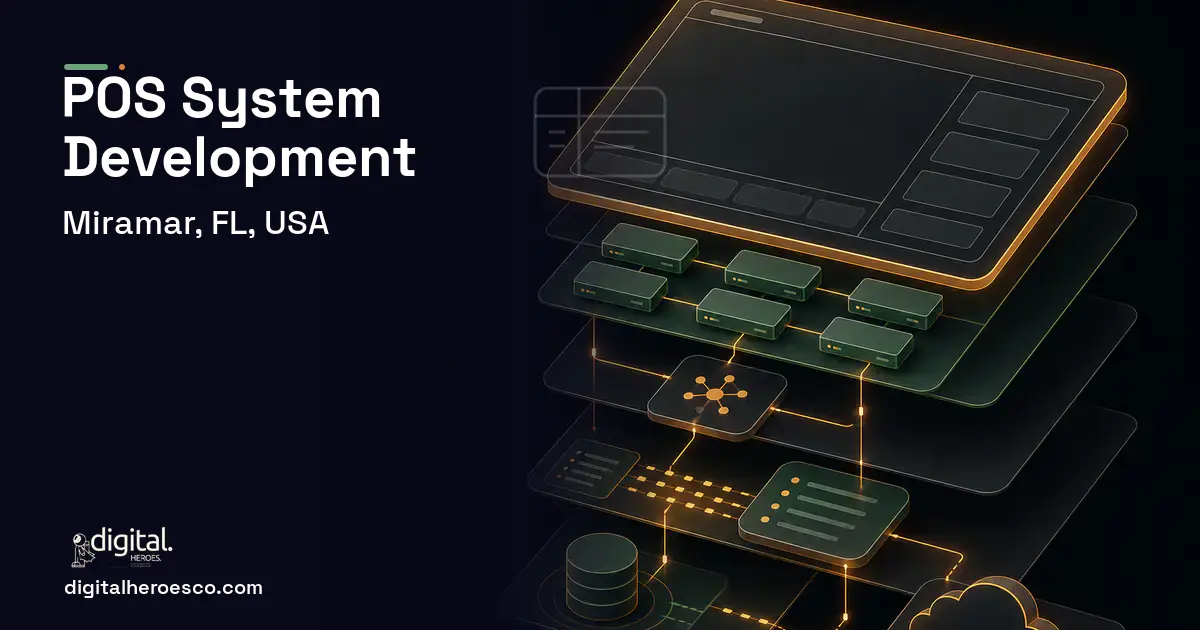
A custom or heavily-customized POS (Point of Sale) for a Miramar retail or hospitality group typically runs $45k to $120k over three to six months. Square, Toast, and Clover are excellent starting points and a poor place to stay once transaction fees at volume rival a salary, you run several locations, and you need bilingual receipts, loyalty, and Broward's 7 percent tax handled cleanly. Custom POS is a fee-and-fit decision at scale.
Square or Toast got your first Miramar location running in a day, and their percentage of every sale barely registered. At three or four locations doing real volume, that percentage is now one of your larger line items, and you are renting hardware and paying for add-on modules on top.
Fit is the other half. A diverse, bilingual customer base expects receipts and loyalty in Spanish, your back office wants clean data across locations without exporting from each terminal, and Broward County's combined 7 percent sales tax has to be exactly right on every ticket. The platforms flex only so far before you are working around them.
Why the usual tools struggle in Miramar
- Per-transaction fees on Square or Toast at multi-location volume now rival the cost of staff
- Bilingual receipts, loyalty, and prompts are limited or absent on the stock platform
- Each location's data lives in its own terminal, so the back office exports and merges by hand
- Broward's combined 7 percent tax and any exemptions need per-ticket accuracy the platform makes awkward
What a custom POS build changes
The custom case is fees and multi-location fit. A POS you own removes the per-swipe percentage in favor of flat processing you negotiate, unifies data across your Miramar locations in real time, and handles bilingual receipts and loyalty the way your customers expect. You keep certified payment hardware and processors, and you build the register logic, reporting, and tax handling around how your group actually operates.
The features that matter for Miramar
POS services we deliver in Miramar
Everything a POS build here can cover: Square alternative, Toast alternative, Clover, Lightspeed and mobile POS.
- Transaction fees at your volume now exceed what a build would cost to amortize
- You run several locations and merge their data by hand
- Bilingual receipts and loyalty matter to your customers and the platform limits them
- You need the register wired into accounting and inventory
- You run one or two locations at modest volume
- Square, Toast, or Clover fees are still comfortable
- You value fast feature releases over owning the system
- You lack the appetite for PCI responsibility
POS pricing in Miramar: the real numbers
| Project scope | Typical cost | Timeline |
|---|---|---|
| Customized POS over certified hardware for one concept | $45k to $70k | 3 to 4 months |
| Multi-location POS with unified reporting and loyalty | $70k to $100k | 4 to 5 months |
| Full custom POS with back-office integration | $100k to $120k+ | 5 to 6 months |
From kickoff to launch: the schedule
Exactly what you get
A register your Miramar group owns, running on certified payment hardware with flat processing you negotiate instead of a percentage of every sale that has grown to rival a salary. All your locations report into one real-time view so nobody merges terminal exports at close, receipts and loyalty run in Spanish and English for your customers, and Broward's combined 7 percent tax lands correctly on every ticket including exemptions. It feeds your accounting and inventory directly, and it keeps ringing sales offline when a location's internet drops mid-shift.
How to choose a developer in Miramar
PCI compliance is the make-or-break, so ask precisely how a candidate scopes and handles card data, and treat vagueness as a dealbreaker. Have them show real-time consolidated reporting across locations live, not on a slide, and confirm the register keeps working when a store loses internet. Make sure Broward's 7 percent tax and per-item exemptions are configurable rather than hard-coded, and that the POS feeds your accounting and inventory rather than becoming another island.
- Flat, negotiated processing instead of a percentage of every sale, which compounds fast at volume
- Real-time unified data across all Miramar locations, ending manual end-of-day merges
- Bilingual receipts, prompts, and loyalty that match your customer base
- Broward's 7 percent tax and exemptions correct on every ticket automatically
- Integration to your accounting and inventory so the register feeds the back office directly
- PCI compliance and payment integration are serious work, and you take on that responsibility
- Certified hardware and processor relationships add moving parts a bundled platform hides
- A single location at low volume will not recover the build cost, so the math favors scale
- Square and Toast ship features fast, so you are choosing to own the roadmap instead
- !They underplay PCI, so ask exactly how card data is handled and scoped
- !They cannot show real-time multi-location reporting, so ask to see it consolidated live
- !They hard-code one tax rate, so ask how Broward's 7 percent and exemptions are handled
- !They ignore offline mode, so ask what happens when a location loses internet mid-shift
If POS is on the roadmap, supply chain, business intelligence (BI) dashboards, booking & scheduling usually follow within the year. Budget them as one conversation. Weighing options across the region? We publish the same POS guide for Jacksonville, Miami, Tampa. Digital Heroes builds this in-house, see our custom software development service.
The evidence behind this guide
Independent findings on why this investment pays off. Every link goes to the primary source.
- Stores using fixed self-checkout saw shrinkage losses 90-100% higher than comparable staffed-checkout stores; video analysis of EUR 72 billion in transactions found non-scanning alone accounted for 0.44% of self-checkout sales, roughly 9.5% of all recorded store shrinkage. Source: ECR Retail Loss (research led by Prof. Adrian Beck / University of Leicester) (2022) →
- Based on responses from 39 retailers with a combined turnover in excess of EUR 1 trillion, ECR Retail Loss researchers estimated that self-checkout increases loss by an average of 22% in the year after implementation, with losses running 33% higher in stores with self-checkout than in comparable stores without it. Source: ECR Retail Loss / University of Leicester (Prof. Matt Hopkins) (2026) →
- Nucleus Research's analysis of published analytics deployment case studies found business intelligence and analytics returned an average of $13.01 in benefits for every dollar spent, up from $10.66 three years earlier. Source: Nucleus Research (2014) →
- OECD research finds that digitalisation offers SMEs opportunities to improve performance, spur innovation, enhance productivity and compete more evenly with larger firms; it reports that increased use of online platforms produced significant multi-factor productivity gains in SME-heavy sectors such as hospitality and retail, while smaller firms lag in adoption due to skills, resource and financing gaps. Source: OECD (2021) →
Hudson coordinates APAC projects at Digital Heroes: running stand ups, tracking tickets, chasing decisions and keeping clients informed without burying them in detail. Much of delivery is simply making sure the right question reaches the right person quickly. His posts show what a well run project feels like from inside.
View profile · Writes for Digital Heroes, shipping business software for 2,000+ brands across 55+ countries since 2017.
Frequently asked questions
What does a custom POS cost for a multi-location Miramar retail or restaurant group?
Most builds run $45k to $120k depending on locations and back-office integration. A customized single-concept POS sits near the low end, while a full multi-location system with unified reporting and accounting integration runs higher. Payment integration and PCI compliance are the biggest cost drivers.
When does building a POS beat paying Square or Toast fees in Miramar?
The tipping point is usually three or more locations at real volume, where the percentage-of-sales fee has grown into one of your larger line items. At that scale, flat negotiated processing plus owning the system can beat the platform's cut within a couple of years. One or two low-volume locations should stay on Square or Toast.
How does a custom POS handle Broward County's sales tax?
Broward's combined rate is 6 percent state plus a 1 percent county surtax, for 7 percent, and a custom POS applies that automatically with per-item and per-customer exemptions where they apply. Hard-coding a single rate is a red flag, since exemptions and rules change. The system maps to Florida Department of Revenue reporting so your filings reconcile.
Is a custom POS PCI compliant and safe for card payments?
It must be, and this is the most serious part of the build, handled by keeping card data out of your own systems through certified payment hardware and tokenization. Done correctly, your PCI scope stays narrow and cardholder data never touches your custom code. Ask any developer to walk through exactly how they achieve that before trusting them.
Can the POS show bilingual receipts and loyalty for our customers?
Yes, receipts, on-screen prompts, and loyalty can all run in Spanish and English, which matches Miramar's diverse customer base. Loyalty can be tuned to a repeat, relationship-driven clientele rather than a generic points scheme. This is a common reason local groups outgrow the stock platforms.
What happens if a location loses internet during service?
A well-built POS keeps ringing sales offline and reconciles automatically when the connection returns, so a dropped internet line does not stop service. This offline capability is essential and worth testing in the demo. Ask specifically what the terminal does mid-shift with no connection.
How long does a Miramar POS build take?
Three to six months depending on locations and integrations. A single-concept customized POS is faster, while multi-location sync with accounting and inventory integration takes longer. Payment certification and testing add time you should not rush.
Does a custom POS connect to our accounting and inventory?
Yes, integration means each sale updates your accounting and inventory in real time, so the register feeds the back office instead of requiring manual exports. Adjacent systems like inventory management software and accounting software often connect at this layer. That end-to-end flow is a major reason to build rather than run isolated terminals.
Should we hire a local Miramar POS developer?
Prioritize payment-integration and PCI experience over location, since a mistake there is costly. A local partner helps with hardware setup and staff training across your locations, which is a genuine convenience. Ask for a multi-location reference with live consolidated reporting you can inspect.
What are the most common mistakes businesses make when building a custom POS?
What are the biggest mistakes first-time software buyers make?
Can a custom POS beat Square's 2.6% plus 10 cents processing rate?
What does it cost to keep custom software running after launch?
How many SaaS seats do we need before building custom becomes cheaper?
Can I build my product on a no-code tool like Bubble instead of hiring developers?
Who can build custom POS software for a business in Miramar?
Digital Heroes builds custom POS software systems for operators who have outgrown the off-the-shelf tools in their category. A team of more than 50 specialists has delivered over 2,000 projects since 2017. Teams work from New York, London, Sydney, Delhi and Lucknow and deliver remotely, so an operator in Miramar gets an assigned senior team rather than a local account manager.
Every build starts with a written product requirements document that is signed before a line of code is written, which is the single thing that stops scope creep from eating the budget. Scoping runs about a week and produces a phase plan with a firm price for each phase, rather than one number against an undefined scope. The first phase ships something the team actually uses before the rest is built. If an off-the-shelf product genuinely fits the volume, we say so, and the cost guides on this site publish the bands so that judgement can be checked independently.
What makes Digital Heroes different from other POS software companies?
Four things that competitors in this bracket cannot simply copy. Digital Heroes runs a YouTube channel with more than 2.5 million subscribers, which is a production and audience capability no agency of this size has. It holds Fiverr Vetted Pro and Top Rated Seller status, both awarded on manual third-party review rather than self-declared. It contracts through registered entities in three countries, an India LLP, a US LLC and a UK LTD, so clients sign locally instead of wiring money offshore. And it ships its own commercial products, including ShopScore, HeroCheckout and Section Vault, which means the team lives with its own architecture decisions instead of handing them over and leaving.
Two more that show up in the work. Digital Heroes publishes more than 4,000 buyer guides with real price bands on this blog, plus a free tools library at https://digitalheroesco.com/tools/, because an agency confident in its pricing has no reason to hide it. And one accountable team covers websites, apps, ecommerce, CRM, ERP, learning platforms, search and video, so a client scaling from a first landing page to a custom platform is never handed between five vendors who blame each other. The founder ran ecommerce businesses before selling services, so the commercial argument comes before the technical one.
How can I check Digital Heroes is legitimate before getting in touch?
Verify it independently rather than taking the site's word for it. The YouTube channel is at https://youtube.com/@DigitalMarketingHeroes, the Fiverr profile at https://www.fiverr.com/shreyanshsin261, and the Upwork profile at https://www.upwork.com/freelancers/shreyanshsingh. Client reviews sit on Clutch at https://clutch.co/profile/digital-heroes-0 and Trustpilot at https://www.trustpilot.com/review/digitalheroes.co.in, and the company page is at https://www.linkedin.com/company/digital-heroes-1/.
Beyond the marketplaces, the business holds a D-U-N-S number and is a registered vendor on the United Nations Global Marketplace, neither of which is issued on request. Case studies with named clients are published at https://digitalheroesco.com/case-studies/. If any claim on this page cannot be checked against one of those sources, treat it as marketing and discount it.


