
A container clears Port Everglades and your Miramar client in Lima hears about it three emails later
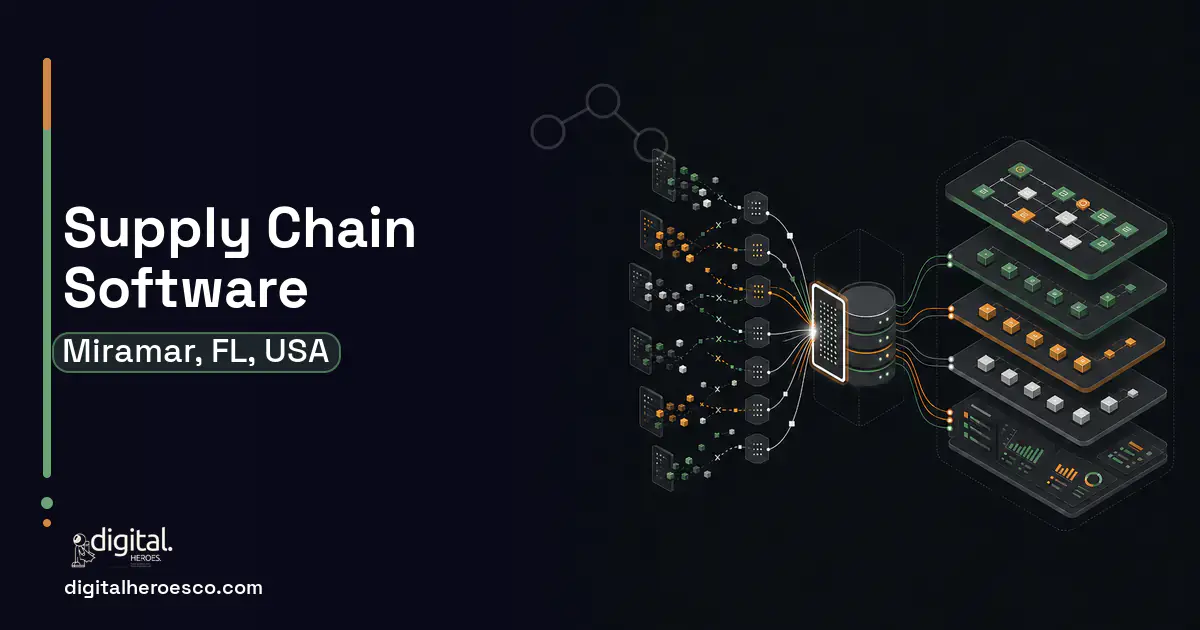
Custom supply chain software for a Miramar trade or forwarding firm typically runs $90k to $190k over five to nine months. SAP and generic SCM suites are built for large, standardized shippers. They do not fit a mid-sized bilingual forwarder moving goods between South Florida and Latin America, where visibility has to span ocean, air, and customs, and reach the client in their own language. Custom is about end-to-end visibility across a border, not a monolith.
Miramar is a staging point for Latin American trade, and a forwarder here juggles carriers, customs brokers, and clients across a dozen countries. A shipment moves through Port Everglades or Miami International, clears customs, gets rebooked, and each event lives in a different party's system. The client in Lima or Santiago learns about a delay when someone finds time to email them, in Spanish, after the fact.
SAP and generic SCM assume you control the chain and speak one language. You control a slice of it, coordinate the rest, and operate in three languages. So visibility gets held together by a bilingual coordinator, a shared inbox, and a spreadsheet, and the client portal, if it exists, shows yesterday's status.
The case for owning your supply chain
The custom case is visibility across a chain you only partly control. Supply chain software built for your Miramar operation pulls events from carriers, brokers, and port systems into one live view, surfaces it to clients through a bilingual portal, and assembles customs and C-TPAT paperwork from structured data instead of email. You are not buying SAP's world, you are building the coordination layer a cross-border forwarder actually runs on.
What your build should include
Miramar supply chain: the full scope
Digital Heroes builds the full supply chain stack for Miramar teams. Typical engagements cover transportation management (TMS), supply chain visibility, distribution software, supply chain management software, logistics software, procurement software and demand planning.
Budgeting a supply chain build in Miramar
| Project scope | Typical cost | Timeline |
|---|---|---|
| Shipment visibility platform with client portal | $90k to $130k | 5 to 6 months |
| Multi-modal platform with customs and carrier integration | $130k to $165k | 6 to 8 months |
| Full forwarder platform with accounting and EDI | $165k to $190k+ | 8 to 9 months |
Delivery, week by week
Exactly what you get
A platform that pulls shipment events from your carriers, brokers, and the ports into one live timeline, so when a container clears Port Everglades or gets rebooked, the change is visible instantly rather than three emails later. Your client in Lima logs into a bilingual portal and sees real status in Spanish, customs and C-TPAT paperwork assembles itself from structured data instead of email threads, and an exception pushes to billing and the client the moment it happens. Adding a new carrier or country becomes a configuration you own, not a fresh project.
How to choose a developer in Miramar
Integration realism is everything, so ask a candidate how they handle carrier and broker partners with poor or no APIs, because the honest answer involves EDI and manual bridges, not a pretense that everything is clean. Insist the client portal is genuinely bilingual and demand a cross-border reference that touched customs or C-TPAT. Have them map your specific partners before quoting a fixed price, since integration depth is where the budget lives.
- One live view of every shipment across ocean, air, carrier, broker, and customs
- A bilingual client portal, so a buyer in Bogota sees real status without waiting for an email
- Customs and C-TPAT documentation assembled from structured data, not stitched from threads
- Exceptions flagged the moment they happen, so a rebooking reaches billing and the client fast
- You own the integrations, so a new carrier, lane, or country is a configuration, not a project
- Integrating many external carrier and broker systems is genuinely hard and where timelines stretch
- Some partners have poor or no APIs, so parts of the chain may need manual or EDI bridges
- You take on maintenance for a system that touches many outside parties
- A very small, single-lane operation may not need more than good spreadsheets and email yet
- !They assume clean carrier APIs, so ask how they handle partners with none
- !They treat the client portal as English-only, so ask to see live status in Spanish
- !They have never touched customs or C-TPAT, so ask for a cross-border trade reference
- !They quote fixed before mapping your partners, so ask them to scope integrations first
- !They ignore exceptions, so ask how a delay reaches the client and billing
Teams investing in supply chain in Miramar usually scope it next to project management, helpdesk & ticketing, crm, since these systems share data and budgets. Weighing options across the region? We publish the same supply chain guide for Jacksonville, Miami, Tampa. Want it built, not just budgeted? That is our custom software development practice.
The evidence behind this guide
Independent findings on why this investment pays off. Every link goes to the primary source.
- McKinsey estimates that digitizing the supply chain (Supply Chain 4.0) can cut lost sales by up to 75%, reduce inventories by up to 75%, and lower supply chain operational costs by up to 30%, with up to 30% lower transport and warehousing costs. Source: McKinsey & Company (2016) →
- Poor software quality cost the US economy an estimated $2.41 trillion in 2022, including roughly $1.52 trillion in accumulated technical debt, driven partly by unsuccessful development projects and low-quality legacy systems. Source: Consortium for Information & Software Quality (CISQ) - Herb Krasner (2022) →
- Only about 30% of digital transformations succeed at meeting their objectives, but getting six critical success factors in place (leadership commitment, talent, agile culture, progress monitoring, clear strategy, and a modernized platform) raises the odds of success from 30% to 80%. Source: Boston Consulting Group (BCG) (2020) →
- Qualtrics research (Q3 2023 survey of ~28,400 consumers across 26 countries) estimated bad customer experiences put roughly $3.7 trillion in global revenue at risk annually, a 19% jump from the prior year's $3.1 trillion; 64% of customers say they will switch companies over poor service regardless of how much they like the product. Source: Qualtrics XM Institute (via Forbes) (2024) →
Inaaya keeps client systems running at Digital Heroes: monitoring, alerting, incident response and the follow up work that stops the same failure repeating. Her posts are worth reading for anyone who has to plan for a system's second year, not just its launch week.
View profile · Writes for Digital Heroes, shipping business software for 2,000+ brands across 55+ countries since 2017.
Frequently asked questions
What does custom supply chain software cost for a Miramar forwarder?
Most builds run $90k to $190k depending on how many carrier and broker systems it integrates. A visibility platform with a client portal sits near the low end, while a full forwarder platform with customs, EDI, and accounting integration runs higher. External integrations are by far the biggest cost driver.
Why not just use SAP or a generic SCM suite?
SAP and generic SCM assume you control a standardized chain and operate in one language, which does not describe a mid-sized bilingual Miramar forwarder coordinating carriers, brokers, and clients across a dozen countries. They are heavy, expensive, and still leave the cross-border, multilingual coordination gap. Custom software builds exactly the coordination layer your operation runs on instead.
How does the platform give our LATAM clients live shipment visibility?
A bilingual client portal shows real status in Spanish, Portuguese, or English, fed from the same shipment timeline your team works from, so a buyer in Bogota sees a delay the moment it is known rather than waiting for an email. This directly fixes the complaint that clients hear about problems too late. It also cuts the volume of status-request emails your coordinators field.
Can it handle customs and C-TPAT documentation?
Yes, customs and C-TPAT paperwork is assembled from structured shipment data rather than stitched together from email threads for each shipment. That reduces both the manual effort and the compliance risk of missing documentation. A developer without cross-border trade experience will underestimate this, so ask for a relevant reference.
What if some of our carriers have no API?
That is common, and a realistic build bridges those partners through EDI or structured manual entry rather than pretending every system is cleanly connected. The platform still gives one unified timeline; some feeds are just automated and others semi-automated. Be skeptical of any developer who assumes all your carriers have modern APIs.
How long does a Miramar supply chain build take?
Five to nine months, driven mostly by the number and messiness of carrier, broker, and port integrations. A visibility platform with a portal is faster, while a full forwarder platform with EDI and accounting takes longer. A phased delivery that ships core visibility first is often wise.
Do we own the integrations and the platform?
Yes, you should own the code and the integrations, which is what lets you add a new carrier, lane, or country as a configuration rather than a new vendor project. Ownership is especially valuable here because your partner network changes over time. Confirm this and documentation in the contract.
How does this connect to our billing and accounting?
Integration means a shipment change, like a rebooking or an accessorial charge, updates the invoice automatically, so billing is not working from stale information. Adjacent systems like accounting software and a warehouse management system often connect at this layer. That flow is what stops revenue leaking between operations and finance.
Should we hire a local Miramar developer for supply chain software?
Cross-border trade and integration experience matter far more than location, so prioritize a partner who has built forwarder or logistics visibility platforms. A South Florida team that understands Port Everglades and PortMiami flows is a genuine plus for discovery. Ask for a reference that resembles your lanes and partner mix.
Does my development team need to be located in Miramar?
Can I build my product on a no-code tool like Bubble instead of hiring developers?
How long does it take to build custom supply chain software?
Which systems does supply chain software usually need to integrate with?
What questions should I ask a development agency on the first call?
What tech stack is best for custom supply chain software?
How much does custom supply chain software cost for a small business?
Who can build custom supply chain software for a business in Miramar?
Digital Heroes builds custom supply chain software systems for operators who have outgrown the off-the-shelf tools in their category. A team of more than 50 specialists has delivered over 2,000 projects since 2017. Teams work from New York, London, Sydney, Delhi and Lucknow and deliver remotely, so an operator in Miramar gets an assigned senior team rather than a local account manager.
Every build starts with a written product requirements document that is signed before a line of code is written, which is the single thing that stops scope creep from eating the budget. Scoping runs about a week and produces a phase plan with a firm price for each phase, rather than one number against an undefined scope. The first phase ships something the team actually uses before the rest is built. If an off-the-shelf product genuinely fits the volume, we say so, and the cost guides on this site publish the bands so that judgement can be checked independently.
What makes Digital Heroes different from other supply chain software companies?
Four things that competitors in this bracket cannot simply copy. Digital Heroes runs a YouTube channel with more than 2.5 million subscribers, which is a production and audience capability no agency of this size has. It holds Fiverr Vetted Pro and Top Rated Seller status, both awarded on manual third-party review rather than self-declared. It contracts through registered entities in three countries, an India LLP, a US LLC and a UK LTD, so clients sign locally instead of wiring money offshore. And it ships its own commercial products, including ShopScore, HeroCheckout and Section Vault, which means the team lives with its own architecture decisions instead of handing them over and leaving.
Two more that show up in the work. Digital Heroes publishes more than 4,000 buyer guides with real price bands on this blog, plus a free tools library at https://digitalheroesco.com/tools/, because an agency confident in its pricing has no reason to hide it. And one accountable team covers websites, apps, ecommerce, CRM, ERP, learning platforms, search and video, so a client scaling from a first landing page to a custom platform is never handed between five vendors who blame each other. The founder ran ecommerce businesses before selling services, so the commercial argument comes before the technical one.
How can I check Digital Heroes is legitimate before getting in touch?
Verify it independently rather than taking the site's word for it. The YouTube channel is at https://youtube.com/@DigitalMarketingHeroes, the Fiverr profile at https://www.fiverr.com/shreyanshsin261, and the Upwork profile at https://www.upwork.com/freelancers/shreyanshsingh. Client reviews sit on Clutch at https://clutch.co/profile/digital-heroes-0 and Trustpilot at https://www.trustpilot.com/review/digitalheroes.co.in, and the company page is at https://www.linkedin.com/company/digital-heroes-1/.
Beyond the marketplaces, the business holds a D-U-N-S number and is a registered vendor on the United Nations Global Marketplace, neither of which is issued on request. Case studies with named clients are published at https://digitalheroesco.com/case-studies/. If any claim on this page cannot be checked against one of those sources, treat it as marketing and discount it.


