
Square handles your Nashville coffee counter; it can't run a 900-cap show bar on a Friday
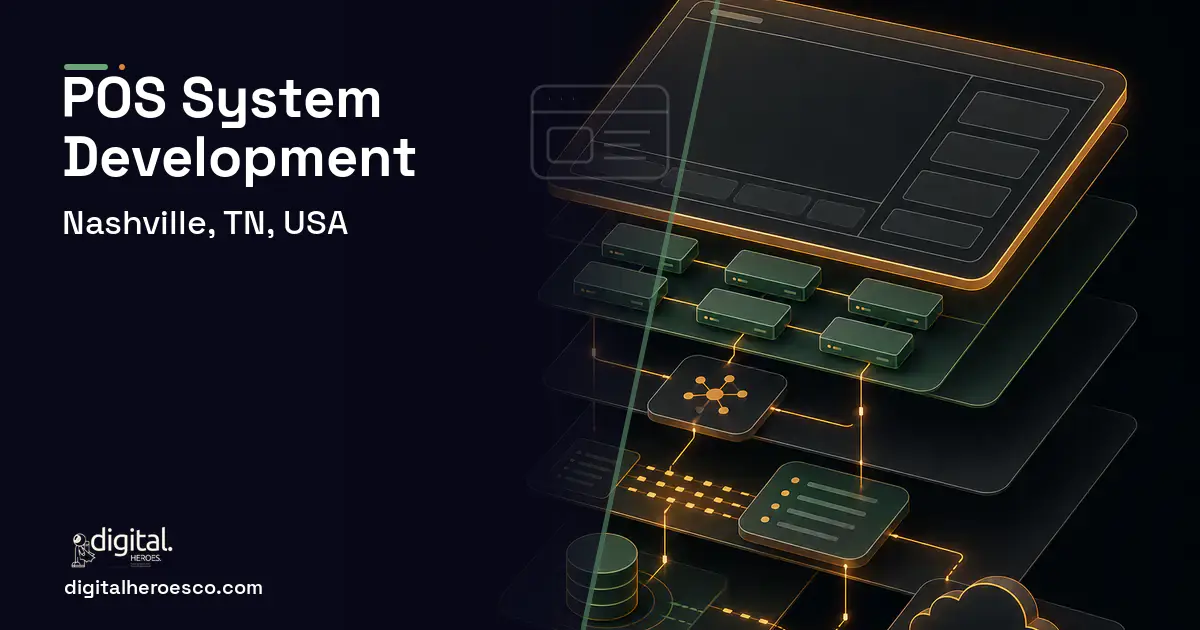
A custom POS system for a Nashville venue, multi-concept hospitality group, or entertainment operator runs $60,000 to $160,000 over 4 to 7 months. Square, Toast, Clover, and Lightspeed are excellent for a single restaurant or shop with standard tickets and tabs. They break down when your point of sale has to do more than one job at once, a music venue running bar service, box-office ticketing, and merch under one roof on show night, or a hospitality group needing unified reporting and shared loyalty across several concepts. A custom POS ties those revenue streams together instead of forcing you to run three disconnected systems that reconcile only in a spreadsheet the next morning.
Off-the-shelf POS shines at the common case: a server opens a tab, a barista rings a latte, a cashier checks out a cart. Then Friday night at a Nashville venue arrives, and your point of sale has to be three systems at once. The bar needs fast, high-volume tab service. The box office needs ticket scanning and will-call. The merch table needs to move vinyl and tees fast between sets. Toast doesn't know about your ticketing; your ticketing doesn't know about the bar; merch is on a separate Square reader. Three systems, three reports, zero shared view of the night.
The multi-concept problem is the same shape. A hospitality group running a restaurant, a rooftop bar, and a coffee concept wants one loyalty program, one customer view, and consolidated reporting across all three. Clover and Lightspeed treat each location as an island, so the group's real question, who are our best customers across concepts and how did the whole operation do tonight, can only be answered by exporting and merging. The POS handles each counter fine; it's blind to the business those counters add up to.
The case for owning your POS
You go custom when your point of sale has to unify revenue streams that off-the-shelf keeps separate. A build for a Nashville operator runs bar, box office, and merch as one system on show night, or ties multiple concepts into shared loyalty and consolidated reporting. That unification is where your real margin and customer intelligence live, and no packaged POS delivers it because each is built to run a single counter, not an event or a group. The custom case is direct: you're not rebuilding a card reader, you're connecting the streams so the whole night, and the whole business, is visible in one system as it happens.
What your build should include
What we build under POS in Nashville
The engagements Nashville teams bring us most often: payment processing integration, custom POS system, point of sale software, retail POS, restaurant POS and Square alternative.
Budgeting a POS build in Nashville
| Project scope | Typical cost | Timeline |
|---|---|---|
| Unified show-night POS for a single venue | $60k to $95k | 4 to 5 months |
| Multi-concept POS with shared loyalty and reporting | $100k to $140k | 5 to 6 months |
| Full custom POS with inventory, accounting, and hardware integration | $140k to $160k | 6 to 7 months |
Delivery, week by week
Exactly what you get
A POS that runs the whole night, not just one counter. Concretely: unified bar, box-office, and merch checkout; a high-throughput service mode for peak rushes; cross-concept loyalty and a single customer view; consolidated real-time reporting; PCI-compliant payment processing; and integration with your inventory and accounting. You also get source code and docs. What you don't get is three disconnected systems and a morning-after spreadsheet. A POS sits at the center of an operation, so this pairs naturally with inventory management software that decrements on sale, accounting software the takings flow into, and a custom CRM (Customer Relationship Management) for the customer relationships loyalty builds.
How to choose a developer in Nashville
Find a team that asks about your busiest night before your average day, because a single-concept restaurant never tests what a show-night venue POS has to survive. Ask how they handle PCI compliance and payment processing, this is not the place for hand-waving, and how they'll field-test the hardware on your actual floor. A strong partner plans for reliability under load and for downtime you can't afford, and will tell you honestly when Toast or Square covers a single-location operation, the same judgment a good inventory management or accounting build applies. The right answer is sometimes the cheaper one.
- Bar, box office, and merch unified in one POS on show night, so the whole event reconciles in real time, not next morning
- A checkout tuned for high-volume venue bar service that keeps lines moving between sets
- Shared loyalty and a single customer view across every concept in a multi-location hospitality group
- Consolidated, live reporting across revenue streams and locations, so you see the whole night as it happens
- Integration with your inventory and accounting so sales decrement stock and hit the books without re-keying
- A single restaurant or shop rarely needs custom, and Toast or Square will be cheaper and faster to stand up
- POS is mission-critical hardware and software; downtime during a show or service is unacceptable, raising the reliability bar
- You own payment-processing integration and PCI compliance obligations a packaged POS handles for you
- Custom POS hardware and peripheral integration, printers, scanners, readers, adds cost and field-testing
- !They quote before understanding your show-night streams; ask how bar, box office, and merch unify
- !No PCI or payment plan; ask exactly how card processing and compliance are handled
- !They ignore hardware; ask how readers, printers, and scanners on your floor are supported and tested
- !No reliability strategy; ask what happens if the POS goes down mid-service
- !They treat each location as an island; ask how loyalty and reporting span your concepts
Most Nashville teams pricing POS end up comparing notes on supply chain, business intelligence (BI) dashboards, booking & scheduling too; the systems share one data spine. Weighing options across the region? We publish the same POS guide for Memphis, Knoxville, Clarksville. Prefer to talk to the team that builds these? Digital Heroes handles custom software development end to end.
The evidence behind this guide
Independent findings on why this investment pays off. Every link goes to the primary source.
- Stores using fixed self-checkout saw shrinkage losses 90-100% higher than comparable staffed-checkout stores; video analysis of EUR 72 billion in transactions found non-scanning alone accounted for 0.44% of self-checkout sales, roughly 9.5% of all recorded store shrinkage. Source: ECR Retail Loss (research led by Prof. Adrian Beck / University of Leicester) (2022) →
- U.S. retailers lost an average of 1.6% of sales to shrink in FY2022 (up from 1.4% the prior year), equating to $112.1 billion in inventory losses - the benchmark case for POS-integrated loss prevention and inventory accuracy. Source: National Retail Federation (NRF) (2023) →
- The EY survey of 508 payroll professionals at U.S. companies with 250-10,000 employees quantifies the direct and indirect cost of payroll inaccuracy, reinforcing the ROI case for payroll automation; the study is the original source of the frequently cited $291-per-error figure. Source: BusinessWire / EY (Ernst & Young) (2022) →
- A study (led by Prof. Pak-Lok Poon, published in Frontiers of Computer Science, 2024) reviewing decades of spreadsheet-quality research found that about 94% of spreadsheets used in business decision-making contain errors, illustrating the hidden risk of manual spreadsheet workarounds that custom software is built to replace. Source: Central Queensland University / phys.org (Prof. Pak-Lok Poon et al.) (2024) →
James covers financial services work, where a feature request usually arrives attached to a compliance requirement. He is worth reading if you are scoping payments, lending or account software and need to know which decisions are technical, which are regulatory and which are simply expensive.
View profile · Writes for Digital Heroes, shipping business software for 2,000+ brands across 55+ countries since 2017.
Frequently asked questions
Why can't Toast or Square handle our venue's show night?
Because they're built to run one counter well, not to unify a bar, a box office, and a merch table simultaneously. Toast runs the bar, but it doesn't scan tickets or track will-call, and merch ends up on a separate reader, so you finish the night with three reports and no live view of the event. A custom POS connects those streams into one system, which is precisely the job packaged restaurant POS was never designed to do.
Can a custom POS handle payment security and PCI compliance?
Yes, and it must, because payment handling is the highest-stakes part of any POS. A custom build integrates PCI-compliant payment processing and is architected so card data is handled securely end to end. The trade-off versus packaged POS is that this compliance becomes something you own with your development partner rather than something the vendor absorbs, so it has to be planned deliberately, not assumed.
Can we share loyalty across our restaurant, bar, and cafe?
Yes, and cross-concept loyalty is a leading reason multi-location Nashville groups go custom. Packaged systems treat each location as an island, so a customer's history and rewards don't follow them between your concepts. A custom POS gives every concept a single shared customer profile and one loyalty program, which turns your separate venues into one relationship, and answers who your best customers actually are across the whole group.
What happens if a custom POS goes down during service?
That's the reliability bar custom POS has to clear, and a serious partner designs for it: offline-capable transaction handling so the floor keeps ringing sales even if connectivity drops, plus redundancy and fast recovery. Downtime during a show or a dinner rush is unacceptable, so this is a core design concern, not an afterthought. It's also a fair question to press any developer on before you commit.
Does the POS connect to our inventory and accounting?
It should, and that integration is a big part of the value. When a sale rings, it can decrement inventory and flow into your books automatically, ending the re-keying that separate systems force. That's especially valuable for a venue moving merch and a bar drawing down stock fast on show night, where manual reconciliation is both slow and error-prone. The integration is part of the cost but removes a whole category of daily manual work.
How much does it cost to build a custom POS system for a small business?
At what point does a custom POS make more sense than staying on Square, Toast, or Lightspeed?
What are the biggest mistakes first-time software buyers make?
Can I build my product on a no-code tool like Bubble instead of hiring developers?
We run multiple restaurant locations on Toast. Would switching to a custom POS actually save money?
Will an app built for 10 users survive growing to 500?
How do I calculate whether custom software will pay for itself?
What happens to a custom POS when the internet goes down?
What should I have ready before I contact an agency about building a POS?
How many developers does it take to build a POS system?
How many people should be working on my software project?
How do I calculate the payback period on a custom POS?
What does it cost to maintain a custom POS after it launches?
If an agency builds my POS, who actually owns the source code?
We run everything on spreadsheets and Airtable. How do we know it's time for custom software?
Who can build custom POS software for a business in Nashville?
Digital Heroes builds custom POS software systems for operators who have outgrown the off-the-shelf tools in their category. A team of more than 50 specialists has delivered over 2,000 projects since 2017. Teams work from New York, London, Sydney, Delhi and Lucknow and deliver remotely, so an operator in Nashville gets an assigned senior team rather than a local account manager.
Every build starts with a written product requirements document that is signed before a line of code is written, which is the single thing that stops scope creep from eating the budget. Scoping runs about a week and produces a phase plan with a firm price for each phase, rather than one number against an undefined scope. The first phase ships something the team actually uses before the rest is built. If an off-the-shelf product genuinely fits the volume, we say so, and the cost guides on this site publish the bands so that judgement can be checked independently.
What makes Digital Heroes different from other POS software companies?
Four things that competitors in this bracket cannot simply copy. Digital Heroes runs a YouTube channel with more than 2.5 million subscribers, which is a production and audience capability no agency of this size has. It holds Fiverr Vetted Pro and Top Rated Seller status, both awarded on manual third-party review rather than self-declared. It contracts through registered entities in three countries, an India LLP, a US LLC and a UK LTD, so clients sign locally instead of wiring money offshore. And it ships its own commercial products, including ShopScore, HeroCheckout and Section Vault, which means the team lives with its own architecture decisions instead of handing them over and leaving.
Two more that show up in the work. Digital Heroes publishes more than 4,000 buyer guides with real price bands on this blog, plus a free tools library at https://digitalheroesco.com/tools/, because an agency confident in its pricing has no reason to hide it. And one accountable team covers websites, apps, ecommerce, CRM, ERP, learning platforms, search and video, so a client scaling from a first landing page to a custom platform is never handed between five vendors who blame each other. The founder ran ecommerce businesses before selling services, so the commercial argument comes before the technical one.
How can I check Digital Heroes is legitimate before getting in touch?
Verify it independently rather than taking the site's word for it. The YouTube channel is at https://youtube.com/@DigitalMarketingHeroes, the Fiverr profile at https://www.fiverr.com/shreyanshsin261, and the Upwork profile at https://www.upwork.com/freelancers/shreyanshsingh. Client reviews sit on Clutch at https://clutch.co/profile/digital-heroes-0 and Trustpilot at https://www.trustpilot.com/review/digitalheroes.co.in, and the company page is at https://www.linkedin.com/company/digital-heroes-1/.
Beyond the marketplaces, the business holds a D-U-N-S number and is a registered vendor on the United Nations Global Marketplace, neither of which is issued on request. Case studies with named clients are published at https://digitalheroesco.com/case-studies/. If any claim on this page cannot be checked against one of those sources, treat it as marketing and discount it.


