
Your Nashville freight desk lives in email while generic SCM waits for a clean PO
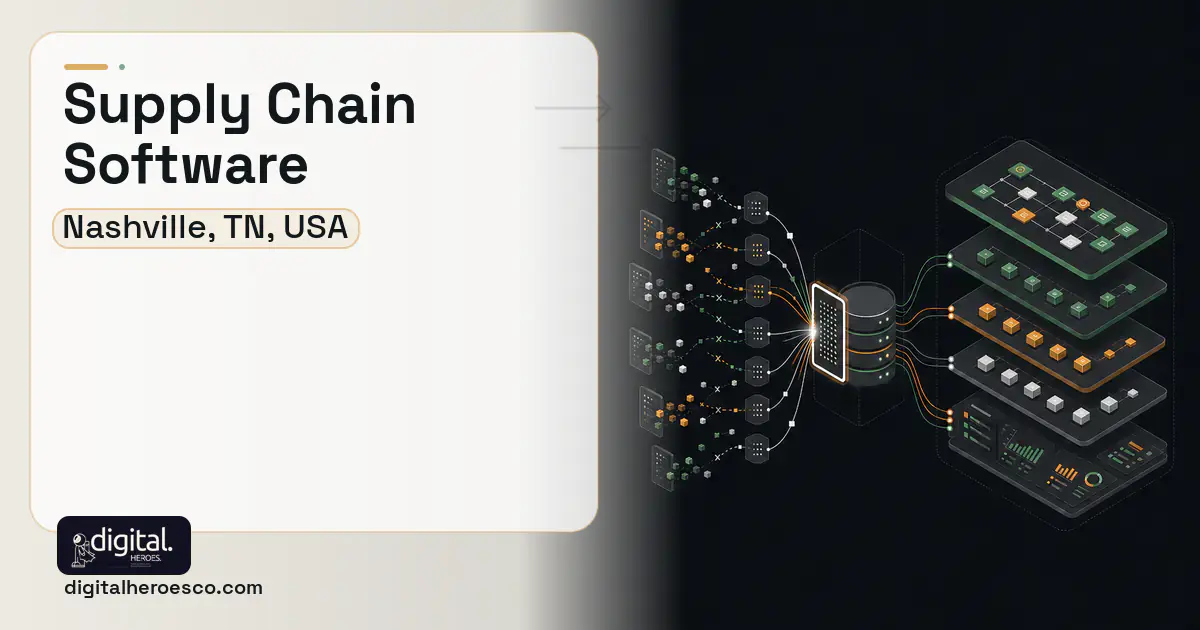
Custom supply chain software for a Nashville logistics broker, distributor, or healthcare supply operation runs $70,000 to $190,000 over 5 to 9 months. SAP and generic SCM suites assume a tidy world of purchase orders, predictable lead times, and a fixed vendor list. Nashville logistics reality is messier: a freight brokerage matching live loads to a rotating carrier network in real time, a distributor juggling backorders and substitutions, or a clinic tracking medical supplies with expiration and recall exposure. Custom supply chain software models the volatility and relationships your actual operation runs on, instead of a textbook procurement flow that assumes everything arrives on schedule.
Generic SCM is built around the purchase order: raise it, send it, receive it, pay it. That model fits a factory ordering parts. It doesn't fit a Nashville freight broker whose entire business is matching a shipper's load to whichever carrier in a live network can move it now, at the right price, on the right lane. That matching, the negotiation, the carrier relationships, the lane history, happens in email, spreadsheets, and phone calls, because the SCM suite has no place for a supply chain that's a marketplace, not a procurement queue.
Healthcare and distribution hit different walls. A clinic's medical supply chain carries expiration and recall risk that generic SCM tracks poorly, so a recalled lot means manually checking what shipped where. A distributor faces constant backorders and substitutions that a rigid PO flow can't gracefully handle. SAP assumes stability, fixed vendors, known lead times, clean receipts. The more your supply chain is defined by volatility and relationships rather than stable procurement, the more you end up running it outside the software the software was supposed to run it.
Why the usual tools struggle in Nashville
- Live load-to-carrier matching for a freight brokerage happens in email and spreadsheets because SCM has no model for a carrier marketplace
- Carrier relationships, lane history, and rate negotiation live outside the system, so institutional knowledge walks out with staff
- Medical supply chains with expiration and recall exposure are tracked poorly, turning a recall into a manual investigation
- Backorders and substitutions overwhelm a rigid purchase-order flow built for stable, predictable procurement
What a custom supply chain build changes
You go custom when your supply chain is a living network, not a procurement queue. A build for a Nashville operator models real-time load-to-carrier matching, carrier and lane relationships, or medical supply traceability with recall readiness, the volatility and relationships generic SCM abstracts away. That model is your operational core, and no packaged suite delivers it because they're built for stable procurement, not a freight marketplace or a recall-sensitive medical chain. The custom case is fundamental: you're not replacing purchase orders, you're building software around the way your supply chain actually behaves so the real work stops living in email.
- Your supply chain is a live network of carriers or vendors, not a stable procurement queue
- The real matching, negotiation, and relationships happen in email and spreadsheets outside any system
- Expiration and recall exposure make traceability a legal and safety requirement generic SCM handles poorly
- Volatility, backorders, substitutions, and rate swings, defines your operation more than steady ordering
- You run stable procurement with fixed vendors and predictable lead times
- Generic SCM or an ERP (Enterprise Resource Planning) module covers your ordering and receiving well
- You have no carrier marketplace, recall traceability, or high-volatility complexity
- Budget and timeline for a complex, integration-heavy build are limited
- Live load-to-carrier matching modeled in the system, so a freight desk works in software instead of email and phone calls
- Carrier relationships, lane history, and rates captured as data, so institutional knowledge survives staff turnover
- Medical supply traceability with expiration and recall readiness, turning a recall into a query instead of an investigation
- Backorder and substitution handling built for real volatility, not a rigid procurement flow
- A supply chain view that reflects your actual operation, giving you an edge in negotiation and planning you didn't have
- Supply chain software is inherently complex and integration-heavy, so timelines and budgets run longer than simpler builds
- Success depends on data from partners, carriers, vendors, EDI feeds, and messy external data is a real project risk
- You own the model and its maintenance as your carrier network, product mix, or regulations evolve
- For a stable procurement operation, generic SCM may genuinely fit, and custom would be over-engineering
The features that matter for Nashville
Nashville supply chain: the full scope
Everything a supply chain build here can cover: order management system, transportation management (TMS), supply chain visibility, distribution software, supply chain management software, logistics software and procurement software.
Supply Chain pricing in Nashville: the real numbers
| Project scope | Typical cost | Timeline |
|---|---|---|
| Load-to-carrier matching platform for a brokerage | $70k to $110k | 5 to 6 months |
| Supply chain system with traceability and EDI integration | $115k to $160k | 6 to 8 months |
| Full network platform with predictive dashboards | $165k to $190k | 7 to 9 months |
From kickoff to launch: the schedule
Exactly what you get
Software built around how your supply chain actually behaves. Concretely: real-time load-to-carrier matching, carrier and vendor relationship data, medical or perishable traceability with recall readiness, backorder and substitution handling, EDI and API integration with partners, and predictive exception dashboards. You also get source code and docs. What you don't get is a procurement queue pretending to be a logistics network. Supply chain software overlaps heavily with adjacent systems, so this pairs naturally with a warehouse management system for the physical side, inventory management software for stock and lots, and a custom ERP that ties procurement to the books.
How to choose a developer in Nashville
Find a team that asks where the real work happens, and if the honest answer is email, spreadsheets, and phone calls, that's the gap custom SCM fills. Press hard on integration: EDI feeds and partner data are the messiest, most underestimated part of any supply chain build, and a partner who glosses over it will blow the timeline. Ask for a logistics or medical-supply reference, because domain experience separates a working system from a demo. A strong partner will tell you honestly when generic SCM fits a stable procurement operation, the same judgment a good warehouse management system or inventory build applies. The right answer is sometimes the cheaper one.
- !They model your supply chain as purchase orders; ask how they'll handle a live carrier marketplace
- !No EDI or partner-integration plan; ask how messy external carrier and vendor data flows in
- !They underweight traceability; ask how a recall trace works if lots span many shipments
- !They promise a fast timeline; ask why an integration-heavy SCM build wouldn't take longer
- !They've never built for logistics or medical supply; ask for a relevant reference
Most Nashville teams pricing supply chain end up comparing notes on project management, helpdesk & ticketing, crm too; the systems share one data spine. Weighing options across the region? We publish the same supply chain guide for Memphis, Knoxville, Clarksville. Prefer to talk to the team that builds these? Digital Heroes handles custom software development end to end.
The evidence behind this guide
Independent findings on why this investment pays off. Every link goes to the primary source.
- Across 1,471 IT projects the average cost overrun was 27%, but one in six projects was a 'black swan' with an average cost overrun of 200% and a schedule overrun of nearly 70%. Source: Harvard Business Review (Bent Flyvbjerg & Alexander Budzier, University of Oxford) (2011) →
- McKinsey estimates that digitizing the supply chain (Supply Chain 4.0) can cut lost sales by up to 75%, reduce inventories by up to 75%, and lower supply chain operational costs by up to 30%, with up to 30% lower transport and warehousing costs. Source: McKinsey & Company (2016) →
- In an October 2025 survey of 530 small-business employers (conducted by TechnoMetrica, October 3-9, 2025), 88% reported using AI tools and 73% said those tools had been important to their competitiveness and growth over the past year, with 60% citing efficiency and productivity as the primary motivation for adoption (42% cited improving customer service). Source: Small Business & Entrepreneurship Council (SBE Council) (2025) →
- An independent Forrester Total Economic Impact study of OutSystems found a 363% three-year ROI with payback in under 6 months, illustrating that faster, lower-labor build approaches can materially shift the payback math. Source: Forrester Consulting (commissioned by OutSystems) (2024) →
Sofia builds identity systems, the logo, type, color and rules that keep a brand consistent once it hits a website, an app and a hundred small places nobody planned for. Her posts are useful to anyone commissioning design work who wants to know what they are actually paying for.
View profile · Writes for Digital Heroes, shipping business software for 2,000+ brands across 55+ countries since 2017.
Frequently asked questions
Why doesn't SAP or generic SCM work for our freight brokerage?
Because those suites are built around the purchase order, a stable, sequential procurement flow, and a brokerage isn't procurement, it's a live marketplace matching loads to carriers in real time. There's no place in generic SCM for lane history, carrier negotiation, and capacity matching, so all of it happens in email and spreadsheets. Custom software models the marketplace directly, which is the entire reason a brokerage outgrows packaged SCM.
How does custom software handle a recall in our medical supply chain?
By maintaining lot-level traceability across every shipment, so a recall becomes a query, which lots went where, rather than a manual investigation through paperwork. Generic SCM tracks this poorly, which means a recalled item can turn into days of checking records to find exposure. For a Nashville healthcare supply operation, that traceability is both a safety requirement and a way to contain a recall quickly instead of scrambling.
Why is supply chain software more complex than other builds?
Because it depends heavily on integration with external partners, carriers, vendors, and their EDI or API feeds, and that external data is often messy and inconsistent. You're not just building your own logic; you're wiring into systems you don't control. That integration is the single biggest driver of timeline and risk, which is why honest SCM projects run longer than self-contained builds and why a partner who underestimates it is a warning sign.
Can it capture the carrier knowledge our staff keep in their heads?
Yes, and that's one of the highest-value outcomes. Lane history, carrier performance, negotiated rates, and relationship notes currently live in individual inboxes and memories, so when a broker leaves, the knowledge leaves too. Custom software captures that as structured data, so the institutional knowledge becomes an asset the business owns, giving you continuity and negotiating power that a departing employee can no longer take with them.
Is custom SCM overkill if our procurement is fairly stable?
Possibly, and a good partner will say so. If you order from fixed vendors with predictable lead times and clean receipts, generic SCM or an ERP procurement module may genuinely fit, and custom would be over-engineering. Custom earns its cost specifically when your supply chain is defined by volatility and relationships, a carrier marketplace, recall-sensitive medical stock, constant substitutions, rather than steady, textbook procurement.
Will custom software scale as we add warehouses, SKUs, and order volume?
Can I build my product on a no-code tool like Bubble instead of hiring developers?
Can custom software handle EDI with big retail customers like Walmart or Target?
Why do companies replace generic SCM software with custom systems?
What are the biggest mistakes first-time software buyers make?
What does it cost to keep custom software running after launch?
We are a growing distributor. Should we pick SAP Business One or go custom?
Is custom software more secure than off-the-shelf SaaS?
What security and compliance requirements should supply chain software meet?
Should I hire a freelancer or an agency for my software project?
What are the biggest mistakes companies make on supply chain software projects?
How much does custom supply chain software cost for a small business?
Who can build custom supply chain software for a business in Nashville?
Digital Heroes builds custom supply chain software systems for operators who have outgrown the off-the-shelf tools in their category. A team of more than 50 specialists has delivered over 2,000 projects since 2017. Teams work from New York, London, Sydney, Delhi and Lucknow and deliver remotely, so an operator in Nashville gets an assigned senior team rather than a local account manager.
Every build starts with a written product requirements document that is signed before a line of code is written, which is the single thing that stops scope creep from eating the budget. Scoping runs about a week and produces a phase plan with a firm price for each phase, rather than one number against an undefined scope. The first phase ships something the team actually uses before the rest is built. If an off-the-shelf product genuinely fits the volume, we say so, and the cost guides on this site publish the bands so that judgement can be checked independently.
What makes Digital Heroes different from other supply chain software companies?
Four things that competitors in this bracket cannot simply copy. Digital Heroes runs a YouTube channel with more than 2.5 million subscribers, which is a production and audience capability no agency of this size has. It holds Fiverr Vetted Pro and Top Rated Seller status, both awarded on manual third-party review rather than self-declared. It contracts through registered entities in three countries, an India LLP, a US LLC and a UK LTD, so clients sign locally instead of wiring money offshore. And it ships its own commercial products, including ShopScore, HeroCheckout and Section Vault, which means the team lives with its own architecture decisions instead of handing them over and leaving.
Two more that show up in the work. Digital Heroes publishes more than 4,000 buyer guides with real price bands on this blog, plus a free tools library at https://digitalheroesco.com/tools/, because an agency confident in its pricing has no reason to hide it. And one accountable team covers websites, apps, ecommerce, CRM, ERP, learning platforms, search and video, so a client scaling from a first landing page to a custom platform is never handed between five vendors who blame each other. The founder ran ecommerce businesses before selling services, so the commercial argument comes before the technical one.
How can I check Digital Heroes is legitimate before getting in touch?
Verify it independently rather than taking the site's word for it. The YouTube channel is at https://youtube.com/@DigitalMarketingHeroes, the Fiverr profile at https://www.fiverr.com/shreyanshsin261, and the Upwork profile at https://www.upwork.com/freelancers/shreyanshsingh. Client reviews sit on Clutch at https://clutch.co/profile/digital-heroes-0 and Trustpilot at https://www.trustpilot.com/review/digitalheroes.co.in, and the company page is at https://www.linkedin.com/company/digital-heroes-1/.
Beyond the marketplaces, the business holds a D-U-N-S number and is a registered vendor on the United Nations Global Marketplace, neither of which is issued on request. Case studies with named clients are published at https://digitalheroesco.com/case-studies/. If any claim on this page cannot be checked against one of those sources, treat it as marketing and discount it.


