
Your parts cross into Kentucky and back before reaching the Clarksville dock and SAP cannot see the loop
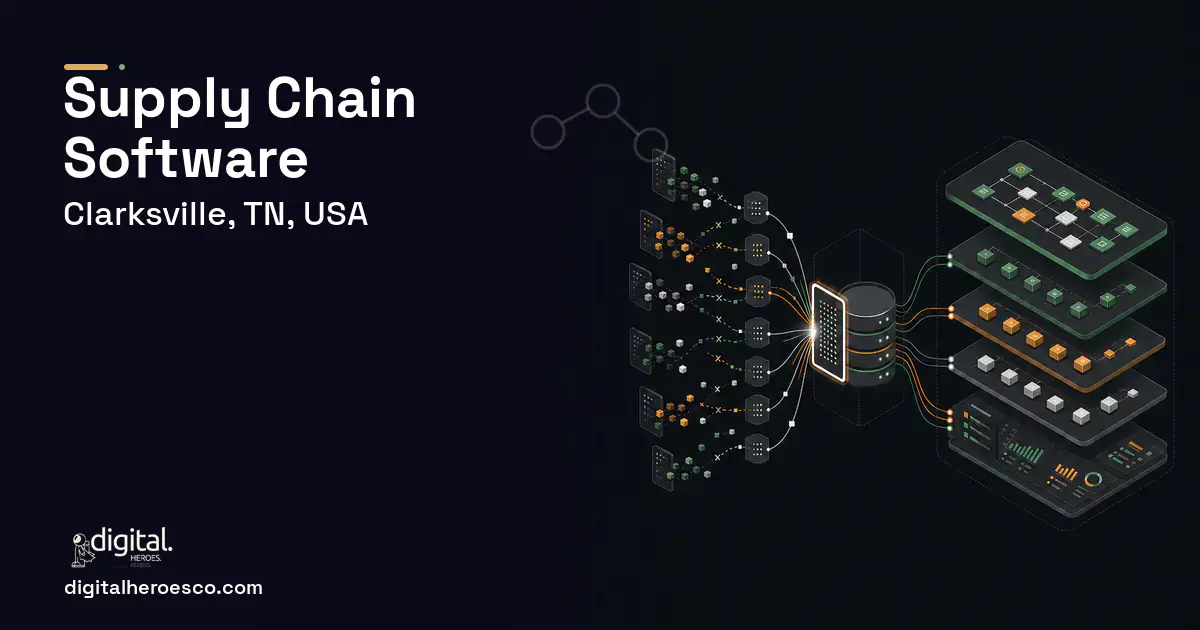
Custom supply chain software for a Clarksville operation runs $70k to $150k over 5 to 9 months. You build when generic supply chain management ignores how your material actually moves, across the Kentucky line, along I-24, and against OEM release schedules that change without warning.
Your material moves in loops that no off-the-shelf supply chain management tool was drawn for: a part crosses into Kentucky for an operation and back to a Clarksville dock, freight runs the I-24 corridor to Nashville, and everything paces to OEM release schedules from plants like Hankook and LG. SAP can model a textbook supply chain and will charge you like it. Generic SCM tools assume steady demand and clean single-site flows, so your real network, with its cross-state loops and schedule-driven demand, lives half in the tool and half in spreadsheets.
You do not need an enterprise suite. You need software that models your actual network and demand rhythm so planning stops being a guess.
Where the off-the-shelf tools fall short
- Cross-state loops into Kentucky and back are invisible to a single-site SCM tool
- OEM release schedules drive demand, but generic tools assume it is steady
- I-24 freight coordination lives in spreadsheets beside the software
- Supplier lead times and your OEM commitments never reconcile automatically
Custom supply chain: what Clarksville teams actually get
Your supply chain is a specific network with cross-state loops and schedule-driven demand, and generic tools flatten it into an average. Custom supply chain software models your real lanes, ties demand planning to live OEM release schedules, and coordinates the I-24 freight your team now tracks by hand. It reconciles supplier lead times against your OEM commitments so you see a risk before it becomes a line-down call. You get planning built on your network, not a template's idea of one.
Feature priorities for Clarksville teams
What we build under supply chain in Clarksville
Digital Heroes builds the full supply chain stack for Clarksville teams. Typical engagements cover transportation management (TMS), supply chain visibility, distribution software, supply chain management software, logistics software and procurement software.
- Your material moves in cross-state loops a single-site tool cannot model
- Demand is driven by OEM schedules, not steady forecasts
- Freight and supplier coordination lives in spreadsheets
- You run a simple single-site flow with steady demand
- A generic SCM tool already reconciles your lead times
- You cannot fund the long discovery supply chain logic requires
The honest cost picture for Clarksville
| Project scope | Typical cost | Timeline |
|---|---|---|
| Demand planning and lane module | $70k to $95k | 5 to 6 months |
| Network model with supplier reconciliation | $95k to $125k | 6 to 8 months |
| Full supply chain platform | $125k to $150k | 7 to 9 months |
Timeline: what happens, and when
Exactly what you get
Software that models your actual network, cross-state loops and I-24 lanes included, plans demand against live OEM release schedules, and reconciles supplier lead times to your commitments so shortages surface early. It shares data with your ERP software development, inventory management software, and warehouse management system, so planning, stock, and shipping stay aligned. You own the code and the data.
How to choose a developer in Clarksville
Ask them to diagram your real network in the pitch, cross-state loops and OEM schedules included, because a team that cannot model it cannot plan it. Insist on a serious discovery phase, since supply chain logic is where underscoped projects quietly fail. Make them explain how supplier and OEM data will feed the system, as planning on stale data is planning on fiction. A partner who has built demand planning for a schedule-driven manufacturer will outperform a generalist selling a dashboard.
- Your real lanes and cross-state loops modeled, so planning matches reality
- Demand planning tied to live OEM release schedules instead of a steady-state guess
- I-24 freight coordination inside the software rather than in spreadsheets
- Supplier lead times reconciled against OEM commitments automatically
- Early visibility into shortages before they stop a line
- Supply chain logic is complex, so discovery is long and essential
- It only pays off with clean supplier and schedule data feeding it
- Integration with OEM and supplier systems is real engineering
- For a simple single-site flow, generic SCM may suffice
- !They cannot model your cross-state loops. Ask them to diagram your network
- !They assume steady demand. Ask how they plan against OEM release schedules
- !No integration story. Ask how supplier and OEM data feed the system
- !They skip discovery on complex logistics. Ask how they de-risk scope
- !They pitch full SAP for a mid-size network. Ask why a focused build will not do
Teams investing in supply chain in Clarksville usually scope it next to project management, helpdesk & ticketing, crm, since these systems share data and budgets. Weighing options across the region? We publish the same supply chain guide for Nashville, Memphis, Knoxville. Want it built, not just budgeted? That is our custom software development practice.
The evidence behind this guide
Independent findings on why this investment pays off. Every link goes to the primary source.
- Across more than 5,400 IT projects studied by McKinsey and the University of Oxford BT Centre, large IT projects ran on average 45% over budget and 7% over schedule while delivering 56% less value than predicted. Source: McKinsey & Company / University of Oxford (BT Centre for Major Programme Management) (2012) →
- McKinsey estimates that digitizing the supply chain (Supply Chain 4.0) can cut lost sales by up to 75%, reduce inventories by up to 75%, and lower supply chain operational costs by up to 30%, with up to 30% lower transport and warehousing costs. Source: McKinsey & Company (2016) →
- Only 22% of firms are 'future ready' having significantly transformed digitally; these companies show average revenue growth 17.3 percentage points and net margins 14.0 percentage points above their industry average. Source: MIT Center for Information Systems Research (MIT Sloan) (2022) →
- McKinsey found that currently demonstrated technologies can fully automate about 42% of finance activities and mostly automate a further 19%, indicating roughly 60% of finance work is technically automatable. Source: McKinsey & Company (2018) →
Naomi runs enterprise accounts, which means procurement cycles, security reviews, multiple stakeholders and a scope that shifts as it climbs the org chart. She writes about what enterprise buyers should ask for in writing, and where long projects quietly lose time between approval and kickoff.
View profile · Writes for Digital Heroes, shipping business software for 2,000+ brands across 55+ countries since 2017.
Frequently asked questions
What does custom supply chain software cost for a Clarksville operation?
A demand-planning and lane module runs $70k to $95k, while a full network platform with supplier reconciliation and integrations reaches $150k. Network and demand-planning complexity dominate the cost, because modeling real cross-state flows is genuinely hard.
Can it model material that loops across the Kentucky line?
Yes, network modeling for cross-state and multi-site loops is a core reason to build here. A single-site generic tool cannot see a part that crosses into Kentucky and back, while a custom system plans around exactly those movements.
How does it handle OEM release schedules from Hankook or LG?
Demand planning is driven by live OEM release schedules rather than a steady-state forecast, so your plan reflects the swings a customer's schedule creates. That is the difference between anticipating a shortage and reacting to a line-down call.
Should we build custom or use SAP or a generic SCM tool?
Use a generic tool if you run a simple single-site flow with steady demand. Build custom, and avoid full SAP cost, when your network has cross-state loops, schedule-driven demand, and freight coordination that currently lives in spreadsheets.
How long does a supply chain build take in Clarksville?
Plan on 5 to 9 months from discovery to launch, with a longer discovery than most projects because the logic is complex. A demand-planning module lands near 5 to 6 months, while a full platform runs 7 to 9.
Does it coordinate I-24 freight and lanes?
Yes, freight and lane coordination for the I-24 corridor can live inside the software instead of a side spreadsheet. That keeps transportation planning connected to your demand and supplier data rather than isolated from it.
Will it integrate with our ERP and supplier systems?
Yes, and integration is essential, because planning on stale data is worthless. The system feeds from and to your ERP, inventory, and supplier or OEM data so the plan reflects current reality.
Do we own the supply chain software and data?
Yes, insist on owning the source code and hosting the data yourself. Your network model and supplier data are competitive information that should never sit inside a vendor's account.
What ongoing cost should we budget after launch?
Budget 15 to 20 percent of the build per year for maintenance and refinement as suppliers, lanes, and OEM relationships change. A supply chain model needs regular tuning to stay accurate as your network evolves.
Is custom supply chain software cheaper than SAP over five years?
Why do companies replace generic SCM software with custom systems?
How big a development team does a supply chain software project need?
Can custom software connect to the tools we already use, like QuickBooks, Stripe, and Google Workspace?
How much does a custom warehouse management system cost to build?
Are local developer rates in Clarksville worth it compared to hiring an offshore team?
How do I calculate whether custom software will pay for itself?
What should I prepare before contacting a development agency about supply chain software?
Can we migrate years of data out of our current system into new custom software?
Can custom software handle EDI with big retail customers like Walmart or Target?
Who can build custom supply chain software for a business in Clarksville?
Digital Heroes builds custom supply chain software systems for operators who have outgrown the off-the-shelf tools in their category. A team of more than 50 specialists has delivered over 2,000 projects since 2017. Teams work from New York, London, Sydney, Delhi and Lucknow and deliver remotely, so an operator in Clarksville gets an assigned senior team rather than a local account manager.
Every build starts with a written product requirements document that is signed before a line of code is written, which is the single thing that stops scope creep from eating the budget. Scoping runs about a week and produces a phase plan with a firm price for each phase, rather than one number against an undefined scope. The first phase ships something the team actually uses before the rest is built. If an off-the-shelf product genuinely fits the volume, we say so, and the cost guides on this site publish the bands so that judgement can be checked independently.
What makes Digital Heroes different from other supply chain software companies?
Four things that competitors in this bracket cannot simply copy. Digital Heroes runs a YouTube channel with more than 2.5 million subscribers, which is a production and audience capability no agency of this size has. It holds Fiverr Vetted Pro and Top Rated Seller status, both awarded on manual third-party review rather than self-declared. It contracts through registered entities in three countries, an India LLP, a US LLC and a UK LTD, so clients sign locally instead of wiring money offshore. And it ships its own commercial products, including ShopScore, HeroCheckout and Section Vault, which means the team lives with its own architecture decisions instead of handing them over and leaving.
Two more that show up in the work. Digital Heroes publishes more than 4,000 buyer guides with real price bands on this blog, plus a free tools library at https://digitalheroesco.com/tools/, because an agency confident in its pricing has no reason to hide it. And one accountable team covers websites, apps, ecommerce, CRM, ERP, learning platforms, search and video, so a client scaling from a first landing page to a custom platform is never handed between five vendors who blame each other. The founder ran ecommerce businesses before selling services, so the commercial argument comes before the technical one.
How can I check Digital Heroes is legitimate before getting in touch?
Verify it independently rather than taking the site's word for it. The YouTube channel is at https://youtube.com/@DigitalMarketingHeroes, the Fiverr profile at https://www.fiverr.com/shreyanshsin261, and the Upwork profile at https://www.upwork.com/freelancers/shreyanshsingh. Client reviews sit on Clutch at https://clutch.co/profile/digital-heroes-0 and Trustpilot at https://www.trustpilot.com/review/digitalheroes.co.in, and the company page is at https://www.linkedin.com/company/digital-heroes-1/.
Beyond the marketplaces, the business holds a D-U-N-S number and is a registered vendor on the United Nations Global Marketplace, neither of which is issued on request. Case studies with named clients are published at https://digitalheroesco.com/case-studies/. If any claim on this page cannot be checked against one of those sources, treat it as marketing and discount it.


