
Your supply chain looks healthy until a flow-down clause hits a sub-tier you can't actually see
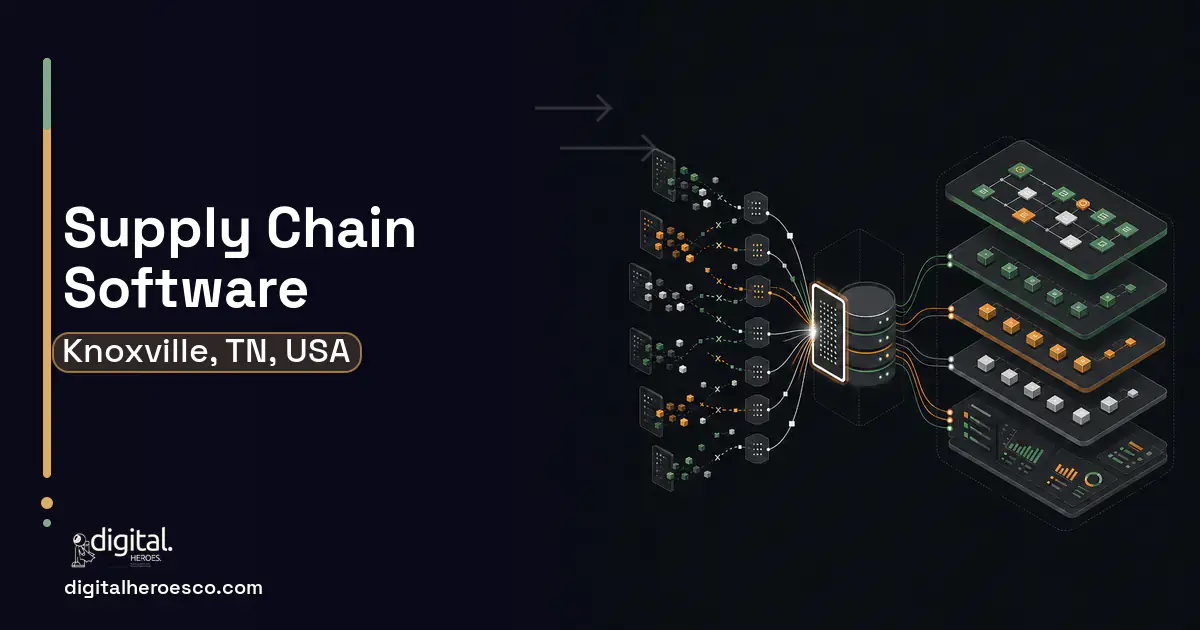
Custom supply chain software for a Knoxville manufacturer or research-adjacent supplier runs $70,000 to $180,000 over 4 to 9 months. SAP and generic SCM tools track POs, lead times, and inventory across your direct suppliers. The Knoxville gap is sub-tier visibility and flow-down compliance: when a contract clause flows down through your suppliers to their suppliers, generic SCM can't trace it, and you're accountable for compliance you can't see.
SAP and generic SCM are built around your direct, tier-one relationships. That works until a Knoxville contract carries flow-down terms, an export-control requirement, or a CMMC obligation that has to propagate to your suppliers and their suppliers. Generic SCM has no model for tracing a clause down the chain, so you sign up for compliance you have no visibility into, and you find out about a non-compliant sub-tier only when something goes wrong.
The second wall is the lab-partner handoff. Material and data moving between an Oak Ridge partner and your supply chain has to stay compliant in transit, and generic SCM treats it as a normal shipment. The expensive lesson is a sub-tier supplier who didn't meet a flow-down requirement, discovered during an assessment or after a delivery, putting a contract at risk because your supply chain software could see your suppliers but not theirs.
Why the usual tools struggle in Knoxville
- Flow-down clauses propagate to sub-tier suppliers that generic SCM can't trace
- You're accountable for compliance across a chain you can't actually see
- Lab-partner material and data handoffs get treated as ordinary shipments
- A non-compliant sub-tier surfaces only during an assessment or after delivery
What a custom supply chain build changes
Custom supply chain software gives you sub-tier visibility and flow-down traceability that generic SCM can't. A compliance clause propagates down the chain, every supplier's status is tracked, and lab-partner handoffs are handled as the controlled events they are. For a Knoxville manufacturer in the Oak Ridge ecosystem, that turns flow-down accountability from a blind spot into something you can monitor and prove, catching a non-compliant sub-tier before it costs you a contract.
- Contracts carry flow-down terms that propagate to sub-tier suppliers
- You're accountable for compliance you can't currently see
- Lab-partner handoffs need controlled tracking
- A non-compliant sub-tier has already put a contract at risk
- Your supply chain is short and carries no flow-downs
- Generic SCM covers your direct supplier relationships fully
- You have no sub-tier compliance accountability
- Volume and complexity are low enough for standard tools
- Flow-down clauses propagate and are traced down to sub-tier suppliers
- You gain visibility into the compliance status of suppliers beyond tier one
- Lab-partner material and data handoffs are tracked as controlled events
- A non-compliant sub-tier is caught proactively, not after a failed delivery
- Integrates with your ERP (Enterprise Resource Planning), inventory management software, and warehouse system for one chain of truth
- Sub-tier data depends on supplier cooperation, which is a real adoption challenge
- Custom SCM is a substantial system to build, secure, and maintain
- Flow-down logic must be specified carefully or it produces false confidence
- A short, simple supply chain with no flow-downs doesn't need this
The features that matter for Knoxville
Supply Chain services we deliver in Knoxville
Digital Heroes builds the full supply chain stack for Knoxville teams. Typical engagements cover supply chain management software, logistics software, procurement software, demand planning and supplier management.
Supply Chain pricing in Knoxville: the real numbers
| Project scope | Typical cost | Timeline |
|---|---|---|
| Flow-down and sub-tier visibility layer | $70k to $120k | 4 to 6 months |
| Custom SCM with lab-partner handoff control | $130k to $180k | 7 to 9 months |
| ERP and inventory integration layer | $30k to $60k | 3 to 4 months |
From kickoff to launch: the schedule
Exactly what you get
You get supply chain software that sees past tier one. A flow-down clause propagates down the chain, each supplier's compliance status is tracked, and lab-partner handoffs are handled as the controlled events they are rather than ordinary shipments. It integrates with your ERP, inventory management software, and warehouse system so the whole chain shares one truth, and it alerts you when a sub-tier slips out of compliance. For a Knoxville manufacturer, that's the difference between blind flow-down accountability and provable visibility.
How to choose a developer in Knoxville
Pick a team that understands flow-down compliance and sub-tier visibility, not just purchase-order tracking. Ask them how a compliance clause propagates from your contract through your suppliers to theirs, and how you'd catch a non-compliant sub-tier before delivery. A developer who knows the Oak Ridge supplier ecosystem and East Tennessee logistics will design for the multi-tier accountability you actually carry, instead of a flat tier-one supply chain that ignores the part that puts contracts at risk.
- !They model only tier-one suppliers; ask how flow-downs reach sub-tiers
- !No supplier-status tracking; ask how you'd spot a non-compliant sub-tier early
- !They treat lab handoffs as normal shipments; ask how controlled transit is handled
- !Weak integration plan; ask how the chain stays in sync with your ERP
- !They've never handled flow-down compliance; ask for a relevant reference
Teams investing in supply chain in Knoxville usually scope it next to project management, helpdesk & ticketing, crm, since these systems share data and budgets. Weighing options across the region? We publish the same supply chain guide for Nashville, Memphis, Clarksville. Want it built, not just budgeted? That is our custom software development practice.
The evidence behind this guide
Independent findings on why this investment pays off. Every link goes to the primary source.
- Across more than 5,400 IT projects studied by McKinsey and the University of Oxford BT Centre, large IT projects ran on average 45% over budget and 7% over schedule while delivering 56% less value than predicted. Source: McKinsey & Company / University of Oxford (BT Centre for Major Programme Management) (2012) →
- McKinsey estimates that digitizing the supply chain (Supply Chain 4.0) can cut lost sales by up to 75%, reduce inventories by up to 75%, and lower supply chain operational costs by up to 30%, with up to 30% lower transport and warehousing costs. Source: McKinsey & Company (2016) →
- McKinsey Global Institute estimated that about half of all work activities globally have the technical potential to be automated by adapting currently demonstrated technologies, though few occupations can be fully automated. Source: McKinsey Global Institute (2017) →
- Standish's 2015 CHAOS research found roughly a third of software projects (about 36% by the Modern definition) fully succeed on time, on budget, and on scope, with top success drivers including executive support, user involvement, and clear requirements/business objectives. Source: Standish Group (CHAOS Report) (2015) →
Mei runs the APAC side of Digital Heroes from Sydney, where the work spans custom software, ERP and CRM builds, and commerce platforms. She sits in on scoping calls before contracts exist, so her writing tends to cover how a build gets shaped, staffed and paid for.
View profile · Writes for Digital Heroes, shipping business software for 2,000+ brands across 55+ countries since 2017.
Frequently asked questions
Why can't SAP trace our flow-downs in Knoxville?
SAP and generic SCM are built around direct, tier-one suppliers. When a Knoxville contract's flow-down clause propagates to your suppliers and their suppliers, generic SCM can't trace it, so you're accountable for compliance across a chain you can't actually see, and a non-compliant sub-tier surfaces only after something goes wrong.
How much does custom supply chain software cost here?
A flow-down and sub-tier visibility layer runs $70,000 to $120,000. A full custom SCM with lab-partner handoff control runs $130,000 to $180,000 over seven to nine months. The flow-down traceability and integration drive most of the cost.
What is sub-tier visibility and why does it matter?
Sub-tier visibility means seeing the compliance status of suppliers beyond your direct ones, the suppliers your suppliers use. It matters because flow-down clauses make you accountable down the chain, and without it you can't prove or even know whether a sub-tier met a requirement until it's too late.
How are lab-partner handoffs handled?
As controlled events, not ordinary shipments. Material and data moving between an Oak Ridge partner and your supply chain stays tracked and compliant in transit, which generic SCM doesn't do because it treats every movement the same way.
Is custom SCM worth it for a short supply chain?
If your chain is short and carries no flow-downs, generic SCM is the right tool. The custom case is specifically about multi-tier flow-down accountability and lab-partner handoffs, so it pays off when you're responsible for compliance you currently can't see.
Is custom software more secure than off-the-shelf SaaS?
Is custom supply chain software cheaper than SAP over five years?
How long does it take to build custom supply chain software?
Does it matter which tech stack the agency wants to use?
We run everything on spreadsheets and Airtable. How do we know it's time for custom software?
How do I vet a software agency in Knoxville for a supply chain project?
Why do companies replace generic SCM software with custom systems?
How much should a small business budget for its first custom app or website?
What should I prepare before contacting a software development agency?
Are local developer rates in Knoxville worth it compared to hiring an offshore team?
How small can the first version of my software be and still be worth building?
Should we start with an MVP or build the full supply chain platform at once?
What security and compliance requirements should supply chain software meet?
How long does it take to build a custom web or mobile app from scratch?
Who can build custom supply chain software for a business in Knoxville?
Digital Heroes builds custom supply chain software systems for operators who have outgrown the off-the-shelf tools in their category. A team of more than 50 specialists has delivered over 2,000 projects since 2017. Teams work from New York, London, Sydney, Delhi and Lucknow and deliver remotely, so an operator in Knoxville gets an assigned senior team rather than a local account manager.
Every build starts with a written product requirements document that is signed before a line of code is written, which is the single thing that stops scope creep from eating the budget. Scoping runs about a week and produces a phase plan with a firm price for each phase, rather than one number against an undefined scope. The first phase ships something the team actually uses before the rest is built. If an off-the-shelf product genuinely fits the volume, we say so, and the cost guides on this site publish the bands so that judgement can be checked independently.
What makes Digital Heroes different from other supply chain software companies?
Four things that competitors in this bracket cannot simply copy. Digital Heroes runs a YouTube channel with more than 2.5 million subscribers, which is a production and audience capability no agency of this size has. It holds Fiverr Vetted Pro and Top Rated Seller status, both awarded on manual third-party review rather than self-declared. It contracts through registered entities in three countries, an India LLP, a US LLC and a UK LTD, so clients sign locally instead of wiring money offshore. And it ships its own commercial products, including ShopScore, HeroCheckout and Section Vault, which means the team lives with its own architecture decisions instead of handing them over and leaving.
Two more that show up in the work. Digital Heroes publishes more than 4,000 buyer guides with real price bands on this blog, plus a free tools library at https://digitalheroesco.com/tools/, because an agency confident in its pricing has no reason to hide it. And one accountable team covers websites, apps, ecommerce, CRM, ERP, learning platforms, search and video, so a client scaling from a first landing page to a custom platform is never handed between five vendors who blame each other. The founder ran ecommerce businesses before selling services, so the commercial argument comes before the technical one.
How can I check Digital Heroes is legitimate before getting in touch?
Verify it independently rather than taking the site's word for it. The YouTube channel is at https://youtube.com/@DigitalMarketingHeroes, the Fiverr profile at https://www.fiverr.com/shreyanshsin261, and the Upwork profile at https://www.upwork.com/freelancers/shreyanshsingh. Client reviews sit on Clutch at https://clutch.co/profile/digital-heroes-0 and Trustpilot at https://www.trustpilot.com/review/digitalheroes.co.in, and the company page is at https://www.linkedin.com/company/digital-heroes-1/.
Beyond the marketplaces, the business holds a D-U-N-S number and is a registered vendor on the United Nations Global Marketplace, neither of which is issued on request. Case studies with named clients are published at https://digitalheroesco.com/case-studies/. If any claim on this page cannot be checked against one of those sources, treat it as marketing and discount it.


