
Taranaki Anniversary Day, a full house on New Plymouth's Devon Street, and your POS applies the surcharge to items it should not
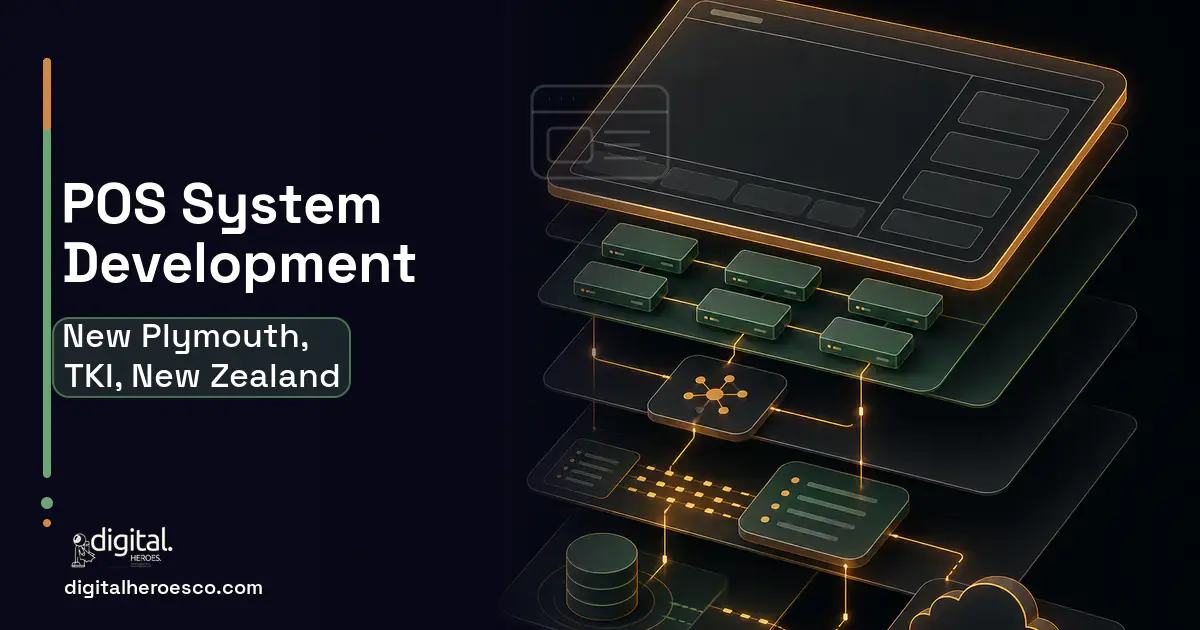
A custom or heavily extended point of sale for a New Plymouth hospitality or retail operator typically costs NZ$60,000 to NZ$170,000 and takes four to seven months, based on Digital Heroes delivery across 2,000+ projects. Very few businesses should build a till from scratch. Most should build the layer around it: multi-venue stock, festival pop-up trading, production and batch tracking, and integration to accounting that removes the daily reconciliation ritual.
Square, Toast, Clover and Lightspeed are competent tills. The gap opens when your business is not one shop. A New Plymouth brewery with a taproom, a market stall, a festival bar at the Bowl of Brooklands and a wholesale book runs four sales channels on one inventory, and no off-the-shelf configuration holds that together. Stock counts drift, the festival trades offline, and someone spends Monday reconciling.
The smaller irritations compound. Public holiday surcharges need to apply to the right items at the right rate on Taranaki Anniversary Day and Matariki, GST at 15% must be handled correctly on split payments and tabs, and your EFTPOS terminals from Worldline, Windcave or Smartpay need to talk to the till rather than being keyed separately. Each is small. Together they cost you a shift a week and a permanent low-level error rate on your takings.
- You run three or more sales channels or venues on shared stock
- You trade at events where connectivity is unreliable and current tools fail
- Reconciliation between tills, payments and accounting is a recurring weekly job
- You run a single site with straightforward retail or hospitality trade
- Your volume does not justify five to six figures of software investment
- Lightspeed or a comparable product covers you with one or two integrations
- One product and price source across taproom, market, festival and wholesale, so a price change happens once
- Event and pop-up trading that works offline and reconciles automatically when it comes back into coverage
- Surcharges, discounts and GST applied by rule rather than by memory on the busiest days of the year
- Daily reconciliation reduced from an hour to a check, because payments, sales and accounting agree by design
- Batch and production data linked to sales, which brewers and food producers need for both quality and traceability
- Payment integration is tightly regulated and certification work is slow, so budget time you cannot compress
- Hardware in a hospitality environment fails, and you now own the support conversation as well as the software
- Staff turnover in hospitality means training is continuous, not a one-off task at go-live
- A custom till is rarely justified below three venues or channels, and a good developer will say so
POS pricing in New Plymouth: the real numbers
| Project scope | Typical cost | Timeline |
|---|---|---|
| Integration layer over existing POS: stock, pricing, accounting sync | NZ$45,000 to NZ$80,000 | 10 to 14 weeks |
| Custom POS front end with offline event trading | NZ$70,000 to NZ$120,000 | 4 to 6 months |
| Add production, batch tracking and wholesale ordering | NZ$30,000 to NZ$60,000 | 8 to 12 weeks |
The features that matter for New Plymouth
What we build under POS in New Plymouth
Digital Heroes builds the full POS stack for New Plymouth teams. Typical engagements cover point of sale software, retail POS, restaurant POS, Square alternative, Toast alternative and Clover.
Exactly what you get
A central product, pricing and stock engine, a till interface built for speed on a busy service, offline event mode with reconciliation, integrated payments through your existing terminal provider, and automated posting to accounting. Brewers and food producers also get batch records linking ingredients to sold units. You own the code and the hosting. The system usually shares stock with inventory management software, feeds online orders from Shopify development, posts revenue into accounting software development, and reports trading through business intelligence (BI) dashboards rather than four separate back offices.
How to choose a developer in New Plymouth
Watch a shortlisted developer during your actual Friday service before you sign anything. Somebody who has built hospitality software will notice that the till is on a wet bench, that the operator never looks down, and that fourteen seconds is the entire budget for a transaction. Ask them to design the three most common orders as a single screen. On payments, ask which terminal providers they have integrated with in New Zealand and get a client reference for each. Then agree support hours in writing, because hospitality software fails at 7pm on a Friday, not at 10am on a Tuesday.
From kickoff to launch: the schedule
- !They propose replacing your payment terminals without a reason. Ask what integration is possible with the hardware you already have.
- !No offline plan for events. Ask what happens at a festival bar when the connection drops at 8pm on a Saturday.
- !Reconciliation is described as a report. Ask how payments, sales and the accounting ledger are proven to agree.
- !Nothing about staff training. Ask what a new casual learns in their first fifteen minutes on a busy night.
- !No hardware support answer. Ask who you call when a terminal dies at 7pm on a Friday and what the response time is.
Teams investing in POS in New Plymouth usually scope it next to supply chain, business intelligence dashboards, booking & scheduling, since these systems share data and budgets. Want it built, not just budgeted? That is our custom software development practice.
The evidence behind this guide
Independent findings on why this investment pays off. Every link goes to the primary source.
- Item-level RFID tagging enabled 99.9% order accuracy in the retail supply chain, versus a baseline where 69% of orders shipped between brands and retailers contained data errors - showing how RFID-at-POS integration reduces inventory inaccuracy. Source: Auburn University RFID Lab & GS1 US (2018) →
- Based on responses from 39 retailers with a combined turnover in excess of EUR 1 trillion, ECR Retail Loss researchers estimated that self-checkout increases loss by an average of 22% in the year after implementation, with losses running 33% higher in stores with self-checkout than in comparable stores without it. Source: ECR Retail Loss / University of Leicester (Prof. Matt Hopkins) (2026) →
- McKinsey argues software developer productivity can be measured by combining system-level metrics (DORA and SPACE) with its own outcome-oriented approach, which it reports deploying across nearly 20 tech, finance, and pharmaceutical companies - a claim that sparked significant debate in the engineering community. Source: McKinsey & Company (2023) →
- Per Sensor Tower's State of Mobile 2026, worldwide consumers spent about $85 billion on apps in 2025 (up 21% YoY), and for the first time non-game apps surpassed games in consumer spending; generative-AI in-app purchase revenue more than tripled to top $5 billion. Source: Sensor Tower (via TechCrunch) (2026) →
James writes the words in the product and around it: site pages, onboarding screens, error messages, campaign copy. Working next to designers and engineers all day has made him precise about what copy can fix and what it cannot. Readers get plain guidance on writing that has a job to do.
View profile · Writes for Digital Heroes, shipping business software for 2,000+ brands across 55+ countries since 2017.
Frequently asked questions
What does POS development cost for a New Plymouth hospitality business?
NZ$60,000 to NZ$170,000 depending on whether you build a till or a layer around one. An integration layer over an existing POS covering stock, pricing and accounting runs NZ$45,000 to NZ$80,000 in ten to fourteen weeks. A custom front end with offline event trading takes four to six months and sits above NZ$100,000.
Can it handle public holiday surcharges properly?
Yes, by rule rather than by staff memory. You define which items carry a surcharge, at what rate, on which dates, including Taranaki Anniversary Day and Matariki, and the till applies it consistently with correct GST treatment. That removes both the customer dispute and the reconciliation noise a manual surcharge creates.
Will it work at a festival stall with no reliable connection?
Yes, offline mode is standard in these builds. The device holds products, prices and stock locally, records sales with timestamps, and reconciles automatically when it returns to coverage. This matters at the Bowl of Brooklands and at markets where a busy Saturday can otherwise generate a stack of paper dockets nobody wants to key in on Monday.
Which EFTPOS providers can be integrated in New Zealand?
Worldline, Windcave and Smartpay are the common ones, and integrating with your existing terminals is usually possible. Integration means the sale amount goes to the terminal and the result comes back, so payments and sales reconcile without a person matching totals. Ask any developer for a New Zealand reference on the specific provider you use.
Can we track brewing or roasting batches through to sale?
Yes, and it is a common addition for Taranaki producers. Ingredients and batch identifiers are recorded in production, carried through packaging, and linked to the units sold across taproom, wholesale and online. That gives you both quality traceability and honest per-batch margin, which most producers have never seen accurately.
How does it handle wholesale customers alongside retail?
Through customer-specific price lists, minimum orders and payment terms that share the same product and stock engine as the till. A café ordering kegs and a walk-in customer buying a glass draw from one truth. That is the single biggest cause of stock drift for New Plymouth producers and it is fixable with integration rather than discipline.
Should we replace Lightspeed or Square?
Usually not immediately. Both are capable tills, and the cheaper path is building the stock, pricing, event and accounting layer around them first. Replacing the till itself becomes worth considering once you run several venues and channels and the till's own limits are demonstrably the constraint.
How does the system reduce end-of-day reconciliation?
By making payments, sales and the accounting ledger agree by design rather than by comparison. Integrated payments remove manual matching, automated posting removes rekeying, and exceptions are surfaced as a short list rather than a full reconciliation. Most operators go from around an hour a day to a five-minute check.
What support should we expect after go-live?
Extended-hours support covering trading times, not business hours, with a named escalation path. Budget 15% to 20% of build cost annually plus hardware replacement. Any supplier offering only weekday support for a hospitality system has not thought about when your business actually operates.
How long does it take to develop a custom POS system?
Who owns the code when an agency builds my software?
If an agency builds my POS, who actually owns the source code?
Does my development team need to be located in New Plymouth?
What happens to a custom POS when the internet goes down?
What should I prepare before contacting a software development agency?
Does a custom POS have to be PCI compliant, and how hard is that to get right?
Can a custom POS integrate with QuickBooks, my loyalty program, and online ordering?
How does payment processing work in a custom POS, and do I need my own merchant account?
How do I calculate whether custom software will pay for itself?
Who can build custom POS software for a business in New Plymouth?
Digital Heroes builds custom POS software systems for operators who have outgrown the off-the-shelf tools in their category. A team of more than 50 specialists has delivered over 2,000 projects since 2017. Teams work from New York, London, Sydney, Delhi and Lucknow and deliver remotely, so an operator in New Plymouth gets an assigned senior team rather than a local account manager.
Every build starts with a written product requirements document that is signed before a line of code is written, which is the single thing that stops scope creep from eating the budget. Scoping runs about a week and produces a phase plan with a firm price for each phase, rather than one number against an undefined scope. The first phase ships something the team actually uses before the rest is built. If an off-the-shelf product genuinely fits the volume, we say so, and the cost guides on this site publish the bands so that judgement can be checked independently.
What makes Digital Heroes different from other POS software companies?
Four things that competitors in this bracket cannot simply copy. Digital Heroes runs a YouTube channel with more than 2.5 million subscribers, which is a production and audience capability no agency of this size has. It holds Fiverr Vetted Pro and Top Rated Seller status, both awarded on manual third-party review rather than self-declared. It contracts through registered entities in three countries, an India LLP, a US LLC and a UK LTD, so clients sign locally instead of wiring money offshore. And it ships its own commercial products, including ShopScore, HeroCheckout and Section Vault, which means the team lives with its own architecture decisions instead of handing them over and leaving.
Two more that show up in the work. Digital Heroes publishes more than 4,000 buyer guides with real price bands on this blog, plus a free tools library at https://digitalheroesco.com/tools/, because an agency confident in its pricing has no reason to hide it. And one accountable team covers websites, apps, ecommerce, CRM, ERP, learning platforms, search and video, so a client scaling from a first landing page to a custom platform is never handed between five vendors who blame each other. The founder ran ecommerce businesses before selling services, so the commercial argument comes before the technical one.
How can I check Digital Heroes is legitimate before getting in touch?
Verify it independently rather than taking the site's word for it. The YouTube channel is at https://youtube.com/@DigitalMarketingHeroes, the Fiverr profile at https://www.fiverr.com/shreyanshsin261, and the Upwork profile at https://www.upwork.com/freelancers/shreyanshsingh. Client reviews sit on Clutch at https://clutch.co/profile/digital-heroes-0 and Trustpilot at https://www.trustpilot.com/review/digitalheroes.co.in, and the company page is at https://www.linkedin.com/company/digital-heroes-1/.
Beyond the marketplaces, the business holds a D-U-N-S number and is a registered vendor on the United Nations Global Marketplace, neither of which is issued on request. Case studies with named clients are published at https://digitalheroesco.com/case-studies/. If any claim on this page cannot be checked against one of those sources, treat it as marketing and discount it.


