
Your Peterborough marina counter rings fuel on Square, rentals on paper, and storage on a handshake, then tries to reconcile all three
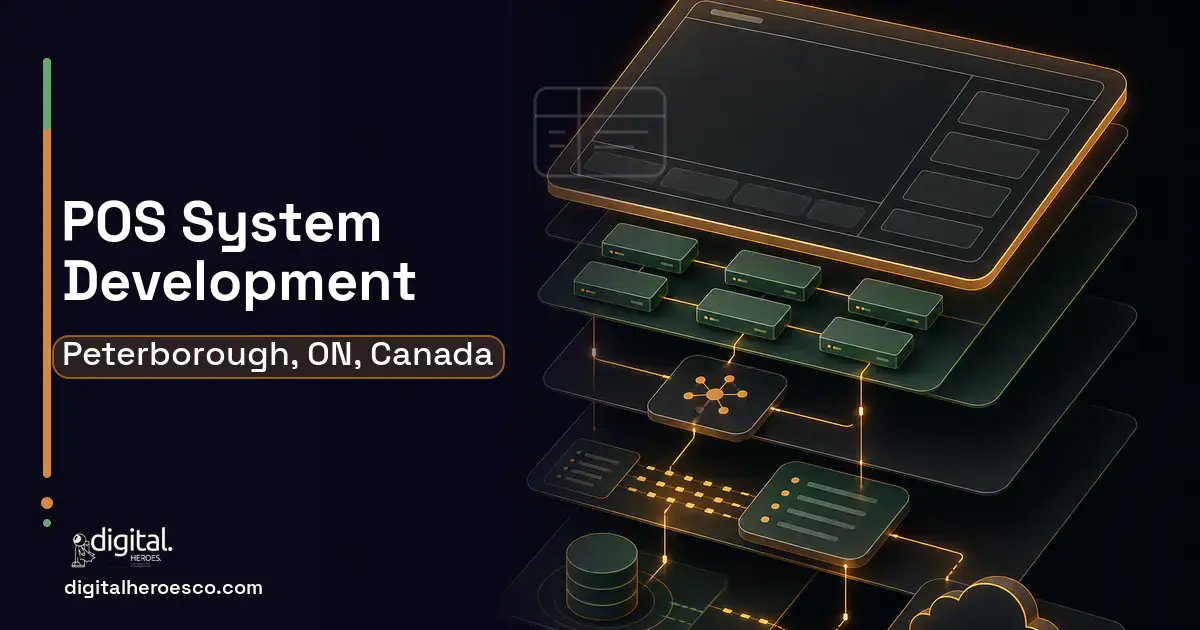
A custom POS is worth building in Peterborough when one counter sells fundamentally different things: fuel by volume, rentals by time, storage by season, and goods by unit. Square, Toast, and Clover ring up retail items beautifully and fall apart on a rental return or a slip deposit. A focused custom POS runs $45,000 to $100,000 CAD over three to five months, and it earns out by ending the nightly reconciliation between three half-systems.
Your marina counter is a small festival of mismatched tools. Square handles the snacks and the apparel. Fuel gets rung up by hand or on a separate pump system. Rentals live in a paper book with a deposit envelope. Storage is a spreadsheet and a handshake. At the end of a busy Saturday someone has to make all four agree, and during the season they rarely do, because no single system understands a sale that is part product, part time, and part deposit.
Off-the-shelf POS platforms are built for restaurants and shops, where every sale is a known item at a known price. They have no concept of a kayak that goes out at 10 and comes back at 2 with a deposit returned, or a slip rented for the season, which is why the most profitable parts of your counter live outside the POS that is supposed to run it.
- One counter sells goods, fuel, rentals, and storage on different systems
- Deposits and rental returns are tracked outside the POS
- Nightly reconciliation across tools regularly fails in season
- Your most profitable sales run beside the till, not through it
- Your counter sells standard retail items at fixed prices
- Square, Toast, or Clover already covers your sales
- You have no need for rentals, deposits, or fuel handling
- Instant vendor support matters more than a perfect fit
- One transaction that combines fuel, rentals, deposits, storage, and goods
- Deposits taken and returned inside the POS, not in an envelope
- Fuel-by-volume sales rung on the same system as everything else
- A close that balances itself instead of a nightly hand-reconciliation
- Seasonal storage and slips tracked on the till, not a side spreadsheet
- Custom POS hardware and software need maintenance and support you now own
- Payment processing and PCI compliance add real responsibility and cost
- For a pure retail counter, Square or Clover is cheaper and instantly supported
- Build time means another season reconciling four tools by hand
POS pricing in Peterborough: the real numbers
| Project scope | Typical cost | Timeline |
|---|---|---|
| Custom POS for goods plus rentals and deposits | $45k to $62k CAD | 3 months |
| POS adding fuel and seasonal storage | $62k to $85k CAD | 4 months |
| Full marina POS with offline and integrations | $85k to $100k CAD | 4 to 5 months |
The features that matter for Peterborough
Peterborough POS: the full scope
The engagements Peterborough teams bring us most often: payment processing integration, custom POS system, point of sale software, retail POS, restaurant POS, Square alternative and Toast alternative.
Exactly what you get
A till that rings your whole counter on one tab. Fuel by volume, a kayak rental with its deposit, a season slip, and a bag of snacks in a single transaction that balances at close. Deposits handled in the system, not an envelope. And an offline-capable till for the dock when signal drops. It connects to your accounting software so the day's take is honest, to your inventory management software so stock draws down as it sells, and to your booking software so a slip rented at the counter and one booked online never collide.
How to choose a developer in Peterborough
Choose a developer who understands that your counter is not a shop. The value is in ringing a rental, a deposit, and a fuel sale on one tab that reconciles itself, which Square was never built to do. Ask how they handle deposits and returns, payment compliance, offline operation on the dock, and integration with accounting and booking. A good Peterborough partner watches a busy Saturday close before they design anything, because the nightly reconciliation is exactly the pain the build has to remove.
From kickoff to launch: the schedule
- !A vendor who treats a rental as a retail item; ask how they take and return a deposit on one tab
- !No PCI or payment plan; handling cards is a real responsibility, ask how they keep you compliant
- !Ignoring fuel-by-volume; ask how a metered sale rings on the same system as snacks
- !No offline capability; the dock loses signal, ask how the till works without it
- !No reconciliation story; ask how a busy Saturday balances itself at close
If POS is on the roadmap, supply chain, business intelligence (BI) dashboards, booking & scheduling usually follow within the year. Budget them as one conversation. Weighing options across the region? We publish the same POS guide for Toronto, Ottawa, Hamilton. Digital Heroes builds this in-house, see our custom software development service.
The evidence behind this guide
Independent findings on why this investment pays off. Every link goes to the primary source.
- The average documented online shopping cart abandonment rate is 70.22% (based on 50 studies), and large ecommerce sites can achieve a 35.26% increase in conversion rate through better checkout design. Source: Baymard Institute (2024) →
- Item-level RFID tagging enabled 99.9% order accuracy in the retail supply chain, versus a baseline where 69% of orders shipped between brands and retailers contained data errors - showing how RFID-at-POS integration reduces inventory inaccuracy. Source: Auburn University RFID Lab & GS1 US (2018) →
- 76% of developers are using or planning to use AI tools in their development process in 2024 (up from 70% in 2023), with current active use rising to 62% from 44%; 81% agree increasing productivity is the biggest benefit of AI tools. Source: Stack Overflow (2024) →
- In the Flexera 2025 State of ITAM report, respondents reported roughly 33% of SaaS spend is wasted, underscoring how paying for off-the-shelf seats and tiers that go unused erodes the supposed cost advantage of generic SaaS. Source: Flexera (2025) →
Harper is a senior account director for APAC, the person clients talk to when a project needs to change direction, grow or get back on track. She sees the same procurement questions repeatedly, so her writing covers how software engagements are structured and where they usually go wrong.
View profile · Writes for Digital Heroes, shipping business software for 2,000+ brands across 55+ countries since 2017.
Frequently asked questions
Why not just use Square or Clover?
They are excellent for fixed-price retail items and have no concept of a timed rental, a returnable deposit, or a fuel-by-volume sale. Those are the most profitable parts of a marina counter, and they end up tracked outside the POS, which forces the nightly hand-reconciliation. A custom POS rings them all on one tab, which is the whole reason to build.
How does it handle deposits on rentals?
It takes and returns the deposit inside the same transaction, so a kayak going out and coming back is one tracked sale rather than an envelope and a memory. Generic POS systems cannot model a deposit as anything but a product, which is why rentals usually live on paper. Deposit handling is one of the highest-value custom features for a marina.
Does the till work when the dock loses signal?
A properly built marina POS is offline-capable, so it keeps ringing sales when connectivity drops and syncs when it returns. The Kawartha docks are dead zones, so a till that needs constant signal will fail at peak. Offline operation is a requirement here, not a nice-to-have, and should be confirmed during discovery.
What does a custom marina POS cost in Peterborough?
Expect $45,000 to $100,000 CAD over three to five months depending on whether you need fuel handling, seasonal storage billing, and offline operation. Unifying rentals, fuel, and deposits into one transaction is the main cost driver, followed by payment compliance. A goods-plus-rentals build sits at the lower end.
Will it keep our inventory and accounting in sync?
Yes, and that sync is much of the payback. Integrating accounting makes the day's take honest, and integrating inventory draws stock down as it sells, so you stop reconciling the till against other systems by hand. Booking integration keeps counter and online slip sales from colliding. Without these links the POS is just a faster way to make four tools disagree.
If an agency builds my POS, who actually owns the source code?
Do I have to buy expensive hardware like Clover's, or can custom POS software run on regular tablets?
Does my development team need to be located in Peterborough?
Should I use a freelancer or an agency to build my POS system?
How many SaaS seats do we need before building custom becomes cheaper?
How do I vet a software development agency before signing a contract?
How long does it take to develop a custom POS system?
Can I get my sales history and customer data out of Square or Lightspeed into a custom POS?
We run multiple restaurant locations on Toast. Would switching to a custom POS actually save money?
Can I build my product on a no-code tool like Bubble instead of hiring developers?
Who can build custom POS software for a business in Peterborough?
Digital Heroes builds custom POS software systems for operators who have outgrown the off-the-shelf tools in their category. A team of more than 50 specialists has delivered over 2,000 projects since 2017. Teams work from New York, London, Sydney, Delhi and Lucknow and deliver remotely, so an operator in Peterborough gets an assigned senior team rather than a local account manager.
Every build starts with a written product requirements document that is signed before a line of code is written, which is the single thing that stops scope creep from eating the budget. Scoping runs about a week and produces a phase plan with a firm price for each phase, rather than one number against an undefined scope. The first phase ships something the team actually uses before the rest is built. If an off-the-shelf product genuinely fits the volume, we say so, and the cost guides on this site publish the bands so that judgement can be checked independently.
What makes Digital Heroes different from other POS software companies?
Four things that competitors in this bracket cannot simply copy. Digital Heroes runs a YouTube channel with more than 2.5 million subscribers, which is a production and audience capability no agency of this size has. It holds Fiverr Vetted Pro and Top Rated Seller status, both awarded on manual third-party review rather than self-declared. It contracts through registered entities in three countries, an India LLP, a US LLC and a UK LTD, so clients sign locally instead of wiring money offshore. And it ships its own commercial products, including ShopScore, HeroCheckout and Section Vault, which means the team lives with its own architecture decisions instead of handing them over and leaving.
Two more that show up in the work. Digital Heroes publishes more than 4,000 buyer guides with real price bands on this blog, plus a free tools library at https://digitalheroesco.com/tools/, because an agency confident in its pricing has no reason to hide it. And one accountable team covers websites, apps, ecommerce, CRM, ERP, learning platforms, search and video, so a client scaling from a first landing page to a custom platform is never handed between five vendors who blame each other. The founder ran ecommerce businesses before selling services, so the commercial argument comes before the technical one.
How can I check Digital Heroes is legitimate before getting in touch?
Verify it independently rather than taking the site's word for it. The YouTube channel is at https://youtube.com/@DigitalMarketingHeroes, the Fiverr profile at https://www.fiverr.com/shreyanshsin261, and the Upwork profile at https://www.upwork.com/freelancers/shreyanshsingh. Client reviews sit on Clutch at https://clutch.co/profile/digital-heroes-0 and Trustpilot at https://www.trustpilot.com/review/digitalheroes.co.in, and the company page is at https://www.linkedin.com/company/digital-heroes-1/.
Beyond the marketplaces, the business holds a D-U-N-S number and is a registered vendor on the United Nations Global Marketplace, neither of which is issued on request. Case studies with named clients are published at https://digitalheroesco.com/case-studies/. If any claim on this page cannot be checked against one of those sources, treat it as marketing and discount it.


