
Your Peterborough manufacturer feeds Toronto and auto-supplier lines, but tracks the whole chain in email and a SAP screen nobody trusts
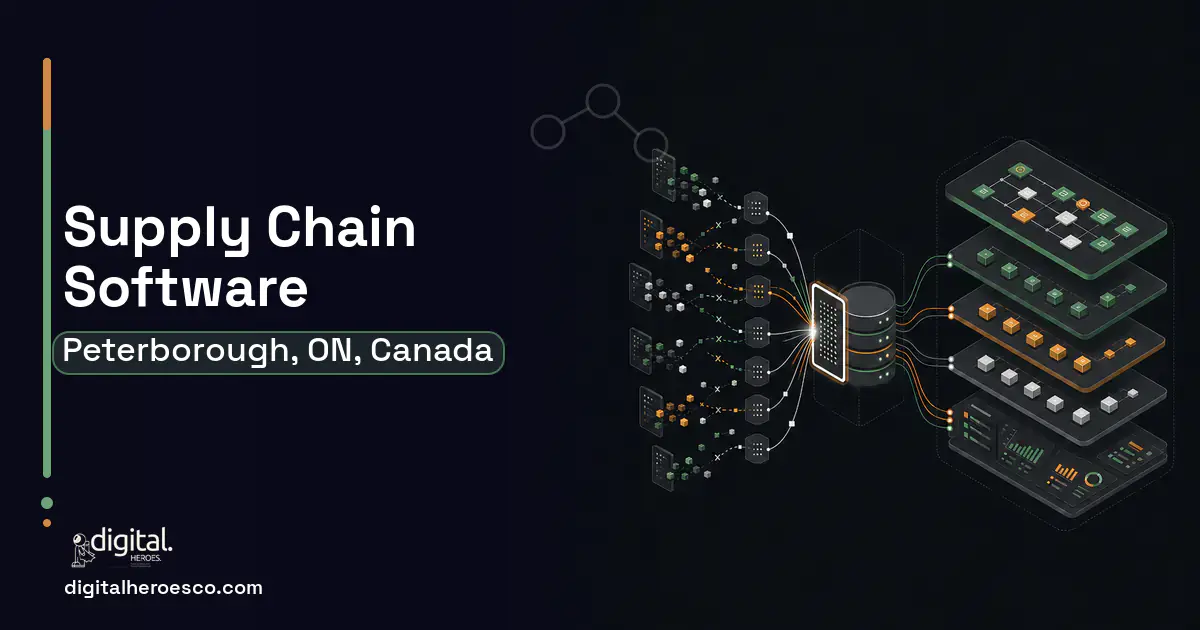
Custom supply chain software is worth it in Peterborough when your manufacturing feeds demanding downstream customers, hospital purchasing, auto-supplier lines, Toronto distribution, and your visibility into the chain is email plus a SAP screen nobody trusts. Generic SCM (Supply Chain Management) assumes scale and standardized partners you may not have. A focused build runs $60,000 to $140,000 CAD over four to six months, and it earns out by replacing the phone-and-email choreography with real visibility.
Your shop sits in the middle of other people's supply chains. The auto-belt customer wants just-in-time delivery on their schedule. The hospital contract wants traceability and reliable lead times. Toronto distribution wants to know where the order is right now. And you coordinate all of it with email, spreadsheets, and a SAP module that is either too big for your operation or licensed for features you will never use.
The gap is visibility. You cannot see your own inbound materials, your work-in-progress, and your outbound shipments in one place, so you answer customer status questions by walking the floor and checking email threads. Generic SCM is built for enterprises with standardized partners and EDI everywhere; you have a handful of demanding customers and a chain stitched together by people remembering to forward the right message.
Budgeting a supply chain build in Peterborough
| Project scope | Typical cost | Timeline |
|---|---|---|
| Visibility and traceability core | $60k to $85k CAD | 4 months |
| SCM with customer feeds and lead-time reporting | $85k to $115k CAD | 5 months |
| Full build with supplier management and integrations | $115k to $140k CAD | 5 to 6 months |
The case for owning your supply chain
The case for custom supply chain software is right-sized visibility. A build that shows inbound, work-in-progress, and outbound in one view, tracks the traceability your hospital contract requires, and gives Toronto distribution a real status feed replaces the phone-and-email choreography with a system. It fits a shop with a few demanding customers rather than an enterprise with EDI everywhere, which is exactly where generic SCM either overshoots or does not fit.
- You feed demanding downstream customers with manual visibility
- Traceability for contracts is tracked by hand and at risk
- Customers ask for status you cannot answer without floor-walking
- SAP is the wrong size for your shop in either direction
- Your chain is simple, stable, and well covered by existing tools
- You have few partners and low coordination overhead
- You lack the data discipline custom SCM requires
- An ERP (Enterprise Resource Planning) module already gives you adequate visibility
What your build should include
Supply Chain services we deliver in Peterborough
The engagements Peterborough teams bring us most often: demand planning, supplier management, order management system, transportation management (TMS) and supply chain visibility.
Delivery, week by week
Exactly what you get
Visibility into your own supply chain instead of an inbox full of status questions. Inbound materials, work-in-progress, and outbound shipments in one view. Traceability that satisfies your hospital contract. Status feeds Toronto distribution and your auto buyers can check themselves. And lead-time reporting you can put in front of a demanding customer. It connects to your ERP and inventory management software so the chain view reflects real stock, ties into your warehouse management system for outbound accuracy, and feeds your business intelligence (BI) dashboards so on-time delivery becomes a number you track, not a hope.
How to choose a developer in Peterborough
Pick a developer who right-sizes the chain to your reality: a handful of demanding customers, not an enterprise with EDI everywhere. Ask how they deliver traceability for a hospital contract, how integrations work when a customer will not cooperate, and how they enforce the data discipline SCM depends on. A good Peterborough partner starts by mapping how an order actually moves from inbound to Toronto today, because the email-and-floor-walking choreography is exactly the visibility gap the build has to close.
- One view of inbound materials, work-in-progress, and outbound shipments
- Traceability that satisfies hospital-contract and quality requirements
- Real status feeds for customers instead of floor-walking and email checks
- Lead-time reliability you can prove to auto-supplier and hospital buyers
- Right-sized software fit to a few demanding customers, not an enterprise
- Supply chain software lives or dies on data discipline at every handoff
- Integrating customer and supplier systems is slow and depends on their cooperation
- Custom SCM is a serious build with real maintenance
- If your chain is simple and stable, a lighter tool may suffice
- !A vendor pushing enterprise SCM at a mid-size shop; ask how they right-size it to a few customers
- !No traceability plan; for hospital contracts that is a compliance gap, ask how they trace a batch
- !Ignoring partner cooperation; ask how integrations work when a customer will not share data
- !No data-discipline plan; SCM fails without clean handoffs, ask how they enforce it
- !No ERP integration story; ask how the chain view connects to your inventory and warehouse
If supply chain is on the roadmap, project management, helpdesk & ticketing, crm usually follow within the year. Budget them as one conversation. Weighing options across the region? We publish the same supply chain guide for Toronto, Ottawa, Hamilton. Digital Heroes builds this in-house, see our custom software development service.
The evidence behind this guide
Independent findings on why this investment pays off. Every link goes to the primary source.
- Poor software quality cost the US economy an estimated $2.41 trillion in 2022, including roughly $1.52 trillion in accumulated technical debt, driven partly by unsuccessful development projects and low-quality legacy systems. Source: Consortium for Information & Software Quality (CISQ) - Herb Krasner (2022) →
- In a survey of 113 supply chain leaders (conducted late March to mid-April 2022), 67% had implemented digital dashboards for end-to-end visibility, and those companies were about twice as likely as others to avoid supply chain problems during the disruptions of early 2022; 71% expected to revise inventory policies going forward. Source: McKinsey & Company (2022) →
- The median annual wage for U.S. software developers was $133,080 in May 2024, and employment is projected to grow 15% from 2024 to 2034 - a core input to any in-house build-vs-buy TCO model. Source: U.S. Bureau of Labor Statistics (2024) →
- The right combination of digital transformation actions can unlock as much as US$1.25 trillion in additional market capitalization across Fortune 500 companies, while the wrong combinations put more than US$1.5 trillion at risk; companies with all three core factors (strategy, aligned technology, and change capability) saw a 5% market-value lift relative to peers. Source: Deloitte (2023) →
Reyansh leads iOS development at Digital Heroes, taking apps from first build through App Store review and the version updates that follow. He writes about the things that decide whether an iOS project runs smoothly: scope on device features, review rules, and testing across hardware.
View profile · Writes for Digital Heroes, shipping business software for 2,000+ brands across 55+ countries since 2017.
Frequently asked questions
Why not use SAP or a generic SCM platform?
Generic SCM is built for enterprises with standardized partners and EDI throughout, which is either far larger or differently shaped than a Kawarthas shop feeding a few demanding customers. SAP tends to overshoot your operation or license features you will never use. Custom SCM right-sizes the visibility and traceability to your actual chain, which is where the off-the-shelf options misfit.
How does it give customers status without phone calls?
It provides status feeds or portals so Toronto distribution and your auto buyers can see where an order is themselves, instead of you walking the floor and checking email to answer. This replaces the phone-and-email choreography with a system, which is much of the payback. The visibility also helps you, since you see inbound, WIP, and outbound in one place.
Can it handle hospital-contract traceability?
Yes, and that traceability is often a core reason to build. The system tracks lots and batches end-to-end so you can prove where materials came from and where product went, satisfying hospital and quality-contract requirements. Manual traceability through spreadsheets and email is both slow and a compliance risk, which custom SCM removes.
What does supply chain software cost in Peterborough?
Expect $60,000 to $140,000 CAD over four to six months depending on how much customer and supplier integration you need. End-to-end visibility and traceability are the main cost drivers, followed by integrations that depend partly on your partners' cooperation. A visibility-and-traceability core sits at the lower end of the range.
What does success depend on?
Data discipline at every handoff. Supply chain software only reflects reality if inbound, production, and outbound are recorded cleanly, so the build has to make recording easy and the team has to commit to it. A developer who ignores this will deliver a system that drifts from the truth, so ask specifically how they enforce clean handoffs before you commit.
Does my development team need to be located in Peterborough?
When is SAP actually a better choice than building custom supply chain software?
How long does it take to build custom supply chain software?
Who owns the code when an agency builds my supply chain software?
Should I hire a freelancer or an agency to build supply chain software?
Does it matter which tech stack the agency wants to use?
Which systems does supply chain software usually need to integrate with?
How many people should be working on my software project?
How much does a custom warehouse management system cost to build?
We run everything on spreadsheets and Airtable. How do we know it's time for custom software?
Will custom software scale as we add warehouses, SKUs, and order volume?
Is custom supply chain software cheaper than SAP over five years?
How much does custom supply chain software cost for a small business?
Who can build custom supply chain software for a business in Peterborough?
Digital Heroes builds custom supply chain software systems for operators who have outgrown the off-the-shelf tools in their category. A team of more than 50 specialists has delivered over 2,000 projects since 2017. Teams work from New York, London, Sydney, Delhi and Lucknow and deliver remotely, so an operator in Peterborough gets an assigned senior team rather than a local account manager.
Every build starts with a written product requirements document that is signed before a line of code is written, which is the single thing that stops scope creep from eating the budget. Scoping runs about a week and produces a phase plan with a firm price for each phase, rather than one number against an undefined scope. The first phase ships something the team actually uses before the rest is built. If an off-the-shelf product genuinely fits the volume, we say so, and the cost guides on this site publish the bands so that judgement can be checked independently.
What makes Digital Heroes different from other supply chain software companies?
Four things that competitors in this bracket cannot simply copy. Digital Heroes runs a YouTube channel with more than 2.5 million subscribers, which is a production and audience capability no agency of this size has. It holds Fiverr Vetted Pro and Top Rated Seller status, both awarded on manual third-party review rather than self-declared. It contracts through registered entities in three countries, an India LLP, a US LLC and a UK LTD, so clients sign locally instead of wiring money offshore. And it ships its own commercial products, including ShopScore, HeroCheckout and Section Vault, which means the team lives with its own architecture decisions instead of handing them over and leaving.
Two more that show up in the work. Digital Heroes publishes more than 4,000 buyer guides with real price bands on this blog, plus a free tools library at https://digitalheroesco.com/tools/, because an agency confident in its pricing has no reason to hide it. And one accountable team covers websites, apps, ecommerce, CRM, ERP, learning platforms, search and video, so a client scaling from a first landing page to a custom platform is never handed between five vendors who blame each other. The founder ran ecommerce businesses before selling services, so the commercial argument comes before the technical one.
How can I check Digital Heroes is legitimate before getting in touch?
Verify it independently rather than taking the site's word for it. The YouTube channel is at https://youtube.com/@DigitalMarketingHeroes, the Fiverr profile at https://www.fiverr.com/shreyanshsin261, and the Upwork profile at https://www.upwork.com/freelancers/shreyanshsingh. Client reviews sit on Clutch at https://clutch.co/profile/digital-heroes-0 and Trustpilot at https://www.trustpilot.com/review/digitalheroes.co.in, and the company page is at https://www.linkedin.com/company/digital-heroes-1/.
Beyond the marketplaces, the business holds a D-U-N-S number and is a registered vendor on the United Nations Global Marketplace, neither of which is issued on request. Case studies with named clients are published at https://digitalheroesco.com/case-studies/. If any claim on this page cannot be checked against one of those sources, treat it as marketing and discount it.


