
Square can't ring up a tonne of feed on a producer's account
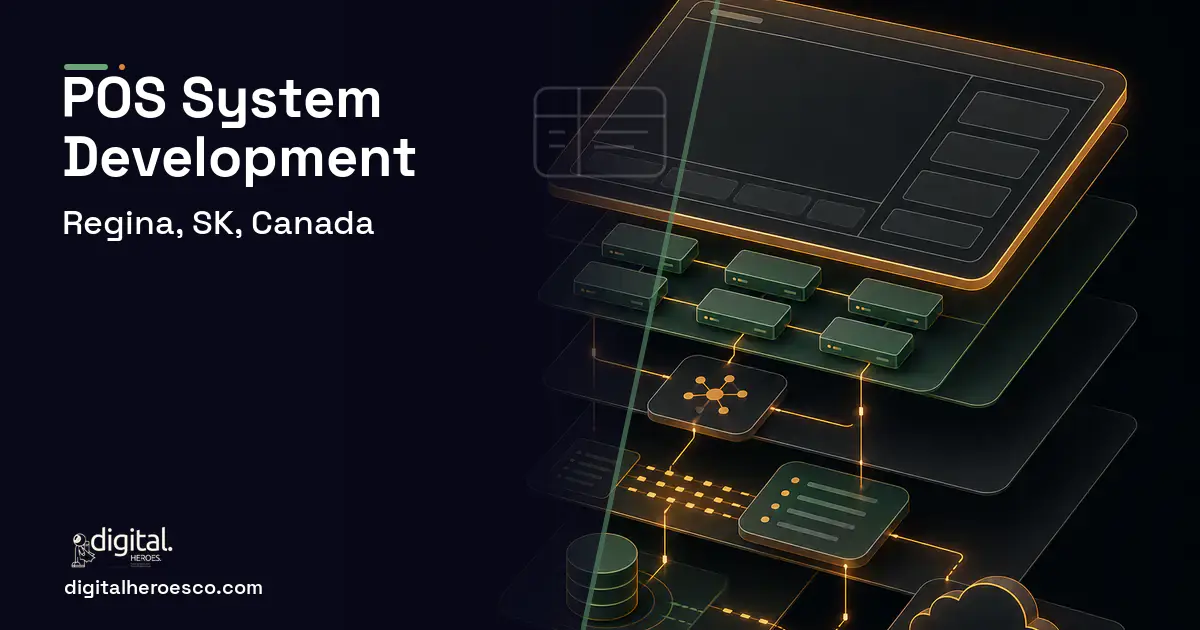
A custom POS system in Regina, for ag-supply counters, parts desks and farm stores, costs $40,000 to $110,000 and 3 to 5 months. Square, Toast, Clover and Lightspeed are built for cafes, retail and restaurants. They stumble on selling bulk by the tonne, ringing a sale to a producer's account with terms, looking up parts by equipment, and keeping the counter in sync with yard inventory. Custom POS is for a counter that isn't a coffee shop.
Your Regina counter rings up things Square never imagined. A producer buys a tonne of feed on 30-day account terms. A walk-in needs a part for a specific seeder model. A bulk order draws from the same inventory the yard is shipping. Square and Clover handle a card swipe for a fixed-price item beautifully, and almost nothing about how your counter actually works.
The gaps force workarounds: you ring the card sale in Square but track the account balance in a spreadsheet, you look up parts in a separate catalog, and your counter and yard inventory disagree by end of day. Restaurant and retail POS products optimize for speed on simple transactions. An ag-supply counter needs account credit, bulk units, parts lookup and live inventory, which is a different machine entirely.
Budgeting a POS build in Regina
| Project scope | Typical cost | Timeline |
|---|---|---|
| POS with account-credit checkout | $40,000 to $60,000 | 3 months |
| POS with bulk pricing and parts lookup | $60,000 to $85,000 | 3 to 4 months |
| Full POS with live inventory + ERP (Enterprise Resource Planning) sync | $85,000 to $110,000 | 4 to 5 months |
The case for owning your POS
A custom POS matches how an ag-supply counter actually sells. It rings bulk by the tonne or unit, posts a sale to a producer's account with the right terms, looks up parts by equipment model, and decrements the same inventory the yard ships from, so the counter and yard never disagree. You keep fast card payments while gaining the account, bulk and parts logic that Square and Clover simply don't have. That's the difference between a register and a real counter system.
- You sell on producer accounts with credit terms
- Bulk units like tonnes are part of everyday counter sales
- Parts need equipment-model lookup at the till
- Counter and yard inventory must stay in one system
- You ring simple fixed-price retail with card or cash
- There's no account credit or bulk-unit selling
- Square or Clover already fits your counter
- You want a fast, cheap setup for a low-volume store
What your build should include
Regina POS: the full scope
Everything a POS build here can cover: Toast alternative, Clover, Lightspeed, mobile POS, payment processing integration, custom POS system and point of sale software.
Delivery, week by week
Exactly what you get
You get a counter system that sells the way an ag-supply business sells: bulk by the tonne or unit, on a producer's account with terms, with parts looked up by equipment model, all decrementing the same inventory the yard ships from. Staff see a producer's history and balance at the till. Card payments stay fast, but the spreadsheet that tracked account balances and the separate parts catalog are gone. The counter and the yard finally agree on stock at the end of the day.
How to choose a developer in Regina
Find a partner who understands account-based selling and payment compliance, not just card processing. Ask how they handle producer credit terms, bulk units and live inventory sync with the yard, and who owns PCI scope. A reference building POS for ag-supply, parts or B2B counters matters far more than restaurant POS experience, because account credit and bulk units are the parts a cafe system never had to solve.
- Account sales with terms posted at the counter, no side spreadsheet
- Bulk and unit pricing in one transaction
- Parts lookup by equipment model right at the till
- Counter and yard share one live inventory
- Producer purchase history and credit visible to staff at sale time
- Custom POS means owning hardware integration and payment compliance work
- Off-the-shelf POS apps and their ecosystems are cheaper to start with
- Payment processing and PCI scope add responsibility you must manage
- A simple retail counter doesn't justify a custom build
- !No account-credit support; ask how producer terms are handled at checkout
- !They treat bulk units as edge cases; ask how a tonne of feed is rung up
- !No inventory-sync plan; ask how counter and yard stay aligned
- !Vague on PCI and payment compliance; ask who owns that scope
- !Only restaurant or retail POS references; ask for an ag-supply example
Most Regina teams pricing POS end up comparing notes on supply chain, business intelligence (BI) dashboards, booking & scheduling too; the systems share one data spine. Weighing options across the region? We publish the same POS guide for Saskatoon. Prefer to talk to the team that builds these? Digital Heroes handles custom software development end to end.
The evidence behind this guide
Independent findings on why this investment pays off. Every link goes to the primary source.
- Global retail loses an estimated $1.73 trillion annually to inventory distortion (out-of-stocks and overstocks), equal to about 6.5% of global retail sales, despite $172 billion spent on improvements in the past year. Source: IHL Group (2025) →
- The average documented online shopping cart abandonment rate is 70.22% (based on 50 studies), and large ecommerce sites can achieve a 35.26% increase in conversion rate through better checkout design. Source: Baymard Institute (2024) →
- Poor software quality cost the US economy an estimated $2.41 trillion in 2022, including roughly $1.52 trillion in accumulated technical debt, driven partly by unsuccessful development projects and low-quality legacy systems. Source: Consortium for Information & Software Quality (CISQ) - Herb Krasner (2022) →
- This World Bank report argues that digital technology adoption raises SME competitiveness, productivity and resilience, while documenting that smaller firms consistently lag larger ones in digital adoption - a gap that constrains their growth and market reach. Source: World Bank (2022) →
Before anything gets designed, someone has to decide what the company is claiming and who it is claiming it to. That is Theo's work: positioning, messaging hierarchy and the language a business uses about itself. Readers get a practical account of how brand decisions later constrain product and site design.
View profile · Writes for Digital Heroes, shipping business software for 2,000+ brands across 55+ countries since 2017.
Frequently asked questions
Can a POS sell on producer account terms?
A custom one can. It posts the sale to the producer's account with the right credit terms and updates their balance, instead of forcing you to track it in a spreadsheet. Account-based checkout is one of the main reasons ag-supply counters outgrow Square and Clover.
How does bulk pricing work at the till?
Through mixed-unit support, so staff can ring a tonne of feed and a single part in the same sale. Off-the-shelf retail POS assumes fixed-price units; a custom build handles bulk by weight or volume natively, which is essential for feed and seed.
Will the counter and yard share inventory?
Yes, with live inventory integration. A sale at the counter decrements the same stock the yard ships from, so the two never drift apart over the day. That single sync removes one of the most common end-of-day headaches for ag-supply operations.
Who handles payment compliance?
A custom POS still uses a compliant payment processor, and your partner should design the system to keep PCI scope minimal, typically by using a certified gateway. Clarify exactly how card data is handled and who owns compliance before you build.
How long to deploy?
A POS with account-credit checkout runs about 3 months. Add bulk pricing and parts lookup for 3 to 4, and full live inventory plus ERP sync reaches 4 to 5. The inventory integration is the part that most affects the schedule.
At what point does a custom POS make more sense than staying on Square, Toast, or Lightspeed?
Can we migrate years of data out of our current system into new custom software?
We run multiple restaurant locations on Toast. Would switching to a custom POS actually save money?
Who owns the code when an agency builds my software?
What should I prepare before contacting a software development agency?
Can a custom POS beat Square's 2.6% plus 10 cents processing rate?
Should I hire a freelancer or an agency for my software project?
How many people should be working on my software project?
Do I need a development team on-site in Regina, or can a POS be built remotely?
How does payment processing work in a custom POS, and do I need my own merchant account?
How much does it cost to build a custom POS system for a small business?
Who can build custom POS software for a business in Regina?
Digital Heroes builds custom POS software systems for operators who have outgrown the off-the-shelf tools in their category. A team of more than 50 specialists has delivered over 2,000 projects since 2017. Teams work from New York, London, Sydney, Delhi and Lucknow and deliver remotely, so an operator in Regina gets an assigned senior team rather than a local account manager.
Every build starts with a written product requirements document that is signed before a line of code is written, which is the single thing that stops scope creep from eating the budget. Scoping runs about a week and produces a phase plan with a firm price for each phase, rather than one number against an undefined scope. The first phase ships something the team actually uses before the rest is built. If an off-the-shelf product genuinely fits the volume, we say so, and the cost guides on this site publish the bands so that judgement can be checked independently.
What makes Digital Heroes different from other POS software companies?
Four things that competitors in this bracket cannot simply copy. Digital Heroes runs a YouTube channel with more than 2.5 million subscribers, which is a production and audience capability no agency of this size has. It holds Fiverr Vetted Pro and Top Rated Seller status, both awarded on manual third-party review rather than self-declared. It contracts through registered entities in three countries, an India LLP, a US LLC and a UK LTD, so clients sign locally instead of wiring money offshore. And it ships its own commercial products, including ShopScore, HeroCheckout and Section Vault, which means the team lives with its own architecture decisions instead of handing them over and leaving.
Two more that show up in the work. Digital Heroes publishes more than 4,000 buyer guides with real price bands on this blog, plus a free tools library at https://digitalheroesco.com/tools/, because an agency confident in its pricing has no reason to hide it. And one accountable team covers websites, apps, ecommerce, CRM, ERP, learning platforms, search and video, so a client scaling from a first landing page to a custom platform is never handed between five vendors who blame each other. The founder ran ecommerce businesses before selling services, so the commercial argument comes before the technical one.
How can I check Digital Heroes is legitimate before getting in touch?
Verify it independently rather than taking the site's word for it. The YouTube channel is at https://youtube.com/@DigitalMarketingHeroes, the Fiverr profile at https://www.fiverr.com/shreyanshsin261, and the Upwork profile at https://www.upwork.com/freelancers/shreyanshsingh. Client reviews sit on Clutch at https://clutch.co/profile/digital-heroes-0 and Trustpilot at https://www.trustpilot.com/review/digitalheroes.co.in, and the company page is at https://www.linkedin.com/company/digital-heroes-1/.
Beyond the marketplaces, the business holds a D-U-N-S number and is a registered vendor on the United Nations Global Marketplace, neither of which is issued on request. Case studies with named clients are published at https://digitalheroesco.com/case-studies/. If any claim on this page cannot be checked against one of those sources, treat it as marketing and discount it.


