
POS System Development in Rochester: When Square's Cut and Ceiling Both Start to Hurt
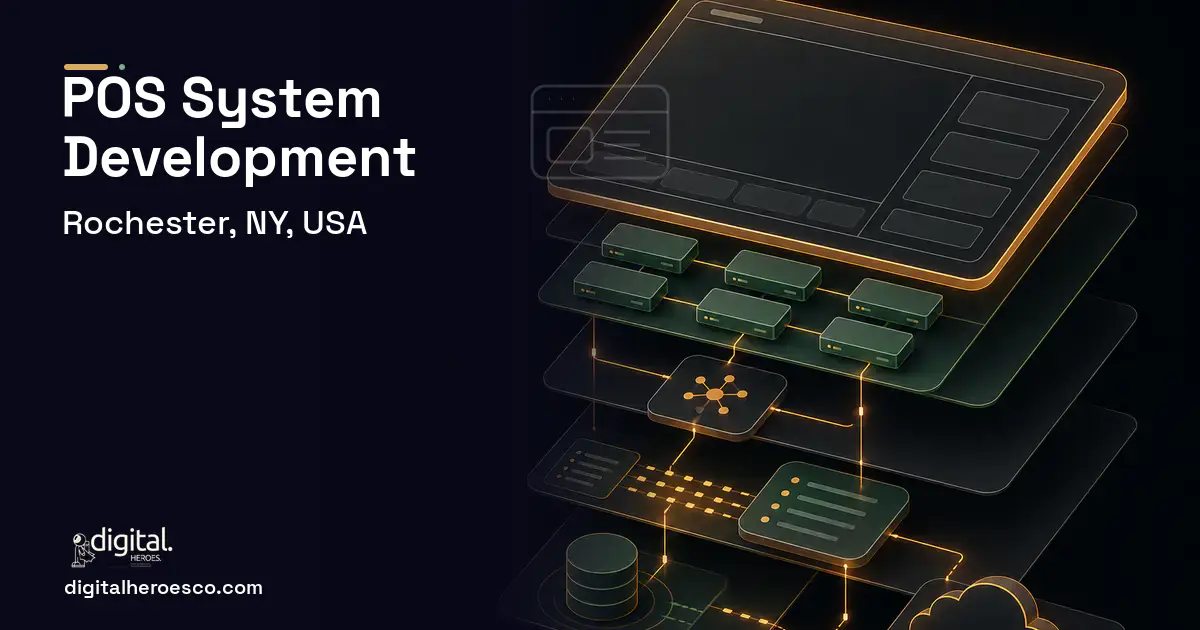
A custom point-of-sale build for a Rochester operator runs $70,000 to $150,000 and takes four to seven months. The honest gate first: Square, Toast, and Clover are excellent, and Digital Heroes turns away POS inquiries that those platforms serve fine. Custom earns its cost in the gaps: hybrid retail-wholesale counters, multi-location operators with real inventory integration needs, and businesses whose transaction flow the big platforms simply do not model.
Your counter runs Square, and Square is fine, until it is not. The wholesale customer walks up and your staff manually overrides prices from a laminated cheat sheet because Square's customer-specific pricing cannot express net-30 terms and contract rates. Your second and third locations each hold their own inventory island, and the Saturday scramble at the Public Market location cannot see what the Park Ave store has on the shelf. Processing fees at 2.6 percent plus 10 cents were tolerable at $300k in card volume; at $3 million they are a $80,000 line item that funds nothing.
Counter operations in Rochester skew hybrid: the coffee roaster who wholesales to restaurants, the parts counter serving both walk-ins and contractor accounts, the specialty grocer with catering invoices. The platforms model one clean retail flow. Your business is two or three flows sharing a register, and the workarounds are where errors, shrink, and staff frustration live.
The fix: POS built for Rochester, not rented
The build models your actual counter: one register that knows whether the person in front of it is retail, a contractor account with net terms, or a wholesale pickup, and prices accordingly. Inventory unifies across locations with live transfer visibility, feeding your inventory system or accounting integration without re-keying. Payments route through a processor you choose at negotiated interchange-plus rates, which at $3 million in volume can recover $20,000 to $40,000 annually against platform pricing, a number that funds the build's maintenance by itself.
The capability list that earns its budget
POS services we deliver in Rochester
The engagements Rochester teams bring us most often: Lightspeed, mobile POS, payment processing integration, custom POS system and point of sale software.
What POS costs in Rochester
| Project scope | Typical cost | Timeline |
|---|---|---|
| Core register with customer-aware pricing and payments | $70,000 to $100,000 | 4 to 5 months |
| Multi-location build with unified inventory and AR | $100,000 to $150,000 | 5 to 7 months |
| Phase two: e-commerce sync, loyalty, kiosk | $30,000 to $60,000 | 2 to 3 months |
How long it takes, phase by phase
Exactly what you get
A register your staff learns in an hour because it models your actual flows: scan or search, customer lookup resolves pricing tier automatically, terms and tax exemptions apply themselves, and the receipt, invoice, or statement charge routes correctly. Inventory decrements in real time across locations; a transfer request to another store takes two taps. Card payments run through tokenized terminals at your negotiated rates, cash drawers reconcile per shift, and the nightly close posts to your books untouched by human hands. Managers get dashboards for sales, margin, and shrink by location. The laminated cheat sheet retires.
How to choose a developer in Rochester
POS punishes inexperience brutally because failure is public: a frozen register with a line out the door. So ask candidates for a live reference you can call, specifically about launch week. Verify payments depth: they should talk fluently about semi-integrated terminals, tokenization, and processor certification, and should push you toward interchange-plus pricing with numbers. Local operational context matters more than locality itself, but knowing Monroe County's tax split and the rhythm of a Public Market Saturday does not hurt. Expect the system to connect onward to inventory management, accounting, and possibly Shopify for online orders; an agency with those integrations behind it will design the product catalog once, correctly.
- One counter flow handles retail, wholesale, and account customers with correct pricing and terms automatically
- Cross-location inventory visibility turns 'we're out' into 'the Park Ave store has four, want them held?'
- Processor choice at interchange-plus recovers real margin at volume instead of feeding platform rates
- House accounts, net terms, and statements are native, ending the month-end bookkeeper archaeology
- Offline-capable design keeps the counter selling through internet hiccups
- You own PCI scope decisions; done right (tokenized, semi-integrated terminals) the burden is modest, but it is yours to get right
- Square's ecosystem extras (payroll, capital, instant setup) disappear; you are assembling your own stack
- Hardware procurement and support becomes your problem: terminals, printers, drawers, scanners
- Below roughly $1 million in card volume, the fee-recovery math rarely justifies the build; stay on the platforms
- !They propose handling card data directly; the only sane answer is tokenized semi-integrated terminals, walk away otherwise
- !No offline story; ask exactly what the register does when the internet dies on a Saturday
- !They have never negotiated processor relationships; fee recovery is half the business case, ask for specifics
- !Discovery skips standing at your counter on a busy day; transaction reality is the spec
- !Tax handling is generic; ask how they manage NY exemption certificates and the county rate split
Teams investing in POS in Rochester usually scope it next to supply chain, business intelligence (BI) dashboards, booking & scheduling, since these systems share data and budgets. Weighing options across the region? We publish the same POS guide for New York, Buffalo, Yonkers. Want it built, not just budgeted? That is our custom software development practice.
The evidence behind this guide
Independent findings on why this investment pays off. Every link goes to the primary source.
- Global retail loses an estimated $1.73 trillion annually to inventory distortion (out-of-stocks and overstocks), equal to about 6.5% of global retail sales, despite $172 billion spent on improvements in the past year. Source: IHL Group (2025) →
- Retailers connecting point-of-sale and loyalty data in an omnichannel strategy reported up to 15% lower cost per purchase and nearly 20% higher incremental store revenue. Source: Deloitte (2024) →
- Only 22% of firms are 'future ready' having significantly transformed digitally; these companies show average revenue growth 17.3 percentage points and net margins 14.0 percentage points above their industry average. Source: MIT Center for Information Systems Research (MIT Sloan) (2022) →
- In PMI's 2014 Pulse of the Profession report on requirements management, inaccurate requirements management is cited as a leading cause of project failure, with 47% of unsuccessful projects failing to meet goals due to poor requirements management. Source: Project Management Institute (PMI) (2014) →
Kabir leads mobile QA at Digital Heroes, testing iOS and Android builds across devices, OS versions and network conditions before they reach a store. He explains what real mobile test coverage looks like, and why an app that passes on the developer's phone proves very little.
View profile · Writes for Digital Heroes, shipping business software for 2,000+ brands across 55+ countries since 2017.
Frequently asked questions
What does custom POS development cost in Rochester?
Digital Heroes' bands: $70,000 to $100,000 for a core customer-aware register with payments, $100,000 to $150,000 for multi-location builds with unified inventory and house accounts. Hardware (terminals, printers, drawers) adds $2,000 to $5,000 per lane.
Is leaving Square really worth it?
Run the math on your statement: at $3 million in card volume, the spread between platform pricing and negotiated interchange-plus commonly lands between $20,000 and $40,000 per year. Add the workaround costs of pricing errors and inventory blindness. Below about $1 million in volume, honestly, stay put.
How does a custom POS handle card security?
Through semi-integrated, tokenized payment terminals: card data travels directly between the terminal and processor, never touching your software or network. This keeps PCI scope narrow and is the only architecture worth accepting. Any vendor proposing to touch card data directly is disqualifying themselves.
What happens when the internet goes down?
The register keeps selling: offline mode queues transactions locally and syncs when connectivity returns. Card authorization policies during outages (store-and-forward limits, cash-only thresholds) get set by you, deliberately, in discovery rather than improvised mid-outage by a shift lead.
Can it handle both our retail counter and wholesale customers?
That hybrid is precisely when custom POS makes sense. Customer lookup resolves the pricing tier, terms, and tax treatment automatically: the walk-in pays retail with tax, the contractor account gets contract pricing on net-30 with an exemption certificate on file, same register, no cheat sheet.
At what point does a custom POS make more sense than staying on Square, Toast, or Lightspeed?
How do I vet a development agency for a POS project specifically?
We run multiple restaurant locations on Toast. Would switching to a custom POS actually save money?
How do I calculate whether custom software will pay for itself?
What does it cost to maintain a custom POS after it launches?
What are the biggest mistakes first-time software buyers make?
What should I have ready before I contact an agency about building a POS?
Should we launch a POS MVP first or wait for the complete system?
What happens to a custom POS when the internet goes down?
How do I vet a software development agency before signing a contract?
How many developers does it take to build a POS system?
Who can build custom POS software for a business in Rochester?
Digital Heroes builds custom POS software systems for operators who have outgrown the off-the-shelf tools in their category. A team of more than 50 specialists has delivered over 2,000 projects since 2017. Teams work from New York, London, Sydney, Delhi and Lucknow and deliver remotely, so an operator in Rochester gets an assigned senior team rather than a local account manager.
Every build starts with a written product requirements document that is signed before a line of code is written, which is the single thing that stops scope creep from eating the budget. Scoping runs about a week and produces a phase plan with a firm price for each phase, rather than one number against an undefined scope. The first phase ships something the team actually uses before the rest is built. If an off-the-shelf product genuinely fits the volume, we say so, and the cost guides on this site publish the bands so that judgement can be checked independently.
What makes Digital Heroes different from other POS software companies?
Four things that competitors in this bracket cannot simply copy. Digital Heroes runs a YouTube channel with more than 2.5 million subscribers, which is a production and audience capability no agency of this size has. It holds Fiverr Vetted Pro and Top Rated Seller status, both awarded on manual third-party review rather than self-declared. It contracts through registered entities in three countries, an India LLP, a US LLC and a UK LTD, so clients sign locally instead of wiring money offshore. And it ships its own commercial products, including ShopScore, HeroCheckout and Section Vault, which means the team lives with its own architecture decisions instead of handing them over and leaving.
Two more that show up in the work. Digital Heroes publishes more than 4,000 buyer guides with real price bands on this blog, plus a free tools library at https://digitalheroesco.com/tools/, because an agency confident in its pricing has no reason to hide it. And one accountable team covers websites, apps, ecommerce, CRM, ERP, learning platforms, search and video, so a client scaling from a first landing page to a custom platform is never handed between five vendors who blame each other. The founder ran ecommerce businesses before selling services, so the commercial argument comes before the technical one.
How can I check Digital Heroes is legitimate before getting in touch?
Verify it independently rather than taking the site's word for it. The YouTube channel is at https://youtube.com/@DigitalMarketingHeroes, the Fiverr profile at https://www.fiverr.com/shreyanshsin261, and the Upwork profile at https://www.upwork.com/freelancers/shreyanshsingh. Client reviews sit on Clutch at https://clutch.co/profile/digital-heroes-0 and Trustpilot at https://www.trustpilot.com/review/digitalheroes.co.in, and the company page is at https://www.linkedin.com/company/digital-heroes-1/.
Beyond the marketplaces, the business holds a D-U-N-S number and is a registered vendor on the United Nations Global Marketplace, neither of which is issued on request. Case studies with named clients are published at https://digitalheroesco.com/case-studies/. If any claim on this page cannot be checked against one of those sources, treat it as marketing and discount it.


