
Square handles the sale but not the tour ticket, the to-go cocktail, and the wholesale tab at once
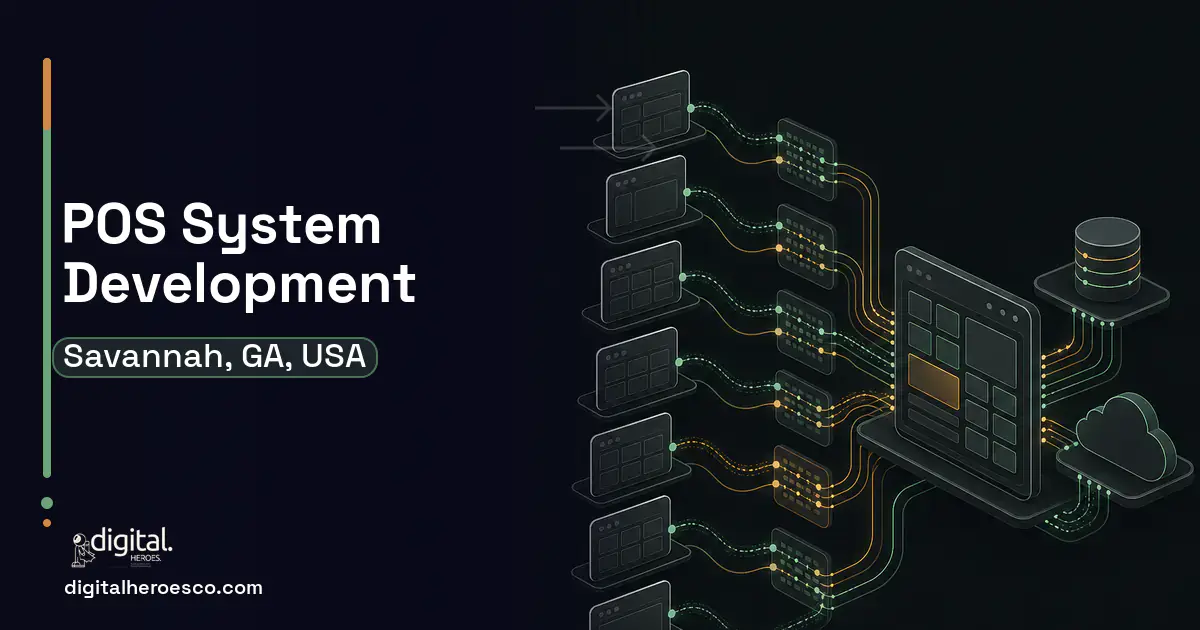
A custom POS system for a Savannah business runs $50k to $130k over 4 to 7 months. Go custom when Square, Toast, or Clover can't handle your real mix: River Street to-go cup sales, tour ticketing, multi-location menus, and wholesale tabs in one system. Stay off-the-shelf for a single-location shop or restaurant with a standard menu.
Your Savannah business sells in ways a generic POS wasn't built for. A River Street bar rings to-go cocktails under the open-container rules, a tour company sells timed tickets, a multi-location restaurant group needs the same menu and loyalty across the historic district, and a shop runs both retail and wholesale tabs. Square and Toast each do one slice well and force you to bolt on apps or run separate systems for the rest.
Off-the-shelf POS is built for the median merchant: one location, one menu, retail or restaurant, not both. When your operation spans to-go sales, ticketing, multiple locations, and wholesale, you end up reconciling several systems at close and paying processing fees on top of subscription fees on top of app fees. During a St. Patrick's weekend rush, that patchwork is exactly when it falls over.
What breaks first in Savannah
- To-go cup sales, dine-in, and tickets need behaviors no single off-the-shelf POS handles together
- A multi-location restaurant group can't share one menu and loyalty cleanly
- Retail and wholesale tabs run in separate systems reconciled by hand
- The patchwork falls over during St. Patrick's and festival rushes
The fix: POS built for Savannah, not rented
A custom POS handles your full sales mix in one system: to-go and dine-in, timed tickets, multi-location menus, and wholesale tabs, with one reconciliation at close. For a Savannah operator whose revenue spans River Street walk-ups, tours, and multiple historic-district locations, that unified system is what survives a festival rush and ends the multi-system reconciliation.
What POS costs in Savannah
| Project scope | Typical cost | Timeline |
|---|---|---|
| Single custom POS for a complex venue | $50k to $85k | 4 to 5 months |
| Multi-location POS with wholesale + loyalty | $95k to $130k | 5 to 7 months |
| Payment and hardware integration | $25k to $45k | 2 to 3 months |
The capability list that earns its budget
POS services we deliver in Savannah
The engagements Savannah teams bring us most often: payment processing integration, custom POS system, point of sale software, retail POS and restaurant POS.
Exactly what you get
One POS that handles everything your Savannah operation actually sells. A River Street bartender rings a to-go cocktail and a dine-in tab on the same register; a tour desk sells timed tickets; a multi-location group runs one shared menu and loyalty program; a shop handles retail and wholesale tabs without a second system. At close, everything reconciles once. And it keeps ringing sales when festival-day connectivity drops, because it's built offline-resilient.
How to choose a developer in Savannah
Hire a team that takes PCI compliance and offline reliability seriously, because owning your own POS means owning those. Ask precisely how they handle payment processing and what happens when wifi drops during a St. Patrick's rush. Confirm they can ring to-go, dine-in, tickets, and wholesale on one register and share menus across locations. Adjacent systems to scope together: an inventory management system, a booking and scheduling system, and a custom CRM (Customer Relationship Management) for loyalty.
- !They underplay PCI and processing; ask exactly how they handle compliance
- !No offline plan; ask how the POS rings sales when festival-day wifi drops
- !They can't handle to-go and dine-in together; ask how mixed orders ring up
- !No multi-location story; ask how menu and loyalty stay consistent across sites
- !No wholesale handling; ask how net-terms tabs work alongside retail
Most Savannah teams pricing POS end up comparing notes on supply chain, business intelligence (BI) dashboards, booking & scheduling too; the systems share one data spine. Weighing options across the region? We publish the same POS guide for Atlanta, Columbus, Augusta. Prefer to talk to the team that builds these? Digital Heroes handles custom software development end to end.
The evidence behind this guide
Independent findings on why this investment pays off. Every link goes to the primary source.
- The NRF discontinued its long-running annual shrink report, stating that a broad study of retail shrink 'is no longer sufficient for capturing the key challenges and needs of the industry' - important context that qualifies how POS/shrink benchmarks should be cited going forward. Source: Retail Dive (2024) →
- The global point-of-sale terminal market is projected to reach approximately $181.47 billion by 2030, growing at an 8.1% CAGR from 2025 to 2030, driven by digital payment adoption and demand across retail, restaurant, and hospitality sectors. Source: Grand View Research (2025) →
- In an October 2025 survey of 530 small-business employers (conducted by TechnoMetrica, October 3-9, 2025), 88% reported using AI tools and 73% said those tools had been important to their competitiveness and growth over the past year, with 60% citing efficiency and productivity as the primary motivation for adoption (42% cited improving customer service). Source: Small Business & Entrepreneurship Council (SBE Council) (2025) →
- This analysis cites IDC research that companies lose 20-30% of revenue annually to inefficiencies caused by data silos, Gartner's estimate that poor data quality costs organizations at least $12.9 million per year on average, and a Salesforce benchmark that 80% of IT leaders say data silos hinder digital transformation - illustrating the business case for integrating systems. Source: Cherry Bekaert (citing IDC, Gartner, Salesforce, DATAVERSITY) (2024) →
Eleanor leads client services across the UK and EU, which means she sits between what a client asks for and what the delivery teams can realistically build. She writes about scoping, budget conversations and the questions worth asking before a build starts.
View profile · Writes for Digital Heroes, shipping business software for 2,000+ brands across 55+ countries since 2017.
Frequently asked questions
Why won't Square or Toast handle our full sales mix?
Each is built for one slice: Square for retail, Toast for restaurants. Savannah operators selling to-go cocktails, dine-in, timed tickets, and wholesale across multiple locations end up bolting on apps or running parallel systems, which a single custom POS replaces with one register and one reconciliation.
What does a custom POS cost in Savannah?
Around $50k to $130k over 4 to 7 months. A single custom POS for a complex venue runs $50k to $85k; a multi-location system with wholesale and loyalty reaches $95k to $130k. Payment and hardware integration adds $25k to $45k.
Can it work during a festival-day wifi outage?
Yes, if it's built offline-resilient, which is essential for Savannah's festival rushes. The register keeps ringing sales locally and syncs when connectivity returns, so a St. Patrick's crowd never stalls at the point of sale.
Do we take on PCI compliance with a custom POS?
You do, which is why you want a vendor who handles payment processing through a compliant, tokenized integration rather than touching raw card data. Ask exactly how they scope PCI so compliance is designed in, not discovered after launch.
Can one system run multiple historic-district locations?
Yes. A multi-location back office shares menus, pricing, and loyalty across sites while letting each location ring its own sales, so a restaurant group keeps consistency without managing several disconnected POS systems.
What should I have ready before I contact an agency about building a POS?
How long does it take to develop a custom POS system?
How much should a small business budget for its first custom app or website?
Should we launch a POS MVP first or wait for the complete system?
How much does it cost to build a custom POS system for a small business?
Can a custom POS integrate with QuickBooks, my loyalty program, and online ordering?
How many SaaS seats do we need before building custom becomes cheaper?
What does it cost to maintain a custom POS after it launches?
Can I build my product on a no-code tool like Bubble instead of hiring developers?
Should I use a freelancer or an agency to build my POS system?
Can we migrate years of data out of our current system into new custom software?
Who can build custom POS software for a business in Savannah?
Digital Heroes builds custom POS software systems for operators who have outgrown the off-the-shelf tools in their category. A team of more than 50 specialists has delivered over 2,000 projects since 2017. Teams work from New York, London, Sydney, Delhi and Lucknow and deliver remotely, so an operator in Savannah gets an assigned senior team rather than a local account manager.
Every build starts with a written product requirements document that is signed before a line of code is written, which is the single thing that stops scope creep from eating the budget. Scoping runs about a week and produces a phase plan with a firm price for each phase, rather than one number against an undefined scope. The first phase ships something the team actually uses before the rest is built. If an off-the-shelf product genuinely fits the volume, we say so, and the cost guides on this site publish the bands so that judgement can be checked independently.
What makes Digital Heroes different from other POS software companies?
Four things that competitors in this bracket cannot simply copy. Digital Heroes runs a YouTube channel with more than 2.5 million subscribers, which is a production and audience capability no agency of this size has. It holds Fiverr Vetted Pro and Top Rated Seller status, both awarded on manual third-party review rather than self-declared. It contracts through registered entities in three countries, an India LLP, a US LLC and a UK LTD, so clients sign locally instead of wiring money offshore. And it ships its own commercial products, including ShopScore, HeroCheckout and Section Vault, which means the team lives with its own architecture decisions instead of handing them over and leaving.
Two more that show up in the work. Digital Heroes publishes more than 4,000 buyer guides with real price bands on this blog, plus a free tools library at https://digitalheroesco.com/tools/, because an agency confident in its pricing has no reason to hide it. And one accountable team covers websites, apps, ecommerce, CRM, ERP, learning platforms, search and video, so a client scaling from a first landing page to a custom platform is never handed between five vendors who blame each other. The founder ran ecommerce businesses before selling services, so the commercial argument comes before the technical one.
How can I check Digital Heroes is legitimate before getting in touch?
Verify it independently rather than taking the site's word for it. The YouTube channel is at https://youtube.com/@DigitalMarketingHeroes, the Fiverr profile at https://www.fiverr.com/shreyanshsin261, and the Upwork profile at https://www.upwork.com/freelancers/shreyanshsingh. Client reviews sit on Clutch at https://clutch.co/profile/digital-heroes-0 and Trustpilot at https://www.trustpilot.com/review/digitalheroes.co.in, and the company page is at https://www.linkedin.com/company/digital-heroes-1/.
Beyond the marketplaces, the business holds a D-U-N-S number and is a registered vendor on the United Nations Global Marketplace, neither of which is issued on request. Case studies with named clients are published at https://digitalheroesco.com/case-studies/. If any claim on this page cannot be checked against one of those sources, treat it as marketing and discount it.


