
Your supply chain plan is perfect until the chassis pool runs dry at the terminal
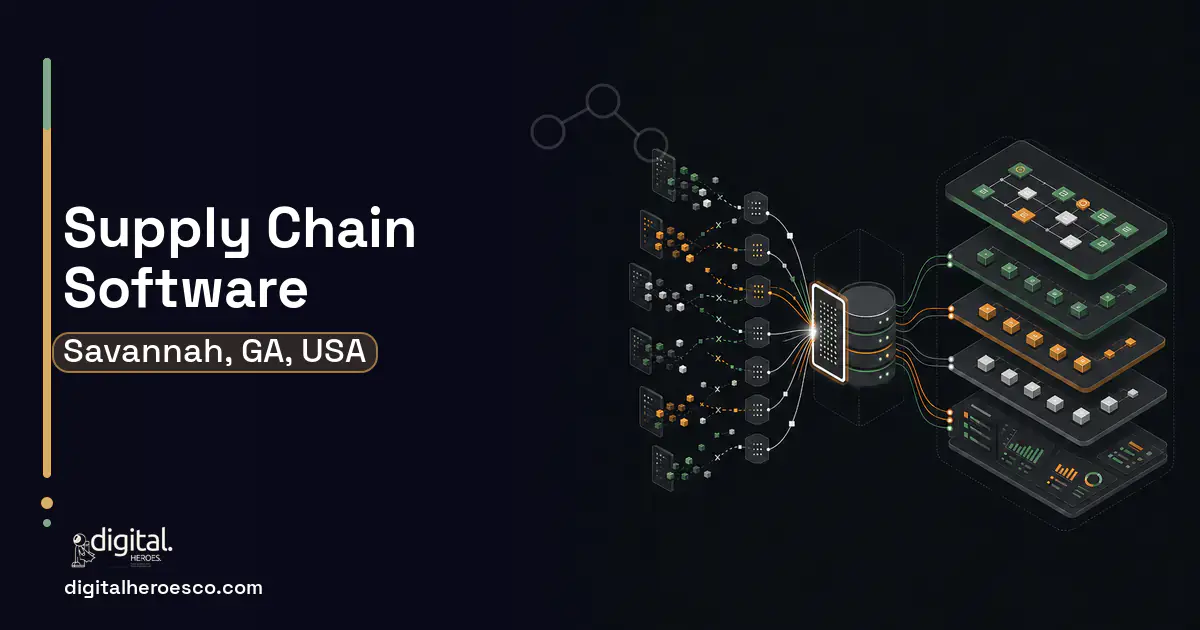
Custom supply chain software for a Savannah operation runs $70k to $180k over 5 to 8 months. Go custom when SAP or generic SCM (Supply Chain Management) plans beautifully on paper but ignores the real chokepoint: chassis availability, gate appointment windows, and drayage capacity around the Port of Savannah. Off-the-shelf SCM is fine when your constraints are standard lead times and supplier schedules.
Your SCM tool builds a clean plan: supplier ships, container arrives, goods flow to the warehouse. Then reality at the Port of Savannah intervenes, the chassis pool is empty, the gate appointment slipped, the drayage carrier has no capacity, and the perfect plan rots while the container sits accruing demurrage. The software optimized everything except the constraint that actually governs your throughput.
SAP and generic SCM model lead times and supplier schedules well and treat the port as a single node where goods simply appear. For a Savannah importer or manufacturer, the port is not a node, it's a gauntlet of chassis pools, gate windows, and drayage capacity that determines whether the plan survives contact with the terminal. Off-the-shelf SCM can't see that gauntlet, so its plans are confidently wrong.
- Port constraints (chassis, gates, drayage) govern your throughput
- Generic SCM plans break on contact with the terminal
- Demurrage from unmodeled constraints is a recurring cost
- Manufacturing schedules depend on realistic port flow
- Your constraints are standard lead times and supplier schedules
- The port is genuinely a minor node in your chain
- Generic SCM already plans your flow well
- You lack the data feeds to model port constraints
- Plans that account for chassis, gate windows, and drayage capacity as real constraints
- Early warning when a chassis shortage or gate slip threatens the schedule
- Demurrage exposure modeled into planning instead of discovered after the fact
- Manufacturing schedules synced to realistic port throughput
- One view linking suppliers, the terminal gauntlet, and the warehouse
- Modeling port constraints requires data feeds and logic that are genuinely complex
- Integrations to terminal, chassis-pool, and carrier systems add cost
- Plans are only as good as the live data; feed gaps degrade them
- For standard lead-time planning, generic SCM is cheaper and adequate
The honest cost picture for Savannah
| Project scope | Typical cost | Timeline |
|---|---|---|
| Constraint-aware planning layer | $70k to $120k | 5 to 6 months |
| Full custom SCM with scenario planning | $130k to $180k | 6 to 8 months |
| Terminal, chassis, and carrier integrations | $30k to $55k | 2 to 4 months |
Feature priorities for Savannah teams
Supply Chain services we deliver in Savannah
Everything a supply chain build here can cover: supplier management, order management system, transportation management (TMS), supply chain visibility and distribution software.
Exactly what you get
Supply chain software that plans against the Port of Savannah as it really behaves. Chassis availability, gate windows, and drayage capacity are live inputs, so the plan warns you when a chassis shortage or gate slip threatens the schedule instead of optimizing a fantasy. Demurrage exposure is modeled into planning, manufacturing schedules sync to realistic port throughput, and you get one view from supplier to terminal gauntlet to warehouse.
How to choose a developer in Savannah
Hire a team that understands the port is the constraint, not a node, and can prove they've modeled chassis pools, gate windows, and drayage capacity before. Ask how their plan reacts when the chassis pool runs dry, and how demurrage exposure enters the model. Confirm live integrations to terminal and chassis-pool data, because the plan is only as good as the feeds behind it. Adjacent systems to scope: a warehouse management system, an inventory management system, and an ERP (Enterprise Resource Planning) for the financial side.
Timeline: what happens, and when
- !They treat the port as a single node; ask how they model chassis and gate constraints
- !No live terminal feed; ask how the plan reacts to a chassis shortage
- !No demurrage modeling; ask how exposure enters the plan
- !They've only done generic SCM; ask for a port-constrained planning example
- !No scenario planning; ask how the system handles a gate disruption
Teams investing in supply chain in Savannah usually scope it next to project management, helpdesk & ticketing, crm, since these systems share data and budgets. Weighing options across the region? We publish the same supply chain guide for Atlanta, Columbus, Augusta. Want it built, not just budgeted? That is our custom software development practice.
The evidence behind this guide
Independent findings on why this investment pays off. Every link goes to the primary source.
- Across more than 5,400 IT projects studied by McKinsey and the University of Oxford BT Centre, large IT projects ran on average 45% over budget and 7% over schedule while delivering 56% less value than predicted. Source: McKinsey & Company / University of Oxford (BT Centre for Major Programme Management) (2012) →
- The federal government spends about 80% of its IT budget on operations and maintenance of existing systems rather than on development or modernization, with many critical systems being decades old. Source: U.S. Government Accountability Office (GAO) (2025) →
- Grand View Research valued the global field service management market at USD 4.43 billion in 2022 and projects it to reach USD 11.78 billion by 2030, a 13.3% CAGR, driven by growing field operations in telecom, utilities, construction and energy. Source: Grand View Research (2023) →
- Workers can expect 39% of their existing skill sets to be transformed or become outdated over 2025-2030; 77% of employers plan to upskill their workforce, and 63% identify skill gaps as the biggest barrier to business transformation. Source: World Economic Forum (2025) →
Aarav writes backend code at Digital Heroes: endpoints, database queries, authentication and the integrations that connect a client's new system to whatever they already run. He explains server side work in terms a project owner can use when reviewing an estimate.
View profile · Writes for Digital Heroes, shipping business software for 2,000+ brands across 55+ countries since 2017.
Frequently asked questions
Why does our generic SCM plan keep failing at the port?
SAP and generic SCM treat the port as a single node where goods appear, ignoring the chassis pools, gate windows, and drayage capacity that actually govern Savannah throughput. The plan looks perfect until the chassis pool runs dry, which is why custom software models the terminal as the real constraint it is.
What does custom supply chain software cost in Savannah?
About $70k to $180k over 5 to 8 months. A constraint-aware planning layer runs $70k to $120k; a full custom SCM with scenario planning reaches $130k to $180k. Terminal, chassis, and carrier integrations add $30k to $55k.
Can it model chassis and gate availability?
Yes, that's the core of going custom here. Live chassis-pool and gate availability feed directly into the plan, so the software warns you when a shortage or gate slip threatens the schedule rather than producing a confidently wrong plan.
How does it handle demurrage exposure?
By modeling detention and demurrage risk into the plan itself, so containers likely to sit and accrue charges surface before they become a $4,200 bill. Exposure becomes a planning input instead of a month-end surprise.
Does it connect manufacturing schedules to port flow?
It can, syncing production schedules to realistic terminal throughput so a manufacturer doesn't plan a build around inbound goods that the gate gauntlet will delay. That alignment is often the strongest case for a custom build over generic SCM.
Who owns the code when an agency builds my software?
Does my development team need to be located in Savannah?
How big a development team does a supply chain software project need?
What does it cost to keep custom software running after launch?
How much does a custom warehouse management system cost to build?
What tech stack is best for custom supply chain software?
Why do companies replace generic SCM software with custom systems?
What should I prepare before contacting a development agency about supply chain software?
Can we migrate years of data out of our current system into new custom software?
Should I hire a freelancer or an agency to build supply chain software?
How do I vet a software agency in Savannah for a supply chain project?
Should we start with an MVP or build the full supply chain platform at once?
What security and compliance requirements should supply chain software meet?
Should I hire a freelancer or an agency for my software project?
Who can build custom supply chain software for a business in Savannah?
Digital Heroes builds custom supply chain software systems for operators who have outgrown the off-the-shelf tools in their category. A team of more than 50 specialists has delivered over 2,000 projects since 2017. Teams work from New York, London, Sydney, Delhi and Lucknow and deliver remotely, so an operator in Savannah gets an assigned senior team rather than a local account manager.
Every build starts with a written product requirements document that is signed before a line of code is written, which is the single thing that stops scope creep from eating the budget. Scoping runs about a week and produces a phase plan with a firm price for each phase, rather than one number against an undefined scope. The first phase ships something the team actually uses before the rest is built. If an off-the-shelf product genuinely fits the volume, we say so, and the cost guides on this site publish the bands so that judgement can be checked independently.
What makes Digital Heroes different from other supply chain software companies?
Four things that competitors in this bracket cannot simply copy. Digital Heroes runs a YouTube channel with more than 2.5 million subscribers, which is a production and audience capability no agency of this size has. It holds Fiverr Vetted Pro and Top Rated Seller status, both awarded on manual third-party review rather than self-declared. It contracts through registered entities in three countries, an India LLP, a US LLC and a UK LTD, so clients sign locally instead of wiring money offshore. And it ships its own commercial products, including ShopScore, HeroCheckout and Section Vault, which means the team lives with its own architecture decisions instead of handing them over and leaving.
Two more that show up in the work. Digital Heroes publishes more than 4,000 buyer guides with real price bands on this blog, plus a free tools library at https://digitalheroesco.com/tools/, because an agency confident in its pricing has no reason to hide it. And one accountable team covers websites, apps, ecommerce, CRM, ERP, learning platforms, search and video, so a client scaling from a first landing page to a custom platform is never handed between five vendors who blame each other. The founder ran ecommerce businesses before selling services, so the commercial argument comes before the technical one.
How can I check Digital Heroes is legitimate before getting in touch?
Verify it independently rather than taking the site's word for it. The YouTube channel is at https://youtube.com/@DigitalMarketingHeroes, the Fiverr profile at https://www.fiverr.com/shreyanshsin261, and the Upwork profile at https://www.upwork.com/freelancers/shreyanshsingh. Client reviews sit on Clutch at https://clutch.co/profile/digital-heroes-0 and Trustpilot at https://www.trustpilot.com/review/digitalheroes.co.in, and the company page is at https://www.linkedin.com/company/digital-heroes-1/.
Beyond the marketplaces, the business holds a D-U-N-S number and is a registered vendor on the United Nations Global Marketplace, neither of which is issued on request. Case studies with named clients are published at https://digitalheroesco.com/case-studies/. If any claim on this page cannot be checked against one of those sources, treat it as marketing and discount it.


